- The paper provides a full classification of scrollar invariants for sextic covers by establishing necessary and sufficient linear inequalities.
- It employs a novel combination of algebraic geometry and combinatorial methods to analyze Tschirnhausen bundles and reveal composite cover factorizations.
- The results refine previous criteria, demonstrating that all realized invariants arise via nontrivial factorization through double and triple covers.
Tschirnhausen Bundles of Sextic Covers of the Projective Line
Introduction and Problem Statement
The paper "Tschirnhausen bundles of sextic covers of P1" (2604.04709) addresses the classification of Tschirnhausen bundles arising from degree $6$ (sextic) covers π:C→P1 by smooth irreducible complex projective curves. Specifically, for such a cover π, the pushforward vector bundle π∗OC over P1 admits a canonical decomposition, and the associated Tschirnhausen bundle encodes combinatorial invariants (the so-called scrollar invariants) which reflect both the geometry of C and the structure of the cover.
The central question, the Tschirnhausen realization problem, is to determine precisely which quintuples of integers (e1,…,e5) can occur as the scrollar invariants of a sextic cover. While this problem is settled for degrees $2$ through $5$, the degree $6$0 case is the minimal composite degree for which new phenomena emerge and for which no conjectural description existed prior to this work.
Summary of Main Results
The authors provide a full classification of possible scrollar invariants for sextic covers: a necessary and sufficient set of linear inequalities is established, refining those previously known, which fully characterizes the set of possible $6$1. Moreover, they demonstrate that every valid tuple can be realized by a cover factoring through a nontrivial proper subcover, i.e., as a composition of a double and a triple cover.
A notable outcome is the identification of new constraints that do not follow from the naive structure of the algebra $6$2, but arise from the requirement that certain subalgebras encode additional cover factorization; this invalidates any expectation that the existing general "multiplication constraints" are always sufficient in the composite, non-prime case $6$3.
A schematic summary of these results is visualized in the paper's principal figure.
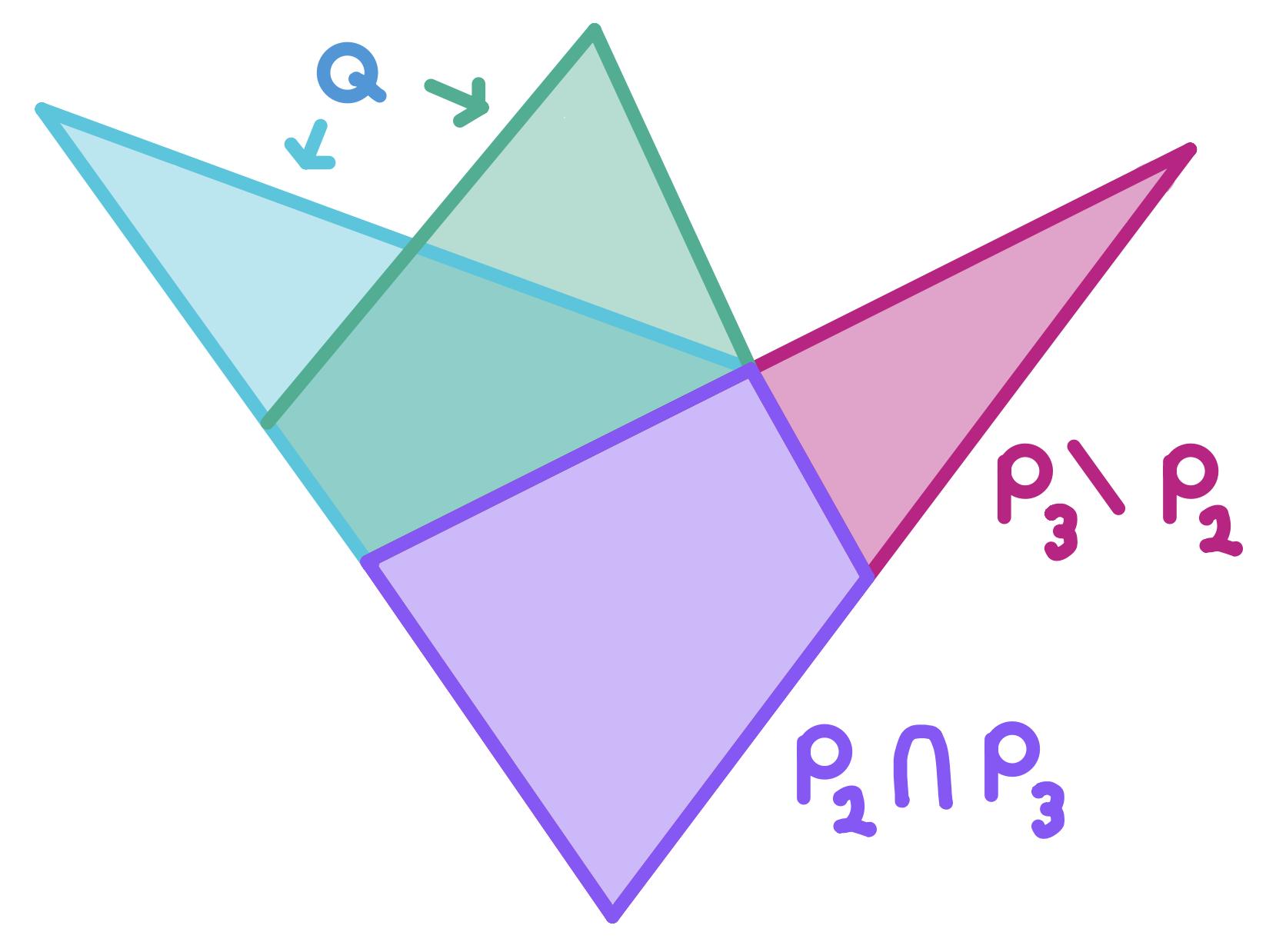
Figure 1: Integer points in the indicated region correspond to possible scrollar invariants of degree $6$4 covers; the blue, green, pink, and purple regions classify whether the resulting cover necessarily factors through a cubic, quadratic, or both kinds of proper subcovers.
Structure of the Classification and Geometric Implications
Given the Birkhoff-Grothendieck theorem, any vector bundle on $6$5 splits as a sum of line bundles, and thus $6$6, with $6$7. The combinatorial regions $6$8, $6$9, and their refinements encode the algebraically necessary inequalities for vector bundles arising as pushforwards from degree π:C→P10 covers, with further restrictions depending on whether the cover admits a factorization through double or triple subcovers.
The main theorem asserts:
A quintuple π:C→P11 occurs as the scrollar invariants of a sextic cover if and only if π:C→P12, where π:C→P13 consists of quintuples in π:C→P14 admitting a special admissible partition determined by intricate inequalities reflecting the possible splitting behaviors of the bundle during factorization.
Crucially, the paper proves that whenever the constraints are satisfied, one can construct a cover realizing those invariants and, in fact, every such cover factors through a nontrivial subcover (either a double cover of a triple cover, or the reverse).
This is visualized in the structure of Figure 1, where the various colored regions correspond to the presence or absence of such factorizations.
Figure 1: The geography of possible Tschirnhausen invariants and their relation to subcover factorizations.
Methods and Technical Approach
The analysis builds upon a combination of explicit algebraic geometry, Brill-Noether theory, and combinatorial linear programming to enumerate and classify possible scrollar invariants. A key aspect is the precise handling of multiplication constraints on π:C→P15 as an π:C→P16-algebra; when the cover factors through smaller-degree covers, additional algebraic relations arise—imposing further inequalities on the splitting types of intermediate pushforwards arising from the subalgebras.
To establish sufficiency, the authors construct explicit families: double covers of triple covers and triple covers of double covers which realize every admissible combination. Central technical tools include the description of line bundles with prescribed splitting types on trigonal and hyperelliptic curves, application of basepoint-freeness to guarantee smoothness, and a detailed use of moduli dimension counting (informed by explicit dimension formulae for splitting loci) to inductively show existence.
For example, realizing a vector bundle with given splitting type as the Tschirnhausen bundle is reduced to constructing a sequence of covers and lifting global sections, using Bertini's theorem to guarantee smoothness and irreducibility.
Numerical and Contradictory Consequences
The paper provides several strong numerical statements:
- Every valid point in the "admissible region" (invariant under all constraints) is realized: No constraint is missed, and every one is necessary.
- The region of primitive covers (ones not factoring through a nontrivial subcover) is strictly smaller than the set of all possible invariants; in fact, for π:C→P17, every realized π:C→P18 arises via a composite cover.
- The established bounds strictly extend and refine previously conjectured lists; naively sufficient criteria from lower degrees π:C→P19 fail for π0.
Implications and Future Directions
The explicit resolution of the sextic case fills a gap in the general theory of the Tschirnhausen realization problem and demonstrates the subtlety and necessity of accounting for more complicated algebraic structures in the non-prime case. This motivates the conjecture that, in higher composite degrees, all constraints on scrollar invariants arise from the algebraic multiplicative structure over subcovers, not merely from the multiplication law in π1 itself.
The methods suggest that similar combinatorial-geometric approaches could resolve the problem for degrees π2, π3, and beyond. They also have consequences for the expected dimension and geometry of Maroni loci: the loci of covers with fixed Tschirnhausen bundle, which may exhibit fiber dimensions exceeding naive dimension counts, linked to the existence and structure of large, possibly reducible Hurwitz spaces.
Several open problems are articulated by the authors:
- Determining the Tschirnhausen invariants for primitive covers in degree π4 (and higher), linked to a conjecture on patterns of inequalities.
- Understanding the geometric structure and dimensions of Maroni loci for fixed invariants, especially when these exceed expected codimensions due to factorization phenomena or "spread out" tuples.
- Extending the methods to explicit constructions in degrees π5, π6, and perhaps higher.
Conclusion
This work gives a definitive answer to which scrollar invariants can arise from sextic covers of the projective line, with a complete set of necessary and sufficient numeric conditions. The resolution hinges on a refined analysis of pushforwards, cover factorizations, and associated algebraic constraints, and represents a substantial step forward in the understanding of the interplay between the algebraic structure of covers and the geometry of the associated vector bundles. The implications extend to the structure of Hurwitz spaces, the study of Maroni loci, and the future classification of more general (especially composite degree) covers and their associated bundles.