- The paper presents an empirically grounded taxonomy of empathy teaching practices developed through qualitative analysis with international educators.
- It demonstrates how integrating societal impact, fairness, and user inclusion enhances both technical rigor and ethical responsibility in AI system design.
- The findings advocate for embedding empathy as a cross-cutting competency, driving responsible AI development in modern engineering curricula.
Integrating Empathy into Software Engineering Education for the Age of AI
Introduction
The increasing integration of AI into software systems raises the salience of social and ethical considerations within software engineering. The paper "Teaching Empathy in Software Engineering Education in the Age of Artificial Intelligence" (2604.04689) addresses a significant gap in both the pedagogical and empirical literature: how to operationalize empathy within technical software engineering coursework, particularly regarding the development of AI-enabled systems. The study provides an empirically grounded taxonomy of teaching practices, developed via qualitative analysis among international software engineering educators, for embedding empathy within core engineering activities.
Methodological Framework
The research employs a qualitative, ethnographically informed methodology: seven experienced software engineering professors from North America, Europe, Oceania, and South America participated in a structured reflective session. The approach leveraged autoethnographic reflection, card-based practice elicitation, and iterative group-based card sorting to analyze how empathy is meaningfully embedded in technical pedagogy. Data included individual reflective notes, practice cards, and summary notes from interactive discussions. Practices were iteratively thematized and classified into five categories through consensus-driven analysis, emphasizing contextual, technical, and societal embedding of empathic reasoning.
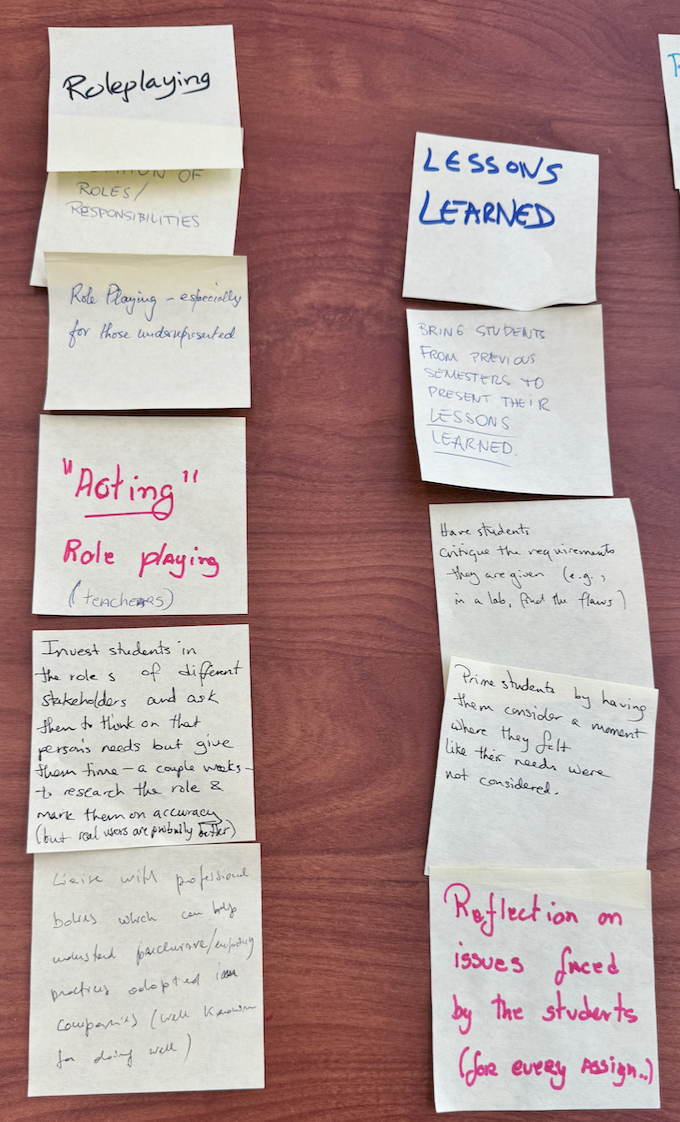
Figure 1: Example of the card sorting process used to elicit and categorize instructors’ empathy-related teaching practices.
Categories of Empathy-Oriented Teaching Practices
Societal Framing of AI Systems
A substantial category involves situating technical development tasks within high-impact societal contexts. Assignments and projects are explicitly grounded in real-world challenges—frequently with direct relevance to underrepresented groups, sustainability issues, or pressing societal risks. This practice transforms conventional requirements engineering by foregrounding contextual analysis and societal impact reasoning as technical imperatives. Empathy here is operationalized as the capacity for contextual sensitivity and the anticipation of systemic effects of AI deployment.
Fairness, Bias, and Accessibility in Design and Evaluation
Empathic technical competence is advanced by integrating fairness and accessibility criteria into design, implementation, and evaluation processes. Assignments are structured to require accessibility features, rotating external evaluators with accessibility needs, and leveraging AI tools to simulate the experience of marginalized users. Critical analysis of code, requirements, and educational content for latent bias is explicitly assessed. Such practices directly connect the identification and mitigation of algorithmic bias and exclusion with core technical workflows, embedding empathy as an epistemic discipline within AI-centric engineering.
Representative Users and Inclusion
Structured engagement with the perspectives of diverse user populations is systematized by involving direct user representation (e.g., guest lectures from disabled users), integrating feedback from underrepresented students, and careful diversification of instructional examples. Anti-tokenization principles are enforced: the intent is meaningful, not superficial, incorporation of diverse human perspectives into all stages of technical system construction. Empathy is thus framed as the methodological inclusion of plural lived realities into the construction and testing of AI systems.
Stakeholder Role Awareness and Responsibility
Assignments model real-world professional responsibility by requiring students to articulate and inhabit the roles and accountability structures of diverse stakeholders—developers, users, regulators, and affected communities. Role-playing, liaison with industry professionals, and diversity-aware team formation are adopted to expose students to the distributed consequences of technical decisions in AI development pipelines. Empathy here is instantiated through deliberate, structured perspective-taking and recognition of the multi-actor nature of engineering accountability.
Critical Reflection, Feedback, and Iterative Awareness
The embedding of structured reflection, iterative critique, and peer feedback into technical assignment cycles operationalizes empathy as an ongoing metacognitive process. Students reflect on personal experiences of exclusion, critique requirements for oversight, and learn from prior cohorts. This cultivates sensitivity to hidden assumptions and potential harms throughout the AI system lifecycle, not as a discrete exercise but as a recurring formative discipline.
Implications for Research and Practice
The findings articulate that empathy is most effectively integrated into software engineering when it is not compartmentalized as a standalone topic, but instead permeates the entire technical curriculum. Empathy is thus constructed as a cross-cutting competency, enabling students to surface, interrogate, and address issues of bias, accessibility, and responsibility as intrinsic elements of AI and software system design and deployment.
The paper concludes that such integration enhances students’ readiness to reason about and address the multidimensional human and societal consequences of AI technologies. For educators, it demonstrates that the operationalization of empathy does not require the displacement of technical rigor but can strengthen it by aligning software engineering pedagogy with contemporary imperatives in responsible AI development.
Theoretical and Practical Impacts
The study advances the discourse beyond existing literature that often conceptualizes empathy as an abstract soft skill. Instead, it evidences concrete pedagogical interventions that systematically integrate social reasoning, fairness, accountability, and inclusion into core technical processes. This supports calls for updating canonical engineering education to prepare professionals for the ethical and societal complexities of AI-dominated contexts.
From an empirical standpoint, the work suggests directions for longitudinal and comparative research—e.g., measuring the longitudinal impact of empathy-oriented instruction on students’ ethical reasoning and real-world technical practices.
Conclusion
This paper provides a structured account and empirical demonstration of how empathy can be systemically embedded in software engineering education in the AI era. The articulated practices—across societal framing, fairness-aware design, user inclusion, stakeholder responsibility, and iterative reflection—collectively support the cultivation of engineers capable of reasoning rigorously about the societal, ethical, and human implications of AI. Future research should empirically evaluate the effects of these pedagogical strategies on graduates’ ability to navigate and impact social contexts via technical innovation.

