- The paper derives exact first-order asymptotics for lower-tail probabilities using BP fixed points and Bethe free energy evaluations.
- It introduces message passing techniques that bridge classical Poisson estimates and container methods in the critical regime.
- The work highlights phase transitions and rigorous asymptotic probabilities in sparse combinatorial models through innovative analytical tools.
Non-existence Probabilities and Lower Tails in the Critical Regime via Belief Propagation
Introduction and Context
This work presents an asymptotic analysis of lower-tail and non-existence probabilities for combinatorial substructures in random discrete models precisely in the so-called critical regime, extending and unifying prior analyses which were restricted to the Poisson (sparse) and container (dense) regimes. The authors introduce message passing (Belief Propagation, BP) and Bethe free energy methodologies, adapted from statistical physics, as analytically rigorous tools for calculating rate functions: the leading order of log probabilities of rare events, such as the absence (or under-representation) of a fixed subgraph H in G(n,p), or the absence of k-term arithmetic progressions in random subsets of [n]. The operational domain is characterized by a regime straddling the point where neither classical large deviation inequalities nor container methods are asymptotically tight.
Main Results and Theoretical Contributions
The central contribution is the derivation, under mild local sparsity conditions, of exact first-order asymptotics (i.e., rate functions) for lower-tail probabilities in random hypergraph models, via a correspondence between these probabilities and the evaluation of the Bethe free energy at the unique BP fixed point. This framework encompasses binomial random subgraphs, arithmetic progression-free sets, and more general induced edge constraints in random k-uniform hypergraphs.
Explicitly, for a k-uniform (possibly non-regular, non-symmetric) hypergraph G=(V,E), the probability that a p-random subset of vertices induces no edges (independence) is shown to satisfy
logPp(independent set)=N−1Bc,1G(x∗)−c+o(1),
where H0 is the Bethe free energy, H1 parameterizes H2, and H3 is the unique BP fixed point. For the more general lower-tail
H4
the rate function involves solving for H5 (an edge-penalty fugacity) such that the BP fixed point matches the empirical proportion H6, and again evaluating the Bethe energy at this point.
For strictly 2-balanced graphs H7 with chromatic number at least three, in H8 with H9 and small G(n,p)0, the first-order rate function for G(n,p)1-freeness is expressed explicitly in terms of the unique solution of a transcendental fixed-point equation involving the Lambert G(n,p)2 function. The landscape interpolates between the domains treatable by classical Poisson estimates (Janson's inequality) and container methods, capturing the sharp change of behavior in the critical regime.
Phase Transition Phenomena
A key structural implication is the demonstration of a non-analytic phase transition in the rate function for G(n,p)3-freeness as G(n,p)4 crosses a threshold, justifying the terminology "critical regime." For strictly 2-balanced non-bipartite G(n,p)5, the rate function is analytic for small G(n,p)6, but continuity with the macroscopic ("container") regime is obstructed by incompatibility in analytic continuation, forcing a transition.
Application to Arithmetic Progressions
The methodology is extended to random subsets of G(n,p)7, computing the large deviations of the number of G(n,p)8-term arithmetic progressions. The non-existence probability is mapped to a functional BP fixed point equation, reflecting the asymmetry of the underlying arithmetic structure. The solution yields both the rate function and marginal probabilities in G(n,p)9-AP-free random sets, showing, for instance, that the conditional marginals are inhomogeneous on k0.
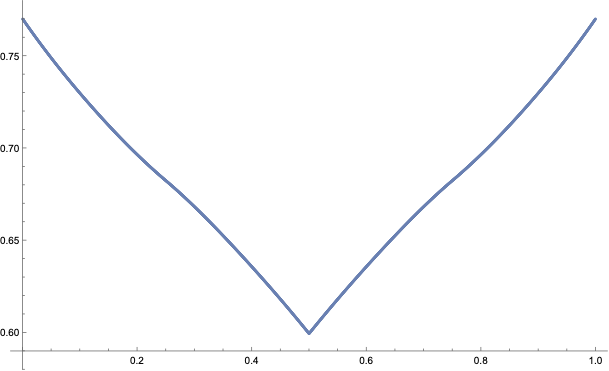
Figure 1: The function k1 for k2, k3, representing the limiting occupation density in the random k4-AP-free subset regime as a function of position in k5.
Methods
The main technical approach is the reduction of the problem to the analysis of the hard-core model (and its soft, edge-penalized generalizations) on asymptotically locally tree-like hypergraphs. Here, the log partition function (in the appropriate critical scaling) is shown to coincide with the Bethe free energy at the BP fixed point (as in classical tree models), and this correspondence yields tight asymptotic probabilities in the underlying random models.
A crucial innovation is that contraction of the BP operator is shown under weak local sparsity and Gibbs uniqueness (weak spatial mixing) on the infinite hypertree, as opposed to the much stronger requirements of prior cluster expansion or strong spatial mixing arguments. This is sufficient since accurate first-order asymptotics are established for growing degree sequences, rather than requiring explicit (polynomial-time) computation as in algorithmic correlation decay approaches.
Together with an analysis of the associated edge-penalty (Gibbs) measures, this provides a powerful and unifying probabilistic combinatorics toolkit for models previously considered analytically intractable in the critical domain.
Numerical Quantification and Contradictory Claims
- The exact forms for the rate functions are provided in terms of transcendental equations involving the Lambert k6 function; for instance, for k7-freeness in k8,
k9
where [n]0 solves [n]1 under a constraint matching the target lower-tail event.
- The authors make the strong claim that the Bethe free energy prediction is not only qualitatively but quantitatively correct for a broad array of sparse combinatorial models in the critical window, a statement rigorously justified under their sparsity and local structure assumptions.
- For [n]2-APs (and odd-bipartite cycles), in contrast to the non-bipartite [n]3, they conjecture analyticity of the rate function across the full critical regime; i.e., that no phase transition arises, corresponding to the absence of a dense extremal structure in these cases. This contrasts with the established non-analyticity for non-bipartite strictly 2-balanced [n]4.
Implications
On the theoretical side, these results provide a rigorous, universal explanation for the appearance of BP (and its rate function predictions) as the correct large deviations calculus in non-mean-field, sparse combinatorial models—moving far beyond random regular or symmetric settings. They suggest that statistical physics intuition, via message passing and free energy functionals, extends robustly and exactly into combinatorics well beyond the algorithmic threshold, up to the uniqueness phase boundary.
Practically, these results suggest that for numerous rare-event questions in random discrete structures that are not handled by existing Poisson or container techniques, the BP/Bethe formalism can provide precise asymptotics. This has implications for probabilistic combinatorics, statistical physics of sparse constraints, and (through computational trees) for approximate counting and sampling in locally tree-like complex systems.
Future Directions
Several open problems and directions are suggested:
- Extending the uniqueness of the phase transition and determining its precise location for various models.
- Characterizing the breakdown of the Bethe prediction beyond the uniqueness threshold, particularly for irregular or denser hypergraphs.
- Further development of functional BP techniques for more complex non-symmetric constraints.
Given the robustness and generality of the approach, further application to large deviation and extremal problems in random discrete structures (including those not neatly encoded as uniform hypergraphs) is strongly indicated.
Conclusion
This work establishes the Bethe free energy and BP fixed point formalism as the analytic core of critical regime lower-tail and non-existence probability calculations in random discrete combinatorial models. It provides explicit, rigorous, and unifying asymptotics for a range of central problems, introduces phase transition phenomena in the rate function, and opens the door to further transfer of statistical physics techniques into the mainstream of probabilistic combinatorics.

