- The paper introduces a deterministic loop SSE algorithm for quantum spin models that circumvents complex directed-loop equations.
- The method optimally separates longitudinal and transverse mode sampling, achieving up to 50% CPU-time savings on large systems.
- The deterministic approach consistently reproduces exact diagonalization results while offering superior autocorrelation and scalability.
Deterministic Loop Stochastic Series Expansion Algorithms in Quantum Spin Models under Magnetic Fields
Introduction and Motivation
Stochastic Series Expansion (SSE) QMC algorithms constitute the core computational methodology for simulating quantum spin systems, particularly those conforming to S=1/2 Heisenberg models. While operator-loop (or cluster) updates have enabled efficient exploration of large quantum state spaces, the presence of external magnetic fields — notably those breaking SU(2) symmetry — introduces significant challenges. Traditionally, directed-loop (DI-L) algorithms are employed to restore detailed balance under these fields, but the requirement to solve the directed-loop equations and the resultant combinatorial loop proliferation tend to reduce sampling efficiency.
This paper introduces a deterministic loop (DE-L) SSE algorithm specifically tailored for antiferromagnetic (AFM) spin chains under staggered magnetic fields. By extending ideas from SSE approaches applied to the quantum Ising model, this method circumvents the complexity and inefficiency of directed-loop constructs, optimizing for cases with symmetry breaking due to external fields and separating longitudinal and transverse mode sampling in magnetically ordered phases.
DE-L Algorithmic Framework for Staggered Longitudinal Fields
A staggered longitudinal field breaks the SU(2) symmetry and serves as a stringent benchmark for cluster-update QMC. The focus is the S=1/2 Heisenberg chain with a staggered magnetic field,
H=J⟨i,j⟩∑Si⋅Sj−hi=1∑N(−1)iSiz.
The Hamiltonian is decomposed into distinct diagonal and off-diagonal bond operators for SSE representations (Figure 1):
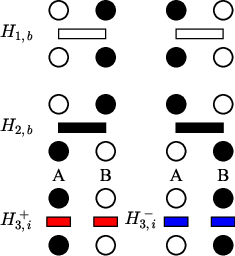
Figure 1: The six different SSE vertices correspond to the matrix elements for the decomposed Hamiltonian operators in the presence of a staggered longitudinal field.
The update protocol employs deterministic loop construction: when a path encounters a Heisenberg vertex, a switch-and-reverse is applied, while magnetic field vertices propagate the path straight ahead. This generates closed loops or clusters in operator space; a typical SSE configuration with an 8-spin chain is depicted in Figure 2.
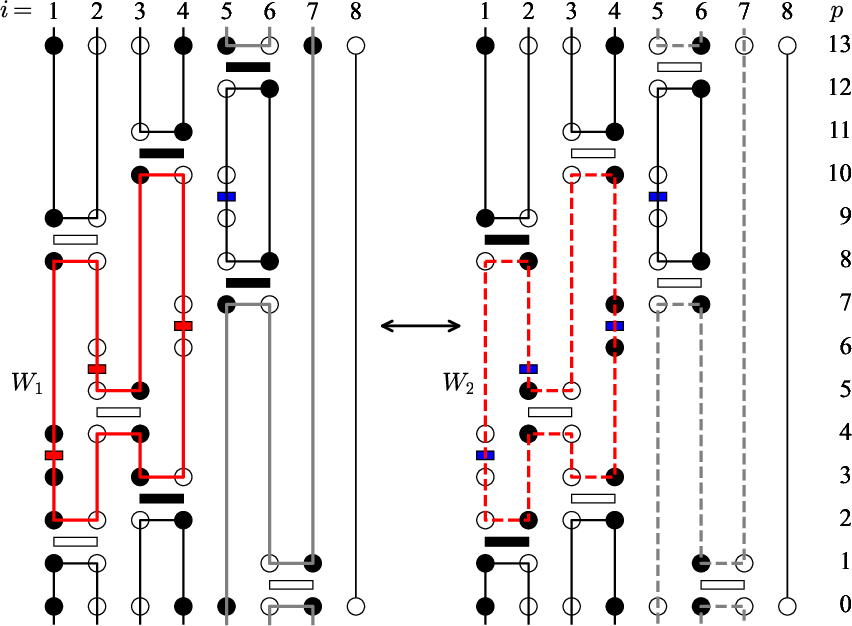
Figure 2: Schematic of an SSE configuration; the red loop illustrates a closed path used for non-local updates, with weights determined by the number and type of magnetic field vertices encountered.
Loop flipping probabilities are formulated based on the configuration weights before and after spin flips. Notably, when magnetic field operators are absent, loop flipping is unbiased (Pflip=1/2); with staggered field operators, the probability is computed as a function of the encountered field vertices, analytically expressible (Eq. [pflip] in the manuscript). This mimics optimal cluster updates observed in Swendsen-Wang algorithms for classical systems.
Comparison to standard DI-L implementations reveals that the DE-L algorithm results in a fixed and unique loop structure for each operator string, eliminating the need for case-by-case solution of directed-loop equations and yielding more robust sampling.
Algorithmic Benchmark and Autocorrelation Analysis
The efficacy of the DE-L algorithm is validated against both exact diagonalization (ED) and DI-L QMC approaches for observables such as the energy density and the AFM order parameter (Figure 3).
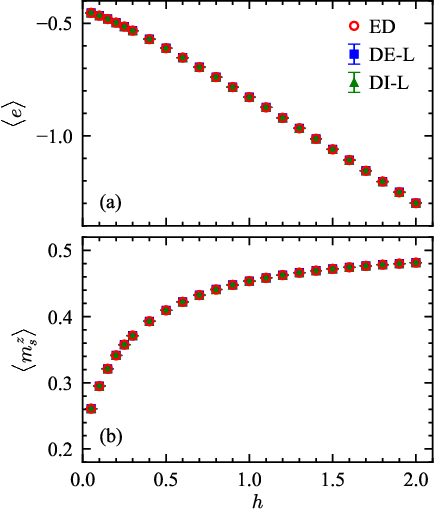
Figure 3: DE-L and DI-L QMC deliver consistent results with ED for energy density and AFM order parameter across a range of staggered magnetic fields.
Monte Carlo (MC) sampling efficiency is quantified via integrated autocorrelation time, τint, and associated CPU time metrics. Parameter ϵ tunes the frequency of certain vertex types, with results revealing an optimal efficiency regime (Figure 4, DE-L; Figure 5, DI-L):
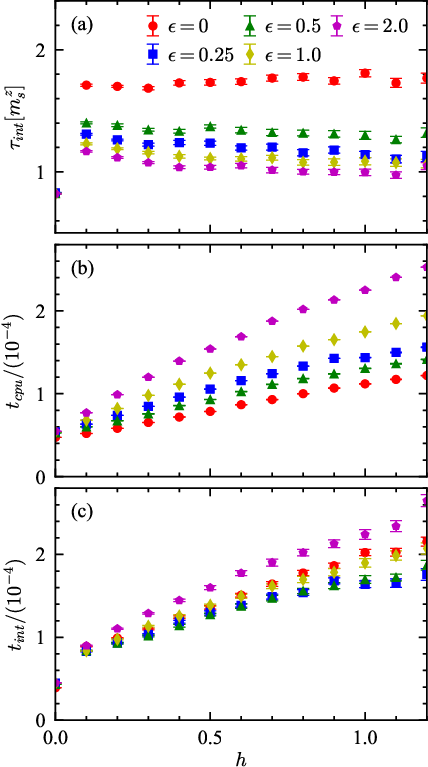
Figure 4: DE-L autocorrelation times and computational effort as a function of ϵ and staggered field; an optimum exists balancing computational cost and sampling decorrelation.
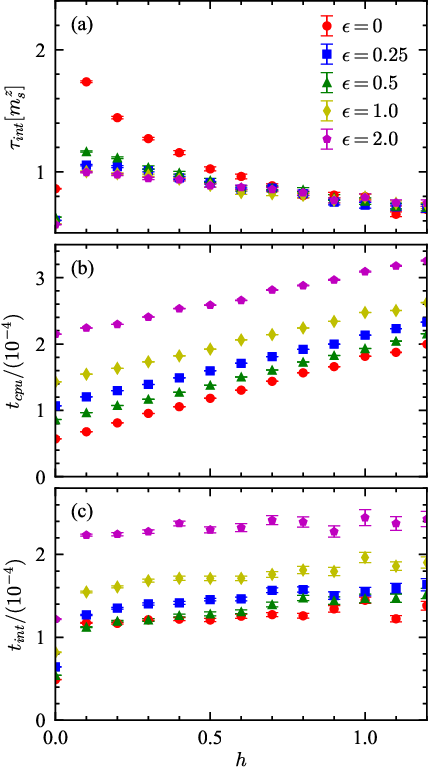
Figure 5: DI-L performance demonstrates different ϵ dependency, but for small fields, DE-L offers a computational advantage.
Full system benchmarks for L=64 (Figure 6) and L=128 (Figure 7) confirm that the DE-L approach demonstrates an efficiency advantage in the weak-field regime, with up to 30% less CPU time per statistically independent sample — a non-trivial advantage for large-scale statistical analyses.
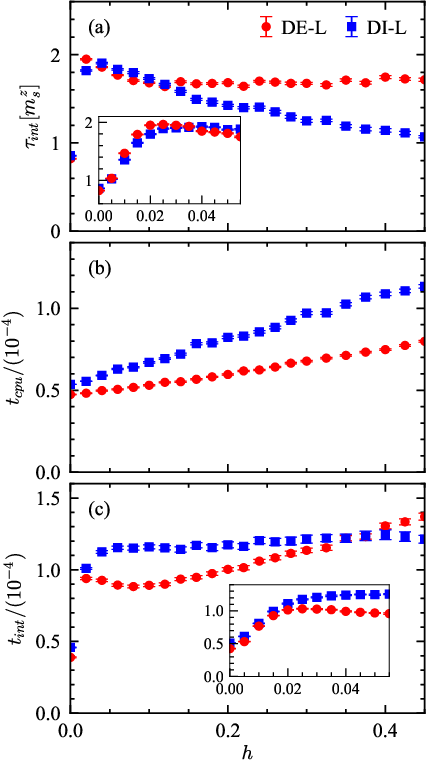
Figure 6: For S=1/20, DE-L consistently outperforms DI-L in both autocorrelation and CPU effort as field strength is varied.
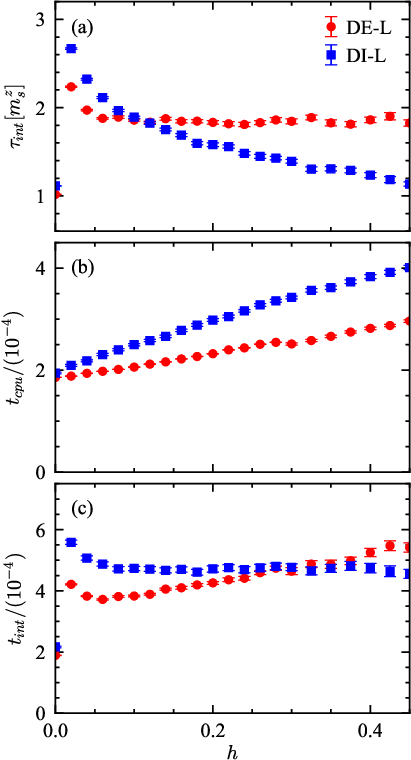
Figure 7: For S=1/21, the efficiency gap persists, demonstrating scalability benefits of DE-L in large spin chains.
Extension to Staggered Transverse Fields
The DE-L formalism is further extended to systems under transverse (x-direction) staggered fields:
S=1/22
Here, the transverse field induces off-diagonal SSE operators, giving rise to cluster decomposition into non-closed clusters terminated by field vertices (Figure 8).
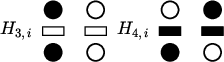
Figure 8: Magnetic field vertices for the transverse-field Heisenberg model; configurations are updated by flipping clusters with field vertex terminations, retaining configuration sign structure.
SSE results using DE-L, DI-L, and ED are fully consistent for energy density and transverse magnetization (Figure 9).
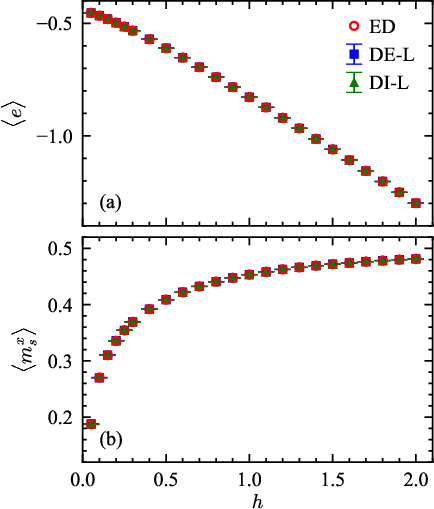
Figure 9: QMC and ED show agreement for observables under staggered transverse fields, validating the DE-L construction.
Autocorrelation and computational cost analyses for system sizes S=1/23 (Figure 10) and S=1/24 (Figure 11) indicate that DE-L maintains superior sampling efficiency (up to 50% CPU-time savings for the studied field ranges), whereas DI-L efficiency decays with increasing field due to more complex loop propagations.
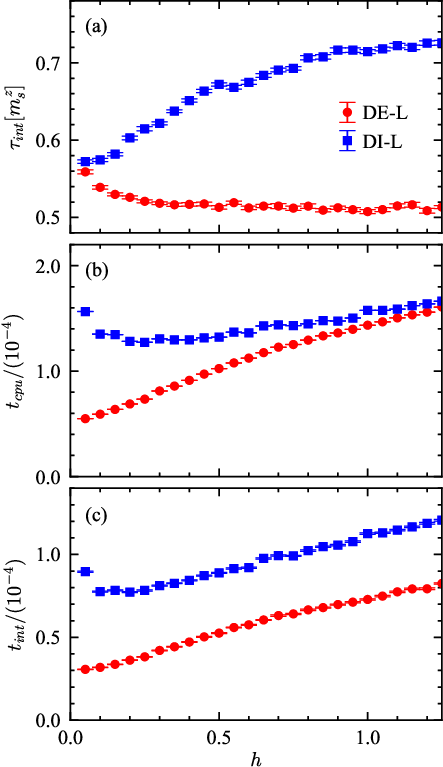
Figure 10: At S=1/25, DE-L delivers lower S=1/26 and CPU time for sample decorrelation in the presence of a transverse field.
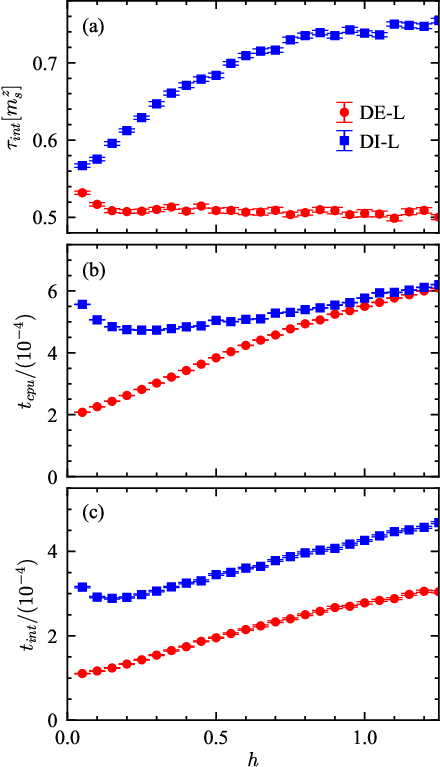
Figure 11: The performance gap in sampling efficiency persists at S=1/27, indicating scalability for the transverse-field extension.
Implications and Outlook
By enabling deterministic cluster decompositions without recourse to directed-loop equations, the DE-L algorithm significantly reduces implementation complexity and computational cost for a broad class of quantum spin and bosonic lattice models under symmetry-breaking fields. The method’s performance advantage is strongest in the low- to intermediate-field regime and persists with system size scaling. The transparent handling of cluster sign structure and field-dependent flipping probabilities opens possibilities for high-precision dynamical correlation studies in quantum magnets, as well as for other contexts where transverse or longitudinal fields couple to order parameters.
It is anticipated that the DE-L approach will be extensible to higher-dimensional lattices, as well as frustrated quantum models where traditional loop updates struggle and sign problems emerge. While DI-L methods retain theoretical optimality in certain parameterizations, in practice, DE-L’s simplicity and efficiency provide compelling motivation for adoption in future large-scale quantum many-body simulations. Algorithmic innovations in loop construction — perhaps integrating adaptive strategies or application-driven parameter tuning — stand as promising directions for further gains in generic quantum Monte Carlo algorithms.
Conclusion
The deterministic loop SSE algorithm provides a robust, efficient, and easily generalized approach to simulating quantum spin systems in the presence of external magnetic fields. By eliminating the complexity of directed-loop equation solving and achieving consistently lower autocorrelation times per CPU cost, this method materially advances the state of QMC for problems where symmetry breaking is present. Its scalability, algorithmic simplicity, and verified accuracy in comparison to existing schemes establish it as a powerful tool for researchers investigating quantum criticality, magnetically ordered ground states, and quantum phase transitions in large-scale lattice models.
Reference: "Deterministic Loop Stochastic Series Expansion Algorithm for Quantum Spin Models in Magnetic Fields" (2604.04635).