- The paper introduces the (≤p)-inversion diameter as a novel metric for assessing reconfiguration distances in oriented graphs via generalized inversion operations.
- It derives sharp upper and lower bounds for various graph classes, including trees and planar graphs, using combinatorial decomposition and edge‐coloring techniques.
- The results unify local and global transformation problems, offering precise asymptotic and exact inversion diameter values that guide future algorithmic research.
The (≤p)-Inversion Diameter of Oriented Graphs
Introduction and Background
The paper investigates the reconfiguration problem on the space of labelled orientations of a graph G, where two orientations are connected if one can be obtained from the other via the inversion of all arcs within a subset of at most p vertices. The central focus is the (≤p)-inversion diameter of a graph G, denoted id(≤p)(G), which is the maximum distance between pairs of orientations in the (≤p)-inversion graph I(≤p)(G).
While classical results consider inversion operations of size $2$ (aligning with the feedback arc set problem), this work generalizes such operations to arbitrary p≥2, thus capturing a spectrum of intermediate reconfiguration problems between local and global operations. The G0-inversion framework unifies several problems: for G1, it recovers the feedback arc set, and as G2 grows, it connects to total inversion diameters studied previously [Havet et al. 2024, Yuster 2025].
Given a labelled undirected graph G3:
- An inversion of a vertex set G4 transforms an orientation G5 into G6 by reversing every arc between pairs of vertices in G7.
- The G8-inversion graph G9 is the reconfiguration graph whose vertices are all labelled orientations of p0, with an edge between p1 and p2 if one can be obtained from the other by a single inversion over a set p3 with p4.
- The p5-inversion diameter p6 is the diameter of this reconfiguration graph.
Associated invariants like the p7-inversion number for acyclic transformation and the p8-converse number for transforming an orientation to its converse are also considered, with the converse number being a lower bound for the inversion diameter.
Main Theoretical Results
General Bounds
The authors establish sharp upper and lower bounds for p9 in terms of the graph's edge set and parameter (≤p)0. The principal result is the existence of a constant (≤p)1 such that
(≤p)2
with bounds (≤p)3, holding for every graph (≤p)4. The lower bound is tight for sparse graphs such as matchings.
For dense graphs, an improved bound is given:
(≤p)5
where (≤p)6, matching a construction for complete bipartite graphs.
Structural Bounds for Graph Classes
The paper develops refined bounds for trees, forests, and planar graphs using combinatorial decompositions and edge-coloring techniques.
Trees
Sharp asymptotic behaviors for trees of order (≤p)7 are determined for specific (≤p)8:
- For (≤p)9: G0
- For G1: G2
- For G3: G4
The general case is encapsulated as
G5
for a constant G6 and any G7.
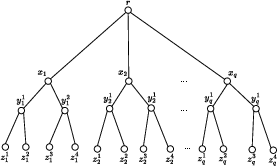
Figure 1: Example of the tree G8 constructed to show tightness in Proposition tree4-tight for G9; the tree structure realizes the worst-case inversion sequence size.
Planar Graphs
For the class id(≤p)(G)0 of planar graphs, the bounds are:
- id(≤p)(G)1
- id(≤p)(G)2
- For id(≤p)(G)3: id(≤p)(G)4
Tightness and Lower Bounds
The constructions, notably for trees (see Figure 1) and for specific planar graphs, show these upper bounds are tight up to additive constants. For id(≤p)(G)5, Figure 1 details the explicit tree structure used for lower bound arguments.
Procedural and Combinatorial Techniques
Several combinatorial innovations underpin these bounds:
Numerical Results and Strong Claims
The strongest numerical findings include:
- For trees with id(≤p)(G)9 vertices, the tight values for the inversion diameter for (≤p)0 are given exactly.
- For planar graphs, the precise linear coefficients in (≤p)1 for (≤p)2 and (≤p)3 inversion diameters are proven, sharpening prior bounds from the literature.
- The additive constant (≤p)4 is precisely computed for small (≤p)5: (≤p)6 for (≤p)7 and (≤p)8 for (≤p)9.
Implications and Future Directions
The results provide a unified framework for inversion-based reconfiguration in oriented graphs, capturing a spectrum from local to global transformations. The sharp bounds have implications for algorithmic approaches to orientation reconfiguration, especially in sparse or structured graphs.
The theoretical findings raise further open problems:
- Determination of the exact form and asymptotic behavior of I(≤p)(G)0 for larger I(≤p)(G)1.
- Potential to extend the methods to additional graph classes, such as minor-free or bounded treewidth graphs.
- Exploration of the computational complexity of finding shortest I(≤p)(G)2-inversion sequences in practice, where the results give worst-case optimality guarantees.
Conclusion
This work provides a comprehensive analysis of the I(≤p)(G)3-inversion diameter across a range of graph classes, offering tight asymptotic and, in many cases, exact values. By connecting combinatorial structure, edge partitioning techniques, and reconfiguration graph diameters, it sets the stage for further expansion into algorithmic and complexity considerations for orientation reconfiguration problems in graphs.
Reference: "On the I(≤p)(G)4-inversion diameter of oriented graphs" (2604.04633)