- The paper presents an analytic and numerical method to derive the SCGF and rate functions governing dynamical phase transitions in self-propelled particles.
- It identifies both first- and second-order phase transitions by analyzing non-analyticities induced by aging reset probabilities and varying residence times.
- The study offers practical insights into transport in confined active matter and extends large deviation theory to incorporate semi-Markovian memory effects.
Semi-Markovian Dynamics and Large Deviations of Self-Propelled Particles under Resetting
Introduction
The study presents an analytic and numerical investigation into the large deviations of integrated currents for self-propelled particles operating in one-dimensional confined environments under semi-Markovian resetting protocols. The model alternates between a running phase (Phase 0) and a wall-attached phase (Phase 1), incorporating time-dependent, “aging” reset probabilities that induce nontrivial transition dynamics. Two representative cases are considered: (1) a running phase with biased random walk and immobilizing wall-attached phase with reset probabilities that decrease over the residence time ("aging"); and (2) a model of minimal rheotaxis, where the particle alternates between forward and backward biased phases, with memoryless and aging reset statistics, respectively. The primary analytic tool is Scaled Cumulant Generating Function (SCGF), whose non-analyticities diagnose Dynamical Phase Transitions (DPTs) in current fluctuations. Analytical results are cross-validated with stochastic cloning simulations.
The dynamics are defined by discrete-time semi-Markovian transitions between two phases. The system tracks time-integrated displacement (the “current”) and leverages the large deviation principle: for displacement Xt over time t, the probability P(Xt/t=v)∼exp(−tI(v)), where I(v) is the rate function. All fluctuation statistics ultimately reduce to properties of the SCGF, Λ(s), extracted via G(s,t)=⟨esXt⟩∼etΛ(s) and related to I(v) by Legendre-Fenchel transform. A central analytic step involves expressing the system's z-transformed generating function in terms of phase-specific weights, with the dominant pole delivering Λ(s). DPTs are indicated whenever the location of this pole (z∗(s)) collides with the analyticity boundary set by the aging statistics of the resets.
Semi-Markovian Random Walk: Aging and Dynamical Phase Transitions
The first scenario considers a particle performing a biased random walk (“running phase,” with right probability t0, left t1), interrupted by immobilizing boundary interactions (“wall-attached” phase). Reset probabilities t2 induce heterogeneous (aging) sojourn time distributions.
The particle's dynamic statistics are controlled by the aging exponent t3:
- For t4, residence times have power-law, heavy tails (unbound regime).
- For t5, sojourn times become integrable (bound regime).
In both regimes, SCGF analysis reveals two DPTs located at t6 and t7, corresponding to fluctuations dominated by the backward and forward dynamics, respectively. The order of the DPTs is dictated by the value of t8: second-order for t9 (continuous derivative of P(Xt/t=v)∼exp(−tI(v))0), and first-order for P(Xt/t=v)∼exp(−tI(v))1 (discontinuous slope).
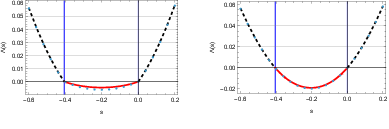
Figure 1: SCGF P(Xt/t=v)∼exp(−tI(v))2 as a function of the biasing field P(Xt/t=v)∼exp(−tI(v))3 for P(Xt/t=v)∼exp(−tI(v))4 (left, first-order DPTs) and P(Xt/t=v)∼exp(−tI(v))5 (right, continuous DPTs). The dashed vertical lines show the transition points.
The first-order DPT features linear interpolations between analytic segments of P(Xt/t=v)∼exp(−tI(v))6, leading to characteristic flat segments in the corresponding rate function P(Xt/t=v)∼exp(−tI(v))7. These plateaus in P(Xt/t=v)∼exp(−tI(v))8 reflect true phase coexistence in the unbiased ensemble, observable in finite-time simulations without further tilting.
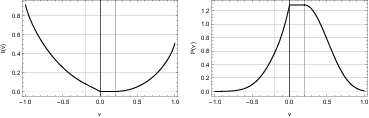
Figure 2: Rate function P(Xt/t=v)∼exp(−tI(v))9 (left) and probability distribution I(v)0 (right) for I(v)1, illustrating regions of phase coexistence and the non-analytic points tied to the observed DPTs.
Renewal reward theory provides explicit expressions for the mean current I(v)2 at I(v)3. The unbound regime features long spells in the running phase, saturating the current to I(v)4. For I(v)5, the mean current is suppressed by more frequent resets. The transition at I(v)6 is second-order, with clear non-analyticity in I(v)7.
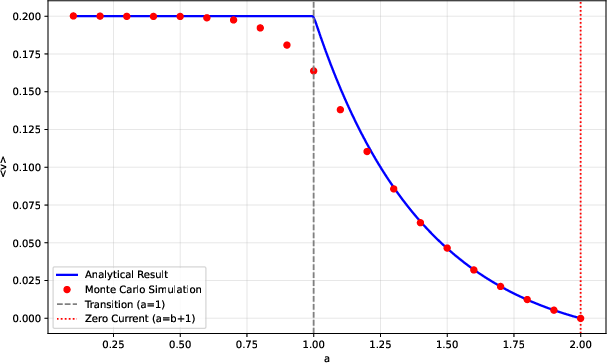
Figure 3: Mean current I(v)8 as a function of aging strength I(v)9, with a clear transition at Λ(s)0 reflecting the unbound Λ(s)1 bound regime change.
Conditional large-deviation analysis, introducing a biasing field conjugate to time spent in Phase 1, characterizes the mean sojourn time in each phase for fixed current.
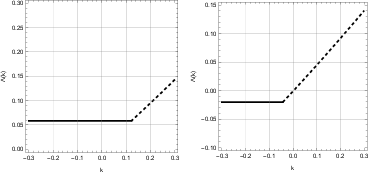
Figure 4: SCGF Λ(s)2 for two values of Λ(s)3. Zero and positive slopes at Λ(s)4 distinguish the dynamical phases under different Λ(s)5.
Minimal Rheotaxis: Competing Bulk and Surface Memory Structures
The second case models rheotaxis by combining a memoryless (Markovian) downstream phase and a backward-biased, age-dependent “surface” phase. Here, the forward phase features geometric splits, while the wall-attached phase inherits the same aging statistics as above.
The model supports both first- and second-order DPTs, with transitions at Λ(s)6 and a re-entrant Λ(s)7 dependent on reset rate parameters. For sufficiently strong aging (small Λ(s)8), the heavy tails in the wall phase confer infinite residence times (“hibernation”), locking the system into the backward mode and inducing a robust symmetry breaking in current fluctuations.
A critical result is the violation of the Gallavotti-Cohen symmetry in the presence of asymmetric (aging) resets: fluctuation functions do not display the usual symmetry about the thermodynamic field—external fluctuation symmetry is shattered due to the non-Markovian memory of the phases. The scenario’s phase diagram depends critically on the reset probability Λ(s)9 relative to bulk drift; only when G(s,t)=⟨esXt⟩∼etΛ(s)0 does the system stabilize into a robust fluctuating regime.
The mean current as a function of aging strength G(s,t)=⟨esXt⟩∼etΛ(s)1 demonstrates a second-order transition at G(s,t)=⟨esXt⟩∼etΛ(s)2 (unbound phase) and the appearance of a stalling point where G(s,t)=⟨esXt⟩∼etΛ(s)3 for G(s,t)=⟨esXt⟩∼etΛ(s)4.
Implications and Perspectives
This work demonstrates that semi-Markovian aging in phase-switching can drive nontrivial fluctuation phenomena, including both first- and second-order DPTs in integrated current statistics, observable even in the unbiased physical dynamics. Resetting mechanisms with time-dependent rates are sufficient to generate coexistence and intermittency phenomena without the need for external driving or artificial conditioning.
Practical implications include:
- Understanding transport properties in confined active matter (e.g., bacterial rheotaxis, cellular motility).
- Predicting critical behavior (e.g., stagnation or alternation) induced by environmental or molecular-scale “aging” in switching rates.
- Insights into the robustness of directed transport under nontrivial phase-memory effects.
Theoretical implications concern:
- Extension of large deviation theory to semi-Markovian multi-phase systems, with explicit control over the order and location of DPTs by tuning microscopic memory parameters.
- Mechanistic understanding of fluctuation symmetry breaking in nonequilibrium systems with internal phase memory.
Future developments may generalize this approach to multi-phase networks, systems with more complex resetting logic, and hydrodynamically driven active matter with additional spatial or topological constraints. The interplay of memory, non-exponential resets, and large deviation structure offers a fertile ground for characterizing rare-event statistics and stochastic phase transitions in active and driven systems.
Conclusion
The analysis rigorously elucidates how semi-Markovian (aging) resets in two-phase stochastic dynamics control the order, nature, and observability of DPTs in time-integrated currents. Analytical predictions for the SCGF, rate function, and mean current are validated against stochastic simulations. Importantly, the results highlight the emergence of non-analyticities at physically observable points (G(s,t)=⟨esXt⟩∼etΛ(s)5), the existence of true phase coexistence in unbiased samples, and the breakdown of fluctuation symmetries due to memory. The work opens avenues for controlling and exploiting fluctuation phase transitions in active matter via design of resetting protocols and external phase-coupling logic.

