- The paper introduces an automated framework that integrates ab initio simulations with Bayesian optimization to accurately determine three-dimensional atomic surface structures.
- It employs adaptive trust-region control and Gaussian Process surrogates to efficiently navigate complex, high-dimensional inverse problems in LEED analysis.
- The methodology demonstrates robust convergence to physically consistent solutions, validated via DFT, for applications ranging from Ag(100)-(1×1) to Fe₂O₃(1̅102)-(1×1) reconstructions.
The paper "Physics-informed automated surface reconstructing via low-energy electron diffraction based on Bayesian optimization" (2604.04578) presents a unified, physics-informed Bayesian optimization (BO) framework for the automated determination of three-dimensional atomic surface structures from low-energy electron diffraction (LEED) intensity–voltage (I(V)) data. Through the direct integration of ab initio multiple scattering simulations into the optimization loop, the authors address long-standing challenges in automated and reproducible surface structure refinement, offering a solution that is demonstrably scalable and robust across both simple and complex inversion scenarios.
Background: Inverse Problems in Surface Structure Determination
Quantitative structural analysis of surfaces is central to the understanding and design of functional materials, as surface reconstructions often underpin catalytic, electronic, and magnetic phenomena. LEED has long served as a high-resolution probe, with I(V) spectra encoding local atomic positions through their sensitivity to scattering phase shifts and multiple scattering effects. However, the mapping from experimental I(V) curves back to atomic positions is a nonlinear, high-dimensional, and highly non-convex inverse problem due to the complexity of dynamical electron scattering in multiple layers.
Traditional LEED structure refinement techniques, including perturbative approaches (TensorLEED [rousTheoryTensorLEED1989, blumFastLEEDIntensity2001]), genetic algorithms [dollGlobalOptimizationLEED1996], simulated annealing [nascimentoFastSimulatedAnnealing2001, correiaGeneralizedSimulatedAnnealing2004], and more recently autoencoder-driven models [ivanovAutoencoderLatentSpace2024], suffer from heavy reliance on expert heuristics, manual tuning, sequential/decoupled parameter optimization, or requirements for extensive training data that limit generalization and interpretability.
This work posits that embedding the complete physical forward model of scattering into a probabilistic inference and optimization framework can resolve these issues, by enforcing physical validity at every evaluation while efficiently navigating the high-dimensional parameter space.
The core innovation is a BO workflow with trust-region adaptation, in which the forward I(V) simulation is integrated as a black-box objective, mapping parameter sets (atomic positions, vibrational amplitudes, incidence angles, etc.) to Pendry R-factors that measure agreement with experiment. The surrogate model (SingleTask Gaussian Process with a Matérn 2.5 kernel, implemented via BoTorch [balandatBoTorchFrameworkEfficient2020, gardnerGPyTorchBlackboxMatrixMatrix2021]) is iteratively refined as new R-factors are sampled, and the acquisition function—qUCB in moderate dimensions, or Thompson Sampling with multiple trust regions in higher dimensions—guides the proposal of new candidates within an adaptively contracted/expanded region based on search progress.
No prior is imposed on the relative importance of parameters; all variables are treated equivalently within a unified, automated loop. Importantly, warm-restart strategies and the retention of all historical simulation data ensure robustness against local minima and enable efficient global optima search [leNonsmoothNonconvexStochastic2024, poloczekWarmStartingBayesian2016].
The pipeline is illustrated in Figure 1:
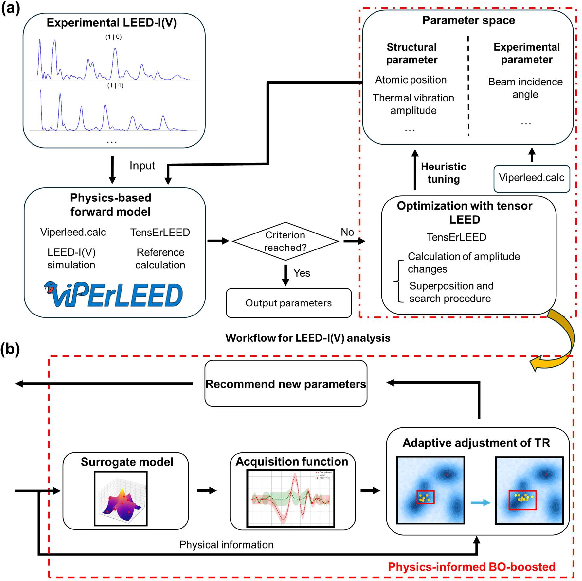
Figure 1: Workflow of ViperLEED.calc (manual, perturbation-based) and the proposed Bayesian optimization loop for LEED-I(V), highlighting the integration of physical simulation and automated adaptive parameter space exploration.
Numerical Validation: Surface Reconstruction of Ag(100)-(1×1)
The Ag(100)-(1×1) case serves as a low-dimensional benchmark (~13 parameters). BO rapidly and autonomously converges to a physically faithful reconstruction within a deliberately broadened search window. R-factor minimization is achieved with no manual hyperparameter tuning. Notably, both geometry (atomic coordinates) and VIBROCC vibrational parameters are optimized in one pass—contrasting with conventional sequential adjustment.
The progression of R-factor and VIBROCC, as a function of sampling steps, along with the structural evolution and spectral fit at selected stages, is shown in Figure 2:
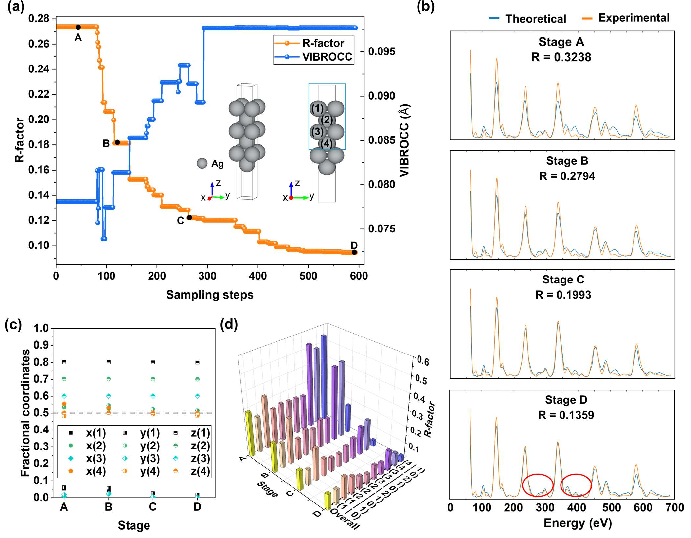
Figure 2: Bayesian optimization for LEED-I(V) analysis of Ag(100)-(1×1): (a) surface structure and convergence of R-factor/VIBROCC; (b) LEED-I(V) spectral fits; (c) atomic coordinate evolution; (d) R-factors for individual diffraction beams.
Energetic validation through DFT demonstrates a highly consistent decrease in both R-factor and configuration energy (Figure 3a), with low-R-factor solutions clustering in a narrow, energy-degenerate structural basin (Figure 3b). Intriguingly, optimization proceeds first through structural relaxation, then via fine-tuning of vibrational parameters, with a brief decoupling observed (R-factor continues decreasing as DFT energy plateaus) that rigorously reflects the lack of an explicit energetic prior.
Critically, the use of fixed (bulk-derived) VIBROCC values leads to catastrophic degradation in R-factor (Figure 3c), affirming the necessity of explicit, surface-specific vibrational amplitude optimization for quantitative reproduction of experimental spectra.
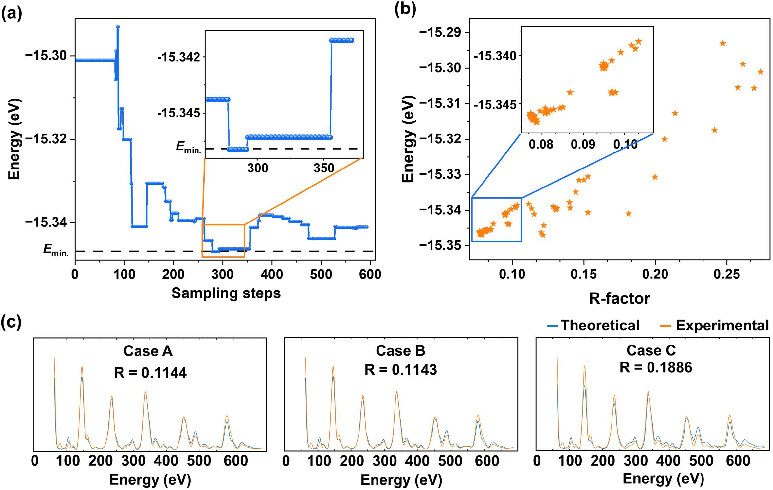
Figure 3: Energetic consistency and experimental validation for Ag(100)-(1×1): (a) evolution of total DFT energy; (b) mapping of R-factor vs. DFT energy for all sampled structures, showing low-R structures are energetically favored; (c) comparison of LEED-I(V) fits with energy- and R-factor-optimal structures vs. bulk VIBROCC.
Scaling to Complex Systems: Fe₂O₃(1̅102)-(1×1)
For high-dimensional, strongly coupled inverse problems (~53 parameters: coordinates, VIBROCC for Fe/O, and electron beam incidence angle θ), the BO framework demonstrates reliable escape from local minima via staged expansion of the effective sampling radius in trust regions across multiple GPs.
Figure 4 visualizes the optimization landscape, adaptation of the effective search radius, manifold transitions in parameter space (UMAP embedded trajectories), and convergence of both R-factor and DFT energy:
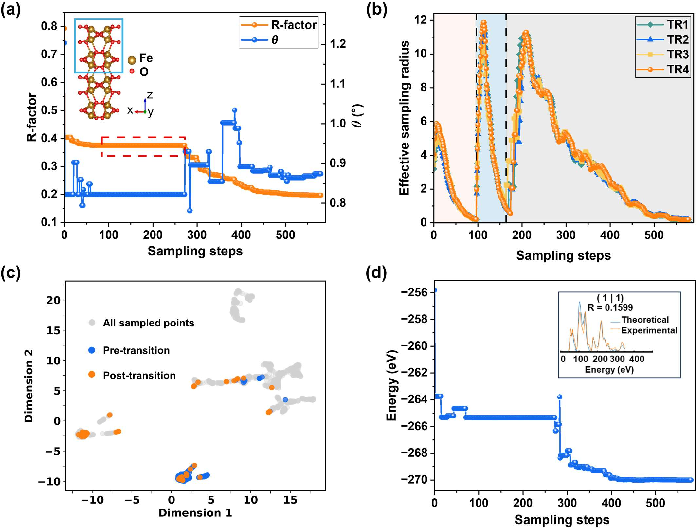
Figure 4: Convergence and structural evolution in BO-driven Fe₂O₃(1̅102)-(1×1) surface reconstruction: (a) R-factor and incident angle θ vs. sampling step; (b) effective sampling radius across trust regions; (c) UMAP embedding of query trajectories; (d) DFT energy evolution with final (1|1) beam fit.
The culmination is a structural solution with R-factor (0.1977) and atomic configuration closely matching, or exceeding in spectral fidelity, results from ViperLEED.calc, yet achieved in a single, autonomous workflow. Simultaneous convergence of energy and R-factor underlines the physical consistency of the inferred solution.
Implications, Comparisons, and Extensions
Numerical Strengths and Bold Advances:
- The framework autonomously finds solutions directly comparable to expert-guided, multistage optimization while requiring no human intervention or prior parameter hierarchy.
- Explicitly surfaces the importance of simultaneous vibrational parameter optimization—failure to do so yields order-of-magnitude worse R-factors.
- Reveals the physical meaningfulness of R-factor minima via dense clustering of energetically degenerate solutions, substantiating the effective physical information embedding in the objective landscape.
Challenges and Contrasts:
- Black-box BO dramatically avoids the limitations of data-hungry, less-interpretable autoencoder methods [ivanovAutoencoderLatentSpace2024].
- Trust-region adaptation enables stable exploration in both low- and high-dimensional parameter spaces [namuraRegionalExpectedImprovement2024, asciaFeasibilityDrivenTrustRegion2025].
- The approach can integrate with first-principles energetics or machine-learned interatomic potentials for further efficiency and scalability, particularly for large systems or when integration with multimodal probes (SXRD, STM) is desirable [wanzenbockMachinelearningbackedTheoreticalStudy2024, bisboGlobalOptimizationAtomic2022, shaiduTransferableDispersionawareMachine2025].
Broader Impact and Future Directions:
The paper’s methodology represents a shift from expert-driven, sequential, and often irreproducible surface structure analysis to an automated, reproducible, and scalable paradigm suitable for high-throughput and multimodal characterization pipelines. The robust, physics-in-the-loop optimization offers a template for:
- Autonomous experimental design in surface and interface science [zhangAutonomousAtomicHamiltonian2023a, szymanskiAutonomousLaboratoryAccelerated2023b].
- Multi-fidelity and multi-modal inference by incorporating additional experimental observables or theoretical priors [biswasAcceleratingDiscoveryPhysicsDriven2024, liDataDrivenMachineLearning2023a].
- Extension to the inverse analysis of other complex probes, such as XAS [cakirMachineLearningEfficient2024, ranjanKvXrayEmission2025], RHEED [khaireh-waliehDatadrivenAzimuthalRHEED2025a], and scanning probe spectroscopies [valletiBayesianLearningAdatom2020a, jarviIntegratingBayesianInference2021].
- Coupling with active learning and ML-interatomic potentials for surface phase diagram and reconstruction search in materials of unprecedented scale and compositional complexity [bisboEfficientGlobalStructure2020a, duMachinelearningacceleratedSimulationsEnable2023, leeMachineLearningDrivenExplorationSurface2025].
Conclusion
Physics-informed Bayesian optimization, with embedded dynamical scattering models and adaptive trust-region control, marks a substantive advance in quantitative surface structure determination from LEED-I(V) data. The approach achieves fully autonomous and reproducible solution of challenging, coupled inverse problems, with robust physical validation via independent DFT energetics. Its extensibility across diverse characterization modalities and compatibility with ML-driven surrogate models positions it as a cornerstone for the evolving field of autonomous, closed-loop materials characterization.
(2604.04578)