- The paper establishes that the maximal signless Laplacian spectral radius in r-dimensional simplicial complexes without r-dimensional wheels is n.
- It employs high-dimensional Laplacian methods, combinatorial neighbor uniformity, and a Turán-type framework to derive sharp spectral bounds.
- It identifies the r-dimensional book as the unique extremal case under r-path connectivity, linking spectral properties to combinatorial rigidity.
Signless Laplacian Spectral Radius of Simplicial Complexes Without r-Dimensional Wheels
Introduction
The paper "Signless Laplacian spectral radius of simplicial complexes without r-dimensional wheels" (2604.04536) addresses the spectral Turán problem in the context of higher-dimensional combinatorial topology. Specifically, it investigates the extremal value of the signless Laplacian spectral radius among all pure r-dimensional simplicial complexes on n vertices that avoid r-dimensional wheels as subcomplexes. The work generalizes fundamental results from spectral extremal graph theory, extending them to the domain of high-dimensional complexes, and provides spectral analogues of classical Turán-type results for simplicial complexes.
Background and Motivation
Extremal combinatorics and spectral theory have long been intertwined, with Turán-type extremal questions forming the backbone of the study of forbidden substructures. The classical Turán number ex(n,F) counts the maximal number of edges in an n-vertex graph avoiding F. Spectral versions ask for the maximum spectral radius among such forbidden-subgraph graphs. For certain families—such as the complete graph, cycles, and wheels—these problems exhibit rich combinatorial and spectral structure. The generalization to r-uniform hypergraphs, and further to simplicial complexes, encounters substantial complexity due to the combinatorial intricacy of higher-dimensional adjacency and incidence structures.
Simplicial complexes and their associated Laplacians are now fundamental in topological combinatorics and data analysis. The signless Laplacian operator, in particular, encodes high-dimensional up-degree and adjacency relations. Studying extremal spectra of such operators under forbidden subcomplex constraints is pivotal for understanding structural, homological, and expansion properties of complexes.
Main Results
The core result establishes that for any pure r-dimensional simplicial complex r0 on r1 vertices avoiding r2-dimensional wheels (i.e., all subcomplexes of the form r3 for a cycle r4), the largest eigenvalue of the up signless Laplacian r5 is at most r6: r7
If, in addition, r8 is r9-path connected, then equality only holds for the r0-dimensional book r1—that is, the join of an r2-simplex and r3 isolated vertices.
This determination is sharp: the book complex achieves r4. These results synthesize and extend classical spectral extremal bounds for graphs (notably results for wheel-free graphs by Zhao et al. and for graphs without cycles), and they generalize a theorem of Sós, Erdős, and Brown related to the maximum number of facets in a wheel-free simplicial complex.
Methods
The authors leverage combinatorial, algebraic, and topological techniques:
- High-dimensional Laplacian Formalism: The r5-th up signless Laplacian captures adjacency between r6-faces and their r7-face extensions. The spectral radius is related to uniformity in the complex's down-neighbor structure.
- Turán Framework: By reducing the extremal question to counting r8-faces and their neighbor expansions under a forbidden subcomplex, the problem is handled using combinatorial and path connectivity arguments.
- Neighbor Uniformity: The concept of "1-neighbor uniformity" is essential: a complex is 1-neighbor uniform if each r9-face and each outside vertex determines exactly one down neighbor. This property is necessary and sufficient (under connectivity) for attaining spectral equality.
- Analysis of Cocycle Complexes: Structures generalizing tight cycles are precisely characterized using cocycle complexes, with intricate analysis on how wheel-like subcomplexes can or cannot arise.
- Use of Perron-Frobenius: The leading eigenvector is shown, in the extremal case, to be the all-ones vector, pinned down by equality cases in the uniform neighbor argument.
Illustrations provided clarify the nature of the forbidden subcomplexes and the structural transition from cycles to wheels in higher dimensions.
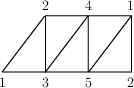
Figure 1: A triangulation of the M\"obius strip, illustrating the combinatorial structure of a tight cycle in dimension n0, which underpins the cocycle complex construction.
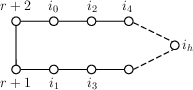
Figure 2: An illustration of the local combinatorial configuration in the proof of Lemma 3, specifically Case 2, depicting neighbor relations and obstruction to wheel formation.
Numerical and Structural Consequences
A standout assertion of the paper is that the extremal spectral value does not grow faster than linearly in n1 for large n2, regardless of n3: n4
This matches the exact bound for book complexes and is unattainable for other non-wheel-free or non-uniform complexes (subject to size constraints). Notably, for n5, this recovers the result that the extremal signless Laplacian spectral radius among n6-free graphs is achieved by the book graph n7.
Further, the characterization of equality cases for finite n8 reveals subtle combinatorial distinctions: for small n9, other types of cocycle complexes can arise, but for sufficiently large r0, only the r1-book is extremal.
Implications and Future Directions
The findings have several significant implications:
- Combinatorial Rigidity: The 1-neighbor uniformity required for spectral extremality demonstrates a form of combinatorial rigidity in higher dimensions, paralleling the uniqueness of Turán graphs in the graph case.
- Topological Expansion: Since spectral gaps and radii in Laplacians relate to expansion properties, these results contribute to understanding the "hardness" of facilitating cycles and wheels in high-dimensional expanders.
- Homological Bounds: The absence of wheels restricts the homology of the complex; spectral extremal results, therefore, interface with Betti number bounds and higher-order random walks.
- Generalization of Turán-Type Extremal Problems: These techniques are likely to be applicable to broader classes of forbidden subcomplexes beyond wheels, including higher genus surfaces and quasirandomness obstructions.
Further lines of research may address:
- The interplay between forbidden (hyper)graph minors and spectral extremal numbers in the complex setting.
- Extension to normalized Laplacian and signless Laplacian spectra.
- The effect of additional topological constraints, such as prescribed Betti numbers, on the spectral extremal value.
- Applications to random complexes and probabilistic topology, especially in the study of phase transitions for homological connectivity.
Conclusion
This work provides a thorough and precise characterization of the maximum signless Laplacian spectral radius in pure r2-dimensional simplicial complexes without r3-dimensional wheels, establishing the r4-dimensional book as the unique extremal configuration for large r5. The results bridge classical spectral extremal graph theory with higher-dimensional combinatorial topology and contribute foundational insights into the structure, expansion, and extremal spectra of high-dimensional complexes.