- The paper introduces MedROI, a framework that extracts regions of interest from brain MRIs using adaptive intensity thresholding, leading to significant compression gains.
- It applies a plug-and-play approach, integrating with any 2D or 3D codec without retraining, thus reducing storage and transfer overhead.
- Experimental evaluations on ADNI datasets show statistically significant improvements in compression ratios and encoding/decoding speeds with minimal ROI reconstruction loss.
MedROI: Codec-Agnostic Region of Interest-Centric Compression for Medical Images
Introduction
The MedROI framework addresses the escalating challenge of efficiently storing and transferring large-scale medical imaging datasets, particularly brain MRI, by introducing a codec-agnostic, region of interest (ROI)-centric compression pipeline. MedROI is explicitly designed to remove non-diagnostic background voxels prior to compression, storing only a compact metadata structure for spatial restoration, and applying any existing 2D or 3D compression codec without requiring network architecture changes or retraining. This paradigm challenges the prevailing methodologies, which either compress full image volumes—including background—or perform differential ROI coding that still retains and encodes background at lower quality.
Methodology
MedROI employs a lightweight, intensity-based thresholding mechanism for precise ROI extraction. For each MRI scan, a mean intensity is computed over non-zero voxels, establishing an adaptive threshold to distinguish tissue from background. Anatomical coverage is ensured through an axis-aligned bounding box, further adaptively padded to minimize tissue miss rates. A fixed-length 54-byte metadata structure is generated, encoding the bounding box, original dimensions, and affine transformation for reversible placement during decompression.
The MedROI compression workflow is as follows: (1) ROI extraction, (2) generation of metadata, (3) cropping to the bounding box and discarding background, (4) 2D axial slice extraction (if the underlying codec is 2D-based), and (5) independent compression using the target codec. Decompression involves inverse placement guided by metadata.
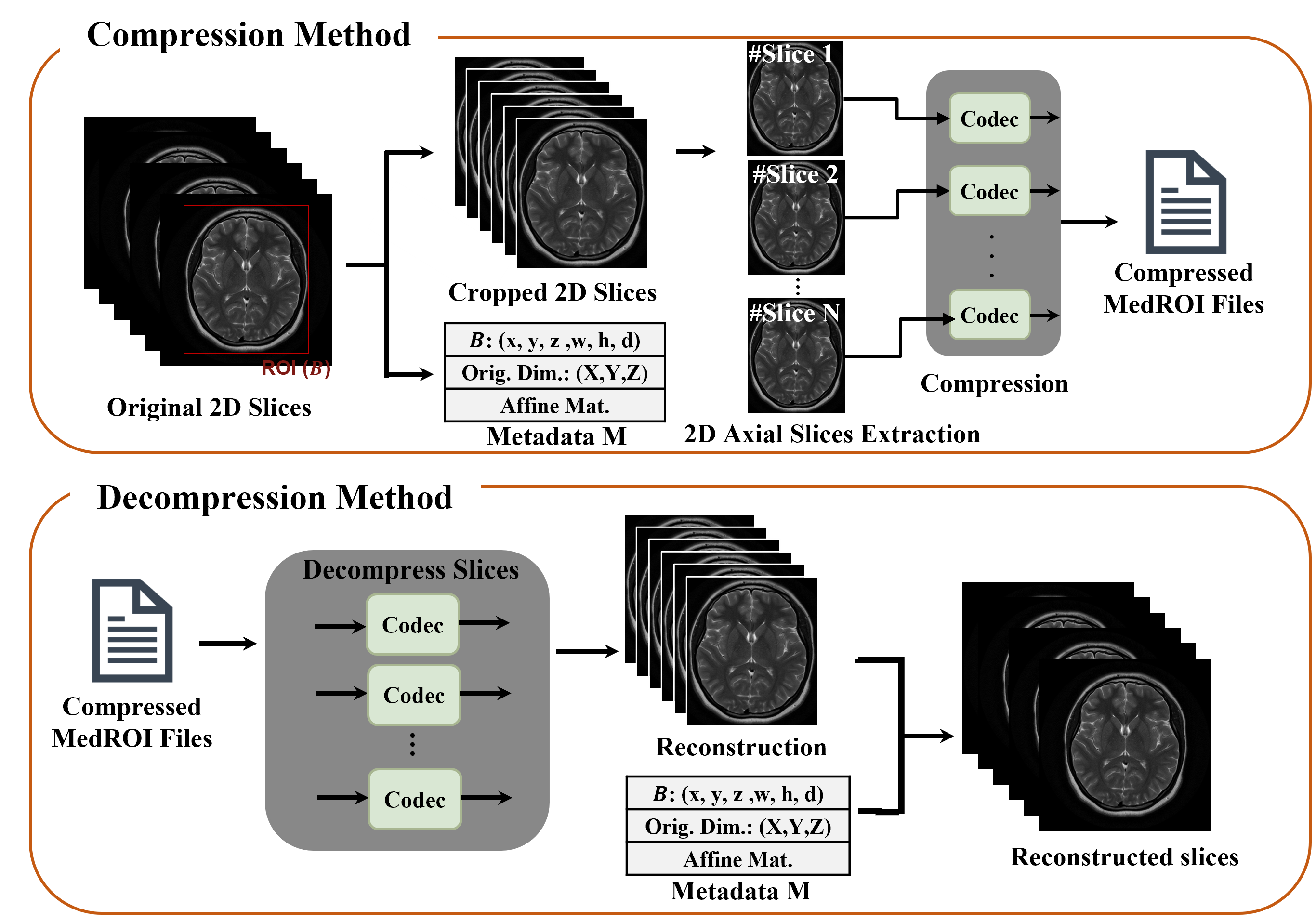
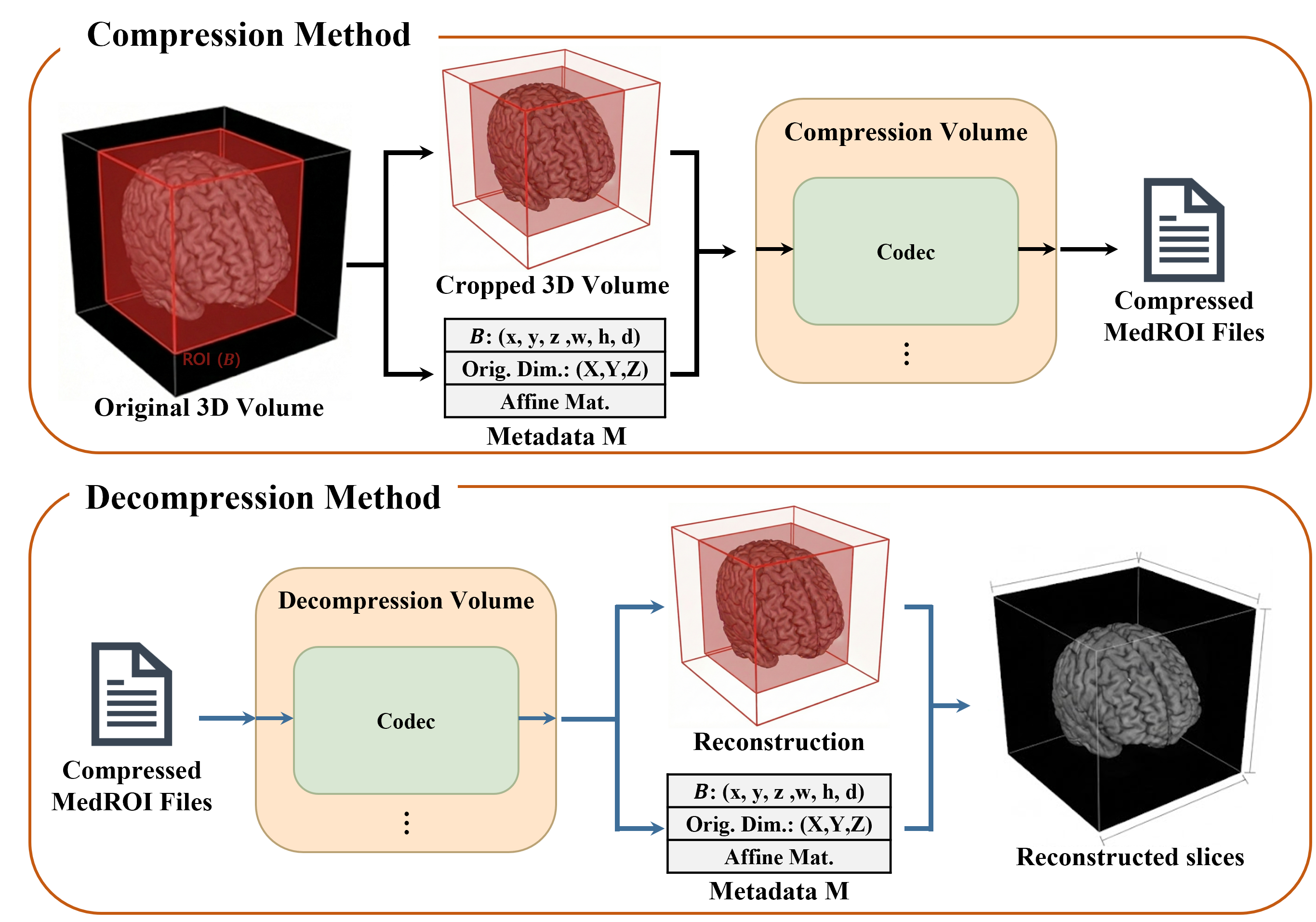
Figure 1: The MedROI pipeline for both 2D slice-wise and 3D volumetric compression, utilizing ROI extraction, minimal metadata, and codec-agnostic integration for volumetric MRI scans.
This approach is notably agnostic to the compression algorithm. The encoding/decoding routine is unmodified for existing codecs, whether conventional (e.g., JPEG2000, HEIF) or neural (e.g., TCM, BCM-Net, SirenMRI).
Experimental Evaluation
The framework is evaluated on 200 ADNI brain MRI volumes, leveraging a diverse set of codecs: JPEG2000 (2D/3D), HEIF, neural 2D codecs (LIC_TCM, TCM+AuxT, BCM-Net), and a 3D neural implicit model (SirenMRI). Metrics include compression ratio (CR), bits per pixel (BPP), PSNR, SSIM, and both compression and decompression times.
Statistically significant improvements (p<0.05 after multiple-comparison correction) are observed for compression ratio and throughput in most configurations, with negligible losses in ROI-specific reconstruction quality—except for marginal or negative changes in HEIF, which is attributed to its inherent optimization for static/uniform scene regions. Notably, the MedROI framework consistently increases CR (e.g., JPEG2000-2D lv3: 20.35 → 27.37; TCM: 79.37 → 81.31), and reduces encoding/decoding times (e.g., TCM: 20.56 s → 17.84 s compression per volume) without additional algorithmic complexity or retraining.
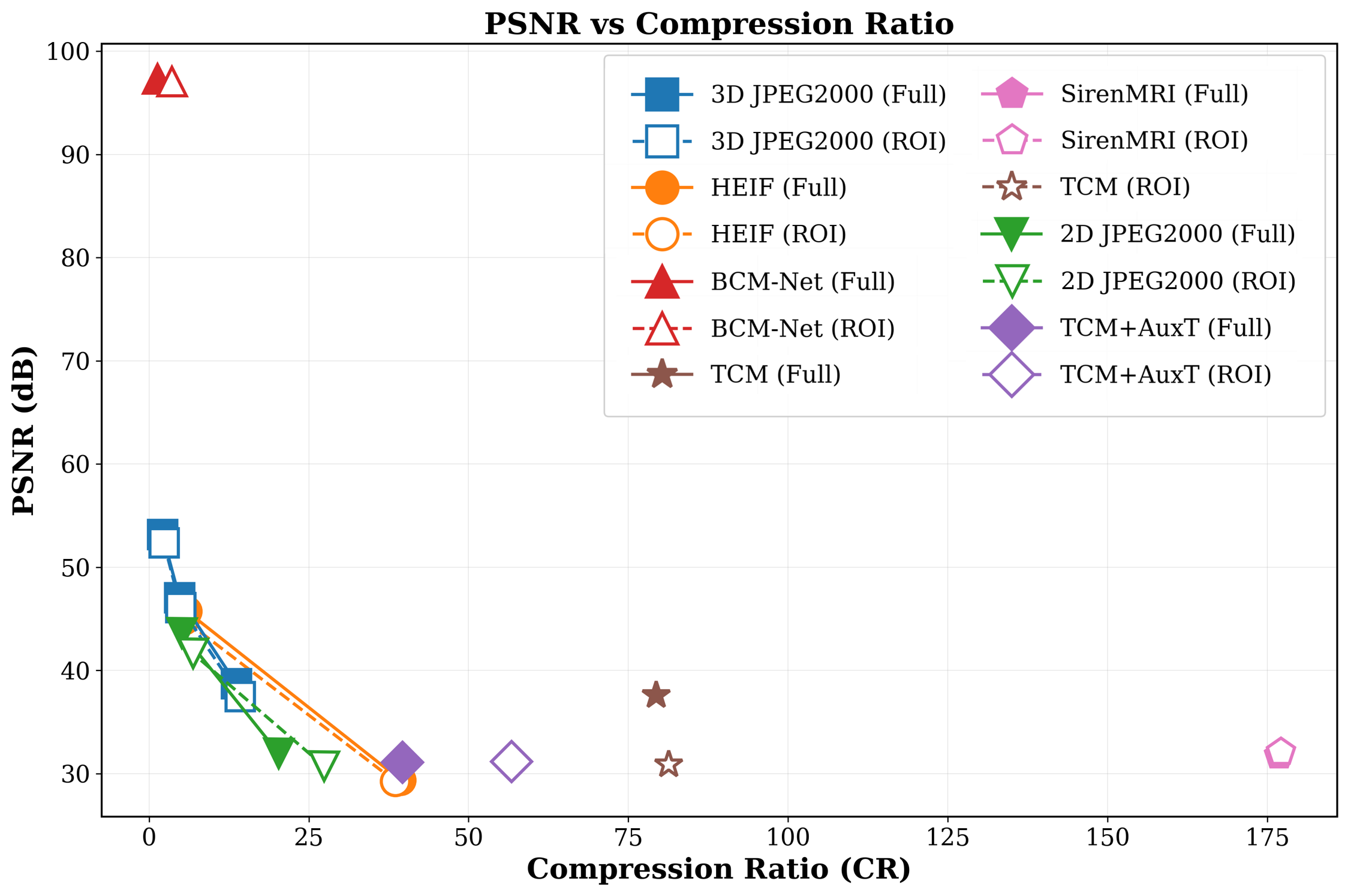
Figure 2: Rate-distortion characteristics (PSNR vs CR) for a variety of codecs on the ADNI dataset, highlighting the efficiency gains achieved through ROI-centric compression relative to full-volume processing.
Visual assessment demonstrates that for both neural and conventional codecs, MedROI reconstructions are perceptually consistent with ground truth and full-volume outputs within the ROI, even as background is zeroed out and removed from the bitstream.
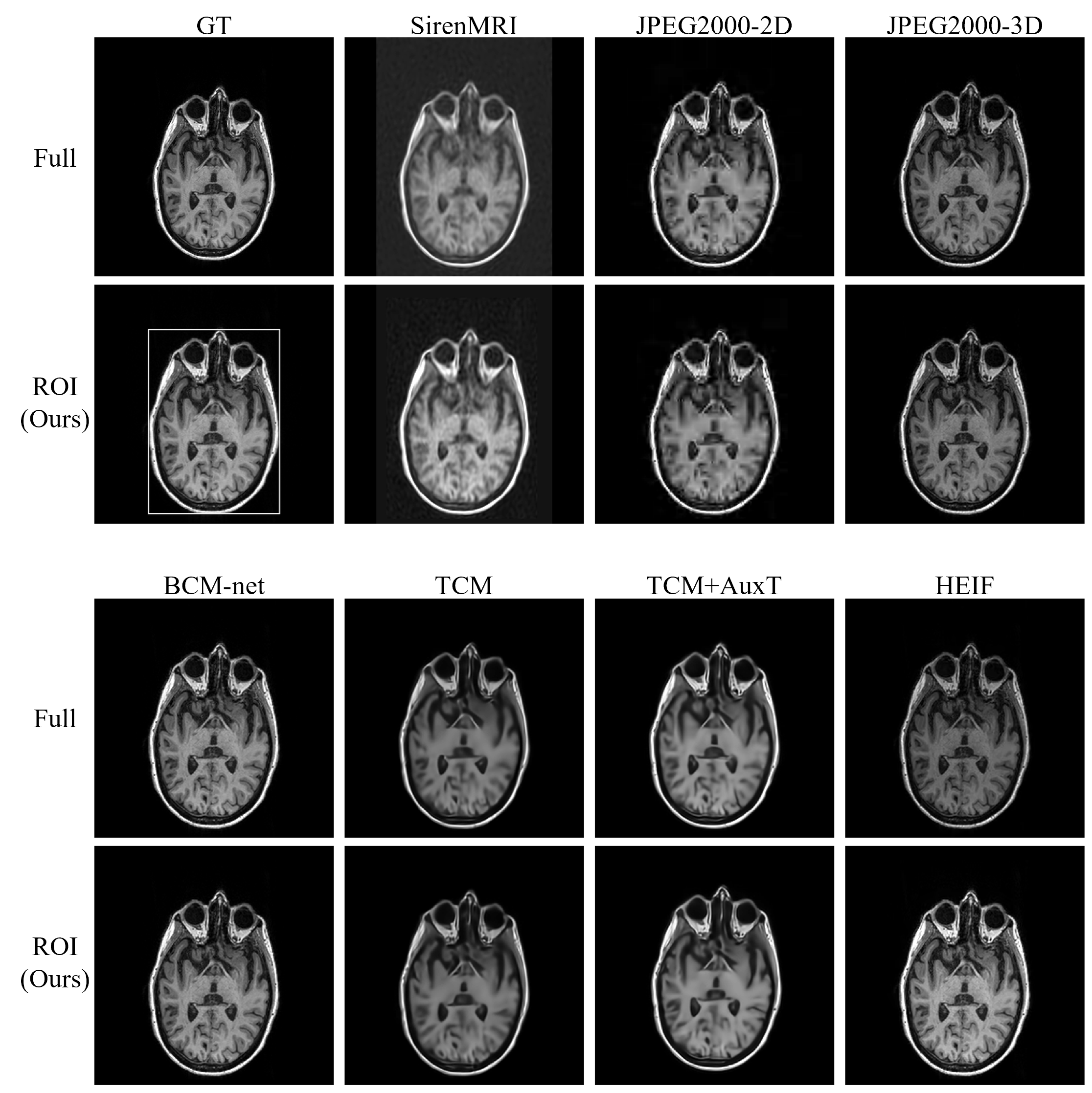
Figure 3: Qualitative reconstructions with and without MedROI across 3D and 2D codecs, where the ROI-based mode maintains high anatomical fidelity and effectively removes background.
Implications and Practical Applications
MedROI's design is fundamentally codec-agnostic and plug-and-play, facilitating rapid integration with both legacy infrastructure and cutting-edge neural codecs. The practical significance is substantial: by eliminating background at the pipeline entrance, storage overhead is reduced without any codec-specific engineering, which directly translates into lower hardware and storage costs for research consortia and clinical archives.
This ROI-centric strategy is compatible with batch-mode and streaming workflows and yields immediate benefits for multi-site studies, research repositories, and any distributed learning scenario constrained by data transfer bandwidth. Pilot tests on other modalities (INbreast mammograms) further indicate robust generalization in both CR improvements and throughput enhancement.
From a theoretical perspective, the framework decouples background redundancy from algorithmic rate-distortion optimization, ensuring that any advances in core codec architectures can automatically leverage the storage and transmission efficiency of MedROI. The approach also complements algorithm-level innovations in learned representation, as neural codecs demonstrate disproportionately strong relative improvements due to their higher sensitivity to input entropy distribution.
Limitations and Areas for Future Work
This work primarily focuses on T1-weighted brain MRI, with limited extension to mammography data. Broad validation on varied organ systems, acquisition protocols, and imaging modalities is necessary to confirm universal applicability. Quality metrics are restricted to PSNR and SSIM within the ROI; more direct clinical relevance would be achieved through reader studies or diagnostic task-based assessments.
MedROI's ROI extraction is based solely on global thresholding. While effective in high-contrast neuroimaging, further research into learned or atlas-guided tissue segmentation for other modalities is warranted. The impact of extreme anatomical variance, pathologies that alter background/tissue boundaries, and volumetric artifacts on thresholding sensitivity also requires investigation.
Conclusion
MedROI establishes a new paradigm for medical image compression, emphasizing complete background voxel removal and codec-agnostic, ROI-only storage with reversible reconstruction, enabled by compact metadata. It delivers statistically significant compression ratio gains and consistent speedup for both encoding and decoding across a wide variety of codecs, with no loss in ROI reconstruction quality except for methods inherently optimized for background redundancy. The plug-and-play nature enables immediate integration and future-proofs archival and data-sharing infrastructure. Prospective research should expand the anatomical/clinical validation space and investigate advanced, anatomy-adaptive ROI detection protocols.