- The paper establishes that every string can be uniquely represented in O(χ(w)) words using a novel SES derived from minimal suffixient sets and super-maximal right extensions.
- It introduces the SES framework that leverages trie encoding of reversed super-maximal right extensions to efficiently capture essential equality constraints.
- The findings imply improved compression and indexing methods by exploiting the tight relationship between suffixient set size, BWT-runs, and LZ77 factorization.
String Representation in Suffixient Set Size Space
Introduction and Context
Repetitiveness measures in stringology are central to the analysis and design of compressed data representations and indexes. Among the numerous measures, the size of the smallest suffixient set χ(w)—the cardinality of the set sufficing to cover all super-maximal right extensions in a string—has emerged as a core parameter due to its computability and applications in indexing and access. Unlike classical measures derived directly from parsing or factorization paradigms, χ(w) originates from combinatorial properties of right extensions, with established relationships to classic parameters such as the number of BWT-runs r(w) and the LZ77 factorization size z(w).
The reachability of a repetitiveness measure—whether any string can be compactly represented within O(f(w)) words if f is the measure for the string w—plays a decisive role in the universality and utility of the measure in compression. For χ(w), it was conjectured that such representations may not be possible, as proving so would resolve major open questions on string attractor reachability.
Substring Equation Systems: Framework and Expressiveness
The paper introduces the substring equation system (SES) as a unifying abstraction for string representations. An SES over w encodes the set of necessary equalities between substrings and individual character assignments to uniquely reconstruct w. Formally, SES are collections of undirected substring equality constraints and explicit character assignments, with the minimal SES size for χ(w)0 denoted χ(w)1.
Crucially, SES strictly generalize bidirectional macro schemes (BMS), which are foundational in the representation of compressible strings but can be shown to admit an SES encoding of the same size, preserving uniqueness due to the acyclicity of dependencies. However, the reverse containment strictly does not necessarily hold.
Suffixient Sets and Super-Maximal Right Extensions
A key combinatorial correspondence underpins the approach: elements of a smallest suffixient set for χ(w)2 are in bijection with super-maximal right extensions of χ(w)3. A set χ(w)4 of positions in χ(w)5 (for a string χ(w)6 of length χ(w)7) is suffixient if every right extension is a suffix of some χ(w)8 for χ(w)9. Minimality is characterized by the bijection with super-maximal right extensions (Figure 1).
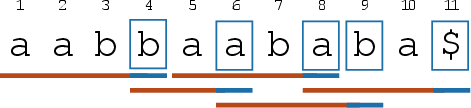
Figure 1: The smallest suffixient set and its corresponding super-maximal right extensions for r(w)0.</p></p><p>Super−maximalrightextensionselegantlycaptureboundariescriticalforcoveringsubstringsinr(w)$1 and permit linear time computation of $r(w)$2, making them effective for compact representation.
Equivalence Relation and Trie-Based Encoding
Central to the construction is the introduction of the position equivalence relation $r(w)$3, defined by overlap in the occurrence of the longest common suffixes within leftmost occurrences of super-maximal right extensions. An immediate consequence, by inductive argument on substring occurrence and localization, is that equivalence classes under $r(w)$4 correspond precisely to the set of distinct characters in $r(w)$5. Accordingly, the number of equivalence classes $r(w)$6 is upper bounded by $r(w)$7.
The encoding of all equivalence constraints is naturally described by the trie (and its compacted form) built from the reversed super-maximal right extensions, with node annotations tracking the positions in $r(w)$8 where corresponding substrings occur. The try of reversed right extensions (Figure 2) not only validates the tight correspondence, but also bounds the space complexity to $r(w)9.<imgsrc="https://emergentmind−storage−cdn−c7atfsgud9cecchk.z01.azurefd.net/paper−images/2604−04377/trie.png"alt="Figure2"title=""class="markdown−image"loading="lazy"></p><p><imgsrc="https://emergentmind−storage−cdn−c7atfsgud9cecchk.z01.azurefd.net/paper−images/2604−04377/compacttrie.png"alt="Figure2"title=""class="markdown−image"loading="lazy"><pclass="figure−caption">Figure2:Trieandcompactedtrieforreversedsuper−maximalrightextensionsforz(w)$0$.
Construction of SES of Size z(w)1
The core result is the explicit construction of an SES of size z(w)2 for any string z(w)3. The process is methodical:
- The trie for reversed super-maximal right extensions is generated.
- A depth-first traversal lists all extensions; consecutive pairs yield substring-equality constraints based on the maximal common suffix associated with their lowest common ancestor.
- The equivalence relations are chained to effect all induced character equivalences, and single-character assignments (one per distinct character) ensure uniqueness and completeness.
This process is illustrated concretely in Figure 3.
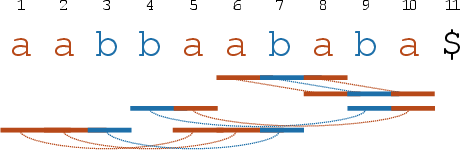
Figure 3: Substring equation system (SES) construction from the reverse compacted trie on z(w)4,showingconcreteequalityandassignmentconstraints.</p></p><p>TheresultingSEShasexactlyz(w)$5 equality constraints and $z(w)$6 assignment constraints, leading to $z(w)$7 total size. Moreover, the string represented by such a system is unique, certifying representation optimality in $z(w)$8-space.
Implications, Open Questions, and Future Work
This result disproves prior conjectures asserting the non-reachability of $z(w)$9 and establishes that $O(f(w))$0 serves as both a lower and upper bound (up to constant factors) for the minimal space required for lossless string representation under this general equality-based framework.
A significant theoretical implication is for the string attractor size $O(f(w))$1 reachability. As $O(f(w))$2 upper bounds $O(f(w))$3, showing that representations of size $O(f(w))$4 are always possible increases the likelihood that similar reachability is attainable for attractor-based space bounds.
Practically, these findings motivate new compression algorithms and indexes parameterized by $O(f(w))$5, distinct from those tied to LZ77 size or BWT-runs, and may yield improved compression for strings where $O(f(w))$6 is substantially smaller than classical measures.
Theoretically, major open problems persist regarding the relationship between SES and BMS minimal sizes, namely whether there exist families of strings with $O(f(w))$7 (SES exponentially outperforming BMS) or with $O(f(w))$8, as such a separation would clarify the structural power of equality-based systems.
Conclusion
The paper "String Representation in Suffixient Set Size Space" (2604.04377) resolves a central question in string combinatorics and compressed representations by demonstrating that every string $O(f(w))$9 can be represented in $f$0 words, via construction of a substring equation system matching the minimal size of the smallest suffixient set. This introduces a new canonical representation framework, generalizes classical schemes, and provides a foundation for both theoretical refinement and practical development of text indexes and compressed data structures. Open questions on SES/BMS separation now form a focal point for further research in the area.