- The paper introduces a dual-space framework coupling robot design with human perception, emphasizing a dynamic, co-evolving process in healthcare settings.
- Methodologically, it uses a 14-week co-design study with semi-structured interviews to trace how stakeholder interactions inform robot design and adoption.
- The findings highlight practical implications such as improved design transparency, gradual user engagement, and the preservation of professional boundaries.
Dual-Space Framework for Considerate Human–Robot Coexistence in Healthcare
Introduction
The integration of advanced robotic systems in healthcare necessitates rethinking traditional conceptions of human–robot coexistence, moving beyond static and safety-focused views to embrace dynamic, organizationally embedded, and socially situated perspectives. The paper "Towards Considerate Human–Robot Coexistence: A Dual-Space Framework of Robot Design and Human Perception in Healthcare" (2604.04374) proposes an explicit dual-space framework, coupling the technical design space of robots with the interpretive perception space of human stakeholders. This paradigm emphasizes that meaningful coexistence is not a static state but a temporally evolving, mutually shaping process involving both robotic capabilities and complex social mediation.
Dynamic Co-Evolution of Human–Robot Coexistence
The framework conceptualizes the relationship between humans and robotic systems as a co-evolving loop. Human needs become design requirements, manifest as deployed robotic systems. These systems, through in situ interaction, recursively influence human interpretation, which is further propagated through social mediation, catalyzing evolving needs and new design requirements.
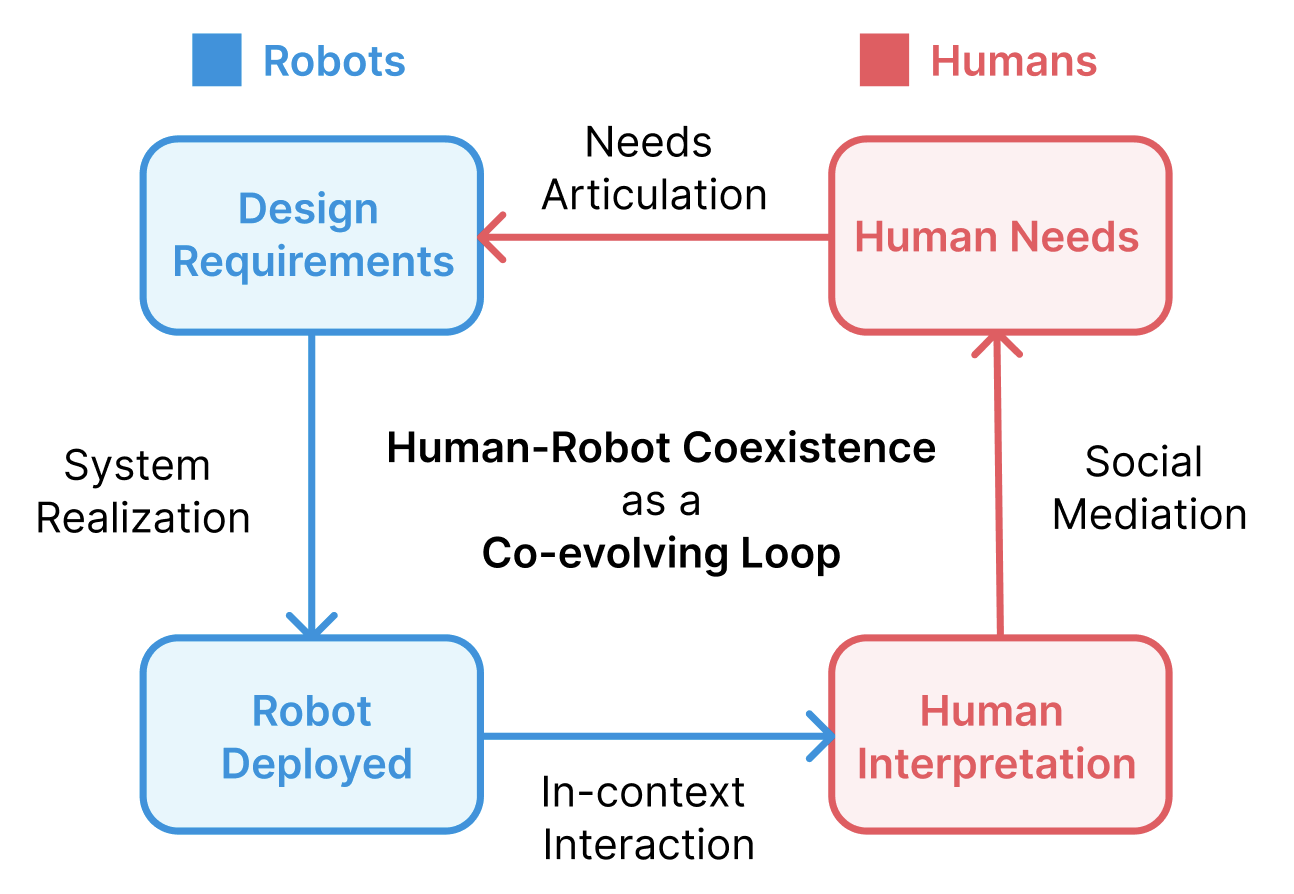
Figure 1: The co-evolving loop models bidirectional influence between human needs, robotic design, situated deployment, and social mediation as the continual formation process of human–robot coexistence.
This dynamic replaces naive, purely spatial or state-based coexistence models with a feedback-rich, situated process. The mutual shaping is central; neither robot design nor user acceptance evolves in isolation.
Components of the Dual-Space Framework
The framework comprises two principle spaces:
- Robot Design Space: Encompasses use scenarios, embodiment, environmental and organizational constraints, and technical feasibility.
- Human Perception Space: Articulated along four interpretive dimensions—degree of decomposition, temporal orientation, scope of reasoning, and source of evidence.
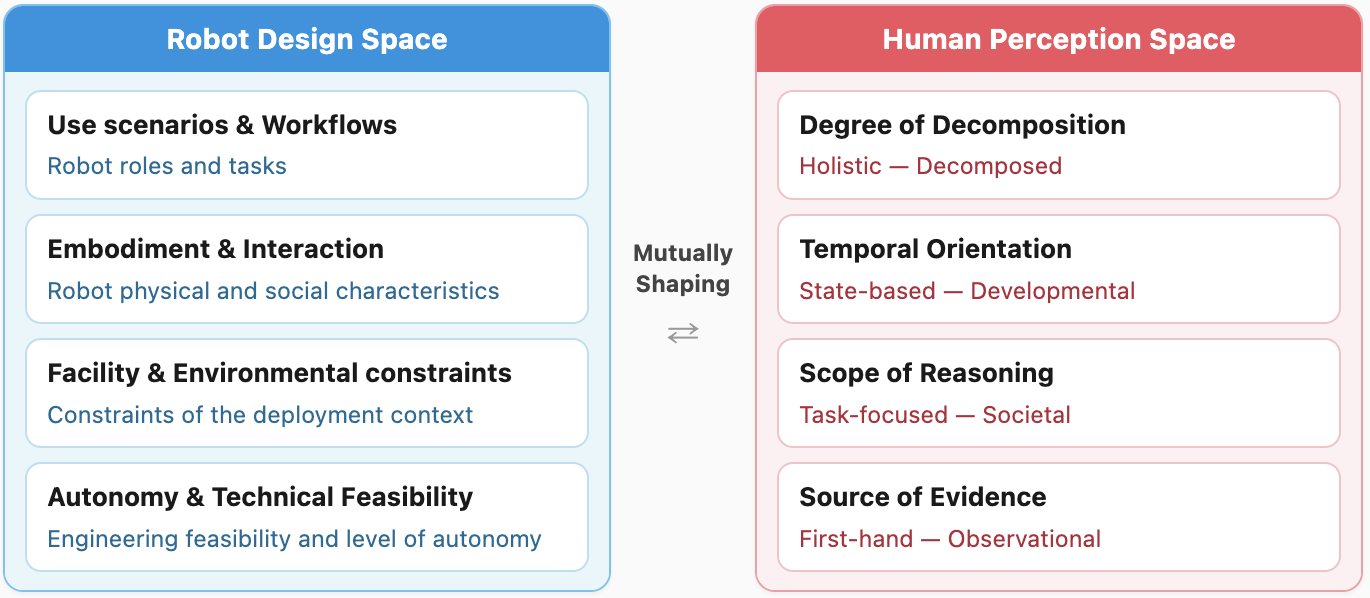
Figure 2: The dual-space framework wherein the robot design space (left) iterates with the human perception space (right), influencing each other longitudinally.
The Four Interpretive Dimensions
- Degree of Decomposition: Concerns whether users analyze a robot as a set of subsystem components (e.g., hardware, software, infrastructure) versus as an undifferentiated entity. High decomposition granularity yields more targeted attributions of responsibility and error analysis, crucial for debugging and safety casework in real-world deployments.
- Temporal Orientation: Captures whether stakeholders evaluate robots' efficacy through a static, state-based lens (current capabilities) or a developmental trajectory, factoring in ongoing technical progress and institutional learning.
- Scope of Reasoning: Reflects whether judgment is made narrowly (task-specific efficacy) or broadly (societal, institutional, and ethical implications including professional displacement and workflow transformation).
- Source of Evidence: Ranges from firsthand direct interaction to socially mediated observation and reputation, informing the credibility and generalizability of interpretive stances.
This multidimensional space governs attitudes, acceptance, and the ultimate boundary of robots’ integration, offering a granular taxonomy for explaining the observed heterogeneity in stakeholder reactions over time.
Empirical Study and Key Findings
The authors operationalized the dual-space framework via in-depth semi-structured interviews with nine participants following a longitudinal 14-week healthcare robot co-design study. This enabled fine-grained tracing of attitudinal shifts and interpretive strategies.
Numerically, the majority of participants (5/9) reported increased perceived promise after design engagement, three remained stable, and one demonstrated a calibrated decrease (moving from idealized expectations to more pragmatic assessment). Key mechanisms driving increased promise included contextual validation of needs and demystification of technical feasibility via exposure to real use cases and ongoing development. Stability was anchored in prior technical experience or robust analogical reasoning, while the decrease reflected realistic recalibration vis-à-vis deployment constraints.
Theoretical and Practical Implications
The dual-space model yields four actionable implications for considerate coexistence:
- Legibility of Design Rationale: Transparency in design intent and capability boundaries is essential pre-deployment.
- Reducing Unfamiliarity: Test runs, educational interventions, and environmentally adaptive design choices are required for minimizing misinterpretation during early deployment.
- Gradual Engagement: Accommodation of individual readiness and optional interaction mitigates resistance and supports diverse workflows.
- Boundary Respect and Functionality: Robots must augment, not supplant, professional care, prioritizing substantive contributions and maintaining clear accountability demarcations.
This moves the field from a technology-push acceptance model to a stakeholder-centric integration paradigm with explicit mediation mechanisms and continuous feedback.
Limitations and Future Directions
Sample size limitations inherent to the longitudinal co-design methodology constrain generalizability, but the articulation of interpretive dimensions and the dual-space model establish a robust foundation for subsequent work. Future research should expand to larger and more diverse cohorts, investigate interpretive evolution beyond the initial co-design window, and formalize metrics derived from the perception dimensions for predictive modeling of adoption and adaptation trajectories.
Conclusion
This paper offers a comprehensive, theoretically grounded, and empirically driven framework for understanding and engineering considerate human–robot coexistence in complex domains such as healthcare. By formalizing the dual-space interplay between robotic systems and human interpretation—and empirically validating the role of interpretive dynamics—the work sets new criteria for robotics deployment evaluation. The findings position coexistence not as a deployment outcome but as a continual, co-produced process, demanding new research into adaptive mediation, transparency protocols, and evolving institutional roles for both robots and human agents.

