- The paper demonstrates that atomic data set choices can produce order-unity shifts in kilonova light curves and spectra, notably after peak luminosity.
- It employs a controlled radiative transfer framework to compare the LANL, HULLAC, and Autostructure codes, including NIST calibration effects.
- The study highlights the critical role of neutral Nd I line completeness in driving late-time IR emission and spectral features.
Comparative Analysis of Neodymium Atomic Data Sets in Kilonova Modeling
Introduction
This study delivers a comprehensive assessment of the impact of different theoretical neodymium (Nd) atomic data sets on the predicted observables—light curves and spectra—of kilonovae (KNe), using controlled radiative transfer simulations. Nd, as a representative lanthanide, is known to play a pivotal role in shaping the electromagnetic signatures of r-process ejecta due to its high opacity, especially in the near-infrared and mid-infrared. The methodology centers on the use of three widely-employed atomic physics codes: the LANL suite (with and without NIST calibration), HULLAC, and Autostructure, all tested within an identical radiative transfer framework (SuperNu) and fixed ejecta model.
The analysis elucidates the consequences of atomic structure modeling choices, configuration lists, and energy calibrations on the computed ejecta temperature, ionization, light curves, and time-dependent spectra. Of particular note are pronounced deviations in late-time observables, which are traced to differences in the treatment of neutral Nd I and, to a lesser extent, the accuracy of low-lying energy levels across these codes.
Atomic Physics Data Set Construction and Calibration
The LANL, HULLAC, and Autostructure data sets each target the first four Nd ionization stages, employing various theoretical implementations rooted in configuration-interaction (CI) models. LANL employs a semi-relativistic Hartree-Fock approach, HULLAC uses a parametric potential within the Dirac formalism, and Autostructure utilizes a Breit-Pauli method optimized for efficiency in open f-shell systems. These approaches result in significant diversity in effective potentials, angular-momentum coupling schemes, and ultimately, the resulting level and line lists.
The LANL data set is considered in both "raw" (ab initio) and NIST-calibrated variants. Calibration involves direct replacement of computed low-lying level energies with values from the NIST Atomic Spectra Database. The process faces nontrivial challenges due to configuration mixing, incomplete experimental data, and the necessity of mapping calculated and observed multiplets with ambiguous dominant labels. The study includes a targeted test of configuration completeness, adding the 4f35d26s configuration for Nd I based on its demonstrated population influence.
Thermodynamic and Ionization Diagnostics
The sensitivity of simulated matter temperatures to atomic data emerges at late times, specifically associated with the recombination front of Nd II to Nd I as the ejecta expands and cools.
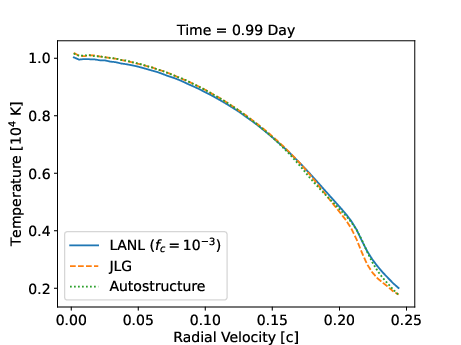
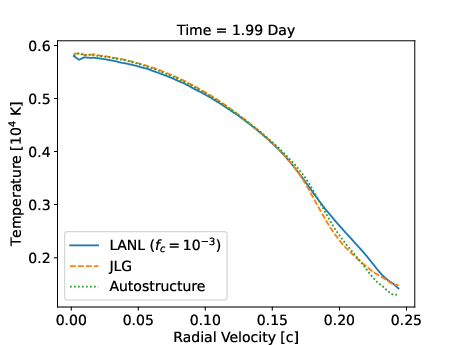
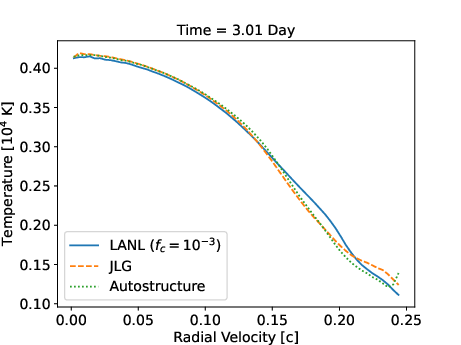
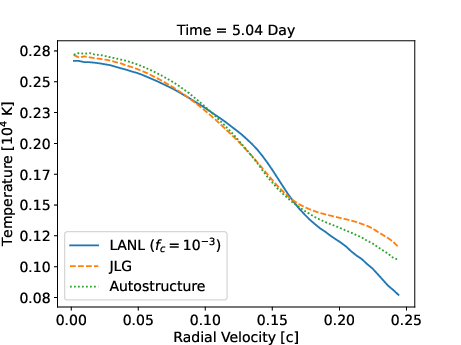
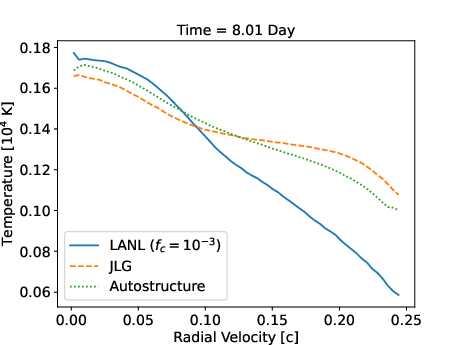
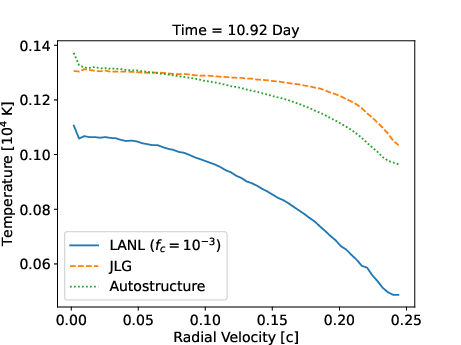
Figure 1: Ejecta temperature profiles as a function of velocity and time, demonstrating band divergence driven by the neutral Nd I population at late epochs.
All three data sets yield consistent ionization fraction histories through peak luminosity, but systematic divergence commences post-day 5, mapping onto the shell where Nd II recombines to Nd I. This phase boundary—whose location and sharpness are modulated by line list completeness and low-energy level accuracy—determines the locus and efficiency of IR photon reprocessing.
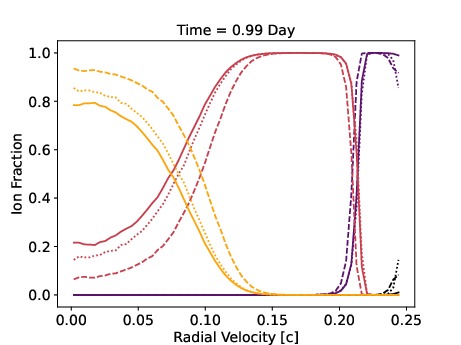
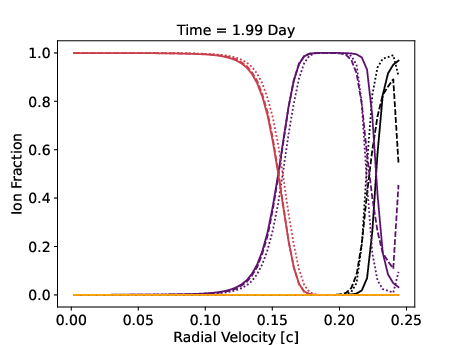
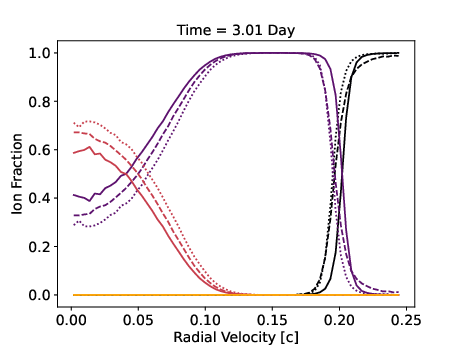
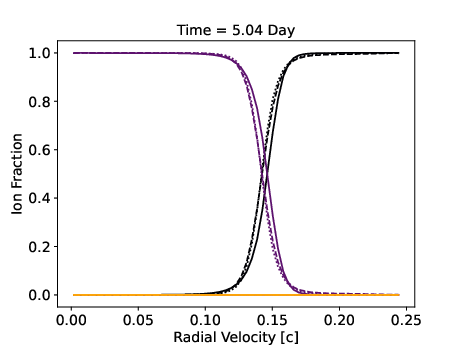
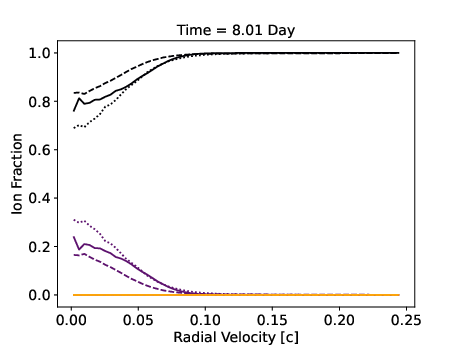
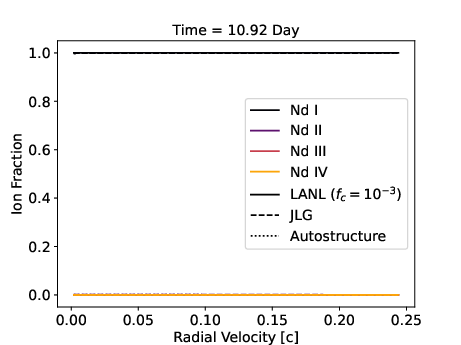
Figure 2: Evolution in fractional populations of Nd ionization states, emphasizing the synchronized recombination wave and the late-time dominance of Nd I under LTE.
Non-LTE effects, not considered in these LTE Saha/Boltzmann population treatments, may significantly alter detailed occupation distributions, especially for neutral and singly-ionized species in nebular regimes.
Impacts on Light Curves and Photometric Bands
Peak bolometric luminosities are set primarily by opacities from early-time dominant ion stages and differ by up to a factor of 1.5 across data sets. The LANL raw data predict systematically steeper declines in both bolometric and optical/near-IR magnitudes compared to HULLAC and Autostructure. The agreement in the K-band up to 8 days is notable, but the r- and z-band post-peak tails are highly diagnostic of atomic data set choices.
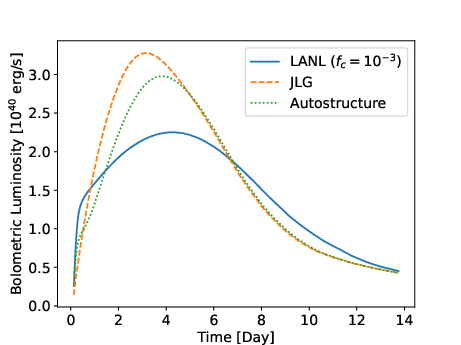
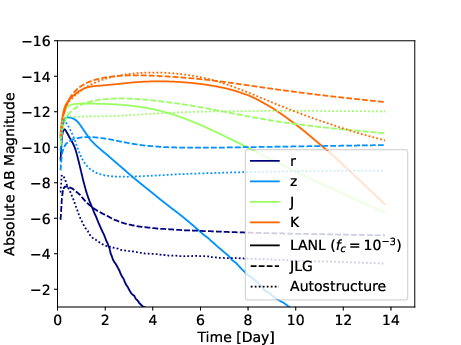
Figure 3: Light curves and broad-band magnitudes versus time, highlighting consistent bolometric outputs but divergent optical and IR evolution tied to atomic set selection.
Spectral Evolution and Neutral Nd Features
The most substantial differences emerge in detailed spectral predictions beyond day 5. Early spectra are similar across all codes, but strong mid-IR line forests originating from Nd I appear only in the LANL data set, with HULLAC and Autostructure yielding smoother and less structured IR spectra.
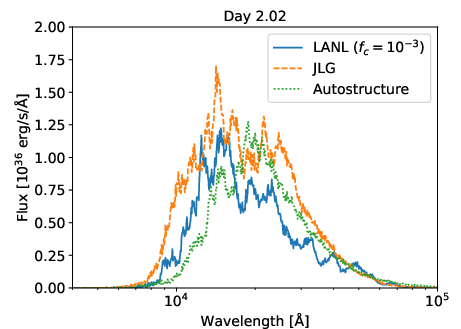
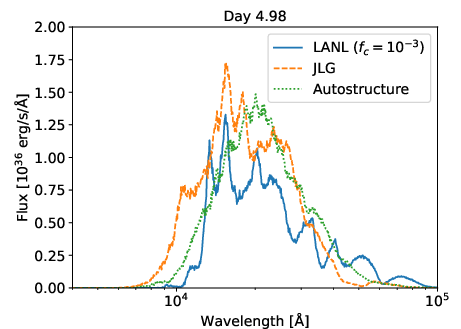
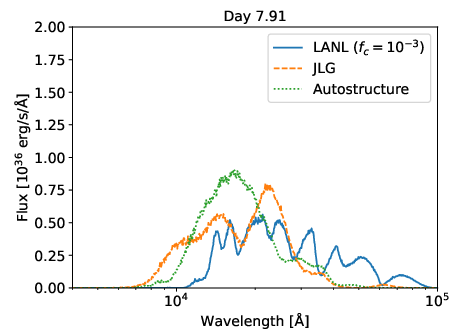
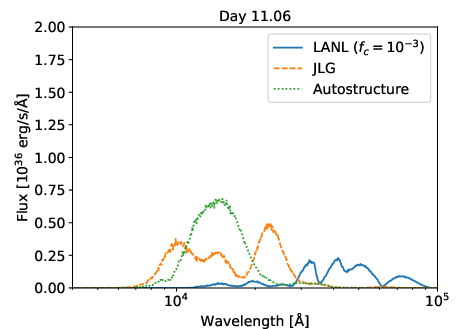
Figure 4: Time-dependent spectra highlighting robust late-time mid-IR structure in the LANL data, attributable to neutral Nd I lines, while other codes present less pronounced features.
Removing neutral Nd I levels and transitions from the LANL simulation substantially reduces mid-IR features and shifts the spectrum toward the other two data sets, confirming the centrality of Nd I completeness in driving late-time emission.
Role of NIST Calibration and Configuration Choice
Calibration of LANL levels to NIST reference data predominantly affects the low-energy neutral and singly ionized transitions. This calibration suppresses both early-time flux (due to slightly decreased oscillator strengths from energy readjustments) and modifies late-time mid-IR structure by refining line positions and strengths. Inclusion of the 4f35d26s configuration in the neutral Nd I model further shifts and splits IR features, directly impacting synthetic observables.
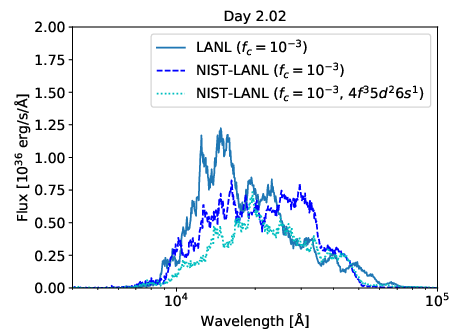
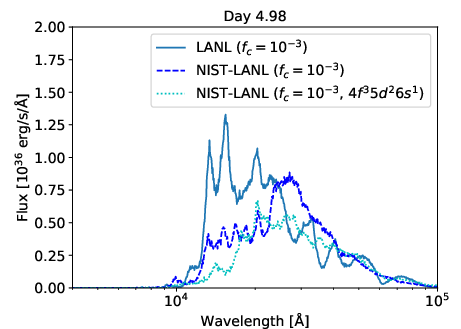
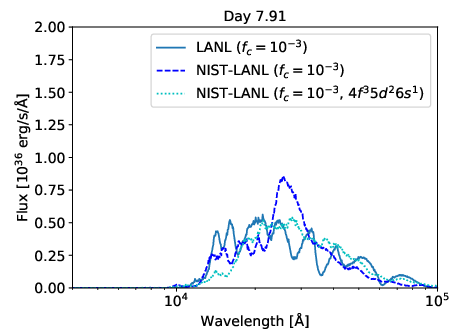
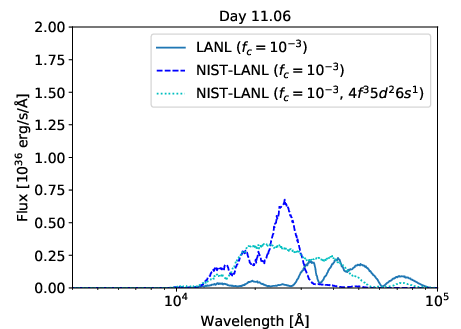
Figure 5: The addition of the 4f35d26s1 configuration to the calibrated Nd I model yields significant alterations in the emergent spectrum throughout 2–11 days, signifying configuration completeness as a major source of spectral uncertainty.
Theoretical and Practical Implications
This work makes explicit the sensitivity of kilonova observables to the choice of atomic structure calculations for even a single lanthanide species. Differences traced to line completeness in neutral Nd I, energy level calibration, and configuration space definition can produce order-unity shifts in predicted IR flux and light curve slopes past peak. This has direct implications for the modeling and interpretation of events such as AT2017gfo, especially in the context of attempts to infer composition, ejecta mass, or velocity distributions.
The significant effect of oscillator-strength calibration and configuration addition reinforces the need not only for comprehensive atomic structure calculations but also for systematic benchmarking against experimental energies where available. Furthermore, for late-time spectra or nebular-phase diagnostics, the dominant uncertainty may well be the fidelity of the neutral and low-ionization-state line lists rather than radiative transfer or ejecta macro-physics. Accurate neutral/low-ionization atomic data are essential for connecting theoretical models to JWST and future IR spectroscopic datasets.
Future directions include development and public dissemination of composite, NIST-calibrated atomic databases for all relevant r-process species, extensions beyond LTE, and formal quantification of composition-morphology degeneracies in the context of multi-dimensional, multi-component ejecta.
Conclusion
This study provides a rigorous, code-controlled comparison of Nd atomic data sets for kilonova modeling, demonstrating that atomic structure uncertainties—especially those associated with neutral stage completeness and energy calibration—can dominate light curve and spectral predictions at late times. These findings underscore the critical role of atomic data integrity in the emerging era of precision kilonova spectroscopy and multi-messenger astrophysics, and motivate continued investment in both theoretical and experimental atomic physics for heavy element species.
(2604.04362)