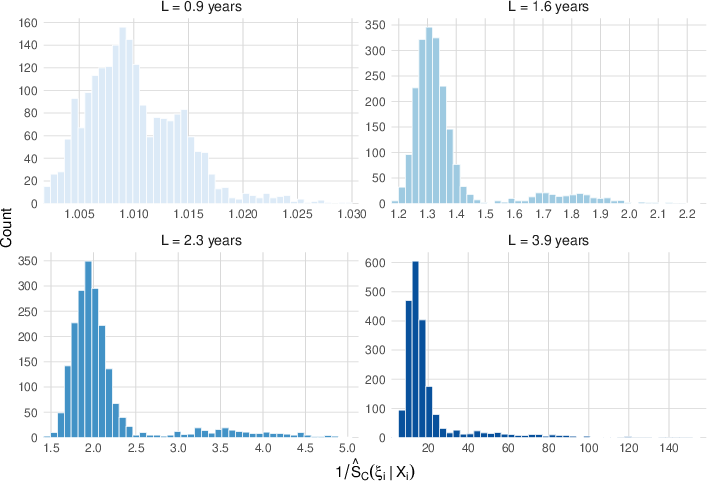
- The paper introduces a generalized win fraction regression model that integrates composite survival endpoints within a flexible GLM framework.
- It employs inverse probability of censoring weighting (IPCW) in unbiased estimating equations to address right censoring and yield reliable inference.
- Simulation studies and HF-ACTION trial applications demonstrate its effectiveness in capturing time-varying covariate effects and improving estimation accuracy.
Generalized Win Fraction Regression for Composite Survival Endpoints
Introduction and Motivation
The paper "Generalized win fraction regression for composite survival endpoints" (2604.04360) presents a formal regression framework that extends win-based inference to prioritized composite survival outcomes, a paradigm increasingly utilized in clinical trial analysis due to its capacity to hierarchically integrate multiple clinically meaningful time-to-event endpoints. Traditional approaches, notably the win ratio (WR), win odds (WO), and win difference (WD), rely on frequentist pairwise comparison constructs. However, right censoring (both administrative and event-dependent) complicates both estimation and inference, introducing bias and inducing a critical dependence on the censoring distribution itself.
Recent advances address the two-sample inference problem using inverse probability of censoring weighting (IPCW), plug-in estimators, and semiparametric regression extensions (such as the proportional win fractions model (PWFM) and generalized win odds models (GWOM)). However, these approaches are typically restricted to specific link functions or time-constant effect assumptions and do not provide the flexibility required for direct estimation of covariate effects on the win fraction under general censoring patterns.
The core contribution is a generalized win fraction regression model (GWFM) for prioritized composite survival outcomes. The method enables regression modeling of the conditional win fraction when comparing subjects i and j—that is, the probability that subject i “wins” over j according to a hierarchical, composite endpoint structure—via any generalized linear model (GLM) link:
E{W(Yi,Yj)(L)∣Xi,Xj}=P{Yi(L)≻Yj(L)∣Xi,Xj}=g−1(βL⊤Zij)
Yi is a vector of prioritized (hierarchically ordered) event times, L is a restriction (truncation) time, and Zij encodes covariate contrast (typically Xi−Xj). This construction separates the regression parameterization from specific summary statistics (WR/WO/WD), allowing inference on the natural win fraction, log odds, or any transformation thereof, depending on the chosen link g.
A critical innovation is the handling of right censoring using IPCW within unbiased estimating equations. The authors propose a weighting structure using the covariate-specific survival function under a Cox model for censoring, which fully accounts for event/censoring patterns in comparison pairs resolved at any hierarchical endpoint. The result is large-sample unbiasedness for the true no-censoring estimand (see Section 2.3 and Appendix B of the paper).
Theoretical Properties
The estimating function incorporates the pseudo-observation framework, recognizing the sparse dependence structure of pairwise comparison statistics. The authors leverage the sparse correlation asymptotic theory (cf. Lumley, 2003), demonstrating that the effective sample size for inference is determined by the maximal independent set of resolved pairs rather than the full j0 pairs.
They derive asymptotic normality for the estimator and establish a robust sandwich variance estimator that accommodates both the pseudo-observational dependence structure and the additional uncertainty arising from the estimation of censoring weights. This variance formula is shown to be consistent and can be used for hypothesis testing and CI construction. Notably, when the censoring weights are omitted (i.e., in the absence of censoring or under the proportional win-fractions assumption), the proposed framework recovers the semiparametric PWFM as a special case.
Comparative Analysis of Modeling Frameworks
The authors systematically compare the proposed GWFM to established regression paradigms:
- PWFM restricts to a log-link (WR), implicitly excludes ties and assumes a proportionality structure invariant to restriction time j1.
- GWOM leverages win odds and logit links but combines ties as half-wins/losses without explicit restriction-time modeling.
- GWFM allows arbitrary links, models a restriction-time-specific win function, and treats ties as failures to win (in the logit link case), offering a more conservative estimand.
A summary table in the paper formally outlines the structural assumptions, regression targets, covariate contrasts, and interpretation of each model.
Simulation Results
Extensive simulation studies demonstrate the statistical properties and finite-sample robustness of the proposed estimator over a range of link functions and censoring rates.
- Logit and Probit Links: The IPCW-adjusted estimator is nearly unbiased except at very high censoring rates, with the unweighted estimator suffering from substantial bias and undercoverage as censoring increases. The sandwich variance estimator accurately reflects empirical sampling variability.
- Identity Link: The method enables direct estimation (and interpretation) of the incremental win fraction associated with covariates—valuable in two-arm randomized settings. Unweighted estimation is shown to be unreliable under even moderate censoring.
- Weight Construction: Empirical studies confirm that the specific IPCW weight proposed yields unbiased estimation, while alternate weights—such as those advocated for WO regression—introduce substantial bias, especially in identity and probit link settings.
- Restriction Time (j2) Sensitivity: The regression estimand j3 is demonstrated to meaningfully depend on restriction time in the general case; thus, scientific interpretations must be inherently time-specific for arbitrary data-generating mechanisms.
Application: HF-ACTION Clinical Trial
The utility of GWFM is illustrated via a re-analysis of the HF-ACTION trial, where the prioritized endpoint is death followed by hospitalization. The model, stratified by treatment and additional clinical covariates, is evaluated across a spectrum of restriction times.
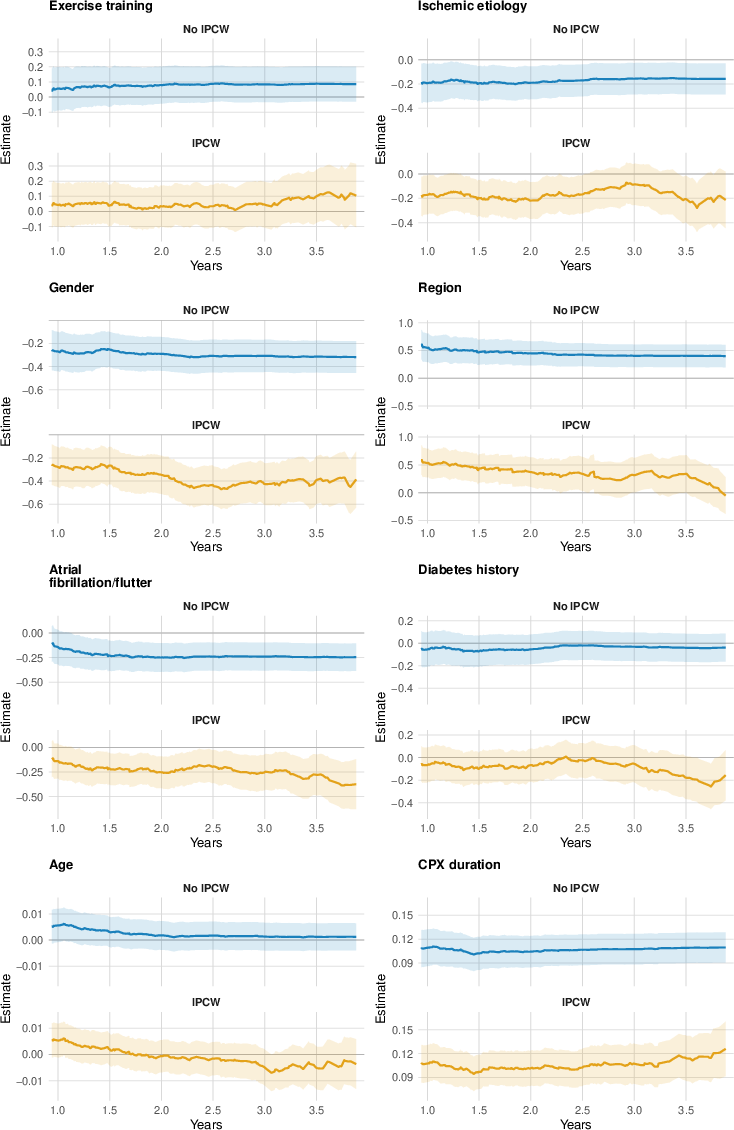
Figure 1: Trajectories of the regression coefficient estimates, j4, from the win-fraction regression model with logit link with and without IPCW across restricted times j5.
Findings include:
The model illustrates its generality by allowing for identity and probit links, with the latter yielding estimates that can be monotonically transformed to the logit scale, facilitating interpretability and comparison.
Discussion and Future Directions
The GWFM approach resolves several critical limitations in the regression analysis of composite survival endpoints by:
- Enabling link-agnostic modeling of the conditional win fraction.
- Providing valid inference under right censoring for hierarchical, tie-prone composite endpoints.
- Accommodating arbitrary covariate structures and restriction times with a mathematically principled variance estimator.
The framework’s flexibility opens new avenues for methodological development, such as:
- Development of time-varying coefficient models for restriction time trajectories.
- Construction of model diagnostics (e.g., censoring-weighted residual process tests).
- Exploration of computational strategies for large-scale i0 pairwise estimation (e.g., split-and-combine approaches).
Conclusion
This paper delivers a rigorously justified, versatile, and computationally tractable regression framework for prioritized composite endpoints in censored survival contexts. It subsumes and extends both WR and WO modeling in a general GLM-based structure, resolves bias and inference issues under dependent censoring, and provides robust methodology grounded in modern asymptotics. The practical implications are immediate for analysts of randomized clinical trials and other comparative effectiveness studies relying on prioritized survival outcomes, establishing GWFM as a new statistical tool for their analysis.
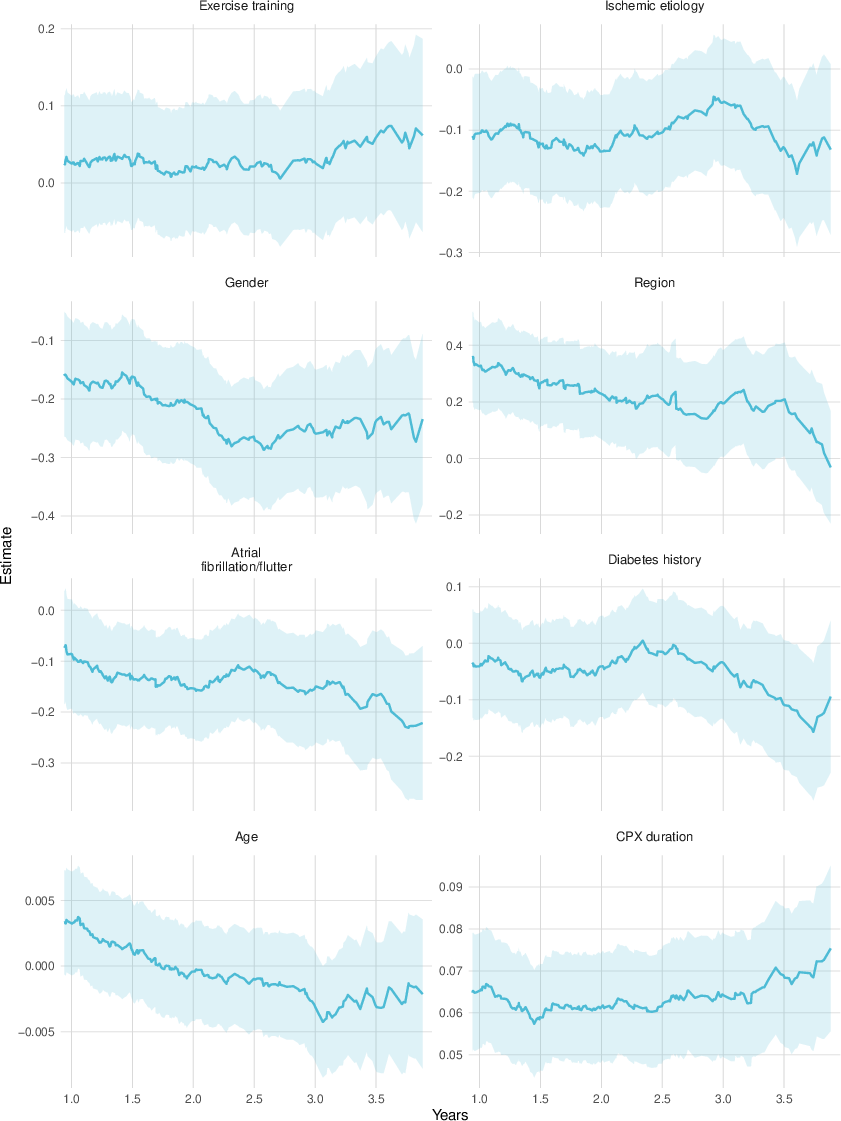
Figure 3: Trajectories of the regression coefficient estimates, i1, from the win-fraction regression model with probit link across restricted times i2.
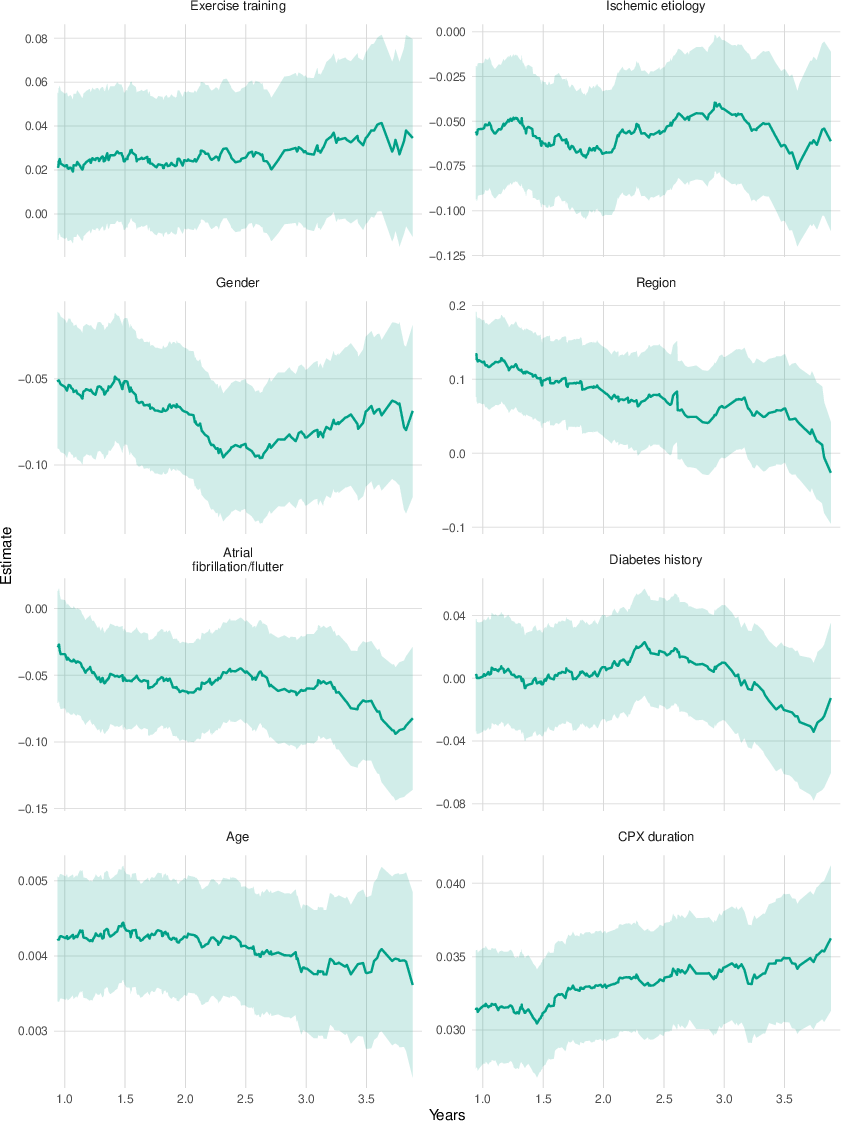
Figure 4: Trajectories of the regression coefficient estimates, i3, from the win-fraction regression model with identity link across restricted times i4.