Stingray Patterns of Dominant Weights
Abstract: We study the set Wr,e,w of dominant weights of sl<em>r arising from partitions of fixed e-weight w. For e-cores, we show that W</em>r,e,0 decomposes as a disjoint union of simplices indexed by compositions of r. For general w, we prove that Wr,e,w is a disjoint union of copies of these simplices, with multiplicities determined by the corresponding quotient data, yielding in particular a closed counting formula for ∣Wr,e,w ∣ . The geometry gives rise to the stingray patterns appearing in the title. More generally, it yields a natural labeling of the dominant e-alcoves meeting Wr,e,w by weak compositions of w, together with a compatible partial action of the affine Weyl group via wall crossing. Finally, we give an explicit alcove-geometric proof of the empty runner removal theorem for Iwahori-Hecke algebras.
- Conjugacy Classes of Renner Monoids (2012)
- Minkowski difference weight formulas (2024)
- Multiplicities of maximal weights of the $\hat{s\ell}(n) $-module $V(kΛ_0)$ (2022)
- Piecewise dominant sequences and the cocenter of the cyclotomic quiver Hecke algebras (2022)
- Multiplicities of some maximal dominant weights of the $\widehat{s\ell}(n)$-modules $V(kΛ_0)$ (2020)
- On singularity properties of word maps and applications to probabilistic Waring type problems (2019)
- A Lower Bound of the Number of Threshold Functions in Terms of Combinatorial Flags on the Boolean Cube (2018)
- Smoothing of weights in the Bernstein approximation problem (2016)
- On multiplicities of maximal weights of $\hat{sl}(n)$-modules (2013)
- Weights of simple highest weight modules over a complex semisimple Lie algebra (2013)
Summary
- The paper establishes a geometric framework that embeds partitions into dominant weight lattices, revealing stingray and hexagonal patterns via alcove decompositions.
- It utilizes abacus combinatorics to classify blocks by e-core and e-weight, providing explicit simplicial decompositions and counting formulas.
- The study delivers a geometric proof of the empty runner removal theorem, offering fresh insights for modular representation theory and categorification.
Stingray Patterns and the Geometry of Dominant Weights for Affine Type A
Introduction
This work, "Stingray Patterns of Dominant Weights" (2604.04326), presents a comprehensive geometric and combinatorial study of the distribution of dominant weights associated with partitions of prescribed e-weight and at most r parts, with a primary focus on affine type A (i.e., the representation theory of symmetric and Iwahori–Hecke algebras). The analysis is grounded in the classification of blocks via e-core and e-weight, exploiting the interplay between weight lattices, abacus combinatorics, and the alcove geometry of the affine Weyl group. The author systematically characterizes the resulting patterns—termed "stingray patterns"—and situates them in the context of Kazhdan–Lusztig theory, culminating in a geometric proof of the empty runner removal theorem. This essay details the main results, methods, and implications of the work, with particular attention paid to the explicit geometric and combinatorial structures arising in this context.
Weight Lattice Embedding and Alcove Geometry
The paper's central construction is the embedding of the set of partitions with at most r parts and fixed e-weight w into the dominant weight lattice P+ of slr, via the map
r0
where r1 are the fundamental weights and r2 are the parts of the partition extended by zeros as needed.
This geometric representation enables the translation of block-theoretic invariants—core, quotient, and r3-weight—into the language of alcove arrangements for the affine Weyl group acting on the real vector space r4.
The main combinatorial tool is the abacus model for partitions, whereby beads (beta-numbers) are placed on runners corresponding to residues mod r5. The configuration records the r6-core and r7-quotient data, which is then reflected in the geometry of the dominant weights.
Simplicial Decomposition and Counting
One of the principal results is the explicit simplicial decomposition of the set r8 of dominant weights. For r9-core partitions (A0), A1 is shown to be a disjoint union of simplices indexed by compositions A2 of A3: A4 where each A5 is the set of weights arising from configurations where the beads are placed on a set of runners specified by A6. Each such component forms the lattice points of a simplex whose dimension is one less than the length of A7 and whose dilation is A8.
For general A9, e0 is shown to be a union of multiple copies of these simplices, with multiplicities determined by the corresponding number of multipartitions of e1 of constrained lengths. Explicitly, the cardinalities are given by: e2 where e3 counts multipartitions of e4 of type e5 and e6 is the number of placements of runners. The combinatorics is managed via the abacus model and stars-and-bars arguments.
An immediate consequence is a closed formula for the number of core weights, which recovers known block counting results in Hecke algebra theory.
Visualization: Stingray and Hexagonal Patterns
A remarkable output of the geometric embedding is the emergence of stingray-like and hexagonal patterns in the set of dominant weights, particularly visible for low ranks. In type e7 (e8), as e9 increases, e0 grows in a manner that the new weights form elongated "tails" protruding from the body of the weight set (the "stingray" metaphor). In the interior, the pattern organizes into hexagonal configurations, reflecting the underlying Weyl group symmetries.
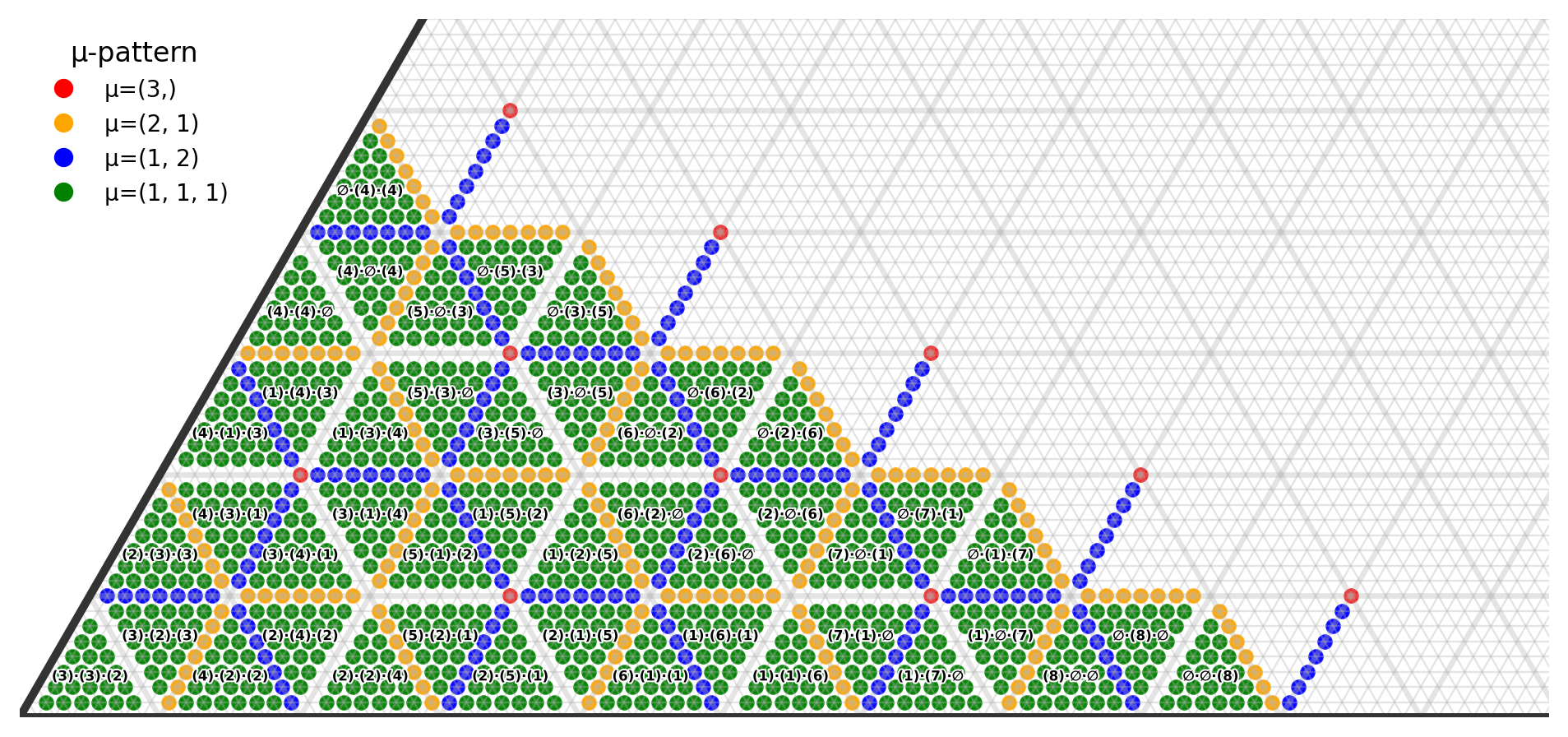
Figure 1: Example of a e1 stingray pattern in the dominant chamber of e2 showing colored simplices arising from the simplicial decomposition; the green simplices fill the interiors of e3-alcoves.
These patterns are rigorously described via the cell decomposition of the dominant chamber into alcoves, with stingray tails corresponding to affine vertices and the combinatorial structure of multipartitions controlling the interior cells.
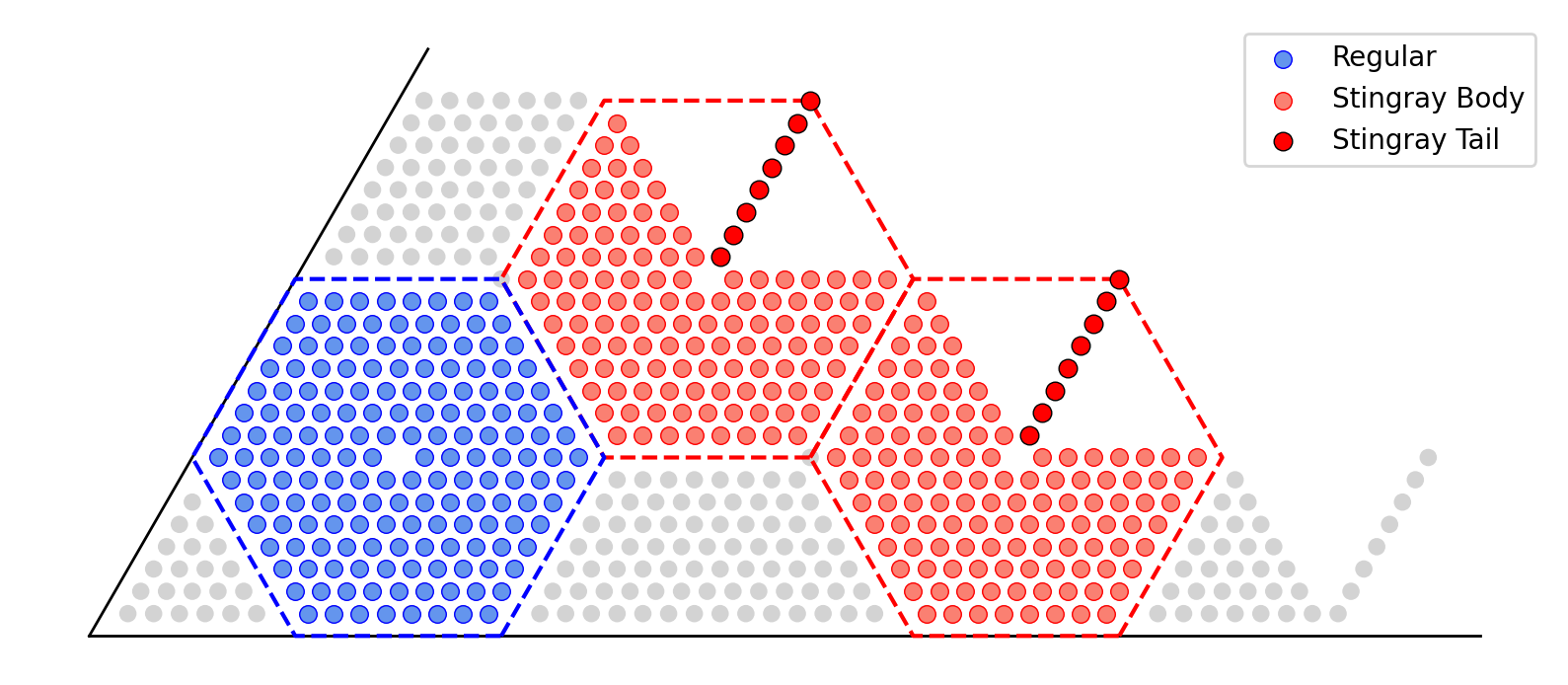
Figure 2: Two stingray patterns and one regular pattern in e4, with the distinct "tails" corresponding to configurations where all beads lie on a single runner.
Indexing Alcoves and Weak Compositions
The interior points of e5 are in bijection with dominant e6-alcoves in the chamber, and, more strongly, the set of alcoves can be indexed by weak compositions of e7 of length e8. Each green simplex in the visualizations corresponds to a different composition, and moving between alcoves encodes the action of simple reflections.
This is reflected combinatorially in transformations of the multipartition data—swapping runner indices or shifting “bead” movements—corresponding to crossing the walls of alcoves under affine Weyl group action.
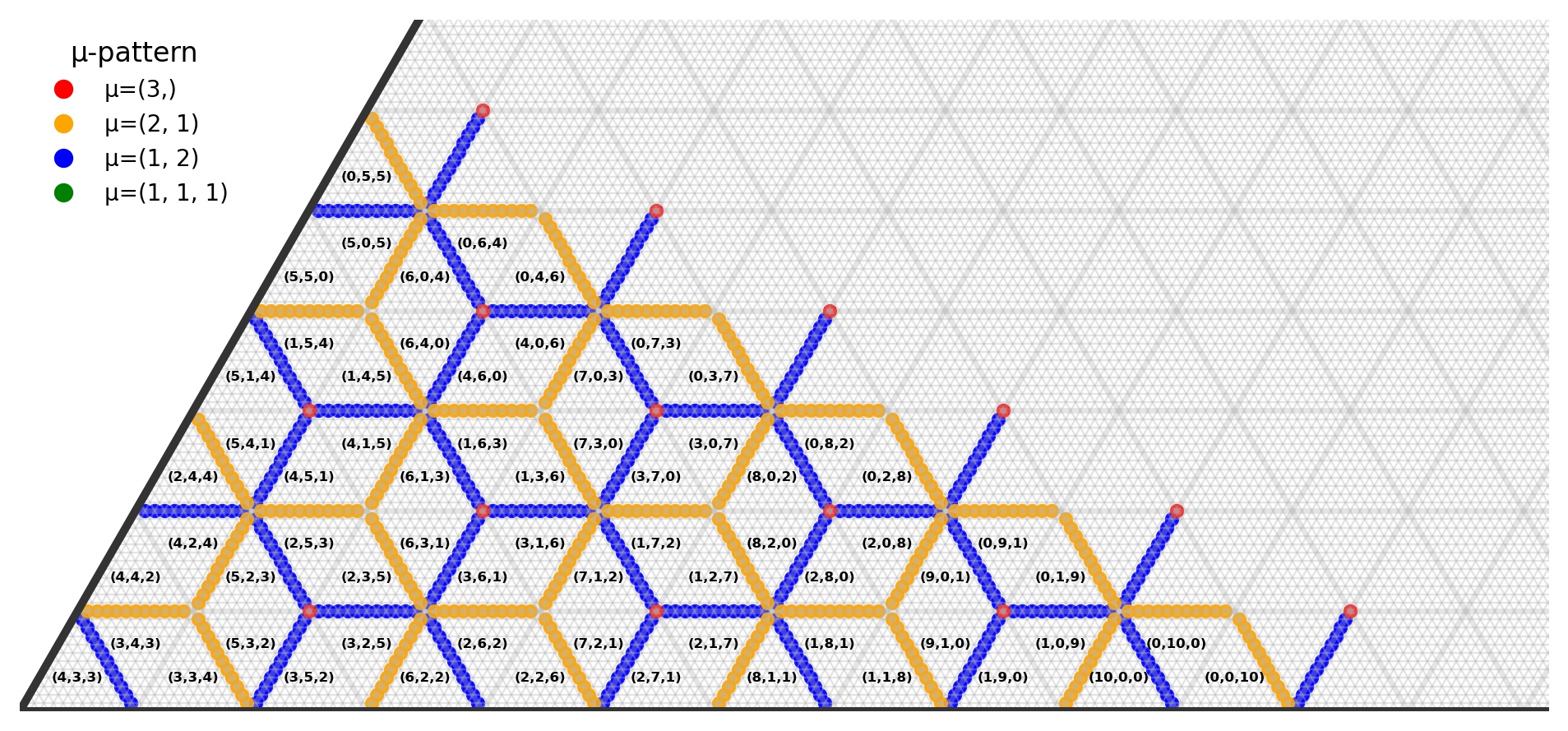
Figure 3: Example with e9, r0, r1, showing alcove decomposition and indexing of green interior simplices by weak compositions.
The formal connection between wall-crossing and Coxeter group action is established by computing the "Shi coefficients" associated to positions in the weight lattice and proving their invariance under the corresponding combinatorial moves.
Affine Weyl Group Action and Wall-Crossing
A further aspect detailed is the partially defined action of the affine Weyl group on these multipartition indexings. Simple reflections act as permutations (for finite Weyl group generators) or certain cyclic shifts with increment/decrement (for affine simple reflection r2). This action is compatible with wall-crossing between adjacent alcoves, as can be checked by explicit calculation of Shi coefficients.
The partiality arises because, in the truncated (length r3) abacus model, some runner swapping operations do not preserve the length constraint or weight region, so the action is only defined when the resulting multipartition remains viable.
Empty Runner Removal: Geometric and Combinatorial Proof
A highlight of the work is a direct geometric proof of the empty runner removal theorem—a result central in the block theory of Iwahori–Hecke algebras, previously established via more algebraic or canonical base methods [jamesmathas-empty-runner-removal]. The proof is formulated by identifying the effect of adding an empty runner to the abacus with a corresponding translation in the affine Weyl group action on alcoves, shown to yield a canonical bijection of dominant weights with the property that the anti-spherical Kazhdan–Lusztig polynomials are preserved under this operation.
This establishes the equality of graded decomposition numbers under runner insertion/removal, providing a conceptually clean proof and indicating the geometric (alcove) underpinnings of the block stability phenomena.
Practical and Theoretical Implications
The results have both combinatorial and categorical significance. The explicit formulas for the distribution and counting of dominant weights with prescribed parameters streamline the enumeration of blocks and facilitate detailed analysis of decomposition matrices. The alcove-geometric approach clarifies the conceptual basis of runner removal, essential for understanding structures in r4-Schur algebras, canonical bases, and higher-level generalizations, with potential for further categorification as noted by the author.
Practically, the visual patterns and indexing methods enable algorithmic enumeration and visualization of representation-theoretic data, which is valuable in the computational study of modular representation theory and the associated KLR and canonical basis modules.
Potential Extensions and Future Directions
The geometric model and the connection to alcove arrangements suggest several directions for further development:
- Extension to other types and higher-level analogues: The decomposition and visualization techniques may be extended to more general Lie types, higher-level Fock spaces, and Ariki–Koike or quiver Hecke settings, as indicated in related work [alice-full-runner-removal, alice-empty-runner-removal, qin-subdivision-runner-removal].
- Categorification and Soergel-theoretic models: The combinatorial stability under runner removal informs the search for explicit categorical equivalences, potentially simplifying equivalences between different KLRW (Khovanov–Lauda–Rouquier–Webster) algebras and realization of Soergel bimodules.
- Fine structure and Bruhat order: The identification of which pairs of affine vertices yield "good" or "bad" pairs (i.e., when the regular pattern completely fills an alcove versus when stingray tails are formed) is closely related to Bruhat order and cell decomposition, suggesting opportunities for finer granularity in the local structure of the weight patterns.
Conclusion
The paper provides an explicit and conceptually unified framework for describing the geometry of dominant weights arising from r5-core/weight data in type r6, with direct combinatorial and geometric tools for understanding block theory, alcove structures, and transformations under affine Weyl group actions. The visual "stingray" patterns, the simplicial decompositions, and the wall-crossing formalism bring new transparency to the structure of modular representation theory for symmetric and Hecke algebras, and the methods developed set the stage for further generalizations and applications within higher-level categorical representation theory.
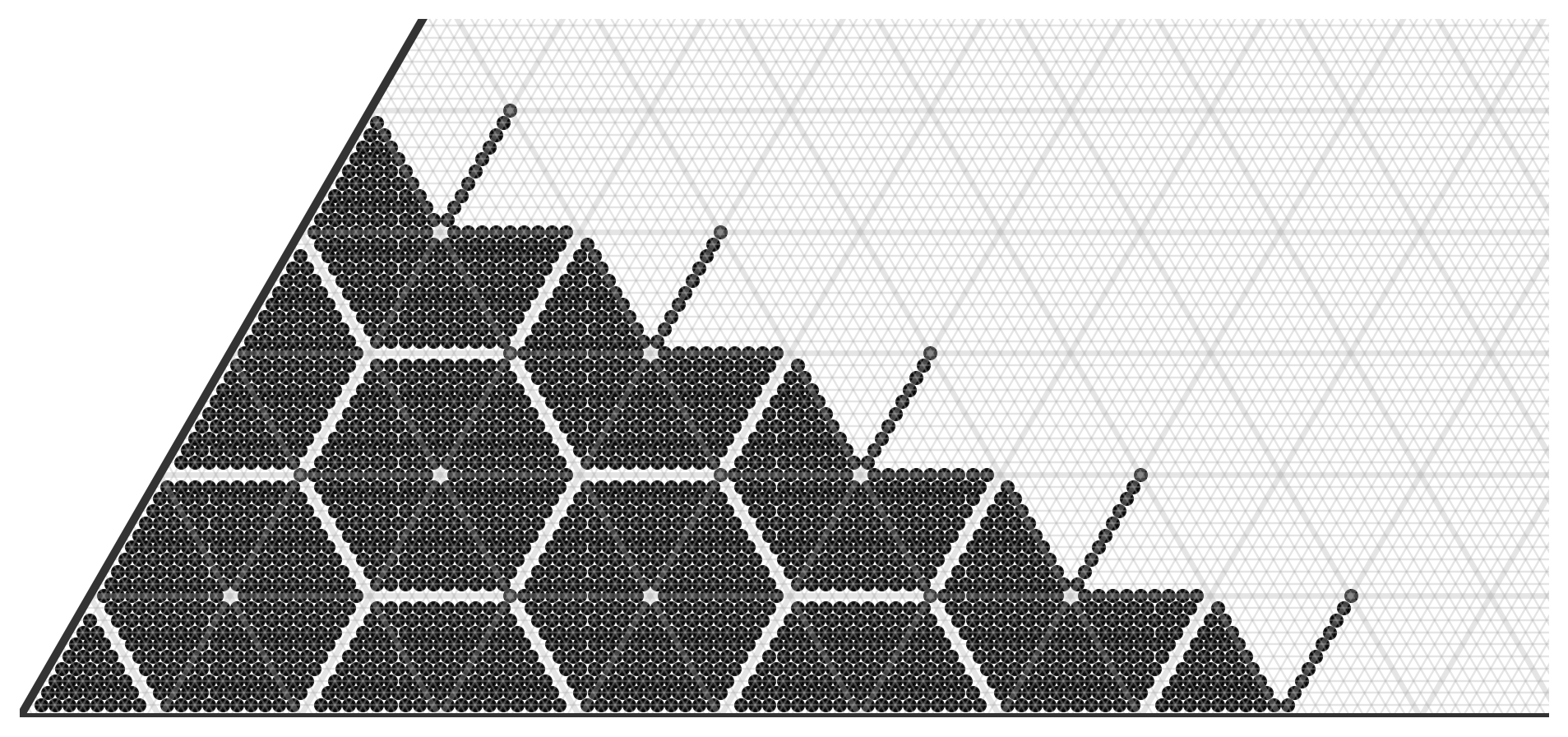
Figure 4: The pattern of dominant weights for r7—the stingray pattern in the r8 dominant chamber, with each black ball a dominant weight in r9.
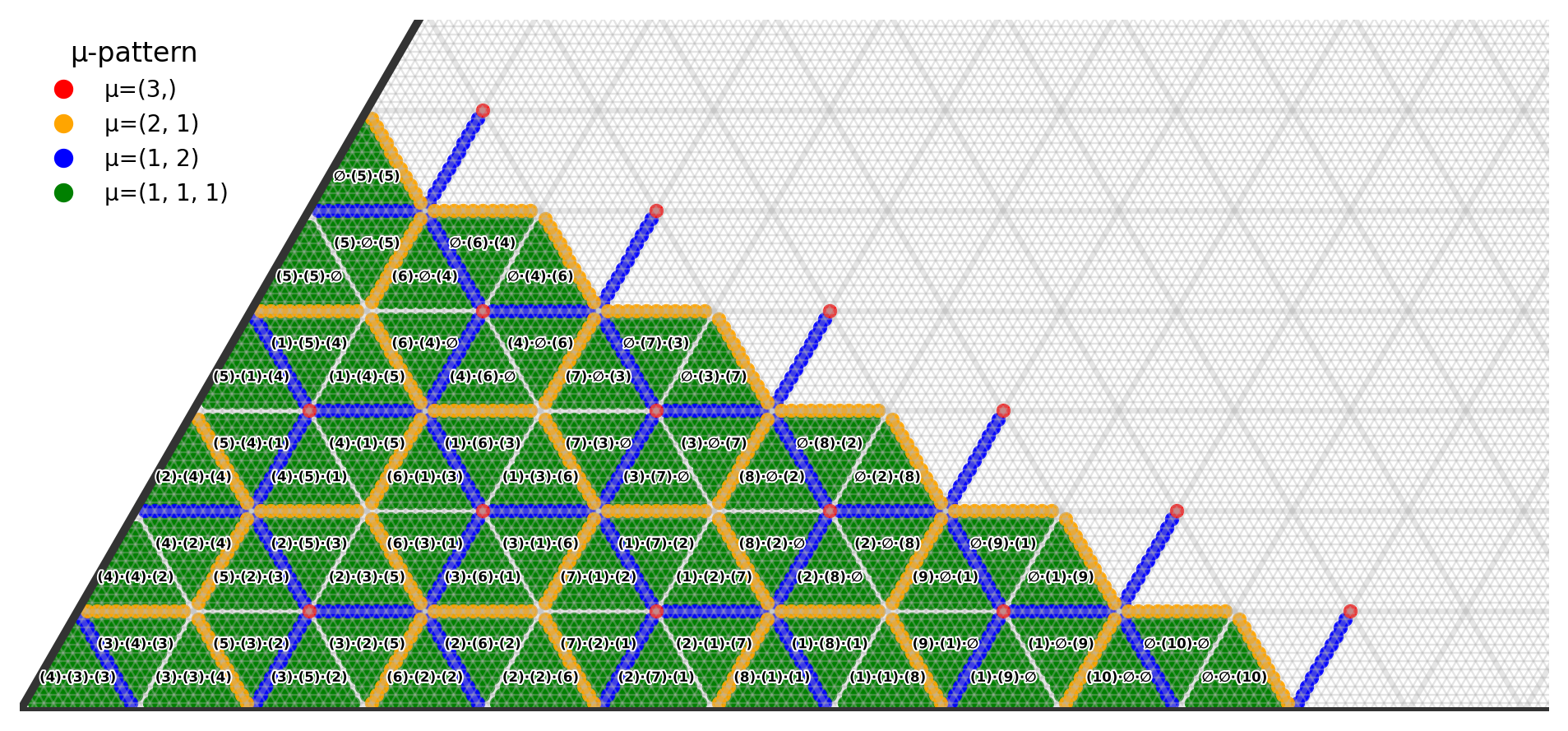
Figure 5: Visualization for e0, further amplifying the formation of stingray and hexagonal arrangements as e1 increases.
References: See (2604.04326) for detailed proofs, combinatorial arguments, and further context.
Paper to Video (Beta)
No one has generated a video about this paper yet.
Whiteboard
No one has generated a whiteboard explanation for this paper yet.
Paper Prompts
Sign up for free to create and run prompts on this paper.
Top Community Prompts
Open Problems
We haven't generated a list of open problems mentioned in this paper yet.
Continue Learning
- How do stingray patterns enhance our understanding of dominant weight geometries in affine type A?
- What are the advantages of using abacus combinatorics for classifying partitions with specific e-weights?
- In what ways do alcove decompositions aid in visualizing affine Weyl group actions?
- How might these geometric methods impact computational approaches in modular representation theory?
- Find recent papers about geometric combinatorics in representation theory.

