- The paper develops a mean-field game framework that models partial immunity observability and uncertain epidemic durations.
- It introduces robust numerical methods combining advection-reaction PDEs and HJB formulations to compute Nash equilibria.
- The results reveal significant reductions in peak infections and mortality under strategic contact rate adjustments.
Partial Health Status Observability and Time Horizon Uncertainty in Mean-Field Game Epidemiological Models
Introduction
This work addresses critical deficiencies in standard epidemiological modeling by embedding two realistic complexities: (i) partial observability of individual immunity status and (ii) uncertain planning horizons for epidemic duration. The framework situates these problems within the theory of mean-field games (MFGs), where rational agents select contact rates to maximize expected personal utility—subject to their knowledge (or uncertainty) of health status and horizon. The model rigorously extends the foundational SIRSD compartmental structure to allow immunity to wane gradually (observable), or disappear abruptly at a random, unobservable time. Efficient computational methodologies for these mean-field forward-backward systems, which include advection-reaction PDEs as well as Hamilton-Jacobi-Bellman equations, are developed. The impact of these extensions is elucidated through numerical experiments.
Mean-Field Game Extensions to Epidemiological Modeling
Baseline SIRSD and MFG-SIRSD
The base compartmental structure divides the population into Susceptible (S), Infected (I), Recovered/Immune (R), and Dead (D) compartments, incorporating SIR transitions, recovery, disease-induced death, and loss of immunity. Standard models pre-program behavioral parameters (e.g., contact rates), whereas MFG-SIRSD endogenizes contact rates via individual utility maximization under Nash equilibrium.
The rationality axiom introduces a backward component: agents dynamically optimize a personal terminal payoff integrating instantaneous utility (dependent on behavioral variables and health status) and penalties for unfavorable epidemic outcomes. The resulting epidemic trajectory (y(t)) and Nash-optimal contact strategy (c∗(t)) arise from coupling the epidemiological ODEs to value-function HJB equations.
Upon benchmarking, significant differences emerge between myopic models and MFG-SIRSD. The Nash equilibrium produces pronounced mitigation in both peak and cumulative infection metrics:
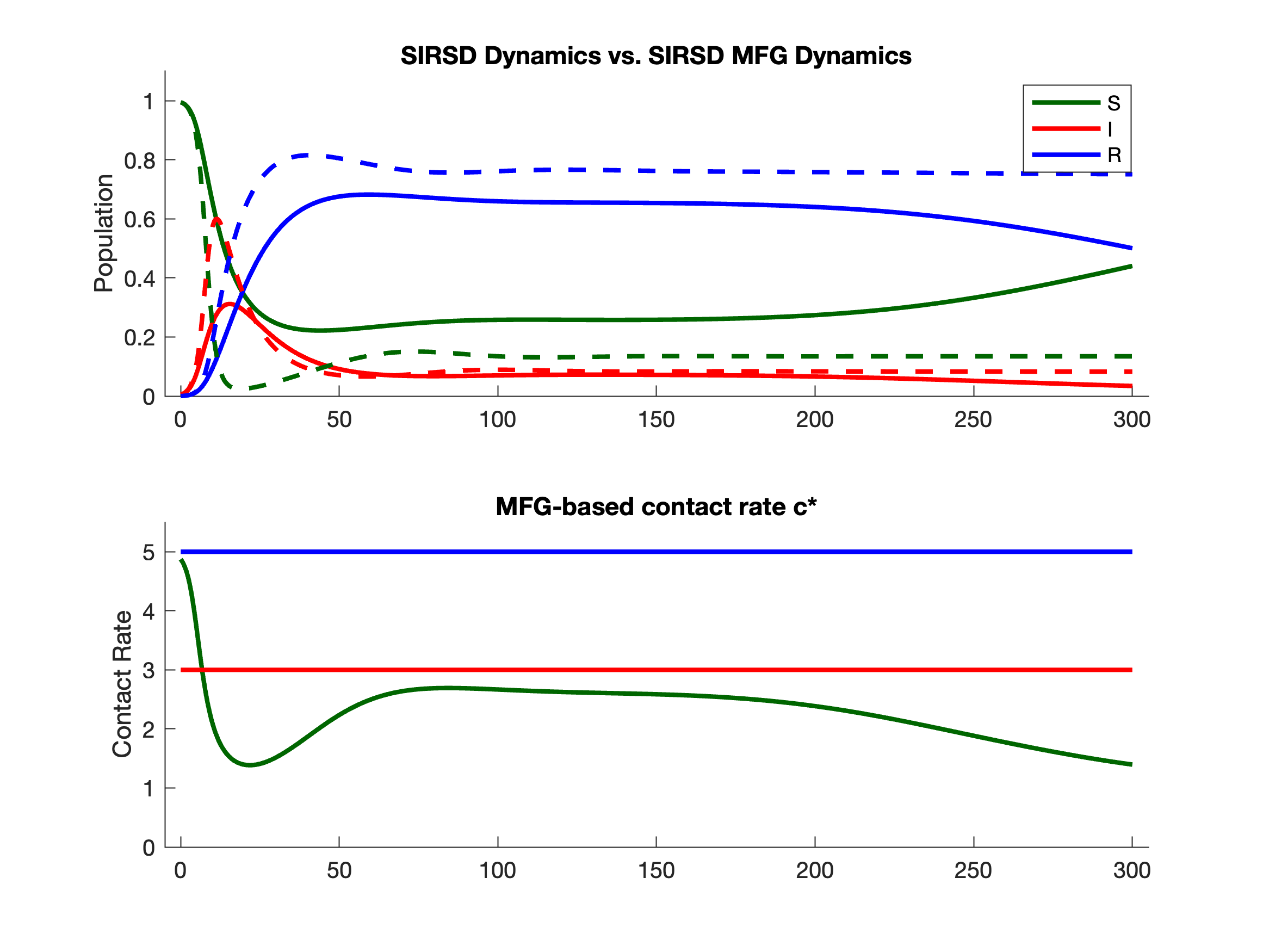
Figure 1: Epidemic trajectories and Nash contact rates for MFG-SIRSD vs. myopic SIRSD; rational control yields substantially reduced peak infection and mortality.
Quantitative Outcomes
- Peak Infection: 0.3117 (MFG-SIRSD) vs. 0.6000 (myopic SIRSD)
- Mean Infection: 0.0823 vs. 0.1869
- Final Mortality: 0.0247 vs. 0.0318
Modeling Uncertainty in Health Status: Waning vs. Unobservable Immunity Loss
Fully Observed Waning Immunity
In the first extension, immunity decays deterministically post-recovery, with each non-infected agent fully aware of their immunity level p∈[0,1]. Transmission rates are modulated by $1-p$, and the population distribution over the immunity spectrum is governed by a convection PDE. Non-infected agents' contact rates are adapted not just to infection prevalence but also to their personal p. The full system involves a coupled set of PDEs and ODEs describing population and value-function dynamics over the immunity spectrum.
Unobserved Disappearance of Immunity (Belief-state MFGs)
Alternatively, consider immunity that disappears abruptly and unobservably at a random time, as is plausible for many viral infections. Here, each agent maintains a Bayesian belief p—quantifying the likelihood of retained immunity—updated via a drift equation dependent on observed lack of infection and the agent's contact rate. This is a mean-field game over belief space, incorporating feedback from survival without infection as evidence favoring continued immunity. The control and population dynamics are structurally similar to the waning-immunity model, but with fundamentally different information structures and thus strategic implications.
Figures comparing both models reveal marked differences in epidemic trajectories and optimal strategy profiles.
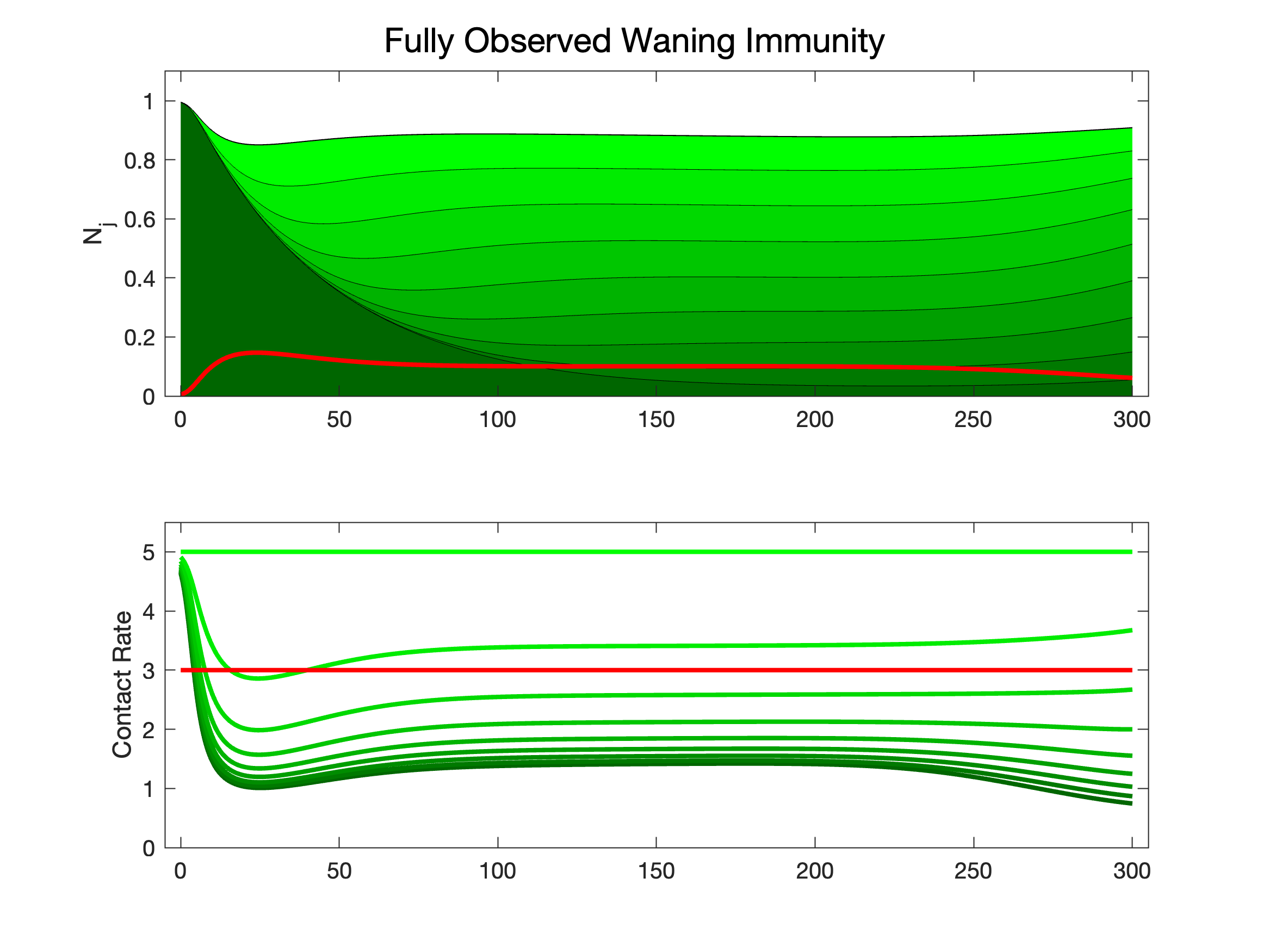
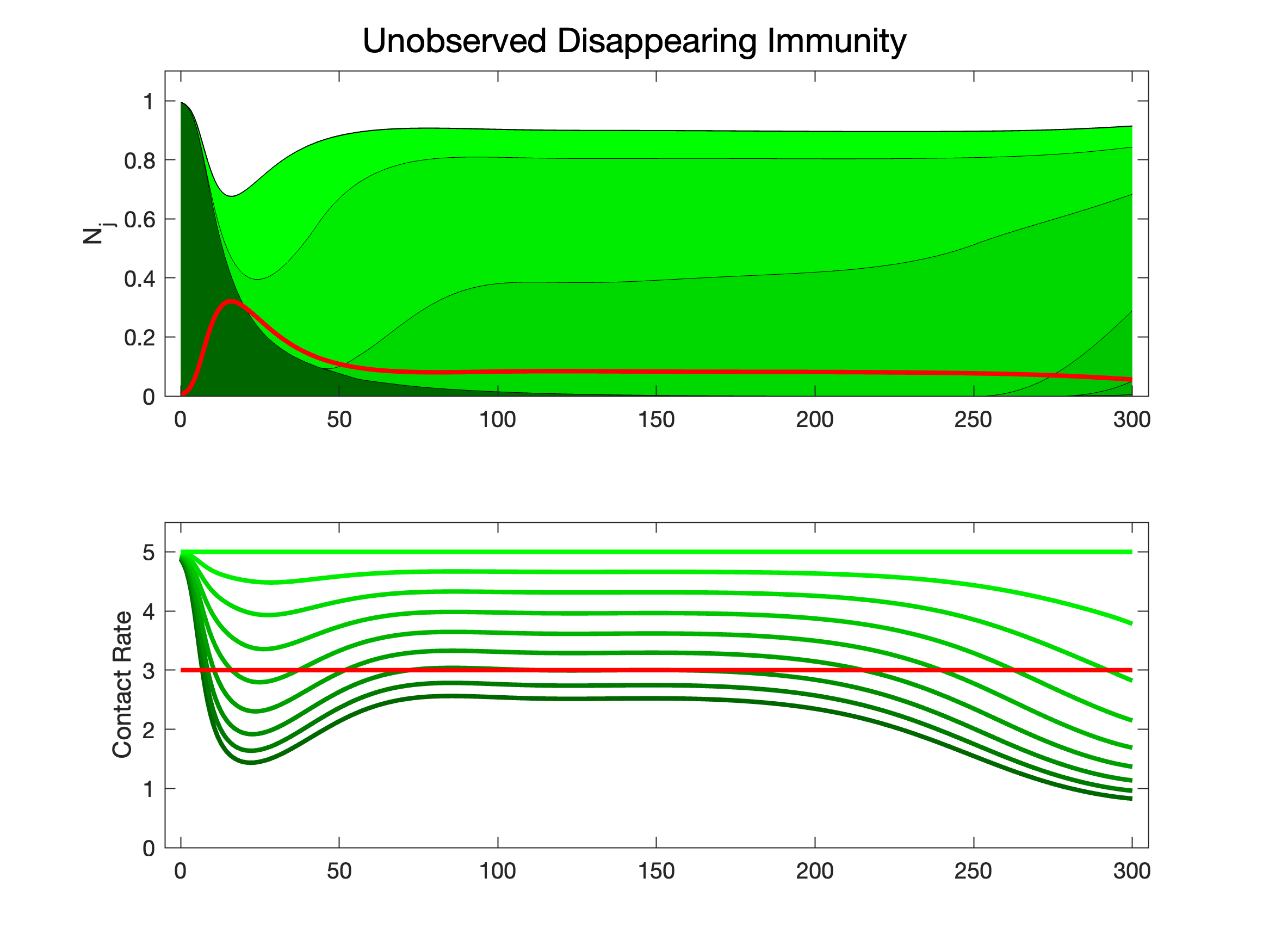
Figure 2: Epidemic dynamics and Nash contact rate profiles under fully observed waning immunity; agents with lower immunity decrease contacts, reducing peak infection to 0.1468.
Agents with observable waning immunity demonstrate highly risk-averse behavior at lower I0-levels, yielding a dramatically reduced infection peak (0.1468) but slightly elevated mean infection and mortality compared to MFG-SIRSD due to the increased fraction of vulnerable individuals. In contrast, individuals with unobserved immunity loss maintain more aggressive behavior at elevated (but not certain) belief levels, resulting in only slight degradation relative to the fully observable baseline.
Planning Horizon Uncertainty and Its Behavioral Consequences
A notable innovation is the inclusion of uncertain planning horizons—that is, the epidemic (and thus the period for which rational behavior matters) ends at a random time, modeling population uncertainty regarding, e.g., vaccine arrival. The MFG system is then structured over a set of possible terminal times (I1) with respective probabilities. This introduces common noise into the MFG framework, with Nash strategies and value functions computed by recursion over possible horizon realizations, including explicit jump conditions at decision epochs.
Numerical results demonstrate that as the probability I2 of early epidemic termination increases, agents sharply reduce risk-taking near the possible early endpoint, producing discontinuous (upward) jumps in contact rates if the horizon is unexpectedly extended.
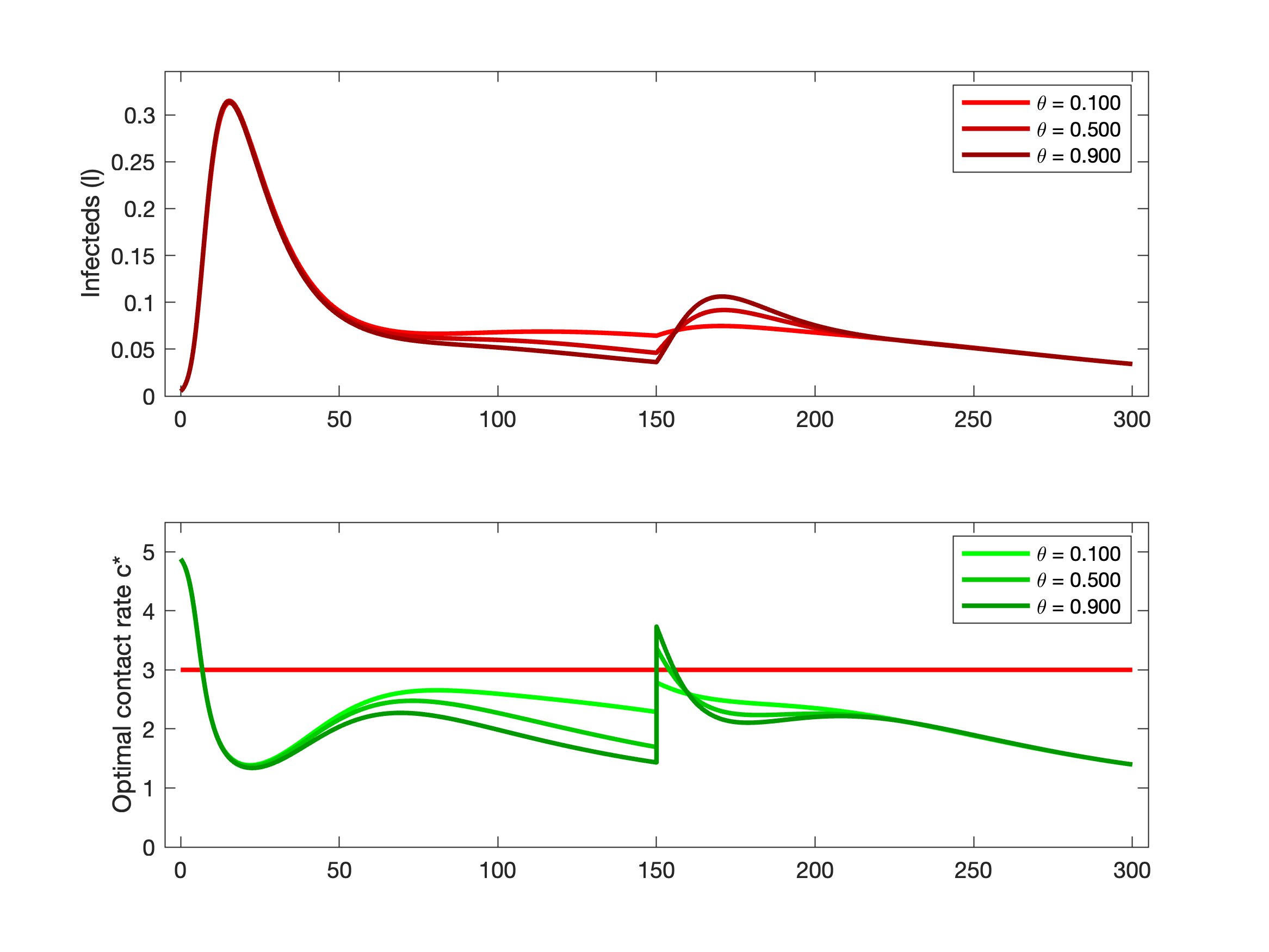
Figure 3: MFG-SIRSD with two possible horizons. Nash-optimal contact rates for susceptibles exhibit abrupt increases after passage of the uncertain early termination time, with the amplitude contingent on its likelihood.
The approach extends to arbitrary distributions over terminal times and holds under partially observable immunity dynamics.
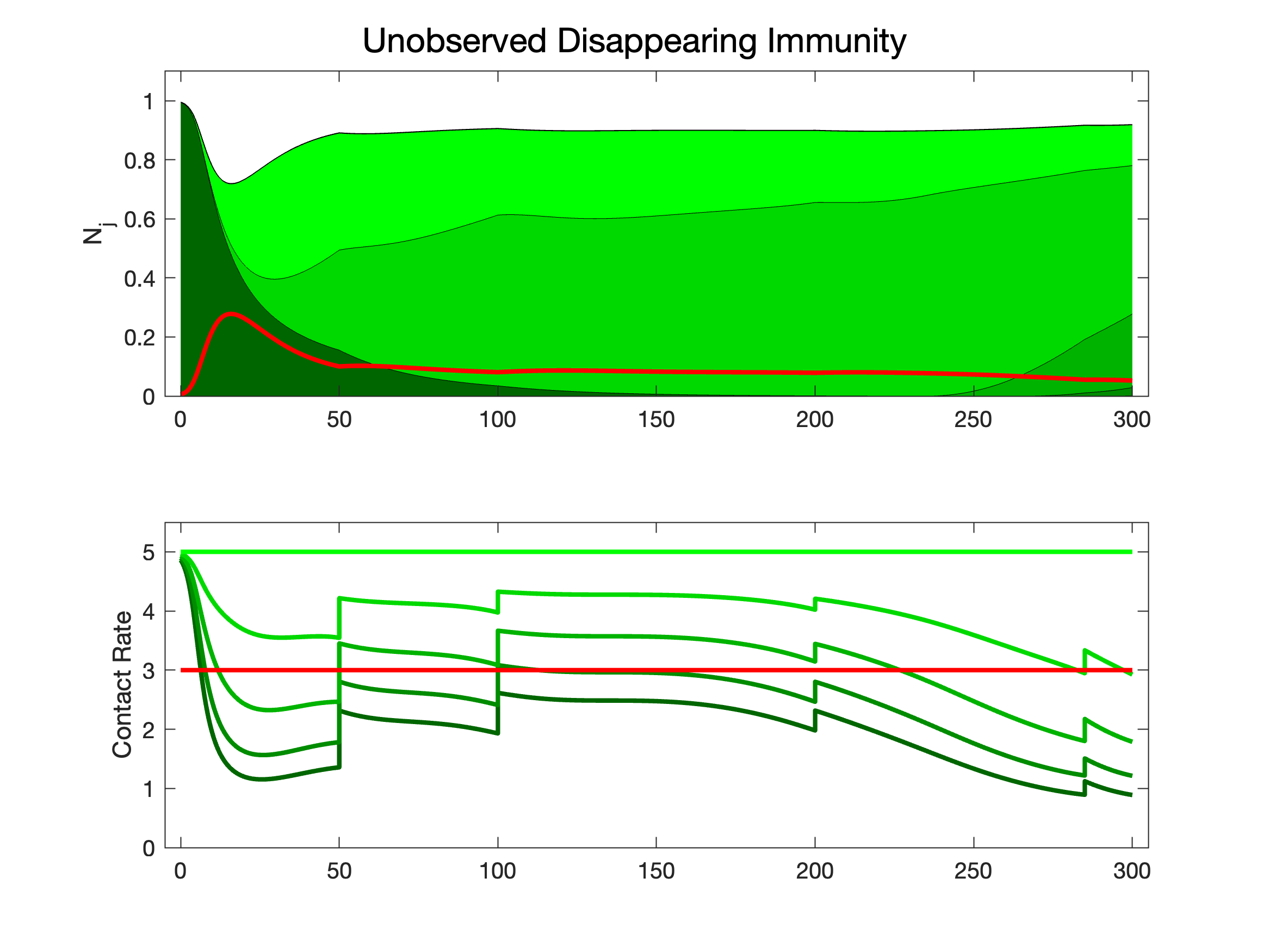
Figure 4: Infection and Nash contact-rate dynamics under an unobserved immunity-disappearance model with horizon uncertainty (I3, non-uniform probabilities). Contact rates and inferred infection risk adjust discretely at each possible stopping event.
Numerical Methods and Computational Feasibility
The study presents a robust numerical approach for solving forward-backward coupled MFG systems, recasting discretized PDEs into two-point boundary value problems for high-dimensional ODE systems. The methodology combines upwind schemes for population dynamics and Lax-Friedrichs-type discretization for the HJB equation, leveraging standard BVP solvers (e.g., MATLAB's bvp5c) with continuation over discretization levels to ensure convergence. This enables efficient and scalable computation even for multidimensional immunity-spectrum models with complex horizon uncertainty structures.
Implications and Future Directions
The findings substantially raise the fidelity of behavioral-epidemics modeling. Allowing explicit regime distinctions between observable and unobservable immunity loss, and integrating horizon uncertainty, exposes qualitative phenomena inaccessible to classical models. For example, agents' beliefs and risk strategies show persistent nontrivial structure even absent explicit information about immunity status; uncertainty in epidemic horizon yields discontinuities in concordant equilibrium strategies.
The theoretical implication is that MFGs with partial observability and common noise can be rendered tractable at significant scale—a prerequisite for realistic pandemic policy analysis. Practically, the results suggest that public communication about immunity loss dynamics and expected epidemic duration can nontrivially shape collective equilibrium behavior and thus epidemic outcomes.
Future work should focus on integrating heterogeneous behavioral types (as in (Buckley et al., 23 Dec 2025)), immunity-dependent disease severity ([angelov2024immuno]), and continuously distributed horizon uncertainty. Extensions to presymptomatic or behavioral-inattention populations (as introduced in [olmez2022modeling]) would further expand applicability. The developed numerical framework can serve as a foundation for data-driven calibration and real-time policy optimization.
Conclusion
This work establishes a flexible, tractable, and behaviorally rich framework integrating partial health-state observability and planning horizon uncertainty into MFG-based epidemic modeling. By formalizing the interplay between individual strategic uncertainty, immunity dynamics, and collective outcomes, it offers both new theoretical tools and actionable insights for epidemic mitigation policy design.
(2604.04305)