- The paper presents a parameterized 7/4-approximation algorithm for rectangle stabbing, using structure-aware greedy selection to reduce the solution space.
- It employs horizontal and vertical strip decomposition along with a reduction to 2-SAT to efficiently cover axis-parallel rectangles.
- The study establishes a tight lower bound under standard complexity assumptions, setting clear limits on achievable approximations in geometric set covering.
Parameterized Approximation of Rectangle Stabbing: Algorithmic and Complexity Thresholds
The Rectangle Stabbing problem entails, given axis-parallel rectangles R and axis-parallel lines L in R2, finding the smallest subset L∗⊆L such that each R∈R is intersected by some ℓ∈L∗. This problem generalizes geometric covering and optimal discretization, with connections to classic set cover as well as applications in machine learning discretization and fault-tolerant sensor networks.
Previous work established the NP-hardness of the problem even under strongly restricted inputs, and provided a polynomial-time $2$-approximation algorithm [gaur2002constant]. Tardos showed that either there exists a collection of k rectangles no two of which are simultaneously stabbed by a line, or all can be stabbed by $2k$ lines, but this existential result was non-constructive. From the parameterized perspective, the problem is W[1]-hard in terms of the stabbing number k, even for congruent squares [dom2009parameterized, giannopoulos2013fixed], and FPT algorithms were only known in special cases (e.g., disjoint rectangles). The status of parameterized approximation for general rectangle stabbing was previously open.
Main Algorithmic Results
The paper introduces a parameterized L0-approximation for Rectangle Stabbing, with running time L1 where L2 is the sought stabbing number and L3. This simultaneously improves the best polynomial-time approximation guarantee (factor L4) and, under standard complexity-theoretic assumptions (FPT L5 W[1]), gives an algorithm with a significantly better running time than is possible for exact parameterized algorithms.
The algorithm employs a structure-aware, multi-step greedy selection, reducing the combinatorial explosion of solutions by case analysis on the counts of horizontal/vertical lines and recursion on weakly structured instances, as visualized below.
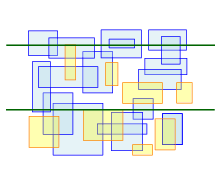
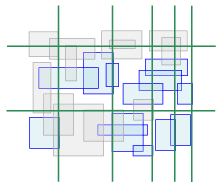
Figure 1: The set of horizontal lines L6 and vertical lines L7 selected in the initial sweep phase of the algorithm, partitioning the instance into regions for further processing.
After guessing the counts of horizontal and vertical lines in the optimum, the main ingredients are:
- Horizontal Line Selection: Greedily select at most L8 horizontal lines L9, combined with R20 verticals R21, to cover as many rectangles as possible, ensuring "nicely positioned" combinatorial properties (Lemma 3.1). This step partitions the problem into strips for further reasoning.
- Vertical Strip Decomposition: Identify a set of vertical strips R22 (Figure 2) such that each strip contains a unique potential vertical stabber from an unknown optimum solution, and select auxiliary verticals R23 to separate strips.
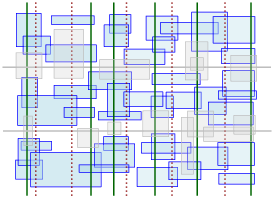
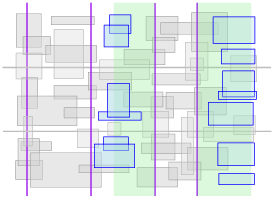
Figure 2: The vertical lines R24 and strips R25 guaranteeing separation and assignment structure as formalized in Lemma 3.2.
- Rectangle Pruning: Compute a representative subset of rectangles R26 that maintains equivalence with the full problem instance for well-structured candidate solutions, ensuring key rectangles are retained for later tractable handling (Figure 3).
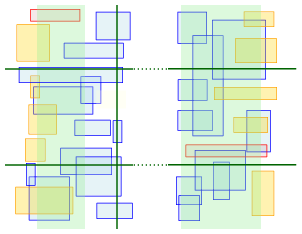
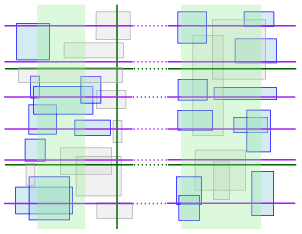
Figure 3: The subset of rectangles R27 and horizontal lines R28 after redundant rectangles have been removed and structure enforced for subsequent dynamic separation.
- Horizontal Strip Identification: Analogous to step 2, construct horizontal strips R29 (Figure 4) and inert horizontal lines L∗⊆L0 so that any solution can be forced to choose lines in a structured fashion.
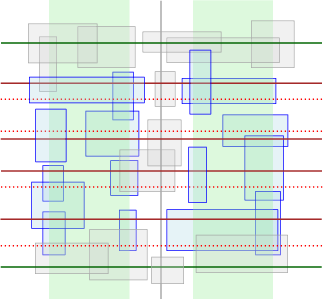
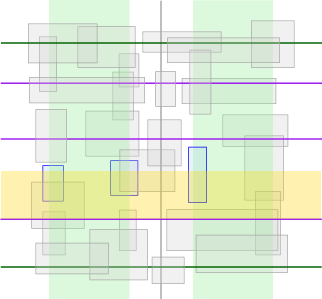
Figure 4: The horizontal lines L∗⊆L1 and strips L∗⊆L2 ensuring the existence and computation of a structured horizontal stabbing.
- Reduction to 2-SAT: The remaining selection of lines in strips can be formulated as an instance of 2-SAT, leveraging Lemma 3.6, since each remaining rectangle intersects at most one vertical and one horizontal strip. This enables a polynomial-time solution for the remainder after combinatorial guessing has reduced the search space.
The aggregate solution size is upper bounded by L∗⊆L3, which is formally shown to be tight for the constructed decomposition used in the algorithm. The final algorithm thus offers a guarantee that advances the landscape of geometric set covering in the parameterized regime.
Parameterized Inapproximability and Optimality
To complement the algorithmic upper bound, the paper establishes a tight lower bound: assuming FPT L∗⊆L4 W[1], there is no L∗⊆L5-time parameterized L∗⊆L6-approximation for any L∗⊆L7. This is achieved by a careful, gap-preserving reduction from Multicolored Clique, leveraging recent advances in parameterized complexity lower bounds [chen2025simple, lin2021constant].
The reduction employs a grid-like construction, associating strips in the stabbing instance to color classes and vertices in the input graph, and forcing selection constraints through carefully engineered rectangles (Figure 5).
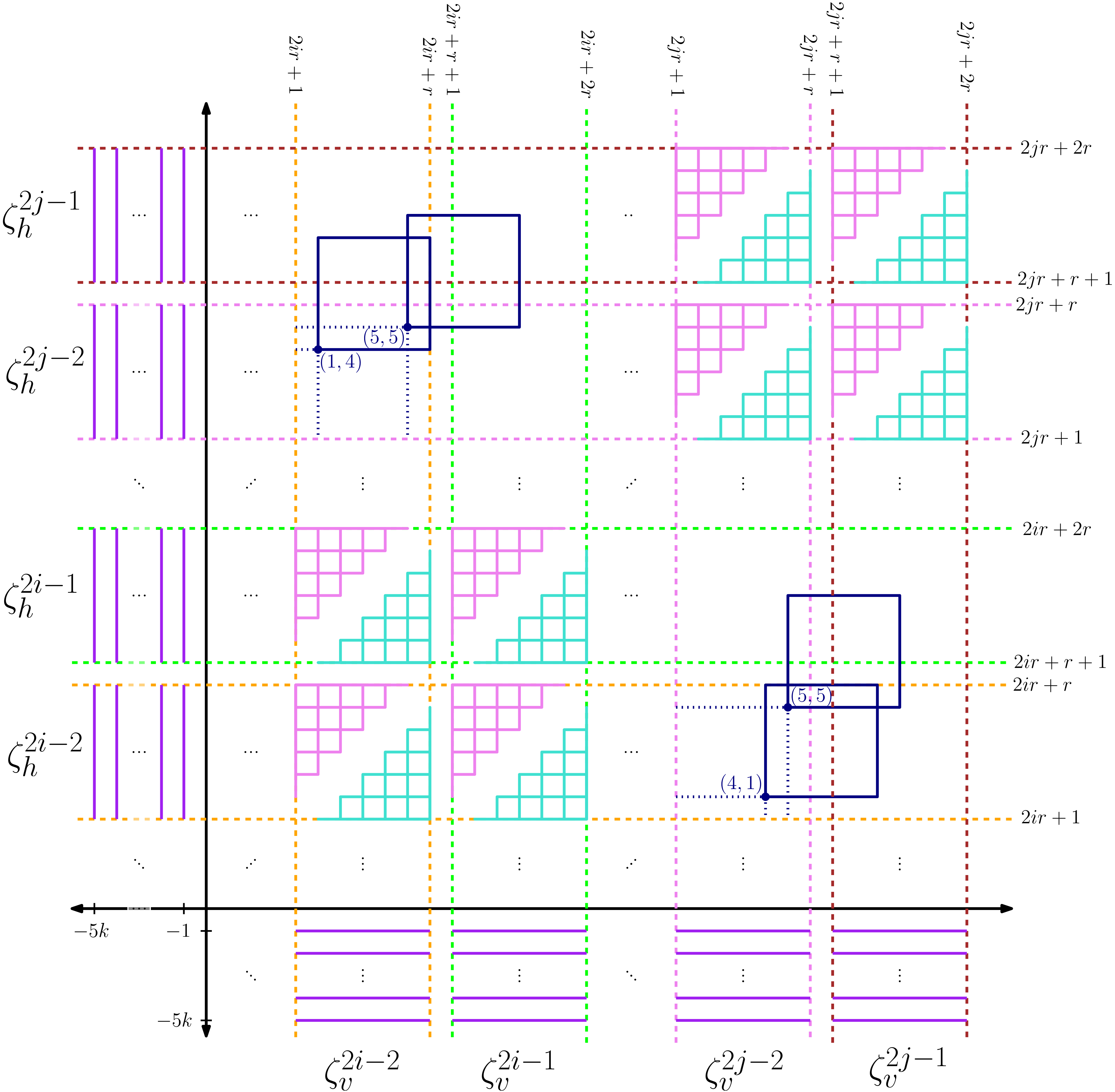
Figure 5: Example reduction snapshot from Multicolored Clique to Rectangle Stabbing, showing rectangles in L∗⊆L8, L∗⊆L9, and R∈R0 enforcing structure and adjacency constraints between strips.
This construction ensures that any solution with fewer than R∈R1 lines corresponds (via a mapping) to a multicolored clique of size proportional to R∈R2 in the original graph, thereby establishing the hardness threshold for parameterized approximation. The analysis details a charging argument that precludes solutions with the desired approximation ratio in the absence of a large clique, via the correspondence between strips and color classes, with rectangles ensuring the clique property and vertex selection consistency.
Implications and Future Directions
The results demarcate a clear complexity threshold: a parameterized R∈R3-approximation is achievable, but not a R∈R4-approximation unless long-standing complexity assumptions fail. This boundary refines our understanding of geometric covering in the parameterized paradigm and provides a separation between feasibly achievable approximation ratios for polynomial-time and parameterized algorithms.
On the theoretical side, the work suggests future investigation into the optimal constants for parameterized approximability and possible tightness of the R∈R5-approximation in polynomial time. Understanding the complexity landscape between R∈R6 and R∈R7 in this geometric context is an open and technically compelling direction. Moreover, the methods—including recursive decomposition, structure-aware guessing, and tractable reduction to 2-SAT—can potentially transfer to related geometric and combinatorial covering problems.
Conclusion
This paper establishes both improved upper and lower bounds for parameterized approximation in Rectangle Stabbing: a R∈R8-time R∈R9-approximation algorithm and a matching conditional lower bound showing the impossibility of ℓ∈L∗0-approximations in FPT time. These results close the gap in the parameterized complexity of a fundamental geometric covering problem and set the stage for further fine-grained study of computational barriers in discrete geometry.

