Causality, the Kovtun-Son-Starinets bound, and a novel sum rule for spectral densities
Published 5 Apr 2026 in hep-th, hep-ph, and nucl-th | (2604.04222v1)
Abstract: We directly show that the local ratio of the shear viscosity to the entropy density for Unruh radiation at a finite distance from the horizon is universal and satisfies the relation $ η/s = 1/(4πc_s2) $, which involves the speed of sound $ c_s $. Since $ c_s2 \leq 1 $ by causality, this establishes the close connection between the famous Kovtun-Son-Starinets bound and causality. Moreover, we show that the ratio of bulk to shear viscosity saturates another well-known bound for the bulk viscosity, predicted within holographic approach. We also show that the condition of isotropy of thermal radiation in the Rindler space leads to a novel sum rule relating the $ c{(0)}(μ) $ and $ c{(2)}(μ) $ spectral densities, and we explicitly demonstrate its validity for conformal field theory and free massive Dirac fields in any number of dimensions. The sum rule provides the validity of Pascal law and bears some similarity with Burkhardt-Cottingham sum rule for spin-dependent parton distributions. Our result suggests a new perspective on dissipative transport phenomena in media undergoing extreme acceleration, such as quark-gluon plasma created in relativistic heavy-ion collisions.
The paper derives a local relation for the shear viscosity to entropy density ratio, showing that any KSS bound violation stems from acausal dynamics.
It formulates a field-theoretic link between dissipative transport coefficients and equilibrium thermodynamic fluctuations without relying on holographic arguments.
The novel isotropy sum rule for spectral densities unifies stress-energy tensor analyses in both conformal and interacting QFTs, impacting our understanding of quark-gluon plasma dynamics.
Causality, KSS Bound, and Sum Rule Structures in Spectral Densities
Introduction
This work investigates the intricate interconnection between fundamental hydrodynamic bounds, such as the Kovtun-Son-Starinets (KSS) entropy-viscosity ratio, causality (specifically, subluminal propagation constraints), and the spectral data of the stress-energy tensor in quantum field theory on Rindler horizons. The analysis transcends the traditional holographic arguments and grounds these universal hydrodynamic relations in the microphysics of generic QFTs, including non-conformal and interacting systems in arbitrary dimensions.
Local Shear Viscosity/Entropy Ratio and Causality Connection
A central result of the paper is the derivation of a universal, local relation for the shear viscosity to entropy density ratio of Unruh (horizon) radiation in Rindler space:
sηloc=4πcs21,
where cs is the speed of sound. The classic KSS bound (η/s≥1/4π) emerges as a direct implication of the causality constraint cs2≤1 on the sound propagation. Thus, any violation of the KSS bound is only possible via acausal dynamics—in direct analogy to previous results connecting holographic KSS limit violation to superluminal graviton propagation in Gauss-Bonnet gravity [Brigante et al., Phys. Rev. Lett. 100, 191601 (2008)].
Another formulation links the shear viscosity to the specific heat at constant volume (cV):
cVηloc=4π1.
This intertwines dissipative transport and equilibrium thermodynamic fluctuations at a fundamental level.
Holographic Bulk Viscosity Bound Generalized
The local bulk-to-shear viscosity ratio is shown to saturate the celebrated bulk viscosity bound:
ηζ=2(d−11−cs2).
This is derived strictly in field-theoretic terms, without recourse to gravitational duals, and emphasizes that the same spectral structures underlie both shear and bulk dissipative phenomena.
Isotropy Sum Rule for Spectral Densities
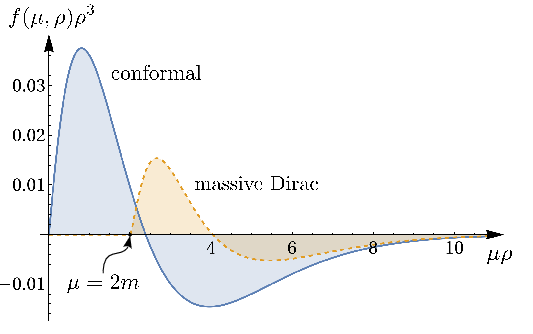
The derivation hinges on imposing isotropy of the stress-energy tensor in Rindler space, which yields a novel sum rule relating the spin-0 and spin-2 spectral densities,
∫0∞dμ{c(0)(μ)A(0)(μ,ρ)+c(2)(μ)A(2)(μ,ρ)}=0.
Explicit calculations demonstrate that this sum rule is obeyed by all conformal field theories and by the free massive Dirac field in any dimension, but not by a free massive scalar. The sum rule is recognized as a field-theoretic realization of Pascal's law at the microscale and is structurally analogous to the Burkhardt-Cottingham sum rule for spin-dependent parton distributions.
Figure 1: Integrand of the sum rule for conformal field theory (blue) and free massive Dirac field (orange) in d=4, demonstrating the isotropy condition as a vanishing integral.
Spectral Representation and Universality
All the transport (viscous) coefficients are expressed explicitly as functionals of the spectral densities c(0)(μ), cs0 inherent to the two-point function of the EMT, establishing a direct bridge to the underlying quantum field microphysics. For CFTs, cs1 collapses to a contact term while cs2 is proportional to the central charge, ensuring compatibility with the sum rule.
The universal nature of the relations is emphasized—the results apply equally to interacting and non-conformal theories provided isotropy is attained, and the local geometric setting is that of the Rindler wedge.
Phenomenological Implications
The formal expressions for cs3 and cs4 in terms of hydrodynamic variables provide a new lens for interpreting the "nearly perfect fluid" properties of the quark-gluon plasma observed in heavy-ion collisions. While uncertainties persist in the extraction of cs5 from experimental data, using the QGP estimate cs6 gives cs7, consistent with inferred values. Importantly, the Unruh/Rindler setting is physically motivated by the extreme accelerations encountered in such collisions, suggesting that entanglement viscosity contributions derived here may have practical relevance for describing the dynamics of the QGP and other strongly coupled media.
Theoretical Perspectives and Outlook
The analysis strengthens the view that fundamental quantum field-theoretic constraints—causality, unitarity, isotropy—rigorously enforce the KSS lower bound, independently of holographic or gravitational arguments. The novel sum rule for spectral densities may catalyze further work in classifying QFTs by their transport properties, especially with applications to anisotropic systems or those with nontrivial entanglement structure.
One open question is identifying the microscopic origins of isotropy breaking, particularly in the case of massive scalars. Further investigation into the interplay between acceleration, geometry, and quantum transport in non-equilibrium QFTs is anticipated.
Conclusion
This paper demonstrates that the KSS viscosity bound is a direct consequence of microcausality in field theory. Through the sum rule for stress tensor spectral functions, a deep relationship is established between equilibrium hydrodynamic responses and local isotropy. The formalism developed here unifies diverse results in holography, black hole physics, and high-energy heavy-ion phenomenology under a single quantum field-theoretic framework (2604.04222).
“Emergent Mind helps me see which AI papers have caught fire online.”
Philip
Creator, AI Explained on YouTube
Sign up for free to explore the frontiers of research
Discover trending papers, chat with arXiv, and track the latest research shaping the future of science and technology.Discover trending papers, chat with arXiv, and more.