- The paper establishes that the optimal relaxation parameter is θ = 1 for iso-averaged maps within graph-based splitting methods.
- It presents a strict convex spectral characterization of the operator, highlighting symmetry properties and the dependence of convergence rates on θ.
- The research unifies theoretical insights and practical algorithm design by emphasizing parameter selection when the graph matches its subgraph.
Summary of "On the optimal relaxation parameter of graph-based splitting methods for subspaces" (2604.04206)
This essay analyzes the theoretical advancements and implications presented in "On the optimal relaxation parameter of graph-based splitting methods for subspaces" (2604.04206). The paper systematically addresses the interplay between relaxation parameters and linear convergence rates in graph-based splitting algorithms applied to the intersection problem of linear subspaces, extending classical Douglas–Rachford results to a broader class of graph-structured operators.
Motivation and Problem Statement
The paper considers minimization problems of the form minx∈Ef1(x)+⋯+fn(x) for proper, convex, lower semicontinuous functions fi over Euclidean space E. Under standard qualification conditions, this reduces to finding x such that 0∈∂f1(x)+⋯+∂fn(x). The coordinated solution of monotone inclusions via splitting methods is central to convex optimization and operator theory.
For indicator functions of linear subspaces, the problem further reduces to finding x in the intersection ∩i=1nUi, which is amenable to projection-based approaches. Classical algorithms such as the Douglas–Rachford algorithm (DRA) employ relaxation parameters to control convergence—prompting a detailed investigation into how such parameters interact with the graph-based abstractions prevalent in contemporary multi-operator splitting frameworks.
Iso-Averaged Maps and Relaxation Parameter Analysis
A central technical contribution is the formal introduction and characterization of iso-averaged maps. A linear operator T on E is iso-averaged if 2T∗T=T+T∗, equivalent to fi0 for an isometry fi1. This membership ensures normality and firm nonexpansiveness, which are crucial for spectral analysis and convergence guarantees.
The relaxation operator fi2 retains normality if fi3 is normal, and its spectral radius (convergence rate) can be explicitly calculated for iso-averaged maps, providing a closed-form dependence on fi4:
fi5
The function fi6 is strictly convex, symmetric about fi7, and uniquely minimized at fi8, establishing fi9 as the optimal relaxation parameter (see Remark and Theorem in the paper).
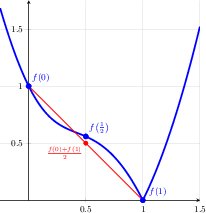
Figure 1: Graph of the nonconvex function E0 for a non-normal map, demonstrating that convexity requires normality.
The nonconvexity illustrated here underscores the necessity of operator normality for ensuring convex dependence on the relaxation parameter.
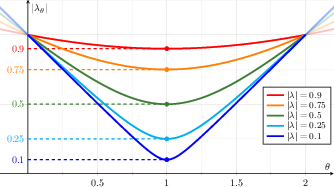
Figure 2: Graphs of E1 for varying E2, showing strict convexity and symmetry about E3 in the iso-averaged case.
This spectral characterization immediately distinguishes iso-averaged from merely normal maps and provides a foundation for optimal parameter selection in algorithmic implementations.
Graph-Based Splitting Methods
Graph-based splitting methods generalize DRA and related algorithms by structuring the variable updates via an underlying directed graph E4 and a subgraph E5. The fixed-point operator associated with such an algorithm is a composite map derived from projection operators, Laplacian matrices, and adjacency matrices corresponding to the graph structure.
The paper proves that the associated fixed-point operator is iso-averaged if and only if E6, i.e., the graph and its subgraph coincide. This result rigorously justifies empirical findings from prior numerical studies and closes an open theoretical question regarding the symmetry and optimality of graph choices. When E7, iso-averagedness fails, and optimal relaxation is not guaranteed; pathological examples are constructed to illustrate these regimes.
Numerical, Geometric, and Algorithmic Implications
The explicit rate formulas and symmetry results have direct practical relevance. For E8, iterates generated with relaxation parameter E9 and x0 have identical distance to the limit point, confirming previously observed numerical symmetries.
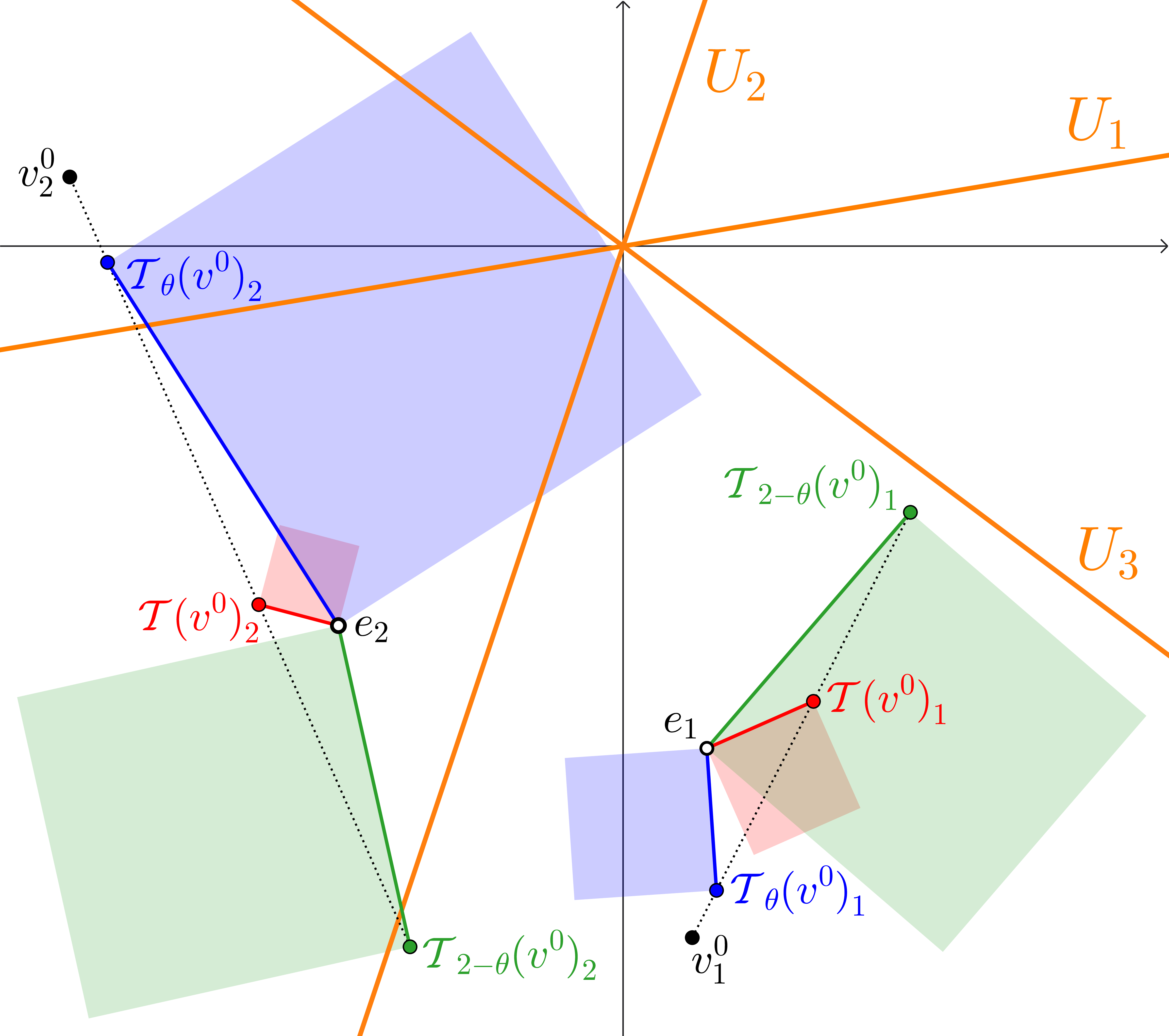
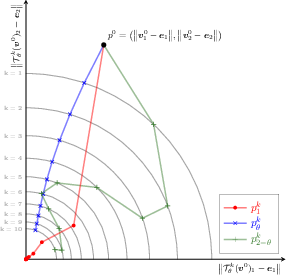
Figure 3: The value x1 interpreted geometrically as the sum of two squares, minimized for x2.
The geometric interpretation enhances intuition for the dynamical properties of the algorithm and reiterates the preferential convergence for x3.
Pathological Operator Examples
The paper provides both normal and non-normal, iso-averaged and non-iso-averaged operator constructions using different graph pairs x4, demonstrating the sensitivity of operator properties to combinatorial graph structure. These examples are essential for informing algorithm designers of potential pitfalls when extending splitting methods to intricate multi-operator scenarios.
Theoretical and Practical Implications; Perspectives
The results unify and extend the spectral and geometric understanding of relaxation dynamics in graph-structured splitting methods. Practically, setting x5 is always optimal when the graph matches its subgraph, ensuring fastest convergence; deviations from iso-averagedness necessitate parameter re-evaluation or algorithm redesign.
Theoretically, the characterization exposes new connections between matrix analysis, operator theory, and combinatorial graph properties in optimization. Future research may explore extensions to nonlinear operators, infinite-dimensional settings with more intricate subspace arrangements, or adaptive graph selection for accelerated convergence.
Conclusion
The paper rigorously establishes that the optimal relaxation parameter for graph-based splitting methods applied to subspaces is exactly x6 when the defining graph and subgraph coincide, fundamentally extending Douglas–Rachford convergence theory to a unified class of algorithms and closing previous empirical gaps. The analysis leverages iso-averaged operator theory, spectral mechanics, and graph-theoretic abstractions, with significant practical and theoretical ramifications for the design of splitting algorithms in convex optimization and monotone inclusion.

