- The paper identifies a significant structural bias favoring AmE, with over 70% frequency of American English variants in key pretraining corpora.
- It introduces DiAlign, a training-free n-gram divergence metric that achieves over 93% accuracy in classifying dialectal text.
- The study highlights that common tokenizers incur higher subword segmentation for BrE, amplifying inefficiencies in model output.
Triangulating Structural Bias Towards American English in Foundation Models
Introduction and Historical Context
This paper presents a comprehensive analysis of structural bias toward American English (AmE) in contemporary LLMs, dissecting how dialectal preference emerges through all major pipeline stages: pretraining corpora construction, tokenization, and generative output. The study is contextualized within a postcolonial framework, reflecting how the combined legacies of British colonial expansion and twentieth-century American dominance established AmE and British English (BrE) as global standards, with the former largely privileged in the digital era.
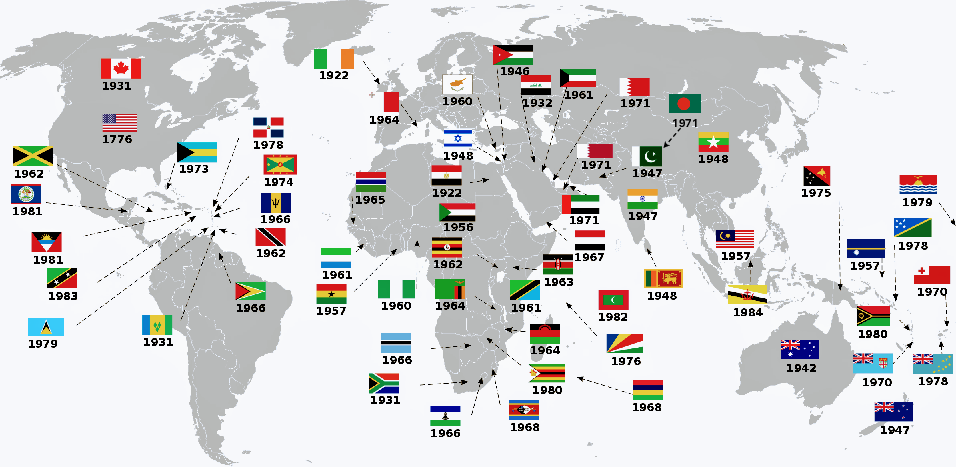
Figure 1: Timeline of political independence post-British colonization, illustrating continued institutional entrenchment of BrE in many regions.
Methodology: Dialectal Resource Construction and the DiAlign Metric
A central technical contribution is a curated lexicon of 1,813 strictly one-to-one AmE–BrE variant pairs, covering both orthographic (spelling) and lexical (vocabulary) contrasts. This enables controlled, high-precision audits of dialectal representation across pipeline components. To quantify the dialectal alignment of arbitrary text, the authors introduce DiAlign, a dynamic, training-free scoring method that leverages n-gram frequency divergences from the Google Books Ngram corpora. The procedure aggregates these signals with divergence weighting and lexicon-based boosting, producing probabilistic alignment estimates (PAmE,PBrE).
Structural Asymmetry in Pretraining Corpora
Audits of six major open-access LLM pretraining corpora, including Book Corpus, Wikipedia, Common Crawl (C4), Falcon RefinedWeb, RedPajama, and Dolma, reveal a pervasive and significant skew toward AmE forms. Across all datasets, AmE-preferred spellings reach over 70% of orthographic variant frequencies, with vocabulary-based differences consistently favoring AmE as well.
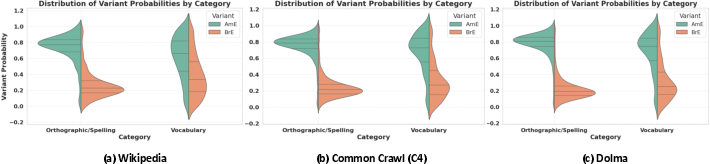
Figure 2: Violin plots: For three representative corpora, AmE variant probability densities are sharply right-skewed, especially for orthographic patterns.
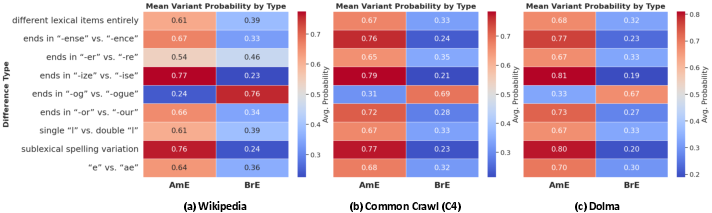
Figure 3: Mean variant probabilities by linguistic category across Wikipedia, C4, and Dolma confirm systematic AmE skew; this persists at both surface and broader structural levels.
Statistical inferencing using non-parametric tests (Wilcoxon signed-rank) verifies that these imbalances are significant (p<0.01 consistently across corpora). Notably, the orthographic skew is more extreme than that observed for lexical items, but all categories implicate AmE as the structurally preferred norm.
Dialectal Inefficiency in Tokenizer Subword Allocations
The study engages in detailed analysis of popular tokenizer architectures (e.g., GPT-4, Llama-3, StableLM, and non-U.S./European/Chinese tokenizers). The core finding is that BrE variants are systematically segmented into more subwords (“higher fertility”) than their AmE counterparts. This is particularly pronounced for vocabulary-based differences (up to 18.72% more subword splits). Fertility and long-tail granularity analyses show BrE forms are disproportionately fragmented into three or more subwords.
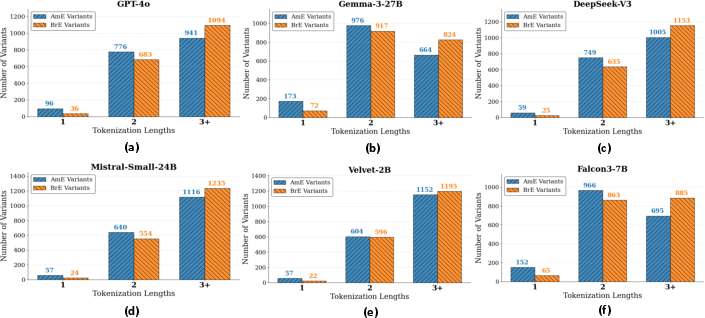
Figure 4: Across six tokenizers, BrE variants incur a much higher rate of 3+ subword segmentation, reflecting structural inefficiency and representational disadvantage.
This disparity is not uniform: tokenizers originating from outside the USA (e.g., DeepSeek-V3, Velvet-2B) exhibit reduced BrE penalty, occasionally approaching parity. However, most widely deployed tokenizers operationalize an implicit structural preference for AmE, amplifying generative and resource allocation bias downstream.
Generative Defaults: AmE as the De Facto Output
Dialectal preferences in LLM output are measured using open-domain QA generation tasks (Natural Questions and ELI5) with both default “English” and explicit “British English (en-GB)” prompt instructions. Under the default, 65–80% of generations align with AmE, frequently at high confidence (PAmE>0.80). When models are instructed to generate BrE, AmE remains overrepresented—rarely dropping below 40% in U.S.-developed models, and only attenuated in certain non-U.S. models and informal (social media-style) prompts.
Illustrative Mechanism: DiAlign
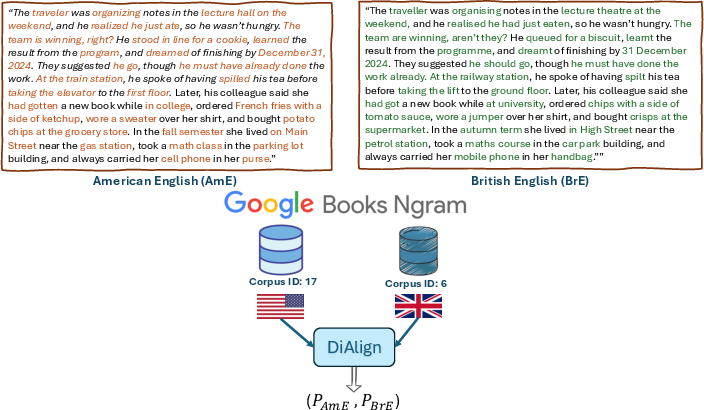
Figure 5: Example DiAlign workflow, demonstrating robust alignment of parallel AmE and BrE passages by aggregating lexical, grammatical, and multiword differences with corpus-informed frequencies.
The DiAlign tool is empirically validated against labeled news datasets (BBC for BrE, HuffPost for AmE), achieving over 93% classification accuracy with high-confidence separation between varieties. This positions DiAlign as an efficient diagnostic for corpus and generation audits.
Practical and Theoretical Implications
Three principal sources of bias are identified and triangulated: (1) overrepresentation of AmE in pretraining corpora; (2) dialect-insensitive tokenizer design leading to higher fragmentation and inefficiency for BrE forms; (3) default generative alignment toward AmE, persistent even under explicit BrE conditioning.
This structural bias has direct implications for global language technology deployment. It risks accelerating linguistic homogenization, undermines inclusion for BrE-dominant and postcolonial regions, and entrenches epistemic injustice by privileging U.S.-centric linguistic and knowledge norms. The work proposes practical mitigation strategies: dialect-aware corpus curation (e.g., upsampling BrE-aligned web domains), dialect-sensitive tokenizer extension using curated lexicons and granularity diagnostics, and reference-based alignment checking of synthetic data inclusion.
Limitations and Future Directions
While the study is limited to AmE–BrE contrasts due to resource availability and analytic tractability, the authors note that the underlying triangulation methodology is extensible to other varieties of English and more broadly to typologically related languages. Extension to code-switched, creole, and informal varieties remains an open challenge. The static nature of the curated lexicon precludes capture of newly emergent dialectal forms; future work could incorporate dynamic induction and/or multimodal sources.
Conclusion
The paper offers the first systematic, multi-faceted examination of dialectal asymmetry in LLMs, revealing a robust, pipeline-spanning structural bias toward AmE over BrE. This bias is present regardless of corpus, tokenizer origin, or explicit generative instruction, with notable statistical and practical implications for global language technology fairness. The findings call for increased rigor in dialectal audit, explicit dialect-aware design in both corpus and tokenizer pipelines, and systematic tracking of representational parity for English varieties in all phases of LLM development.

