- The paper demonstrates deterministic sub-100 fs Néel vector switching in chiral antiferromagnets via ultrafast spin current injection.
- It employs time-dependent density-functional theory with extended SU(2) vector potentials to capture femtosecond spin dynamics and the quadratic scaling of the switching rate with current amplitude.
- The study reveals robust, reversible switching among degenerate noncollinear ground states in Mn₃Sn, highlighting its potential for energy-efficient, THz-rate spintronic devices.
Ultrafast Néel Vector Switching in Chiral Antiferromagnets
Introduction and Background
The work "Ultrafast Néel vector switching" (2604.04203) provides a first-principles prediction and mechanistic analysis of Néel vector switching in chiral antiferromagnets (AFMs) via ultrafast spin current injection. Targeting Mn3Sn as a prototypical kagome AFM with pronounced anomalous Hall effect and multiple degenerate, noncollinear ground states, the study addresses a major speed discrepancy: while ferromagnetic systems have demonstrated sub-picosecond spin switching, analogous processes in chiral AFMs have remained limited to nanosecond or longer timescales, restricting their viability for ultrafast spintronic applications.
The theoretical approach leverages time-dependent density-functional theory (TD-DFT), extended to explicitly include spin-dependent vector potentials representing injected spin currents, to capture the nonequilibrium spin dynamics with full material-specific detail. This framework allows dissection of the dynamical mechanisms underlying spin reorientation under femtosecond excitation conditions, going beyond simplified torque or precessional pictures rooted in quasi-static responses.
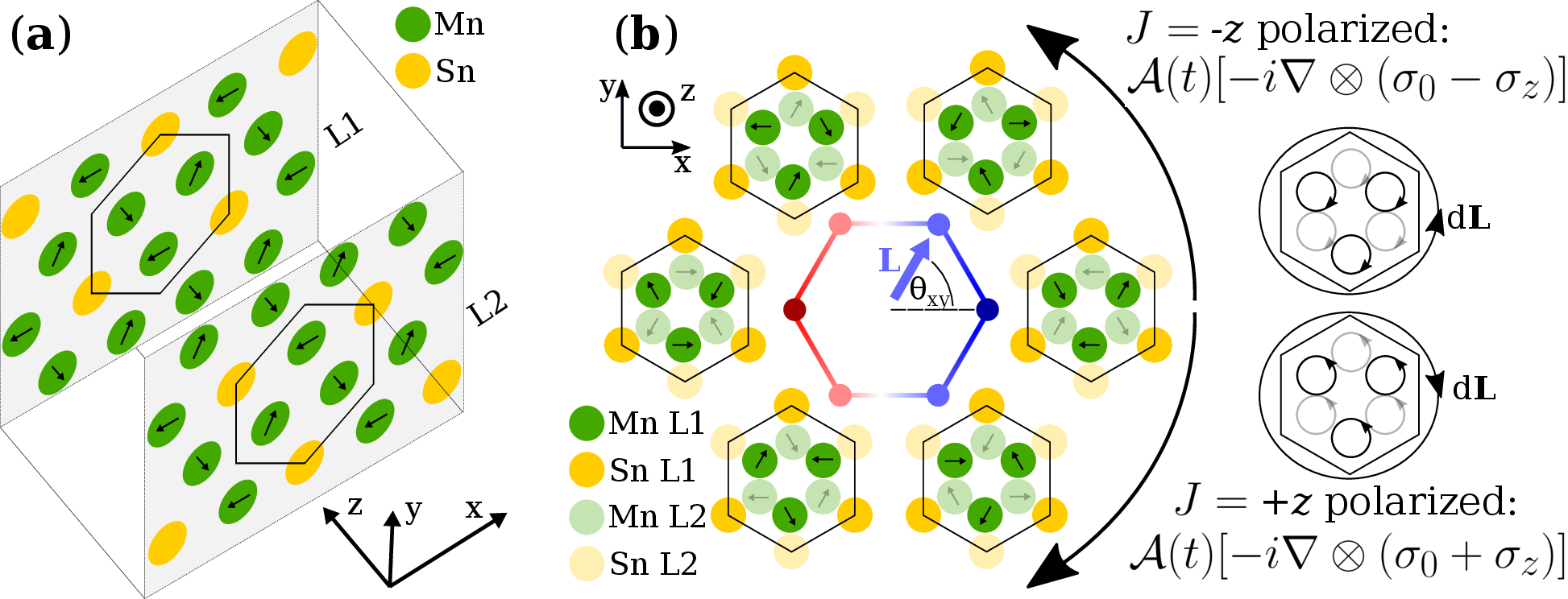
Figure 1: Schematic illustration of the Mn3Sn lattice and its six non-collinear magnetic ground states, which are separated by 60° rotations of the local moments (Néel vectors).
Mechanistic Framework and TD-DFT Simulations
The analysis centers on the compensated, noncollinear spin structure of Mn3Sn. The kagome lattice supports six degenerate Néel vector configurations, separated by 60° rotations, readily accessible due to low in-plane anisotropy. The system's nontrivial magnetic multipole order parameter enables experimentally accessible readout through anomalous Hall and Nernst effects, despite vanishing net magnetization.
TD-DFT, implemented in the Elk code with full non-collinearity and adiabatic local spin-density exchange-correlation, is used to simulate the time evolution of the magnetic order under ultrafast spin current injection. A crucial method extension models the injected spin current as a time-dependent, locally resolved SU(2) vector potential, enabling the direct simulation of transient effects of injected angular momentum.
Key Results: Femtosecond Switching via Massive Transient Fields
Application of a spin-polarized current pulse, polarized orthogonal to the Mn3Sn kagome plane, produces pronounced coherent rotation of the local moments. The primary effect is a 60° rotation of each local moment, corresponding to deterministic switching between the inequivalent noncollinear ground states, i.e., Néel vector switching.
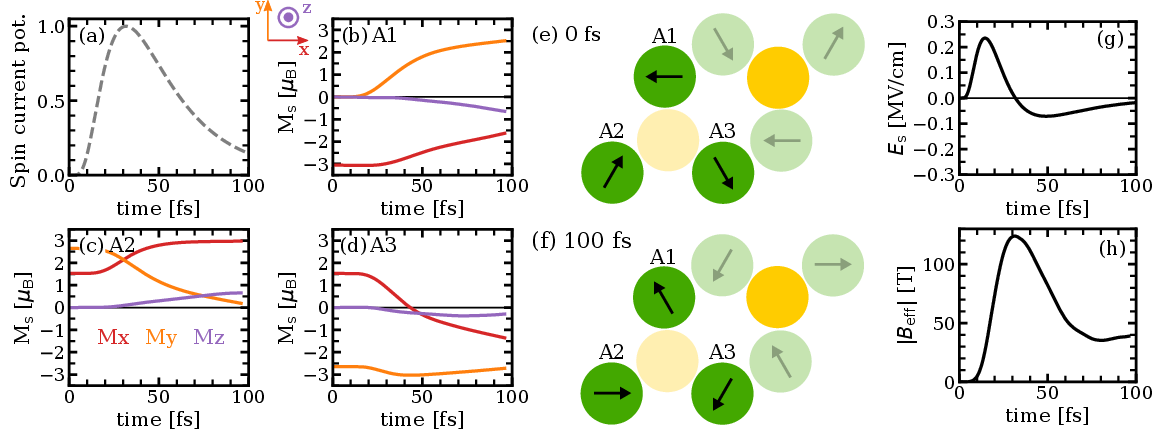
Figure 2: Ultrafast spin current injection induces coherent rotation of local magnetic moments by 60°, with the transient effective magnetic field and spin-electric field reaching extreme values, enabling femtosecond-scale switching.
The induced spin dynamics are not driven by conventional spin-orbit torque or inertia: suppressing spin-orbit coupling or varying pulse profiles does not alter the dynamics substantially. Rather, the essential mechanism is the creation of a massive transient effective magnetic field by the injected spin current, with field magnitudes approaching ~100 T but acting only for tens of femtoseconds.
Crucially, the effective magnetic field and resulting spin rotation rate scale quadratically with the amplitude of the injected spin current. This highly nonlinear response enables significant spin rotation at experimentally reasonable current densities, provided the current is sufficiently spin-polarized and intense. The study reports that even with only 1% spin polarization, switching on the order of 100 fs can be achieved at higher absolute current densities.
Robustness and Control: Spin Current Polarization Dependence
Dependence on spin current polarization is mapped in detail. The rotation rate is maximal for matched charge and spin currents (i.e., maximally spin-polarized charge current), but the effect persists over a wide range of polarizations, only vanishing for the unphysical limits of pure charge or pure spin current. Notably, the switching efficacy degrades only slightly for imperfect polarization, greatly easing experimental constraints.
The process is also reversible: sequential pulses of opposite spin polarization can repeatedly drive the Néel vector back and forth among the degenerate states.
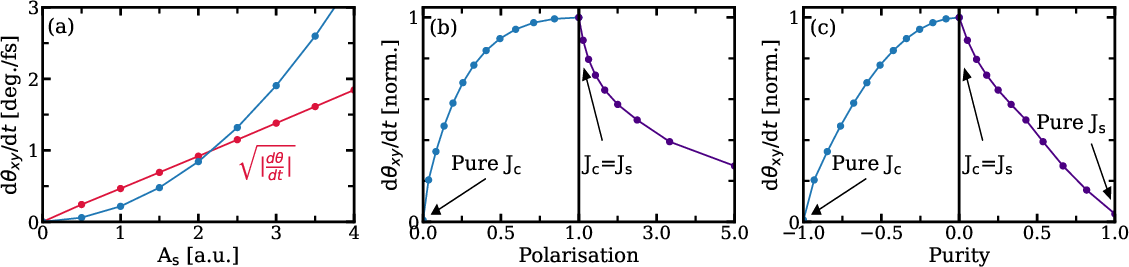
Figure 3: The rotation rate of the Néel vector displays quadratic dependence on spin current amplitude and a robust polarization dependence, remaining efficient for nonideal spin purity.
Numerical and Physical Claims
- Switching is predicted to occur on sub-100-fs timescales, nearly five orders of magnitude faster than conventional torque-driven nanosecond switching.
- The magnitude of the effective field generated by a spin current pulse is of order 100 T (transient), sufficient for large-angle coherent rotation within femtoseconds.
- The switching mechanism is not reliant on spin-orbit torque or inertia but on direct spin current-induced field effects.
- Quadratic scaling of rotation rate with spin current amplitude enables ultrafast switching at accessible current densities.
- Robust switching is achievable for spin current polarization far from ideal; 80% of the maximal effect is reached at only 35% polarization.
- The process is reversible and repeatable within the coherence times of the system.
Theoretical and Practical Implications
On a fundamental level, this work demonstrates that noncollinear AFMs with accessible multi-domain ground states, such as Mn3Sn, are suitable platforms for true femtosecond spintronic control—overcoming the severe speed bottlenecks imposed by spin-orbit mediated switching mechanisms in other systems. The mechanism elucidated is broadly generalizable to other magnetic materials supporting current-induced switching and is not unique to the kagome lattice or chiral anomalies.
On the practical front, this mechanism provides a pathway for THz-rate, energy-efficient manipulation of magnetic order in device architectures. The low stray fields intrinsic to AFMs minimize device crosstalk and enable dense integration, while the anomalous Hall response enables electrical readout even in the absence of net magnetization. The study also establishes practical recipes for maximizing ultrafast control—by optimizing both spin and charge current densities and utilizing materials supporting robust, low-energy-barrier domain configurations.
Potential device applications include ultrafast antiferromagnetic MRAM elements, neuromorphic hardware operating at THz speeds, and programmable topological antiferromagnetic platforms exploiting the multipole Hall responses of chiral AFMs.
Outlook and Future Developments
This work motivates experimental studies targeting coherent ultrafast spintronic switching in noncollinear AFMs under intense, femtosecond spin current injection, using optically generated spin sources, heterostructure engineering, and transient reflectivity or Hall probes for readout. The predicted quadratic relationship between current amplitude and rotation rate invites systematic investigation of energy efficiency and threshold behavior.
On the theoretical side, further elucidation of material-dependent nonlinearities, interface effects, dissipation and relaxation channels, and the full multimode dynamics of spin-lattice coupled systems under ultrafast driving is warranted. Exploration of sublattice-selective, valley-dependent, or topologically protected modes of switching in generalized AFM and ferrimagnetic platforms is an open direction.
Conclusion
The paper delivers a complete mechanistic and ab initio demonstration that ultrafast, deterministic Néel vector switching in chiral antiferromagnets is feasible within femtosecond timescales via ultrafast, highly spin-polarized current injection. The switching mechanism is driven by transient, massive effective fields rather than conventional precessional torques, and is robust to substantial deviations from ideal spin current purity. These findings substantially advance the theoretical and practical prospects of ultrafast spintronic devices based on antiferromagnetic and chiral materials.

