Optimal Synthesis in a Radially Symmetric Grushin Space
Published 5 Apr 2026 in math.DG | (2604.04201v1)
Abstract: We study the geometry of R<sup>3 equipped with a rotationally invariant Carnot-Carthéodory metric obtained by weighting motion in the z-direction by a function f(r) of the cylindrical radius. When f vanishes only at r=0, the space exhibits a Grushin--type singularity along the vertical axis. We provide sufficient conditions on f ensuring a Grushin--like structure and describe the full optimal synthesis at singular points. For Riemannian points, we propose a candidate cut time determined by a discrete symmetry of the Hamiltonian flow. In the integrable case f(r)=r, we prove that this candidate coincides with the true cut time and give an explicit description of the cut locus.
The paper presents the explicit characterization of geodesics in radially symmetric Grushin spaces through an optimal control framework using Pontryagin’s Maximum Principle.
It derives precise cut and conjugate loci results—including ball-box estimates and energy identities—by analyzing the Hamiltonian structure of the system.
The study extends classical sub-Riemannian analysis to singular regimes where Hörmander’s condition fails, providing tools for further research in control theory and metric geometry.
Optimal Synthesis and Geodesic Structure in Radially Symmetric Grushin Spaces
Introduction and Mathematical Framework
This work establishes a comprehensive analysis of the optimal control problem—specifically, geodesic synthesis—in a class of metric spaces on R3 endowed with a Carnot–Carathéodory (CC) metric defined by the vector fields X=∂x, Y=∂y, and Zf=f(r)∂z, where r=x2+y2 and f is a smooth, strictly increasing function vanishing only at the origin. The prototype is the radial Grushin space, which interpolates between Riemannian regions and a singular set Σ={r=0}, the latter characterized by loss of bracket-generating condition. While classical sub-Riemannian geometries require Hörmander’s condition, the author extends the analysis to a regime where it fails on a codimension-2 set but regularity and optimal control theory are nonetheless maintained.
The class of admissible functions f∈F encompasses f(r)=rα (α≥1), as well as higher vanishing order and non-monomial examples. The main achievements are an explicit characterization of minimizing geodesics starting at singular and regular points, new bounds and characterizations of cut and conjugate loci, explicit results for the integrable case X=∂x0, and precise "ball–box" estimates on the induced geometry.
Control Theoretic and Hamiltonian Structure
The geodesic equations are derived via Pontryagin’s Maximum Principle for the control system driven by X=∂x1. The Hamiltonian
X=∂x2
on X=∂x3 is smooth away from X=∂x4 and X=∂x5 globally due to the imposed regularity on X=∂x6. The analysis confirms that all length-minimizing curves are normal extremals, with abnormal trajectories excluded except for constant (trivial) solutions.
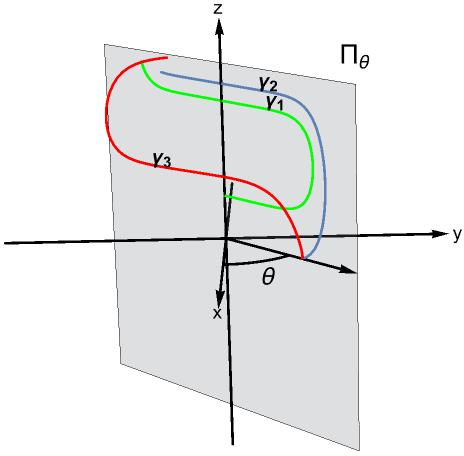
Two conservation laws, energy and a generalized angular momentum X=∂x7, stratify the geodesic flow into three regimes:
Singularity-attached (X=∂x8 and initial point on X=∂x9),
Planar (Y=∂y0 but off Y=∂y1),
Non-planar/oscillatory (Y=∂y2).
Figure 1: Schematic of the three geodesic regimes: origin-attached, planar-invariant, and oscillatory-excluding the singular set.
The analysis of the radial ODE for Y=∂y3 showcases how the interplay between the radial degeneracy (via Y=∂y4) and angular momentum governs accessibility and optimality. The equations reduce to integrable systems in specific cases, notably Y=∂y5.
Geodesic Synthesis at Singular and Regular Points
Singular Initial Data and Planar Geodesics
For initial points on Y=∂y6, all directions are equivalent due to rotation symmetry, and the constrained geodesic equations become ODEs in a vertical half-plane: Y=∂y7
where Y=∂y8 is the odd extension of Y=∂y9. The "energy" identity
Zf=f(r)∂z0
immediately yields periodic behavior for Zf=f(r)∂z1, with explicit expressions for turning points and periods. The cut time for these geodesics is shown to occur at the first recurrence to Zf=f(r)∂z2, with the corresponding locus forming the axis itself: Zf=f(r)∂z3
for Zf=f(r)∂z4.
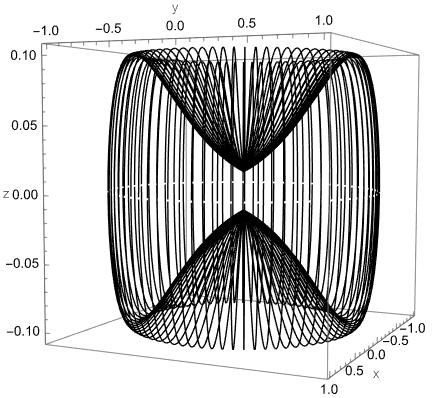
Figure 2: Projection of the unit CC-ball centered at the singular point, visualizing anisotropic metric dilation induced by the Zf=f(r)∂z5-weighted structure.
Riemannian Points and Non-Integrable Cases
For Zf=f(r)∂z6, geodesics split into regimes by the angular momentum. For Zf=f(r)∂z7, they remain in a plane through the origin and are analogous to higher-dimensional planar Grushin geodesics. For Zf=f(r)∂z8, the flow is truly three-dimensional and oscillatory, and collisions with Zf=f(r)∂z9 are dynamically suppressed.
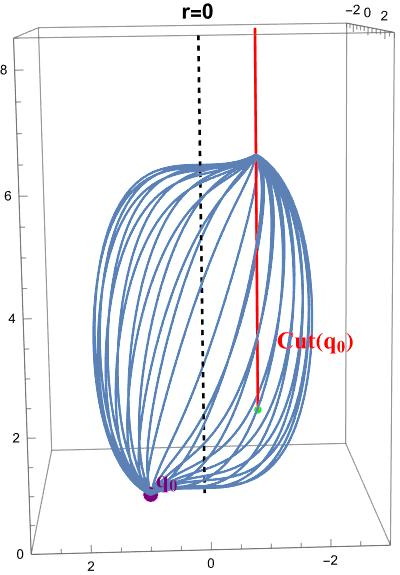
The author constructs minimizing geodesics and an explicit "symmetrizing" procedure: each geodesic r=x2+y20 with r=x2+y21 has a reflection-symmetric counterpart r=x2+y22, and their first intersection provides an upper bound for the cut time r=x2+y23: r=x2+y24
with equality established for r=x2+y25. This mechanism generalizes the "Maxwell set" approach in nilpotent approximations and yields new insights into optimal synthesis beyond classical sub-Riemannian cases.
Figure 3: Cut locus for a Riemannian starting point r=x2+y26, illustrating the locus of points reached by distinct minimizing geodesics at cut time r=x2+y27.
Jacobian Reduction and Conjugate Times
A technical highlight is the reduction of the computation of conjugate times to a tractable Jacobian determinant of the endpoint mapping in appropriate coordinates (on the energy shell r=x2+y28). Through a sequence of variable reductions and investigation of limiting regimes, the author gives a robust argument that, for r=x2+y29, the first conjugate time for all non-straight geodesics arises at
f0
which coincides precisely with the cut time previously computed. This identification is rigorously justified via a specialized "extended Hadamard" technique, leveraging covering space properties of the exponential map and local diffeomorphicity. The analysis further clarifies that straight line geodesics do not incur conjugate points, providing a complete optimal synthesis in the integrable case.
Ball-Box Estimates and Metric Geometry
Using the explicit geodesic structure, the author derives sharp "ball-box" estimates: f1
where f2 is the inverse of f3, generalizing classical Grushin ball-box scaling. This demonstrates how the presence of the degeneracy at f4 produces a rapid divergence of the vertical metric in the vicinity of f5, influencing the growth of CC balls and hence all issues of analysis (e.g., volume and heat kernel bounds, measure contraction) in this setting.
Extensions, Limitations, and Open Problems
A significant outcome is the demonstration that the lack of the Hörmander condition on f6 does not preclude the development of a complete, well-posed metric geometry, nor does it obstruct fine optimal synthesis results, at least for f7 in the specified class. However, for general f8, especially non-integrable or non-monomial growth, the behavior of conjugate and cut times is highly sensitive to the function's detailed asymptotics, and full extension of the Hadamard approach remains an open challenge. The analysis for f9, Σ={r=0}0, indicates the possibility of more complicated cut loci and suggests the need for novel comparison or variational techniques.
The explicit structure uncovered for Σ={r=0}1 makes immediate further study of geometric properties—such as the measure contraction property, volume growth, and heat kernel asymptotics—available. These have direct implications for geometric analysis, optimal transport, and stochastic processes on singular metric spaces.
Conclusion
This work presents a thorough optimal synthesis for geodesics in radially symmetric Grushin spaces, fills a significant gap in the detailed characterization of control and metric-theoretic phenomena in spaces with symmetry-adapted singularities, and sets the stage for further advances in both the geometric analysis and control theory of sub-Riemannian-type structures with degeneracies. The methods developed, particularly the precise reduction of conjugacy and cut phenomena in the integrable case, provide tools and benchmarks for tackling more complex singular geometries and may influence the study of generalized heat flow, random processes, and metric measure invariants in the absence of global bracket-generating conditions.
Reference: "Optimal Synthesis in a Radially Symmetric Grushin Space" (2604.04201)