- The paper demonstrates that nonlocal hyperdissipative corrections in the 3D Navier-Stokes system achieve global regularity when the dissipation exponent meets the Lions threshold α = 5/4.
- It introduces a precise Fourier-symbol criterion to distinguish genuinely hyperdissipative perturbations from lower-order convolution modifications, ensuring effective spectral damping.
- The analysis reveals that as the hyperdissipation parameter vanishes, uniform energy control breaks down, potentially facilitating singularity formation in classical 3D flows.
Nonlocal Hyperdissipative Perturbations of the Three-Dimensional Navier-Stokes System
Introduction and Problem Setting
The study investigates the three-dimensional (3D) incompressible Navier–Stokes system perturbed by a nonlocal dissipative term defined via a Fourier multiplier operator. Specifically, it considers the PDE
∂tu+(u⋅∇)u+∇p=νΔu+Lu,∇⋅u=0,
where L is a selfadjoint Fourier multiplier with symbol comparable to −∣ξ∣2α for α>1. The authors systematically analyze when such nonlocal hyperdissipative corrections truly impact the large-data regularity theory (as opposed to lower-order convolution modifications which are mathematically harmless).
A sharp criterion is developed, separating lower-order and genuinely regularizing perturbations at the level of the Fourier symbol. The system’s critical threshold for global regularity is shown to coincide with the classical Lions exponent α=45, even when the local Laplacian is replaced by a wider class of nonlocal operators.
Symbol Class Analysis and Regularity Criteria
A major contribution is the explicit Fourier-symbol criterion distinguishing the classes of convolution-type perturbations in question.
- Order-zero and first-order convolutions (e.g., L realized via convolution with L1 kernels, or with first derivatives): These result in bounded or at most linear-in-∣ξ∣ growth of the symbol. Such corrections are strictly lower order and cannot address supercriticality in the 3D case.
- Genuinely hyperdissipative corrections (e.g., L corresponding to a symbol m(ξ) with coercive growth L0, L1): Only these produce spectral damping strong enough to fundamentally alter the global well-posedness landscape.
This distinction is made precise in the analysis of linear damping rates.
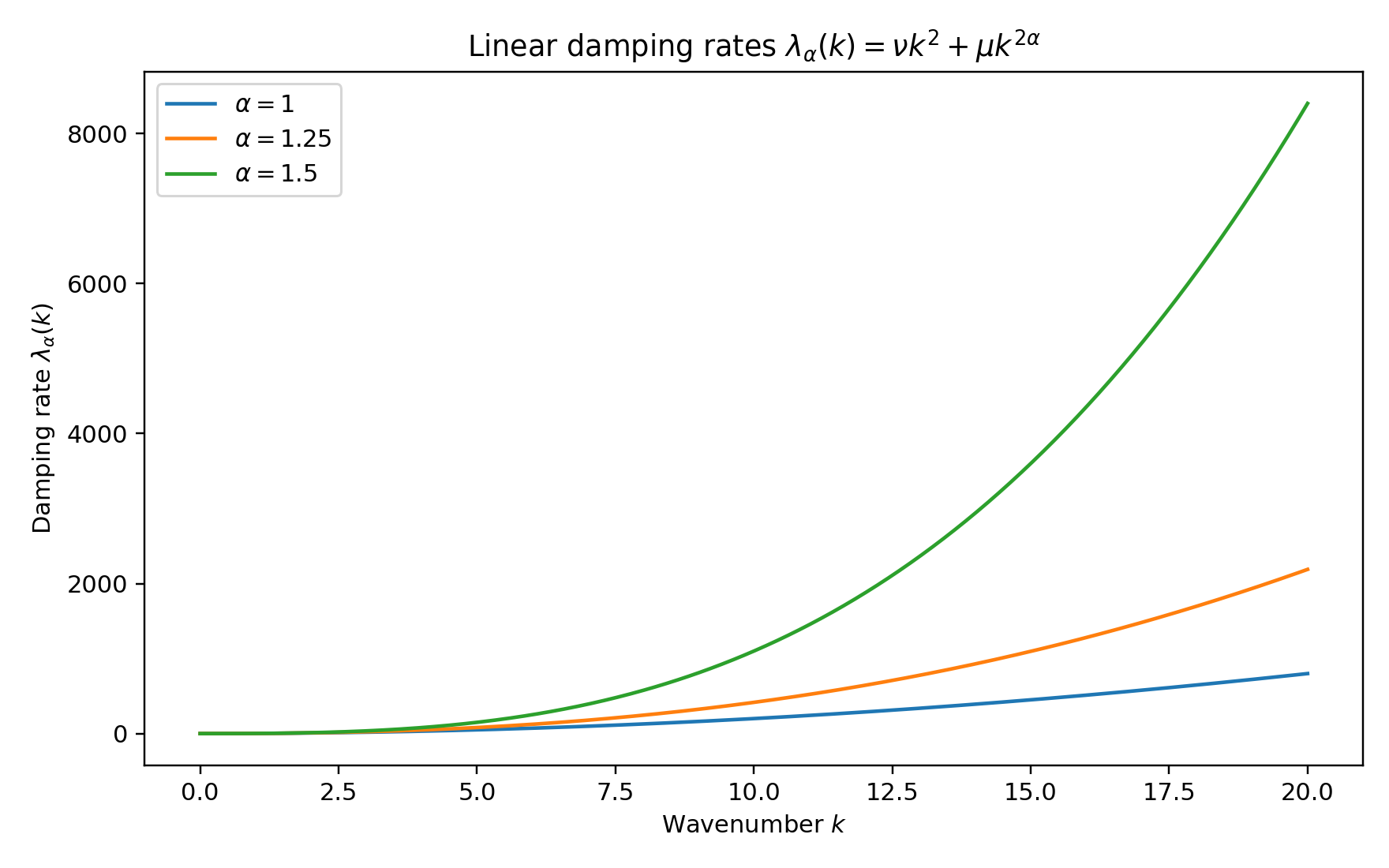
Figure 1: The linear damping rate L2 for several L3, showing that large L4 induces dominant high-frequency damping.
The critical scaling analysis confirms that L5 is the unique exponent at which the L6 energy is invariant under the self-similar rescalings compatible with the nonlinearity and the hyperdissipative term.
Main Results: Well-posedness regimes
For symbols in the hyperdissipative class, the following hold:
- Exact L7 energy identity: Extends naturally to the nonlocal setup due to the selfadjoint structure.
- Global weak solvability for every L8: Using the L9 energy method combined with spectral coercivity.
- Local strong well-posedness in −∣ξ∣2α0 for −∣ξ∣2α1: Based on established bilinear estimates and parabolic energy methods.
- Global strong solvability for all data when −∣ξ∣2α2: Reflecting that the Lions threshold remains critical in this general setting.
- Global small-data solvability for all −∣ξ∣2α3: Strong solutions exist for initial data with small −∣ξ∣2α4 norm, even if the equation remains energy-supercritical for large data, −∣ξ∣2α5.
Within these regimes, nonlinear energy estimates and critical Sobolev product bounds are carefully developed, isolating the precise role of the nonlocal dissipation. The sufficiency of the power-growth condition on the symbol is demonstrated to control both bilinear and commutator terms, which are essential for propagation of high-regularity norms.
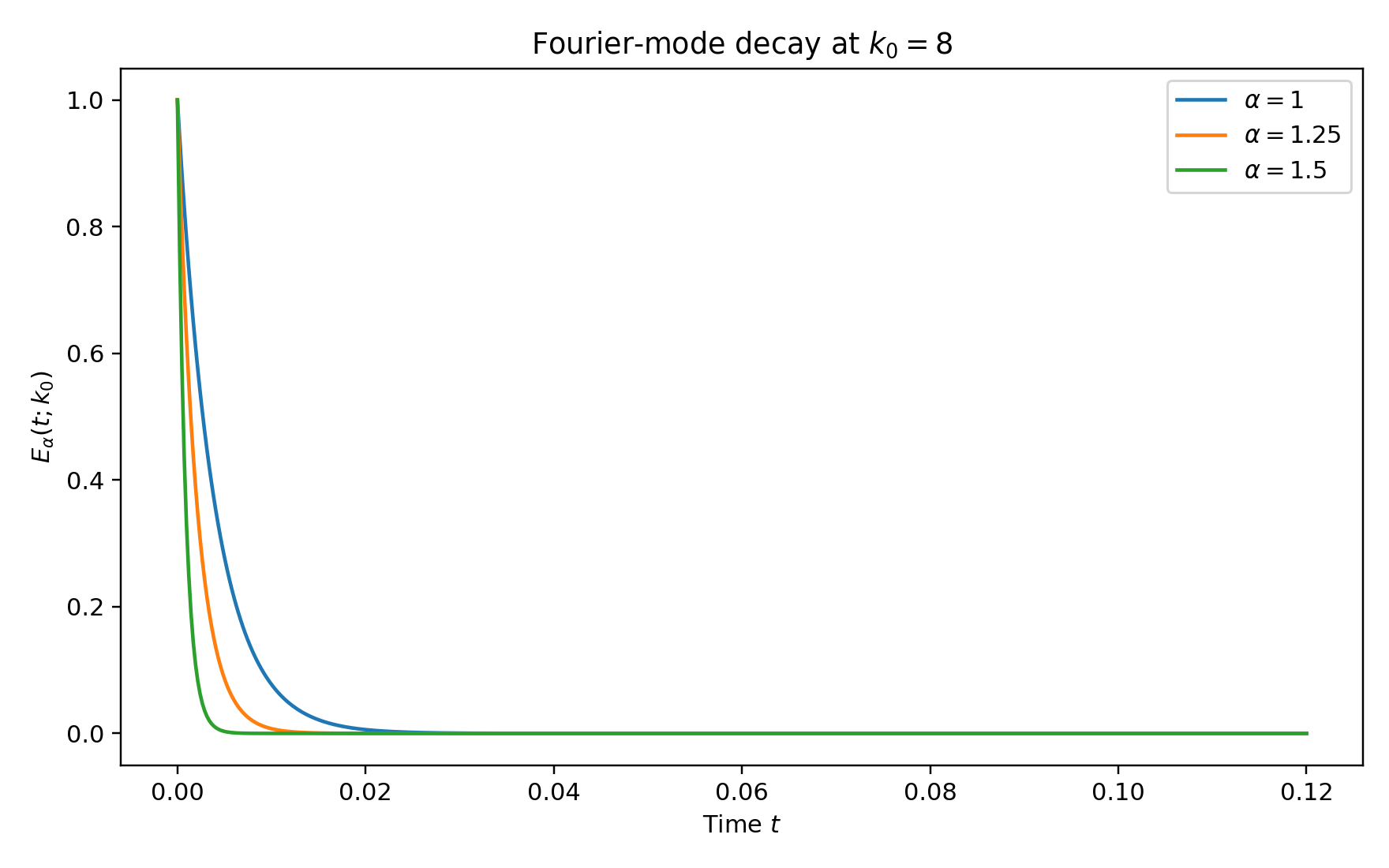
Figure 2: Decay of a representative Fourier mode under the linearized dynamics for different −∣ξ∣2α6; increasing −∣ξ∣2α7 rapidly accelerates high-frequency dissipation.
A central analytical issue is the behavior of the system in the "vanishing-hyperdissipation" limit—where the nonlocal hyperdissipative term parameter −∣ξ∣2α8, recovering the classical Navier–Stokes system. For each fixed −∣ξ∣2α9, the problem is globally well-posed above the Lions threshold. However, the uniformity of the energy and higher-order Sobolev estimates degrades as α>10:
- The high-regularity bounds (e.g., in α>11) incur constants diverging as α>12, reflecting loss of compactness and possible turbulent energy accumulation at progressively higher frequencies.
- It is rigorously proved that any hypothetical singularity (finite-time blow-up) for the classical system must manifest as a non-uniformity: for any scale-critical continuation norm α>13, the regularized family cannot remain uniformly bounded in α>14 on intervals approaching the singular time.
This is formalized by a precise near-singular divergence principle, demonstrating that necessary conditions for singularity imply concentration at the spectral crossover scale. However, the analysis does not construct counterexamples or identify whether such concentration occurs in actual 3D flows.
Spectral Regimes and Physical Models
The framework is sufficiently general to cover operator-valued symbols and nonlocal viscosity laws arising from convolution of second derivatives, filtered variable-viscosity models, and fractional Laplacians (α>15). This encompasses both classical and modern turbulence closures. The transition across α>16 is sharply visible in the spectral damping rates and temporal decay of Fourier modes, with figures illustrating the transition from Laplacian to hyperdissipative dominance as α>17 increases.
The practical implications extend to the analysis and design of subgrid models and hyperviscosity, where improper tuning of the dissipation exponent affects the balance between regularization and physical fidelity: increasing α>18 provides more control but may suppress key inertial-range features in turbulent spectra.
Open Problems and Directions
The work identifies the analytic locus at which uniform control is lost in the vanishing-hyperdissipative limit—specifically, in continuation classes critical for the original Navier–Stokes system. While global regularity is certified for all fixed-parameter families with α>19, no scale-invariant uniform bounds are available as α=450. The possibility of constructing a true blow-up solution by forcing energy to concentrate at ever smaller scales (even in the presence of hyperdissipation) remains unresolved.
The natural open directions are:
- Sharp characterization of concentration/compactness scenarios at the spectral crossover scale.
- Construction or exclusion of nontrivial rescaled blow-up profiles in the vanishing-hyperdissipation regime.
- Further development of structure-preserving nonlocal models that preserve regularity without destroying the physical turbulence cascade.
Conclusion
This work establishes a precise spectral criterion for when nonlocal dissipative perturbations affect large-data regularity in the 3D Navier–Stokes system. The Lions threshold α=451 remains critical in this broad nonlocal class, with global strong solvability for all smooth data above it, and uniform breakdown of control as the hyperdissipation parameter vanishes. Although the results rigorously bound what can and cannot be achieved by regularization schemes of this type, the classical large-data problem for the 3D system remains open, and the actual structures of loss of compactness and singularity formation demand further investigation.