- The paper introduces HMIMO, a paradigm shift from conventional MIMO architectures, achieving efficient beamforming with a reduced number of RF chains.
- It presents a comparative analysis, showing HMIMO's superior hardware scalability, energy efficiency, and spatial multiplexing in challenging NTN environments.
- A LEO satellite case study demonstrates that HMIMO-enabled systems consistently enhance sum-rate performance under LoS-dominated conditions.
Advanced Holographic Multi-Antenna Solutions for Global Non-Terrestrial Network Integration in IMT-2030 Systems
IMT-2030 NTN Integration and System Architecture
IMT-2030 mandates seamless, high-capacity, and resilient global coverage, including terrestrial and non-terrestrial domains. Integration of terrestrial networks with NTNs—spanning LEO satellites, HAPS, and UAVs—extends broadband access to maritime, rural, and underserved urban areas. The envisioned NTN landscape exploits the varied advantages of different platforms, with LEO satellites offering the most attractive balance between latency and coverage due to their proximity and capacity for constellation-based spatial diversity.

Figure 1: Illustration of NTN integration as envisioned in IMT-2030, where satellites, HAPS, and UAVs complement terrestrial coverage infrastructure to serve maritime, rural, and urban areas.
NTNs are challenged by extreme mobility, severe path loss, atmospheric effects, stringent onboard resource constraints, and dynamic, time-varying network graphs. Most notably, the high velocity of LEO satellites induces pronounced Doppler and rapid channel variation, significantly increasing the complexity and demand on channel estimation and beamforming orchestration. The resource limitations on aerial platforms, including energy and mass budgets, further constrain the scalability of conventional antenna solutions. Additionally, performance stability is threatened by frequent handovers and unpredictable propagation, complicating QoS assurance and multi-user coordination.
Existing NTN architectures predominantly rely on multi-beam, massive MIMO, distributed MIMO, and RIS-assisted frameworks. Multi-beam schemes utilize phased arrays for spatial multiplexing but require complex beam management and rely on additional multiple access techniques to scale user connectivity. Massive MIMO architectures provide high array gains to counter path loss but become untenable for NTN platforms owing to excessive RF chain requirements and compromised spatial multiplexing in LoS-dominated environments, necessitating techniques such as user grouping and ML-based precoding to mitigate performance degradation.
Distributed MIMO distributes antenna arrays across constellations or aerial clusters, leveraging spatial diversity and extended footprints. While this approach alleviates some energy and coverage constraints, mobility-induced Doppler and synchronization complexity persist. RIS-assisted architectures facilitate cost-effective phase control and wavefront shaping, suitable for LoS augmentation and interference mitigation, yet their efficacy is limited in sparse multipath conditions and typically hinges on terrestrial deployments or clustering for robust performance.
HMIMO: Principles, Architectures, and Advantages for NTN
HMIMO represents a paradigm shift from conventional MIMO architectures. Instead of discrete, λ/2-spaced radiators, HMIMO employs quasi-continuous metasurface apertures densely packed with tunable elements, illuminated by a small set of shared RF feeds. This enables high antenna gain and flexible beamforming with reduced physical footprint and dramatically fewer RF chains—critical for resource-constrained NTN platforms.
HMIMO architectures span leaky-wave antennas (RHS), microstrip-driven DMAs, transmissive RISs (T-RIS), and stacked intelligent metasurfaces (SIM). These configurations leverage sub-wavelength element spacing to synthesize precise electromagnetic holography, facilitating narrow beams, spatial focusing, enhanced wavefront shaping, and efficient side-lobe suppression.
Comparative Assessment: HMIMO vs. Conventional MIMO
HMIMO outperforms conventional MIMO in RF hardware scalability, energy efficiency, and aperture compactness. Sub-wavelength element spacing allows finer-resolution beamforming and reduces hardware burden by limiting the number of required RF chains—a decisive advantage given the severe power and mass constraints on LEO satellites, HAPS, and UAVs. HMIMO also achieves superior aperture gain per unit area and directivity under LoS-dominated NTN channels, facilitating improved spatial multiplexing where conventional MIMO struggles with channel orthogonality and multiplexing rank.
However, HMIMO introduces heightened sensitivity to mobility-induced Doppler effects due to its narrow beams and directivity, and mutual coupling effects among closely spaced elements necessitate advanced electromagnetic modeling. Despite its emerging maturity, HMIMO overcomes most fundamental hardware and wavefront limitations restricting conventional MIMO—making it a compelling candidate for IMT-2030 NTN integration.
The paper presents a case study involving a LEO-based multi-user communication system, where satellites are equipped with HMIMO arrays and ground base stations deploy transmissive RIS (T-RIS). The satellites form cooperative clusters, orchestrating hybrid digital and analog holographic beamforming. On the ground, RIS-ABSs steer incident waves for optimized downlink delivery to mobile users, with the overall system aiming to maximize sum-rate under MMSE constraints.
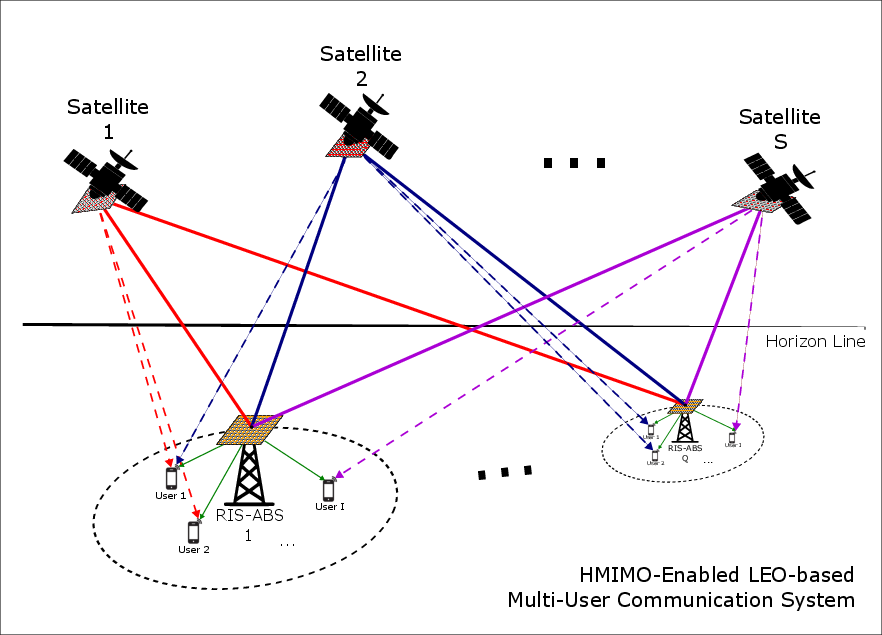
Figure 2: Proposed HMIMO-enabled LEO satellite architecture for multi-user communication via RIS-ABS.
Monte Carlo results demonstrate that sum-rate consistently increases with element count due to higher array gain, with optimal performance observed when LoS links dominate between RHS-equipped satellites and users. These numerical results reveal that HMIMO supports feasible multi-user connectivity, achieving sum-rate levels in line with practical satellite communication benchmarks.
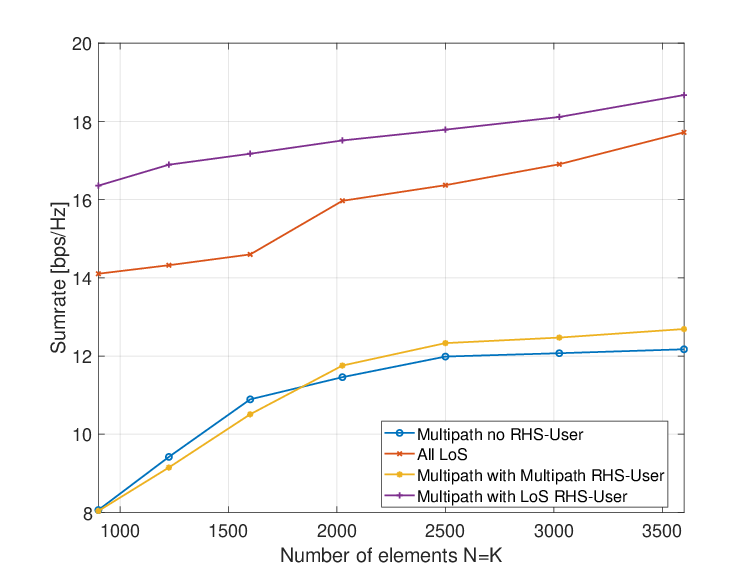
Figure 3: Sum-rate as a function of the number of elements (N=K) for RHS and T-RIS under various channel conditions.
Implications and Future Research Directions
The deployment of HMIMO within NTN unlocks key opportunities, including global-scale IoT, integrated access and backhaul (IAB), ISAC, dynamic overlay networks for resilience and load balancing, and advanced physical-layer security. Narrow HMIMO beams enable traffic offloading and interference nulling surpassing conventional MIMO capabilities.
Despite these advantages, HMIMO poses open technical challenges requiring further research:
- Compactness and Lightweight Materials: Maximizing aperture density without exceeding mass or geometric limits of aerial platforms.
- Efficient Signal Processing: Addressing increased orchestration demands by leveraging advanced deep learning and fast CSI estimation strategies.
- Adaptive Beamforming: Mitigating sensitivity to mobility and atmospheric variations through responsive beam tracking and optimization.
- Multi-Band Operation: Ensuring frequency-flat performance across wideband, multi-band NTN links.
- Advanced Channel Modeling: Developing mutual-coupling-aware models that accurately reflect propagation in NTN environments, accounting for LoS-dominated and atmospheric variability.
Conclusion
Advanced HMIMO represents a viable alternative to conventional MIMO for enabling IMT-2030 NTN-terrestrial integration, addressing power, mass, and scalability constraints intrinsic to aerial platforms. The case study validates HMIMO's practical feasibility and competitive performance in LEO-based multi-user systems. HMIMO’s architectural flexibility, hardware efficiencies, and wavefront control capabilities align strongly with the requirements of global broadband coverage. While open challenges persist, HMIMO is poised to drive the evolution of antenna solutions for future NTN-enabled mobile communication systems.