- The paper presents a comprehensive analytical framework deriving closed-form expressions for energy harvesting from LEO satellite grids.
- It demonstrates a quadratic scaling law (harvested energy ∝ M·N²) and integrates key system parameters, including phase misalignment effects.
- Extensive simulations validate practical thresholds and dependencies on frequency and altitude, offering design guidelines for emergency power delivery.
Wireless Energy Transfer from Space to Ground via Satellite Constellation Grids
Introduction and Problem Statement
This work presents a comprehensive framework for satellite-enabled wireless energy transfer (WET) targeting wirelessly chargeable devices (WCDs) in remote and disaster-affected regions, where conventional power delivery is infeasible. The proposed paradigm utilizes low Earth orbit (LEO) satellite grids—multi-satellite constellations with multi-antenna capability—to transmit energy to ground-based WCDs via RF power beaming. This approach is motivated by the global proliferation of LEO constellations and their potential for ensuring connectivity and power access in off-grid scenarios.
The research addresses fundamental gaps in prior literature that has focused either on terrestrial/aerial WET infrastructures or narrow aspects of space-based RF energy delivery, often without deriving closed-form harvested energy expressions or explicitly assessing system scalability with respect to satellite and antenna counts.
System Model and Analytical Derivations
A rigorous analytical model is developed based on a multi-satellite, multi-antenna grid orbiting with well-defined geometry. The model assumes LOS conditions and utilizes the Friis transmission equation, with the satellite-to-ground channel characterized by shadowed Rician fading. The distance-dependent harvested power is formally described, including receiver sensitivity thresholds and energy conversion efficiency.
The system layout is visually summarized:
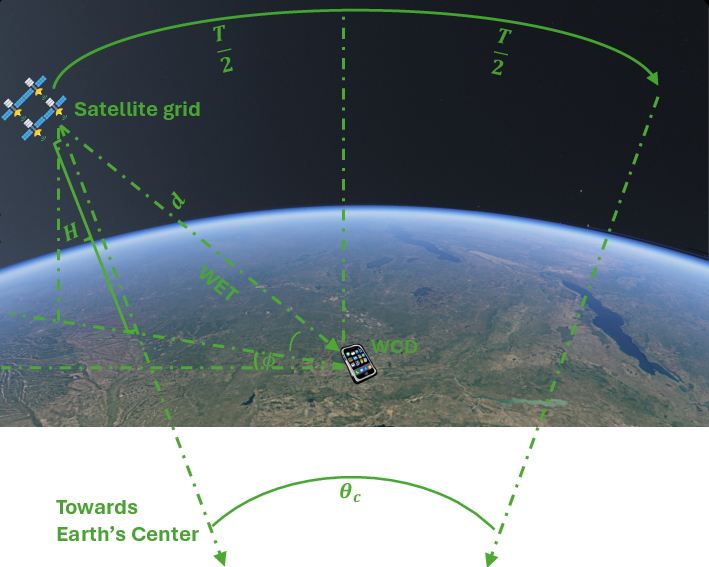
Figure 1: A satellite grid transferring energy to a WCD.
The harvested power at the WCD incorporates a non-linear, thresholded efficiency model to capture practical circuit limitations. The main technical contribution is the derivation of closed-form expressions for the total harvested energy over the device's charging visibility window, analytically integrating system parameters including orbit altitude, satellite count, antenna configurations, operating frequency, and azimuth plane inclination.
A critical finding is the quadratic scaling law under maximum ratio transmission (MRT): with N satellites, each having M antennas, harvested energy upper-bound grows as MN2 due to coherent combining. This demonstrates functional equivalence between densifying satellites and equipping satellites with additional antennas. Explicit consideration of phase misalignment is included, quantifying the degradation in energy delivery due to synchronization errors.
Numerical Analysis and Key Results
Extensive simulations are conducted, relying on empirically chosen system and channel parameters consistent with practical LEO operation. Key insights are as follows:
- Harvested Energy vs. Satellite Count: Minimum constellation sizes are established for practical WCDs (e.g., 9 satellites for Pth=−10 dBm), with harvested energy strongly increasing with satellite and antenna numbers. Even small azimuth misalignments (e.g., 1°) cause pronounced drops in energy capture.
- Frequency Dependency: Results reveal the stringent impact of increasing carrier frequency on received power due to path loss. A grid of 10 satellites becomes ineffective above 950 MHz, while 20 satellites remain viable up to ~1.9 GHz.
- Orbital Altitude: The maximum feasible charging altitude is shown to depend on satellite count, with higher constellations requiring larger grids due to geometric spreading and path loss.
- Charging Efficiency: The fraction of available energy successfully harvested is shown to be highly sensitive to both receiver sensitivity and orbital inclination. Energy delivery is sharply reduced as the satellite grid’s ground track deviate from the WCD location.
- Phase Misalignment: Increasing phase noise variance among satellites directly reduces charging efficiency, confirming the critical importance of phase synchronization in distributed beamforming regimes.
Implications and Prospective Extensions
The theoretical framework and simulation results provide quantifiable benchmarks for the practical deployment of orbital WET systems. Notably, delivering on the promise of millijoule-level energy capture in realistic disaster/remote scenarios is contingent upon optimizing satellite geometry, enhancing WCD circuit sensitivity, and maintaining strict phase alignment across the array. The established scaling laws enable clear trade-off analysis between constellation size and satellite antenna densification, with implications for economic planning and launch resource allocation.
On a broader theoretical level, the models extend naturally to scenarios involving simultaneous wireless information and power transmission (SWIPT), integration with satellite-based IoT connectivity platforms, or hybrid systems utilizing laser-based WET for higher power densities.
Future research directions include atmospheric modeling for higher frequency operation, orbit optimization under stochastic coverage constraints, and the development of practical synchronization methods for satellite beamforming under non-ideal hardware constraints. The potential to extend the framework to modulation-based information-energy co-transfer, as hinted via noise modulation concepts, opens new avenues in integrated space-ground communications.
Conclusion
This paper delivers a foundational analytical and simulation-based study of wireless energy transfer from LEO satellite constellation grids to ground-based low-power devices. By deriving closed-form energy expressions, establishing scaling laws for satellite/antenna deployment, and rigorously accounting for practical circuit and synchronization constraints, the framework sets baseline performance expectations and design guidelines for future space-enabled WET infrastructure. The findings have direct implications for emergency communications, IoT activation in remote regions, and future satellite system design aimed at robust, infrastructure-independent power delivery.

