- The paper presents LSALM, a retraction-free, single-loop primal-dual approach that bypasses costly manifold projections for orthogonality constraints.
- It introduces a linearized smoothing augmented Lagrangian technique that combines explicit primal and dual updates to ensure robust convergence and scalability.
- Empirical evaluations show LSALM outperforms traditional methods on sparse PCA and graph matching, achieving optimal iteration bounds and efficient parallelization.
Primal-Dual Algorithms for Nonsmooth Nonconvex Optimization with Orthogonality Constraints
Problem Formulation and Context
The paper "Primal-Dual Methods for Nonsmooth Nonconvex Optimization with Orthogonality Constraints" (2604.04130) tackles the structured minimization problem
X∈Rm×nminf(X):=ℓ(X)+g(X)s.t.X⊤X=In
where ℓ is smooth, g is weakly convex and proximal-friendly, and the feasible set is the Stiefel manifold. This class subsumes tasks such as sparse PCA, low-rank matrix completion, group synchronization, dictionary learning, and orthogonal parameterizations in deep networks. While Riemannian optimization is prevalent for these problems, nonsmoothness and nonconvexity severely complicate manifold-based algorithms due to subproblem complexity, feasibility drift, and poor scalability.
Algorithmic Contributions
The authors present a retraction-free, single-loop primal-dual framework (LSALM) for nonsmooth nonconvex optimization with orthogonality constraints. The approach departs from the Riemannian paradigm by operating in the ambient Euclidean space and exploiting primal-dual dynamics to enforce the orthogonality constraint via explicit Lagrange multipliers, thereby avoiding projection or retraction operators onto the Stiefel manifold. The nonsmooth term is handled by a linearized smoothing augmented Lagrangian approach:
- The primal step employs a surrogate augmented Lagrangian, linearizing the smooth terms and introducing both a proximal regularization and a Moreau-Yosida smoothing of the nonsmooth part, so each iterate is explicit and subproblems are avoided.
- The dual update is explicit, with Tikhonov regularization, ensuring multipliers remain bounded and the iterates stay sufficiently feasible without inner iterations.
- All major steps consist of only matrix multiplications and proximal operations, conducive to large-scale parallel implementations.
The algorithm is formulated as a single-loop update, contrasting with standard double-loop methods that require solving inner subproblems (often via expensive SVDs or Newton methods).
Theoretical Analysis
Iteration Complexity
The paper establishes an O(ϵ−3) iteration bound for producing ϵ-KKT points, matching the strongest guarantees for manifold-based methods on the Stiefel manifold, and improving on existing retraction-free alternatives.
- Explicit conditions on parameters ensure convergence and stability, with rigorous descent analysis based on a carefully constructed potential function (blending primal, dual, and penalization energies).
- The method leverages a local constraint qualification (UCQ) for the orthogonality constraint to guarantee that stationary points of a quadratic penalty on X⊤X=In yield exact feasibility.
- Asymptotic sequential convergence is shown under the standard Kurdyka-Łojasiewicz (KŁ) property, which holds for semi-algebraic structured problems, ensuring the iterates converge to an O(ε)-KKT point in the limit.
Practical Robustness
The algorithm’s convergence is robust with respect to stepsizes and penalty parameters, and does not require the large penalty multipliers that destabilize smoothing-based or manifold penalty methods, due to its explicit balancing of primal and dual updates.
Empirical Evaluation
Extensive experiments validate the theoretical findings using both synthetic and real data.
Parameter Range Robustness
The feasible parameter regime for LSALM is broad, and the algorithm reliably converges across a variety of tuning choices (see (Figure 1)):
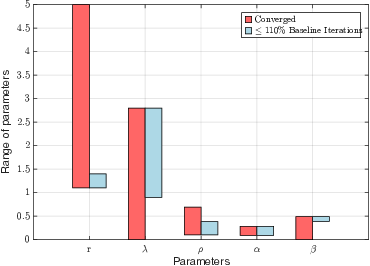
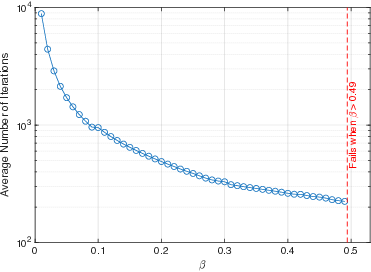
Figure 1: The feasible range of parameters for LSALM, showing robust convergence for a wide configuration range on synthetic quadratic programs.
- The evolution of primal feasibility violation with respect to penalty parameters is stable, with strong control over constraint satisfaction (see (Figure 2)).
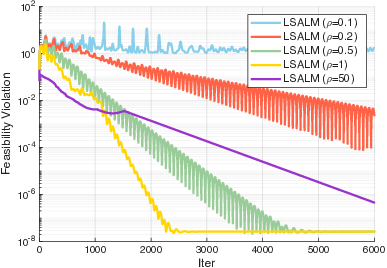
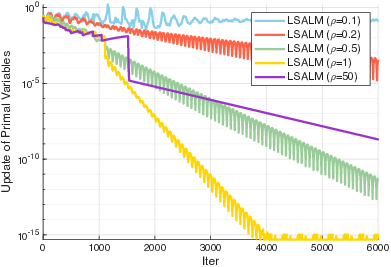
Figure 2: Feasibility violation ∥X⊤X−In∥F decays rapidly and robustly with LSALM versus varying penalty ρ.
- The (r,β) parameter region supporting reliable convergence aligns closely with the theoretical bounds (see (Figure 3)).
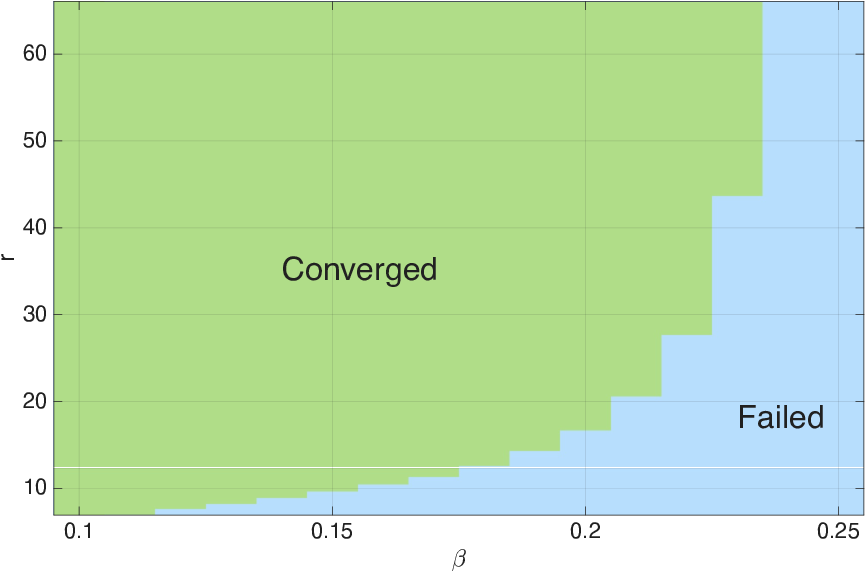
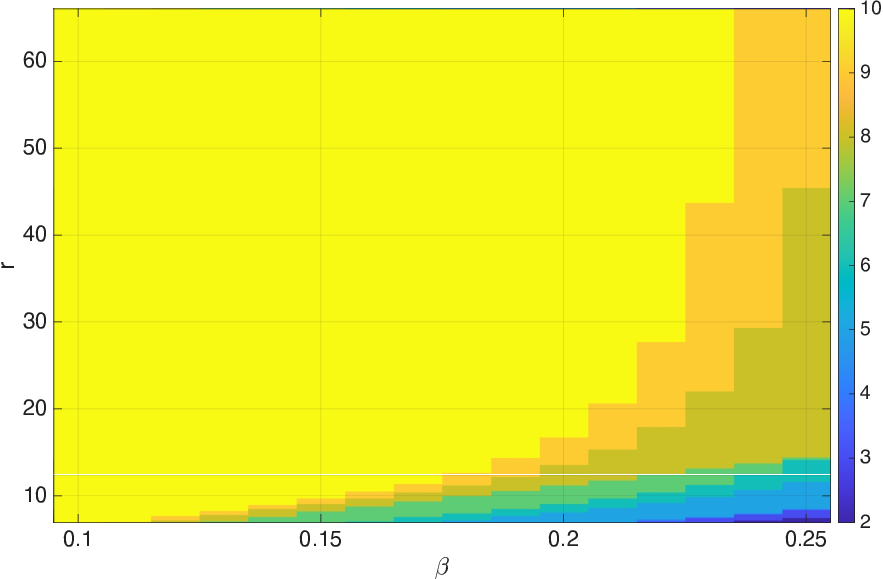
Figure 3: Region of parameters ℓ0 and ℓ1 for which all runs converge, supporting the theoretical sufficient conditions.
Comparative Benchmarking
Sparse Principal Component Analysis
LSALM is compared against ManPG-Ada, SOC, and RADMM on large-scale sparse PCA benchmarks. For ℓ2:
- LSALM achieves completion in 41.0s (with ℓ3s/iter), while
- ManPG-Ada takes 763.2s, SOC 231.1s, and RADMM 106.0s for comparable solution quality and final sparsity.
LSALM’s per-iteration cost is consistently the lowest, preserving efficiency at increasing scales (see (Figure 4)).
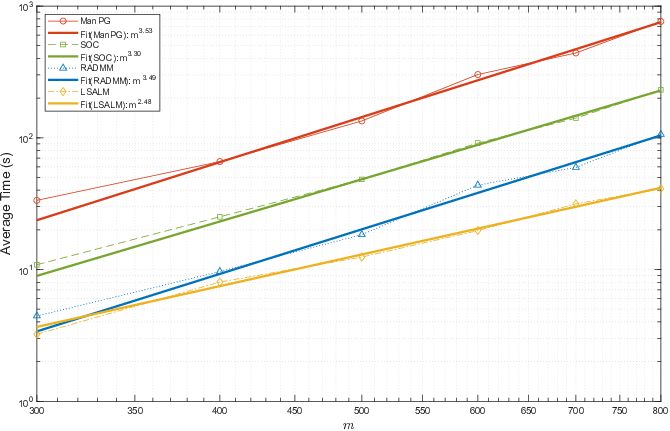
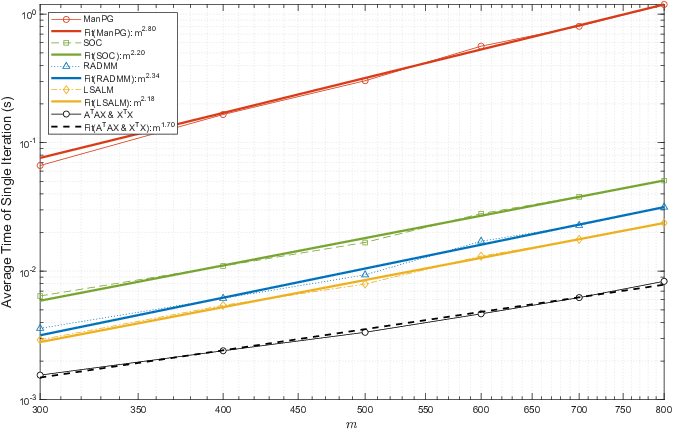
Figure 4: Average time per algorithm as a function of problem dimension shows LSALM achieves superior scalability and efficiency compared to alternatives.
Graph Matching
On smooth graph matching tasks, LSALM attains objective values and F-measures nearly identical to Riemannian gradient (RGD) and projection-based methods, at lower or comparable wall-clock cost, demonstrating its versatility beyond nonsmooth cases.
Implications and Future Perspectives
The presented LSALM framework addresses several acute issues in nonsmooth constrained nonconvex optimization:
- Scalability: The method avoids SVDs, matrix exponentials, or manifold retractions, making it highly scalable and parallelizable as confirmed empirically.
- Feasibility: The global convergence proof is grounded in a detailed primal-dual balancing analysis and a constraint-qualification region, enabling prompt recovery of high-accuracy feasible points.
- Flexibility: The explicit handling of the nonsmooth ℓ4 term allows seamless extension to problems with composite regularization (e.g., elementwise sparsity, group penalties).
- Extensibility: The primal-dual linearization/smoothing and regularized multiplier step point the way towards advanced algorithms for broader classes of geometric and functional constraints, such as simultaneous norm and orthogonality constraints.
The approach is promising for large-scale machine learning (e.g., dictionary learning, robust PCA, structured neural networks), as well as for engineering problems where orthogonal structure and nonsmooth penalties coexist. Future research includes higher-order variants and adaptive-step extensions, as well as generalizations to other manifold constraints and functional constraints beyond strict orthogonality.
Conclusion
This work gives a rigorous, carefully constructed, and computationally efficient primal-dual approach to a fundamental yet challenging class of nonsmooth, nonconvex, orthogonality-constrained optimization problems. The method attains optimal theoretical guarantees, robust empirical behavior, and manifests superior performance and versatility relative to state-of-the-art Riemannian and retraction-free baselines. The framework provides new technical tools for enforcing challenging constraints in nonsmooth optimization without resorting to projection-heavy or double-loop architectures, opening directions for scalable applications in advanced scientific and engineering domains.