Published 5 Apr 2026 in math.DS, nlin.CD, and quant-ph | (2604.04128v1)
Abstract: We formulate Lagrangian descriptors (LDs) in the path integral framework. Averaging the classical LD over fluctuations about extremal trajectories defines a quantum LD that incorporates quantum effects. Invariant manifolds, which sharply organize classical transport, become finite-width phase space structures under quantum fluctuations, and their overlap provides a geometric mechanism consistent with tunneling as fluctuation-induced delocalization of transport barriers. We demonstrate this approach for the Hamiltonian saddle, where path integral sampling reveals manifold broadening and barrier penetration. This establishes a geometric framework for studying phase space transport and tunneling beyond the classical regime, while also providing a natural route toward the application of LDs to field theory.
The paper introduces a quantum extension of Lagrangian descriptors by integrating Feynman path integrals to capture the finite-width overlap of invariant manifolds.
It demonstrates precise analytical and numerical agreement, with manifold broadening scaling accurately (within 1% discrepancy) in a one-degree-of-freedom Hamiltonian saddle.
The methodology bridges classical dynamics with semiclassical quantum mechanics, providing a framework that can extend to higher-dimensional and field-theoretic settings.
Quantum Lagrangian Descriptors: A Path Integral Perspective
Introduction
The paper "Quantization of Lagrangian Descriptors" (2604.04128) addresses the geometric underpinnings of quantum transport phenomena by formulating Lagrangian descriptors (LDs) within the Feynman path integral framework. Lagrangian descriptors, which have become a central tool for unveiling invariant manifolds and transport barriers in classical dynamical systems, are re-expressed to accommodate quantum fluctuations. This approach bridges modern dynamical systems theory and semiclassical path integrals, elucidating how quantum mechanics modifies sharp classical phase space structures. The quantum LD formalism introduces finite-width manifold structures, capturing the phenomenon of quantum tunneling in terms of overlap and fluctuation-induced delocalization. Analytical and numerical investigations are performed for the paradigmatic Hamiltonian saddle with one degree of freedom.
Classical and Quantum Lagrangian Descriptors
Classically, LDs are scalar functionals on phase space trajectories that efficiently reveal invariant manifolds, tori, and periodic orbits. In Hamiltonian systems, LDs typically take the form:
L(x0,t0,T)=∫t0−Tt0+TdtF(x(t;x0),t)
where F is often chosen as a root of the phase space velocity components, optimized for structure visualization. Traditional methods for quantum transport—Wigner and Husimi distributions, semiclassical propagators, entangled trajectory molecular dynamics—do not directly characterize the geometric phase space structures underlying transport barriers.
The quantum extension in this work introduces a geometric observable within the path integral formulation. The quantum LD is defined by averaging the classical LD over fluctuations about the extremal (classical) path, utilizing the path integral measure:
⟨L⟩=∫DηeℏiΔS[η;qcl]∫DηL[q,p]eℏiΔS[η;qcl]
Phase space structures, sharp in the classical limit, become broadened under quantum fluctuations, and their mutual overlap provides a phase-space mechanism for tunneling. The formalism leverages Lefschetz thimble decompositions to regularize the rapidly oscillatory integrals inherent in real-time quantum path integrals.
Analytical Framework and Spectral Decomposition
A one-degree-of-freedom (DoF) Hamiltonian saddle,
H(q,p)=2λ(p2−q2),λ>0,
serves as the principal example. The saddle's stable and unstable manifolds (p=±q) act as classical transport barriers. Quantum effects are introduced by expanding fluctuations about classical paths in the eigenbasis of the Sturm-Liouville operator,
O=−dt2d2+λ2,
with orthogonal eigenfunctions ϕn(t) and mode coefficients cn. After contour deformation, these coefficients become independent complex Gaussians with variance set by the ultraviolet regulator—i.e., the finite spectral truncation N.
The central quantity capturing quantum-induced broadening of invariant manifolds is the transverse coordinate fluctuation. Its root mean square (rms) width is derived analytically:
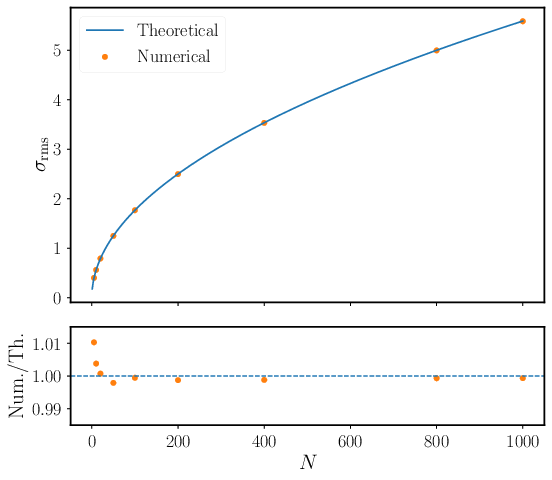
σrms=4TλN,
demonstrating explicit scaling with the number of modes (UV cutoff), interval duration, and the linearized instability F0.
Numerical Results: Manifold Broadening
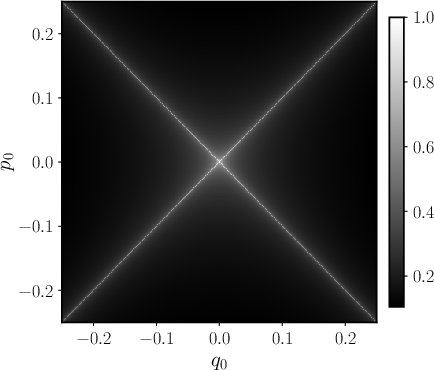
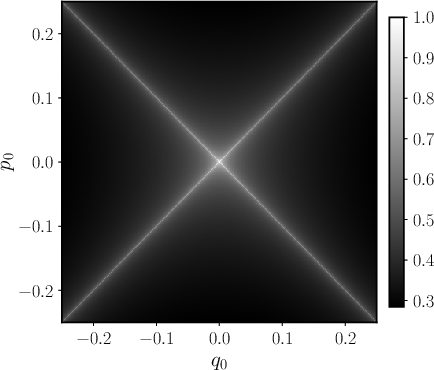
The quantum LD, computed via Monte Carlo sampling of the path integral, exhibits increased width of the invariant manifolds compared to the classical case. The finite grid and mode truncation act as effective regularizations, with the quantum LD resolving manifold broadening at the accessible resolution. Importantly, the quantum LD encodes nonzero overlap between classically disjoint regions, a geometric signature of tunneling and barrier penetration.
Figure 1: Visualization of the difference between classical and quantum Lagrangian descriptors for the Hamiltonian saddle, showing significant broadening of manifolds as the mode cutoff is increased.
A comparative analysis of manifold width as a function of the spectral mode cutoff F1 and fixed F2 yields excellent agreement between analytical predictions and simulation, with discrepancies below F3 across the parameter range.
Figure 2: Width of quantum-broadened invariant manifolds as a function of the number of modes F4; analytic scaling (blue) matches Monte Carlo data (orange) to better than F5.
The scaling law for relative broadening between two systems,
F6
is regulator-independent and directly testable—constituting a physical prediction within the formalism.
Theoretical and Practical Implications
The quantized LD framework formalizes quantum-induced delocalization of transport barriers and provides a means to quantitatively analyze tunneling in phase space as geometric overlap of broadened invariant manifolds. This extends dynamical system diagnostics from classical to quantum domains without resorting to phase-space quasi-probability representations. The formalism is amenable to generalization beyond one-dimensional systems and suggests a route to analyze geometric phase space structures in quantum and classical field theories, potentially impacting the study of quantum field theory transport, statistical field theory, and quantum cosmology.
Regularization explicitly appears due to the UV sensitivity of path integrals for non-smooth observables, and the regulator dependence is resolved in physically meaningful ratios—paralleling the renormalization paradigm in quantum field theory.
Conclusion
The quantization of LDs in the path integral framework supplies a natural, geometric definition of transport barriers and tunneling in quantum systems. The analytical and numerical results establish that invariant manifolds acquire a finite, regulator-dependent width, with their overlap encoding quantum transport phenomena. The methodology brings dynamical systems observables and semiclassical quantum mechanics into alignment, with clear paths toward extension in high-dimensional and field-theoretic settings. Future work may involve exploration of quantum effects on normally hyperbolic invariant manifolds in many DoFs and explicit computations in lattice or continuum quantum field theories.
“Emergent Mind helps me see which AI papers have caught fire online.”
Philip
Creator, AI Explained on YouTube
Sign up for free to explore the frontiers of research
Discover trending papers, chat with arXiv, and track the latest research shaping the future of science and technology.Discover trending papers, chat with arXiv, and more.