- The paper demonstrates that electron-phonon coupling and geometric frustration drive transitions from metallic to bond-ordered or superconducting phases based on filling.
- It utilizes DQMC simulations and finite-size scaling to identify precise quantum critical points for bond order at quarter filling and superconductivity at three-quarter filling.
- The study reveals an absence of magnetic correlations on the triangular lattice, underscoring the unique impact of frustration on phase competition.
The Optical Su-Schrieffer-Heeger Model on a Triangular Lattice: Phase Transitions and Competing Orders
Introduction and Background
The study undertakes a determinant quantum Monte Carlo (DQMC) analysis of the optical Su-Schrieffer-Heeger (SSH) model on the triangular lattice, focusing on the interplay between electron-phonon (e-ph) coupling, geometric frustration, and the resulting many-body phases. The SSH model departs from more canonical Holstein- or Fröhlich-type models by coupling phonon degrees of freedom to the kinetic (hopping) terms of electrons rather than site energies, which fundamentally alters the competition between emergent orders in metallic systems.
Three principal variants of the SSH model—bond, optical, and acoustic—possess different e-ph coupling forms and thus support distinct physics. The optical SSH variant considered here is particularly sensitive to lattice geometry due to its explicit modulation of electronic hopping via phononic displacements, enhancing the impact of frustration on the triangular lattice. This investigation focuses primarily on two characteristic fillings: one-quarter (⟨n⟩=0.5) and three-quarters (⟨n⟩=1.5), each representing a unique Fermi surface topology and commensurability.
Model and Simulation Details
The Hamiltonian evaluated includes nearest-neighbor hopping modulated linearly by phononic displacements, spin-symmetric interactions, and an Einstein phonon term for lattice dynamics. System simulations on L×L periodic clusters employ DQMC with Hybrid Monte Carlo (HMC) updates, exploiting the model's sign-problem-free property due to determinantal symmetry between spin species. Physical results are presented for a dimensionless e-ph coupling λ=α2/(MΩ2t) and in scaled temperature units (t=1).
Order is diagnosed using the s-wave pair-field susceptibility for superconductivity and bond-order-wave (BOW) structure factors for bond-ordered states, with careful symmetry-resolved analysis (C2, C3, C6) to distinguish the nature of broken symmetry. Critical points are extracted through finite-size scaling of correlation ratios, providing numerically robust estimates for quantum critical points (QCPs).
Phase Diagram and Key Results
Analysis of the superconducting and BOW susceptibilities versus carrier concentration and phonon energy reveals robust, filling-dependent phase behavior:
- At quarter filling (⟨n⟩=0.5): The system transitions from a metal to an insulating BOW phase that breaks C6 rotational symmetry. The compressibility vanishes at this filling, confirming the insulating nature of the bond-ordered state.
- At three-quarter filling (⟨n⟩=1.50): For small phonon energies (adiabatic limit, ⟨n⟩=1.51), a BOW phase emerges, while for larger phonon frequencies (⟨n⟩=1.52), superconductivity prevails, with enhanced s-wave pairing correlating to a hexagonal Fermi surface topology.
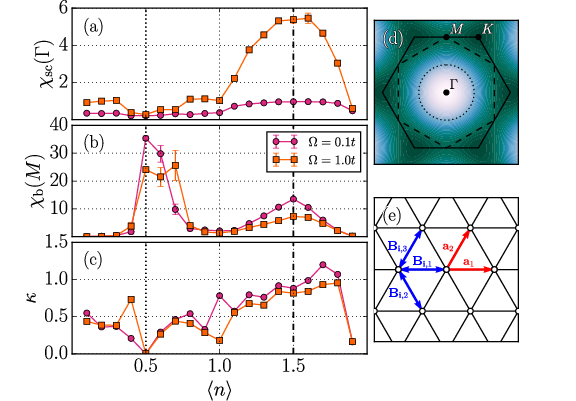
Figure 1: Low temperature (⟨n⟩=1.53) results at fixed ⟨n⟩=1.54 reveal that BOW correlations dominate near ⟨n⟩=1.55, while superconductivity is significant for ⟨n⟩=1.56 in the antiadiabatic regime.
Finite-Size Scaling and Phase Boundaries
Correlation ratio analysis for both BOW and superconducting responses shows sharply defined QCPs, with thermodynamic critical couplings ⟨n⟩=1.57 for the BOW transition at ⟨n⟩=1.58 and ⟨n⟩=1.59 for the onset of superconductivity at L×L0.
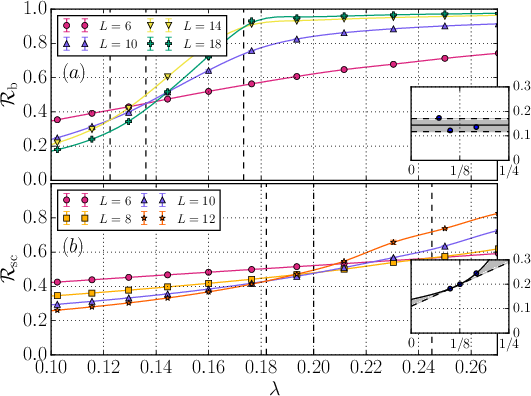
Figure 2: Finite-size scaling of the correlation ratios L×L1 and L×L2 provides precise location of quantum critical points.
These phase boundaries are summarized over the L×L3-L×L4 parameter space:
- At L×L5: The metal-to-BOW transition occurs with a nearly vertical boundary, indicating the linear dependence of the critical coupling on phonon frequency.
- At L×L6: The model hosts both BOW and superconducting ground states, with a metallic region intervening. Notably, the superconducting region is only stabilized for large L×L7, which is also where the linear hopping approximation underlying the model begins to break down due to significant hopping sign inversions.
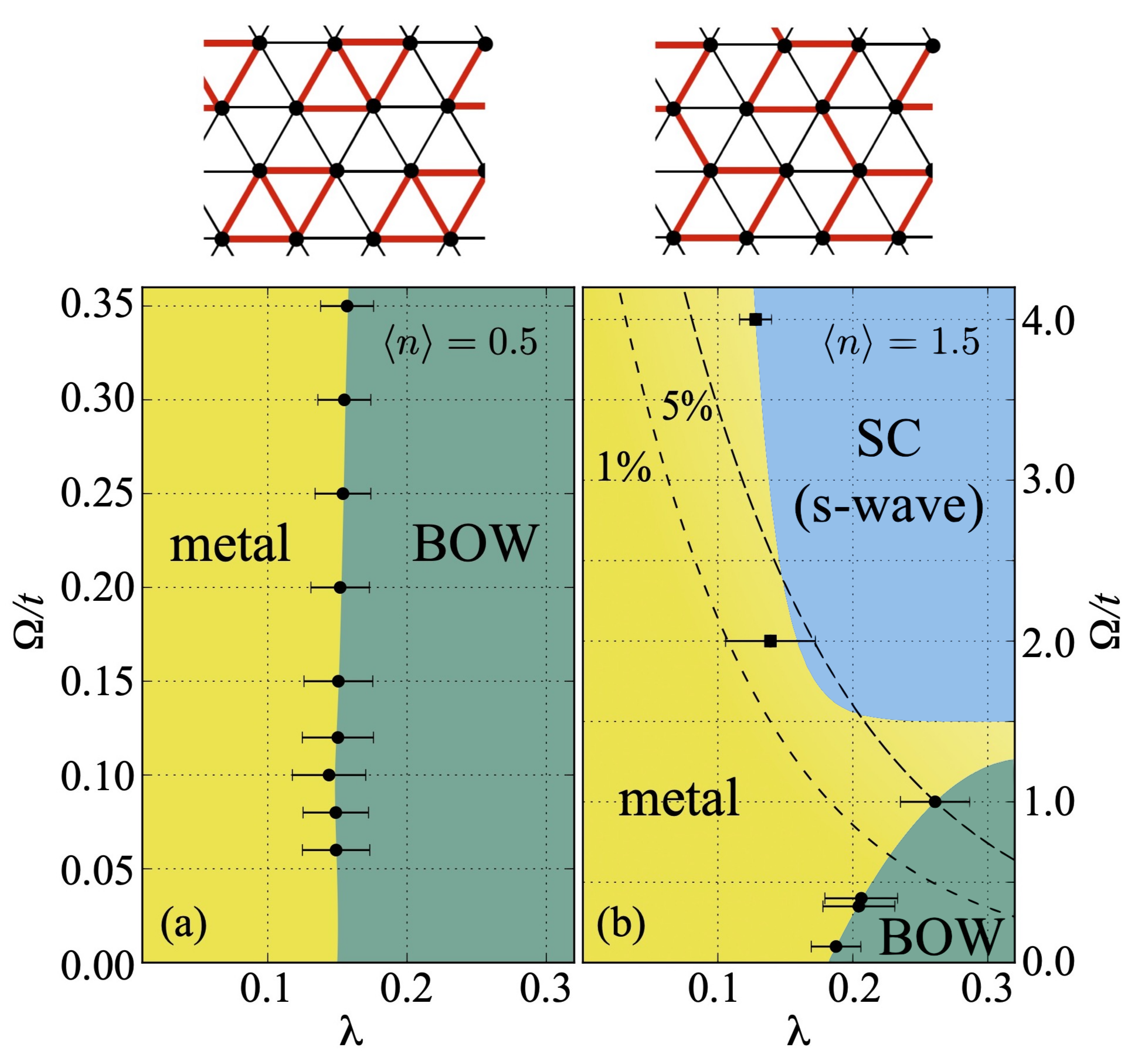
Figure 3: Ground state phase diagrams chart the parameter regions where BOW and superconducting phases are stabilized for quarter and three-quarter fillings.
Absence of Magnetic Correlations
Contrary to findings for the SSH model on the square lattice, the optical SSH model on the triangular lattice exhibits no enhancement of magnetic correlations at any parameter regime examined, irrespective of L×L8 or L×L9. This is attributed to the frustration intrinsic to the triangular lattice, the geometric suppression of conventional magnetic exchange, and the absence of effective intersite antiferromagnetic superexchange.
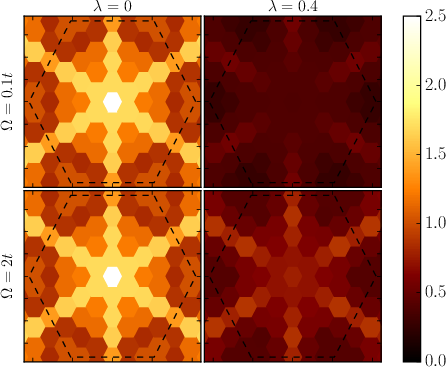
Figure 4: Spin structure factors at λ=α2/(MΩ2t)0 show suppression of magnetic correlations as λ=α2/(MΩ2t)1 is increased, indicating that neither geometry nor e-ph coupling favor AFM order.
Implications and Future Directions
The results concretely demonstrate the intricate interplay between geometry, filling, e-ph coupling, and frustration in the optical SSH model, leading to distinct regimes of BOW order and phonon-mediated superconductivity. These findings emphasize that superconductivity in the triangular lattice SSH model is stabilized at parameter values where the linear SSH coupling approximation becomes questionable, suggesting a need for future investigations of non-linear e-ph effects. The absence of enhanced magnetism sets this geometry apart from bipartite (square) lattices and negates the possibility of magnetic order acting as a competing or coexisting phase at the fillings and couplings surveyed.
Potential future work includes systematic doping studies away from commensurate BOW fillings, exploration of nonlinear SSH coupling, and investigation into the role of further neighbor hopping or phonon dispersion. Given the stabilization of unconventional superconductivity and bond order in frustrated lattice structures, controlled engineering of such models in cold atoms, optical lattices, or designer quantum materials could leverage these findings for new quantum ground states.
Conclusion
This systematic DQMC study of the optical SSH model on the triangular lattice shows that geometric frustration and e-ph coupling conspire to stabilize BOW insulators and s-wave superconductors at specific fillings, with phase competition modulated by the phonon frequency. The absence of magnetic order differentiates the triangular geometry from square lattices and focuses attention on bond and pairing channels as the primary order parameters. The theoretical and practical implications strongly motivate further quantitative and experimental investigation, particularly concerning the impact of non-linear e-ph interactions and the tunability of such phases in engineered quantum materials.