- The paper presents a comprehensive finite-temperature theory of low-dimensional Bose gases dominated by three-body interactions.
- It employs an infinite resummation of ring-type Feynman diagrams to compute virial coefficients, trimer fractions, and non-monotonic specific heat.
- The findings offer clear experimental benchmarks for observing three-body effects in quasi-1D/2D cold atom setups, advancing many-body physics.
Finite-Temperature Thermodynamics of Low-Dimensional Bosons with Three-Body Interactions
Introduction and Context
The paper "Finite-temperature properties of low-dimensional bosons with three-body interaction" (2604.04114) addresses the finite-temperature thermodynamic behavior of low-dimensional Bose gases dominated by three-body interactions. While the zero-temperature properties of such systems have been extensively investigated, there is a notable lack of analysis for their finite-temperature phases, particularly in the presence of resonant or finite-range three-body forces. The work employs a two-channel model, mapping the Hamiltonian onto atoms and closed-channel trimers, allowing the study of non-integrable three-body physics in dimensions d<2 while accounting for finite-range corrections.
The primary methodology involves summing an infinite series of ring-type Feynman diagrams contributing to the thermodynamic grand potential, which effectively captures three-body correlations at the t-matrix level. This construction enables the computation of virial coefficients, the equation of state, the closed-channel trimer fraction, and specific heat, elucidating non-trivial thermal phenomena exclusive to this interaction regime.
The system consists of N bosonic atoms in d spatial dimensions under periodic boundary conditions and is described by a two-channel Hamiltonian. The open channel hosts the atoms, while the closed channel introduces composite trimers, corresponding to three-body bound states. Importantly, for d<2, the three-body interaction is relevant in the renormalization group sense, but for d>1 it is not renormalizable in the zero-range limit, necessitating an explicit ultraviolet cutoff and finite-range two-channel regularization.
The Hamiltonian is
H=p∑εpbp†bp+p∑(3εp+δωΛ)cp†cp+3!Ldgp1,p2,p3∑(cp1+p2+p3†bp1bp2bp3+h.c.),
where g is the inter-channel coupling and δωΛ serves for renormalization. For g=0, the t0 symmetry is broken to a global t1, encoding total particle conservation with t2. The three-body bound state energy t3 is determined by a transcendental equation involving finite-range and dimensional parameters.
At finite temperature, the grand potential is given by
t4
where t5 is the trimer self-energy encompassing three-body correlations, and the sums run over Matsubara frequencies. The diagrammatic structure underlying this expression is a resummation of ring Feynman graphs, critical for capturing non-trivial three-body effects at all temperatures.
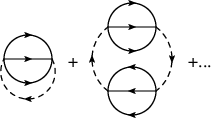
Figure 1: The infinite series of ring-like Feynman diagrams contributing to the thermodynamic potential, encoding the leading-order three-body correlations between atoms and closed-channel trimers.
High-Temperature Limit and Virial Expansion
In the regime t6, the model admits a virial expansion in fugacity t7. The first two virial coefficients are trivial in the absence of two-body interactions (t8), but the third (t9) is strongly modified by three-body processes, exhibiting an interaction-induced correction N0. The temperature and coupling dependence of this shift provide sensitive diagnostics of finite-range three-body physics, with the difference from the zero-range (broad resonance) limit manifest in measurable features.
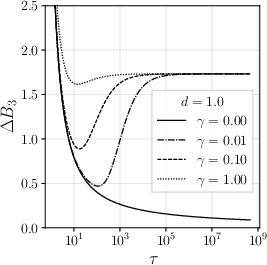
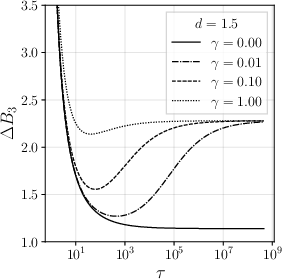
Figure 2: The temperature dependence of the interaction-induced correction to the third virial coefficient in N1 (left) and N2 (right) for various inter-channel couplings, highlighting the sensitivity of N3 to finite-range effects.
The results demonstrate a strong deviation from the broad-resonance limit for any finite-range interaction, with N4 providing an experimental probe of the underlying three-body scale. This establishes the virial expansion as a practical tool for distinguishing between effective three-body potentials in low-dimensional Bose gases.
Temperature-Induced Depletion of Trimers
The closed-channel trimer (composite boson) population N5 directly impacts the system's Tan contact parameter and encodes the decay and recombination processes of three-body bound states. At zero temperature, N6 is maximized, determined by the composite residue, but as N7 increases, thermal dissociation depletes N8 monotonically to zero.
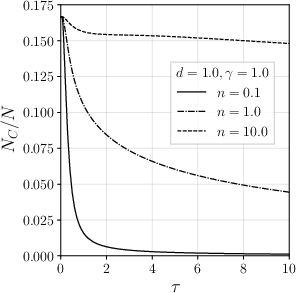
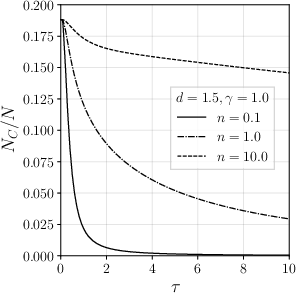
Figure 3: The temperature depletion of closed-channel trimers at three densities in N9 (left) and d0 (right); depletion is universal and governed by the dimensionless density and binding energy.
This thermal depletion is strongly non-linear and universal in scaled units, reflecting the loss of closed-channel bound states and the concomitant increase in open-channel atomic population. The precise temperature dependence constrains the dynamical balance between binding and dissociation, which is absent in simpler two-body models.
Non-Monotonic Specific Heat and Quantum Thermodynamics
One of the most significant findings is the strongly non-monotonic temperature profile for the isochoric heat capacity per particle, d1. Unlike ideal or weakly interacting low-dimensional Bose gases (where d2 usually increases monotonically with d3), here d4 exhibits a pronounced peak at intermediate temperature before decaying at high d5, robust across dimensions and densities.
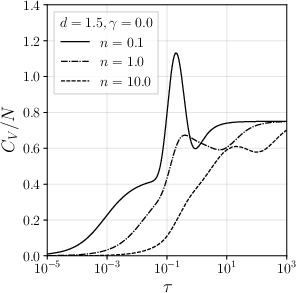
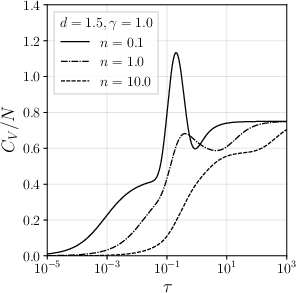
Figure 4: Isochoric heat capacity per particle versus temperature in d6 at varying densities, showing the emergence and enhancement of non-monotonicity on broad resonance and at lower densities.
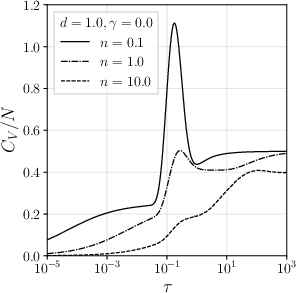
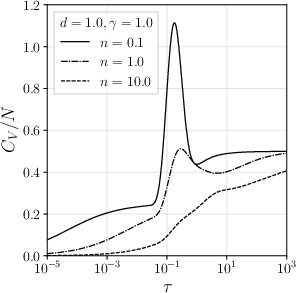
Figure 5: Specific heat in d7, with and without finite-range effects, revealing the generic presence of non-monotonicity across dimensionalities.
This anomalous d8 behavior arises from the abrupt thermal depletion of the trimer fraction; the dissociation of composite particles releases additional degrees of freedom, momentarily boosting d9. The correspondence between the d<20 derivative and the d<21 peak substantiates this mechanism. The effect is maximized in the broad resonance (zero-range) limit and at lower densities, clearly distinguishing three-body dominated systems from their two-body or non-interacting counterparts.
Equation of State and Thermodynamic Stability
The paper examines the equation of state by generating isotherms d<22 for fixed temperature and varying density. At low density, the system behaves as a classical ideal gas. With increasing density and quantum degeneracy, the isotherm shows the characteristic crossover to quantum statistics.
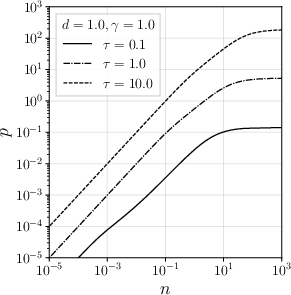
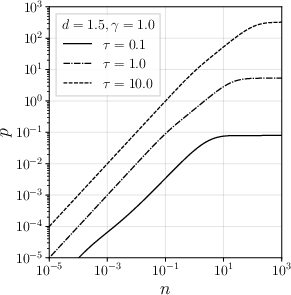
Figure 6: Isotherms (d<23 vs d<24) for several temperatures in d<25 (left) and d<26 (right). All display positive isothermal compressibility and confirm the system's thermodynamic stability at finite d<27.
Crucially, the isothermal compressibility remains positive throughout, verifying the absence of mechanical instability and validating the metastable thermodynamics of the three-body Bose gas even near resonance and in the finite-range regime. Notable deviations from the ideal gas equation of state are only observed at high density and temperature, primarily due to enhanced quantum effects and finite-range corrections.
Theoretical and Experimental Implications
This work significantly advances understanding of bosonic systems where three-body interactions, rather than two-body ones, dominate. The methods provide a systematic approach for calculating thermodynamic properties even in the non-perturbative, resonance, and finite-range regimes. The identification of non-monotonic specific heat as a universal signal, the quantification of trimer depletion, and the virial expansion corrections represent concrete predictions for cold atom experiments, especially those employing Feshbach engineering and quasi-1D or quasi-2D traps where three-body effects are relevant.
Future directions include extending the two-channel framework to include higher-order interactions required for fully regular finite-dimensional models when d<28 and d<29 increases. Moreover, coupling to external fields, optical lattices, or incorporating quantum anomaly effects and collective excitations would generalize the results for broader experimental relevance. The interplay of three-body correlations with other few-body scales (e.g., Efimov or super-Efimov physics) remains an interesting avenue for both theory and measurement.
Conclusion
The paper establishes a comprehensive finite-temperature theory for low-dimensional Bose gases with dominant three-body interactions, leveraging a two-channel model and diagrammatic resummation beyond conventional mean-field or two-body descriptions. The results include explicit predictions for the virial coefficients, closed-channel trimer population, non-monotonic heat capacity, and equation of state across dimensions and interaction ranges. These findings provide clear experimental signatures and theoretical benchmarks for systems in which higher-order interactions set the principal energy landscape and thermodynamic phenomenology.