- The paper demonstrates through Monte Carlo simulations how exchange anisotropy, DMI, and crystalline fields alter KT transitions and vortex dynamics in 2D XY ferromagnets.
- It reveals that increasing anisotropy sharpens specific heat peaks and drives a crossover from continuous U(1) to discrete Z2 order, impacting ferromagnetic behavior.
- The inclusion of DMI stabilizes chiral phases and shifts phase boundaries, offering insights for engineering ultrathin films and spintronic devices.
Anisotropy, Dzyaloshinskii–Moriya Interaction, and Symmetry Breaking in the 2D XY Ferromagnet
Introduction
This paper presents a comprehensive Monte Carlo analysis of the two-dimensional XY ferromagnet (XYFM) incorporating the effects of exchange anisotropy, bulk Dzyaloshinskii–Moriya interactions (DMI), and crystalline symmetry-breaking fields. The main objective is to elucidate the intertwined roles these perturbations play in the thermodynamic and topological properties of planar magnets. By systematically tuning the strength of anisotropic coupling, DMI, and various Zp-symmetric field terms, the study investigates alterations in the Kosterlitz–Thouless (KT) transition, quasi-long-range order (qLRO), phase diagrams, vortex dynamics, and order parameter behavior—especially relevant for quantum materials with tunable spin–orbit coupling and engineered chiral textures.
XY Model Baseline: Thermodynamics and Topological Transition
The isotropic XY model on a 2D lattice serves as the fundamental starting point, showcasing the archetypal Berezinskii–Kosterlitz–Thouless transition driven by the binding and unbinding of vortex–antivortex pairs. Metropolis Monte Carlo simulations confirm the established phenomenology: a broad specific heat (CV) hump marks the onset of topological defect proliferation at T∼0.895J/kB, while the spin stiffness (helicity modulus, ρS) exhibits a universal jump at TKT, intersecting at ρS=2T/π, consistent for all simulated lattice sizes. The correlation function exponent, η, and finite-size scaling are quantitatively consistent with prior high-precision studies, affirming the robustness of the simulation protocol.
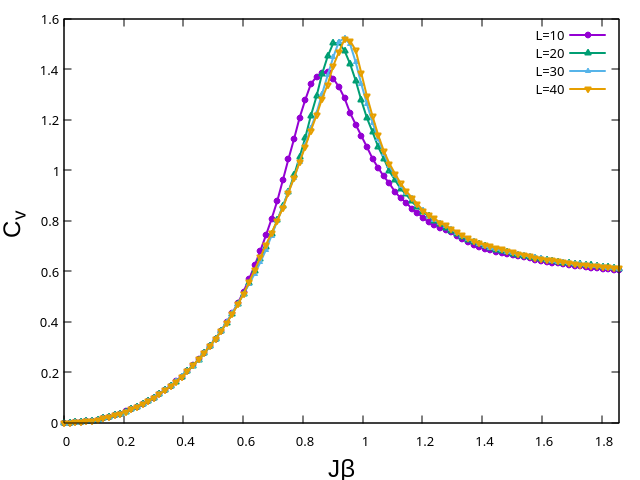
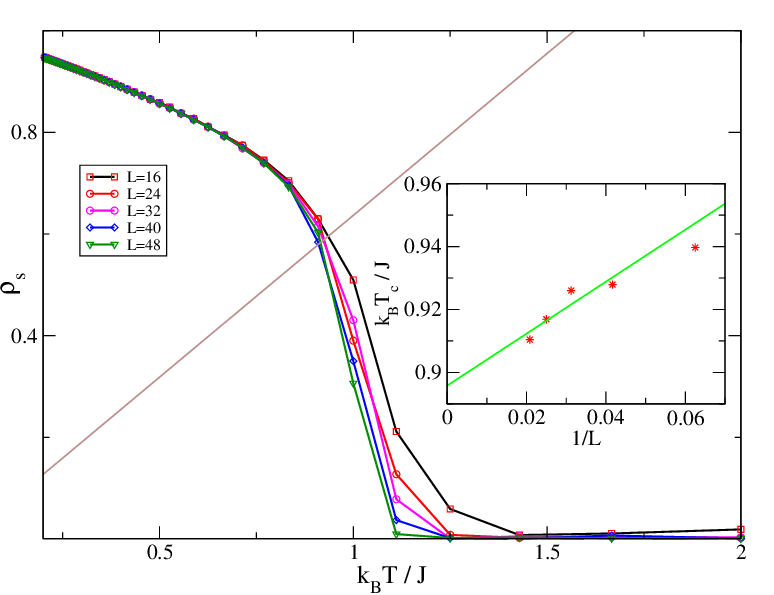
Figure 1: (a) Specific heat CV and (b) spin stiffness ρS versus inverse temperature Jβ for various lattice sizes; CV0 exhibits a universal jump at the KT transition.
Exchange Anisotropy Effects
Introducing an anisotropy CV1 in the XY exchange drastically alters the nature of the underlying transition. With increasing CV2, the specific heat becomes sharper and transitions shift to higher temperatures, revealing crossover behavior toward Ising-like order for large anisotropy. The emergent phase exhibits true long-range ferromagnetic order at low temperatures, further corroborated by a nonzero magnetization. However, even in the strong anisotropic regime, vortex-like excitations persist, as evidenced by non-vanishing vortex densities at high temperatures. Exchange anisotropy thus breaks continuous CV3 symmetry, making the system increasingly susceptible to discrete CV4-type order.
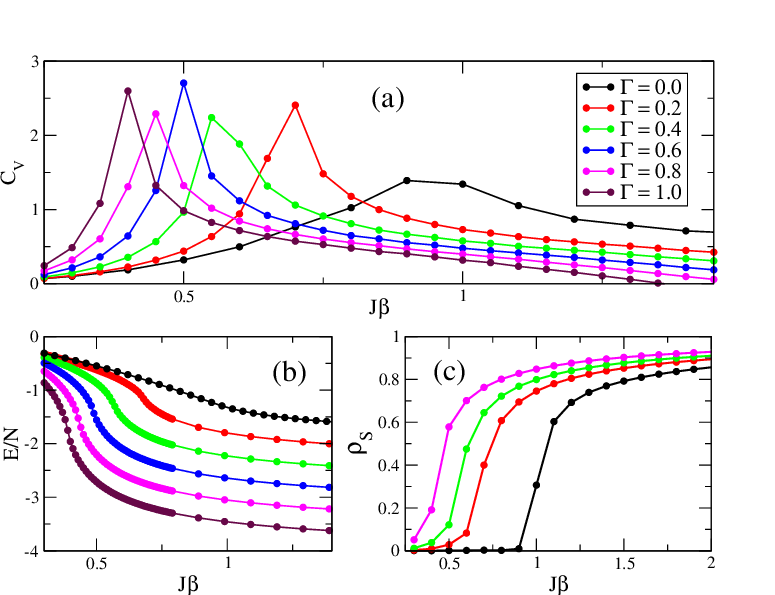
Figure 2: (a) CV5, (b) energy per spin CV6, and (c) spin stiffness CV7 versus CV8 for different anisotropy parameters CV9.
Inclusion of Dzyaloshinskii–Moriya Interaction
DM interaction, treated as a uniform chiral bulk term with strength T∼0.895J/kB0, fundamentally modifies the spin texture and phase diagram. Increasing DMI augments the critical temperature and stabilizes a canted qLRO, clearly observable from the shift in the T∼0.895J/kB1 peak and phase boundaries. Typical ground-state configurations display spiral modulations rather than collinear alignment, in excellent agreement with analytical expectations and prior MC studies. Notably, for commensurate DMI, the system supports nontrivial diagonal arrangements of spins at low temperature, which thermal fluctuations disrupt at elevated temperatures.
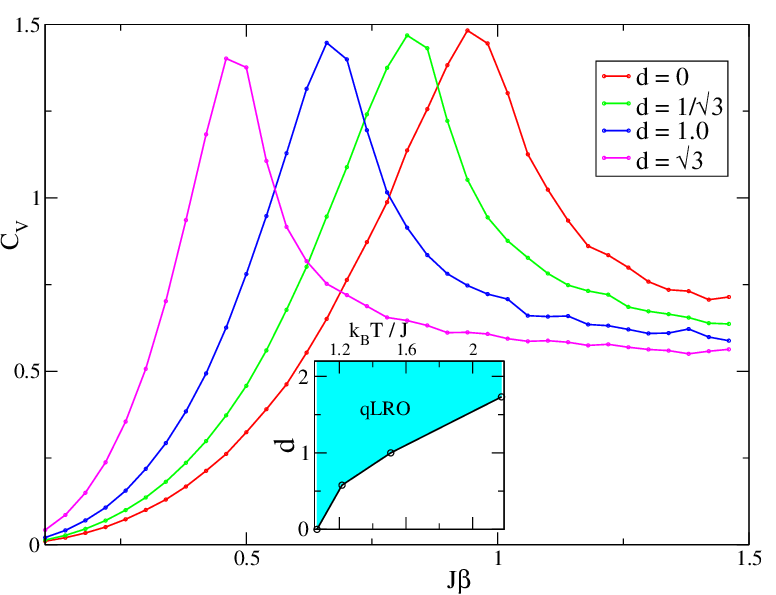
Figure 3: T∼0.895J/kB2 as a function of T∼0.895J/kB3 for different DMI strength T∼0.895J/kB4; inset: phase diagram for QLRO–DO phase.
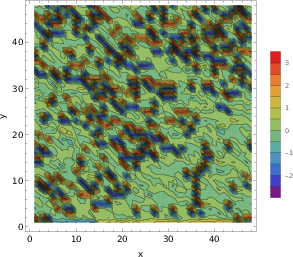
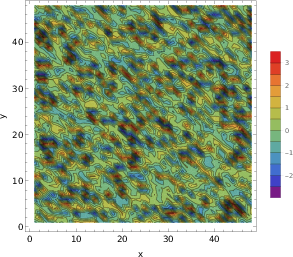
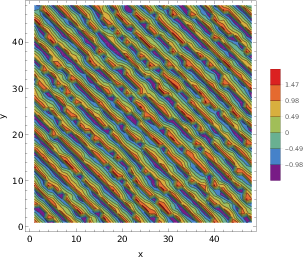
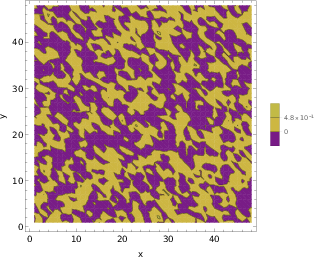
Figure 4: Representative low-T∼0.895J/kB5 and high-T∼0.895J/kB6 spin configurations (T∼0.895J/kB7) for various T∼0.895J/kB8 pairs, displaying the vortex-antivortex structure and canted ordering induced by DMI.
Competition and Interplay: Anisotropy vs. DMI
When both anisotropy T∼0.895J/kB9 and DMI ρS0 are present, strong competition arises between collinear and chiral tendencies. DMI drives the pseudo-critical temperature upward and suppresses magnetization, whereas anisotropy fosters ferromagnetic order. The phase boundary's response to ρS1 in the presence of DMI is non-monotonic, with ρS2 profiles, magnetization curves, and spin stiffness reflecting the shifting balance and rich crossover phenomena. The second-moment correlation length, computed for a range of system sizes, provides key insights into the spatial scale of magnetic coherence and accurately identifies crossover or transition regions.
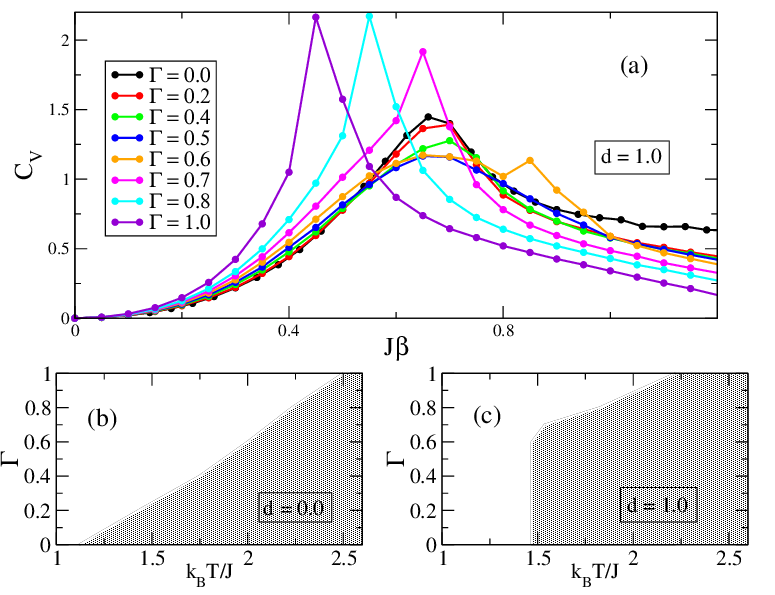
Figure 5: (a) ρS3 vs ρS4 for ρS5 at several ρS6; (b,c) phase boundaries from ρS7 peaks for ρS8 and ρS9 respectively.
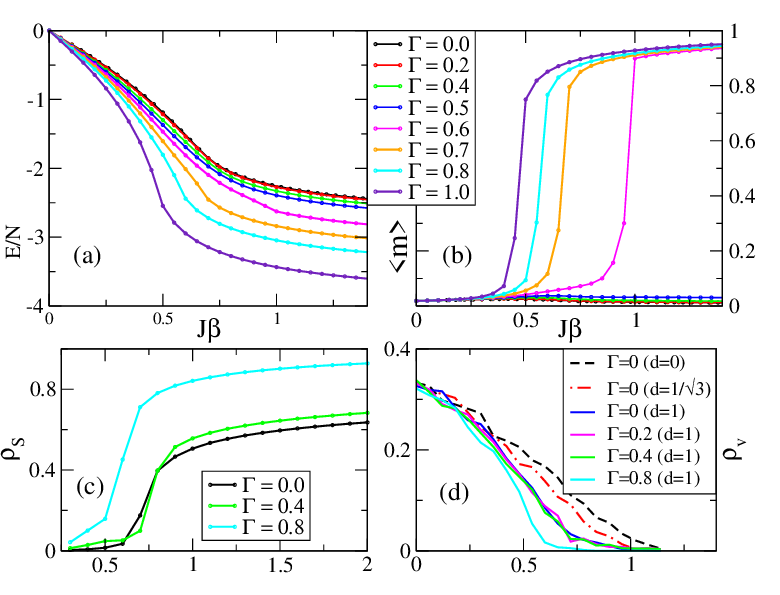
Figure 6: (a) TKT0, (b) TKT1, (c) TKT2, and (d) vortex density TKT3 versus TKT4 for several TKT5 at TKT6.
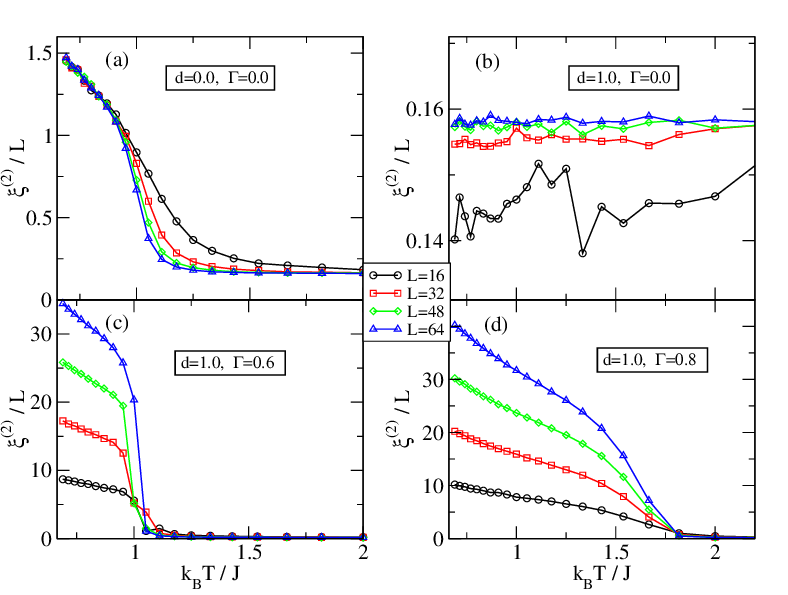
Figure 7: Second-moment correlation length as a function of temperature for different values of DMI and anisotropy.
Symmetry-Breaking Fields: Multipeak Specific Heat and Competing Orders
The inclusion of TKT7 and TKT8 symmetry-breaking crystalline fields (parameterized as TKT9 and ρS=2T/π0) introduces further complexity to the phase structure. The principal observation is the appearance of multi-peak ρS=2T/π1 signatures indicating multiple phase transitions or crossovers. For compatible fields (ρS=2T/π2), a single transition plus low-ρS=2T/π3 crossover is observed; in the competing regime (ρS=2T/π4, ρS=2T/π5), a sharp low-ρS=2T/π6 peak and a broader KT-like peak manifest, signaling successive transitions between FM, KT, and paramagnetic phases. The presence of DMI shifts and sometimes suppresses these features, demonstrating the nontrivial interplay between chiral and symmetry-breaking perturbations.
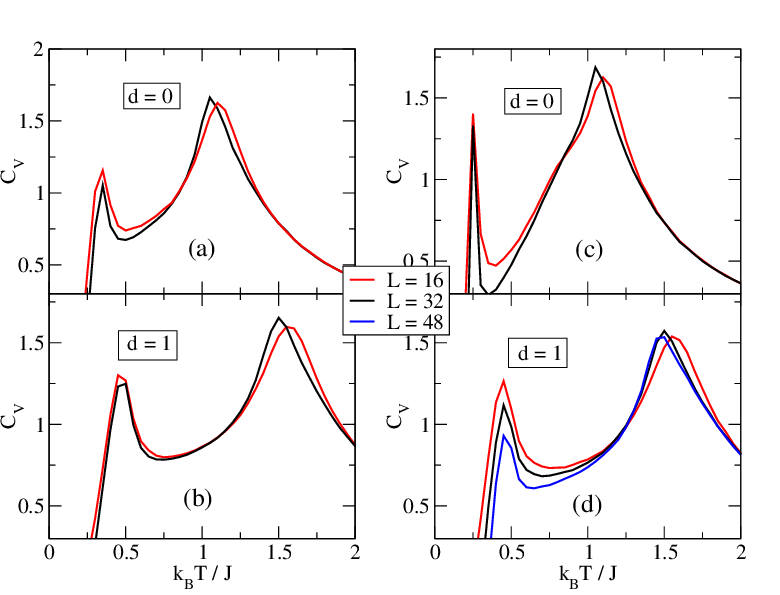
Figure 8: ρS=2T/π7 versus ρS=2T/π8 for several field configurations and system sizes, with and without DMI, highlighting double-peak structure characteristic of competing symmetry-breaking fields.
Implications and Future Directions
The study establishes that DMI and exchange anisotropy act as powerful control parameters for tuning the thermal and topological behavior of 2D magnetic systems—relevant to the engineering of ultrathin films, interfacial magnets, and van der Waals materials with large spin–orbit coupling. The controlled introduction of DMI or anisotropy can stabilize novel chiral or Ising-like phases and manipulate vortex-driven transitions, while crystalline fields further enrich the landscape with multi-transition regimes. These results lay a rigorous foundation for subsequent studies on quantum and 3D generalizations, with implications for emergent phenomena such as skyrmion nucleation and transport (e.g., skyrmion Hall effect), as well as for understanding field-driven dynamics in topological magnonic materials.
Conclusion
By systematically mapping the combined effects of anisotropy, DMI, and symmetry-breaking fields, this paper advances a nuanced and quantitative understanding of the 2D XYFM. The equilibrium phase diagrams and thermodynamic observables reveal intricate competition and coupling effects, consistent with predictions from renormalization group and large-scale MC studies. The findings not only quantify how each perturbation modifies KT-like criticality but also provide specific predictions for experimental platforms where these couplings are tunable. The general framework and numerical strategies employed offer a versatile template for future investigations into topological matter, quantum fluctuations, and chiral spin structures in higher dimensional systems.