- The paper presents a systematic analysis of session manipulation attacks on VPNs by exposing flaws in NAT and state management frameworks.
- It demonstrates three novel attack classes—port exhaustion DoS, TCP session hijacking, and DNS injection—with empirical success rates up to 90%.
- The study highlights practical countermeasures including randomized port assignment and per-user session isolation to strengthen VPN security.
Systematic Analysis of Session Manipulation Attacks on VPNs
Introduction
"Invisible Adversaries: A Systematic Study of Session Manipulation Attacks on VPNs" (2604.04099) presents a detailed investigation into session-level vulnerabilities within VPN server infrastructures. The authors systematically dissect shared resource misuse and improper session state management in mainstream connection tracking frameworks utilized by VPN services. The paper exposes how the violation of non-interference properties in VPN architectures enables off-path attackers to mount session-targeted exploits, even without privileged network positions or direct knowledge of victim session parameters.
Threat Model and Technical Foundations
The study adopts a threat model where the attacker is another client legitimately connected to the same VPN server as the victim. This adversary is "physically off-path" but retains the capability of IP spoofing, allowing for crafted packet injection directly to the VPN exit’s public interface. While the VPN server is expected to enforce client isolation and proper session separation (the "non-interference property"), the analysis reveals systemic violations due to shared connection tracking state in common frameworks.
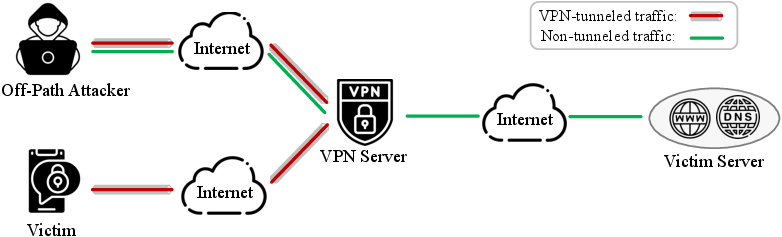
Figure 1: Adversary model, highlighting both tunneled (red) and spoofed (green) traffic against the shared VPN server infrastructure.
VPN servers typically deploy stateful Network Address Translation (NAT) with session tracking, using frameworks such as Linux Netfilter, FreeBSD PF, IPFW, IPFilter, or natd. These middleboxes maintain mappings from internal client source addresses and ports to external translation tuples. Design choice between port preservation and random selection for the NAT source port fundamentally impacts the attack surface.
Session Manipulation Attack Taxonomy
The paper introduces three novel attack classes, each exploiting distinct aspects of NAT state management:
- Port Exhaustion Denial-of-Service (DoS): An attacker can deliberately consume all ephemeral VPN server source ports to a targeted remote service, precluding other clients from establishing new outbound sessions.
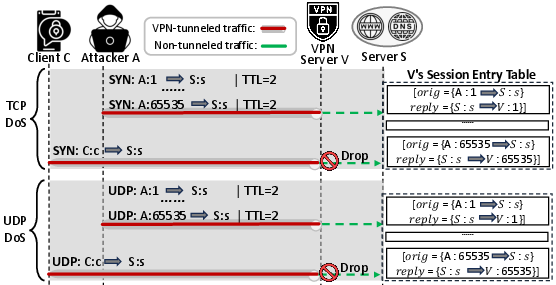
Figure 2: DoS realized by fully exhausting the interface port space towards the target server; new legitimate connections are dropped.
- TCP Session Hijacking: The adversary infers NAT external port assignments for victim sessions via active port probing and subsequently triggers state manipulation through crafted packets (notably abusing TCP RST handling) to supplant or inject traffic into established flows.
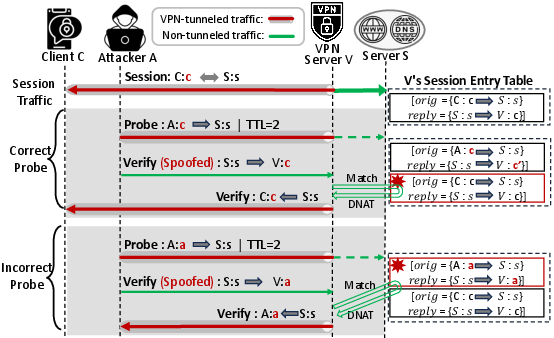
Figure 3: Probing and inference methodology for deducing the VPN’s NAT-ed source port for the victim’s session.
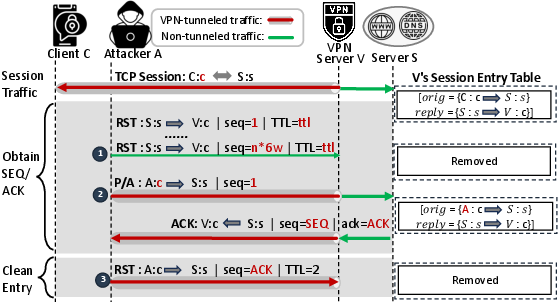
Figure 4: Advanced exploitation phase—use of crafted RST sequences (with controlled TTL and sequence numbers) to acquire valid TCP SEQ/ACK state, enabling complete hijack or injection.
- DNS Response Injection (Hijacking): By identifying the client’s mapping for DNS resolver sessions (exploiting port allocation/preservation), the attacker brute-forces the DNS transaction ID to race legitimate responses, overriding DNS results seen by the victim.
Empirical Findings and Evaluation
The authors evaluate five prevalent connection tracking implementations and nine major commercial VPN providers. Systematic vulnerabilities are confirmed across all frameworks (given port preservation semantics) and eight out of nine providers. Mitigation efficacy is observed only in limited deployments employing strict randomization and proxy-based egress mechanisms.
- Port Exhaustion DoS: Attackers can render targeted destinations (TCP/UDP) unreachable by occupying the entire VPN-exit port range. The empirical cost for complete DoS is ≤4.4 seconds with >90% success rate.
- TCP Hijack and Injection: The attacker obtains valid tuple and state parameters within ∼64 seconds for HTTP and ∼23 seconds for FTP, with success rates of 66.7% and 81.3%, respectively. Notably, frameworks with in-window or absent RST checks allow state demotion or removal, further facilitating session hijack.
- DNS Hijacking: The attack completes within typical DNS timeouts (5–15s), with success probabilities scaling to 70% as the query lifetime increases.
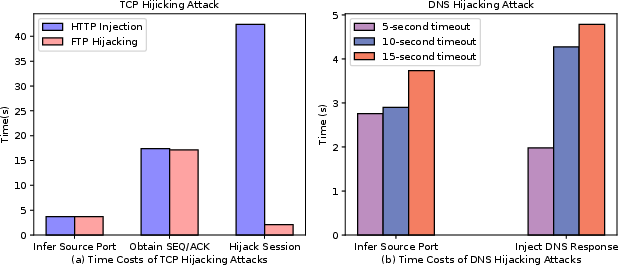
Figure 5: Comparative time cost of successful DoS, TCP hijacking, and DNS injection attacks across representative providers and configurations.
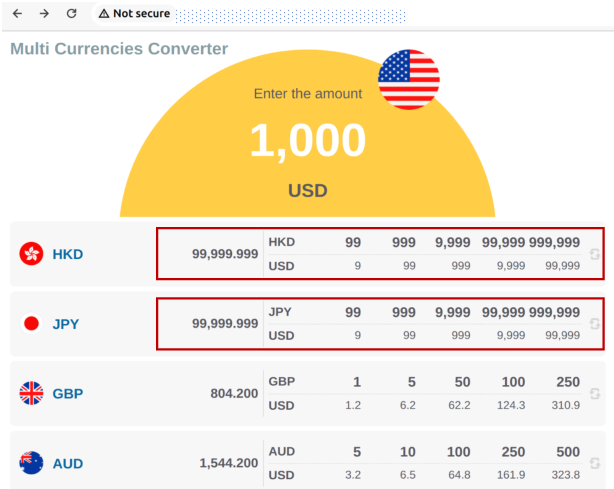
Figure 6: Visual evidence of HTTP response manipulation via TCP session hijack—injected exchange rates as rendered in the victim’s browser.
The study’s responsible disclosure has resulted in patch acknowledgments, 19 CVE/CNVD assignments, and active engagement with major OS and VPN vendors.
Theoretical and Practical Implications
This research has several critical implications:
- VPN Non-Interference is Not Guaranteed: The non-interference axis is violated in mainstream deployments where users share stateful connection tracking/NAT tables. This undermines privacy and session integrity assumptions inherent to multi-tenant VPN services.
- Bypassing Traditional NAT and Middlebox Defenses: The port-based session isolation model breaks under shared port space exhaustion and weak state validation logic (especially surrounding RST handling and port preservation). Attacks are feasible without traditional in-path or proximity requirements.
- Implications for Multi-Tenant Infrastructures: These findings generalize to any public middlebox environment (e.g., cloud VPN gateways, institutional split tunnels, wireless gateways with NAT), altering defense priorities for both protocol design and system engineering.
- Vendor Patching Complexity: While strict RST validation patches improve robustness, operational concerns (i.e., unswept state leading to exhaustion) highlight tensions between security hardening and practical state management on high-throughput middleboxes.
Countermeasures and Future Outlook
The paper details immediate countermeasures: imposing per-user connection/session limits, enforcing randomization for ephemeral source ports, and validating TCP state transitions with exact sequence number checks. However, the efficacy of these measures can be constrained by performance overhead and deployment inertia.
Looking forward, the evolution of VPN infrastructure should integrate robust session namespace isolation—potentially per-user NAT mappings or full tenant virtualization. Additionally, the security community must reassess middlebox behaviors with respect to session state synchronization and explicit failure logging to avoid undetectable stealth attacks. Practical intrusion detection and anomaly-based rate limiting schemes must also be considered.
Automation of multi-layer session validation, attuned to the observed attacker model, is increasingly crucial as adversaries exploit indirect session resource contention and weakly-verified teardown logic.
Conclusion
This paper rigorously challenges the foundational premise of user isolation and session integrity in mainstream VPN services, shifting the dialogue from classic cryptanalysis and in-path adversaries to multi-tenant architectural flaws. Immediate improvements in connection tracking isolation and stronger protocol-level state validation are necessary. As VPNs are increasingly positioned as privacy-critical infrastructure, the demonstrated attacks serve as a directive for both system and protocol redesign to fortify practical session non-interference.
(2604.04099)

