- The paper proposes a novel thermocoherent framework that identifies hidden relational resources as drivers of neural information flow.
- It employs resource-theoretic methods using process tensor and pseudo-density operator frameworks to capture delocalized quantum and classical correlations.
- The study predicts measurable deviations in relaxation dynamics, such as Mpemba-type effects, offering experimental paths to validate hidden resource dynamics.
Introduction and Motivation
The paper "The physical basis of information flow in neural matter: a thermocoherent perspective on cognitive dynamics" (2604.04069) addresses the long-standing gap between computational, abstract notions of information flow in cognition and their concrete physical instantiation within neural matter. Rather than equating information flow with either purely local physical currents or disembodied abstract variables, the work proposes a resource-theoretic framework derived from concepts in quantum information thermodynamics, focusing particularly on the thermocoherent effect. It posits that delocalized relational structure—encoded in quantum and classical correlations, as well as temporally extended process-level structures—functions as an operationally significant, physically grounded "hidden resource" in biological substrates.
This resource can modulate energy and matter transport, bias relaxation and signaling dynamics, and influence the mesoscale coordination essential for cognitive function, without recourse to speculative claims of macroscopic quantum cognition or reductionist local-transport models.
Theoretical Framework: Delocalized and Hidden Relational Structure
The formalism discerns information-bearing resources not by subsystem-local observability but by the existence and dynamic accessibility of relational structure within the composite state of neural substrates. Information flow, in this context, transcends the carrier-based intuition (where information is attributed to the transport of well-localized variables):
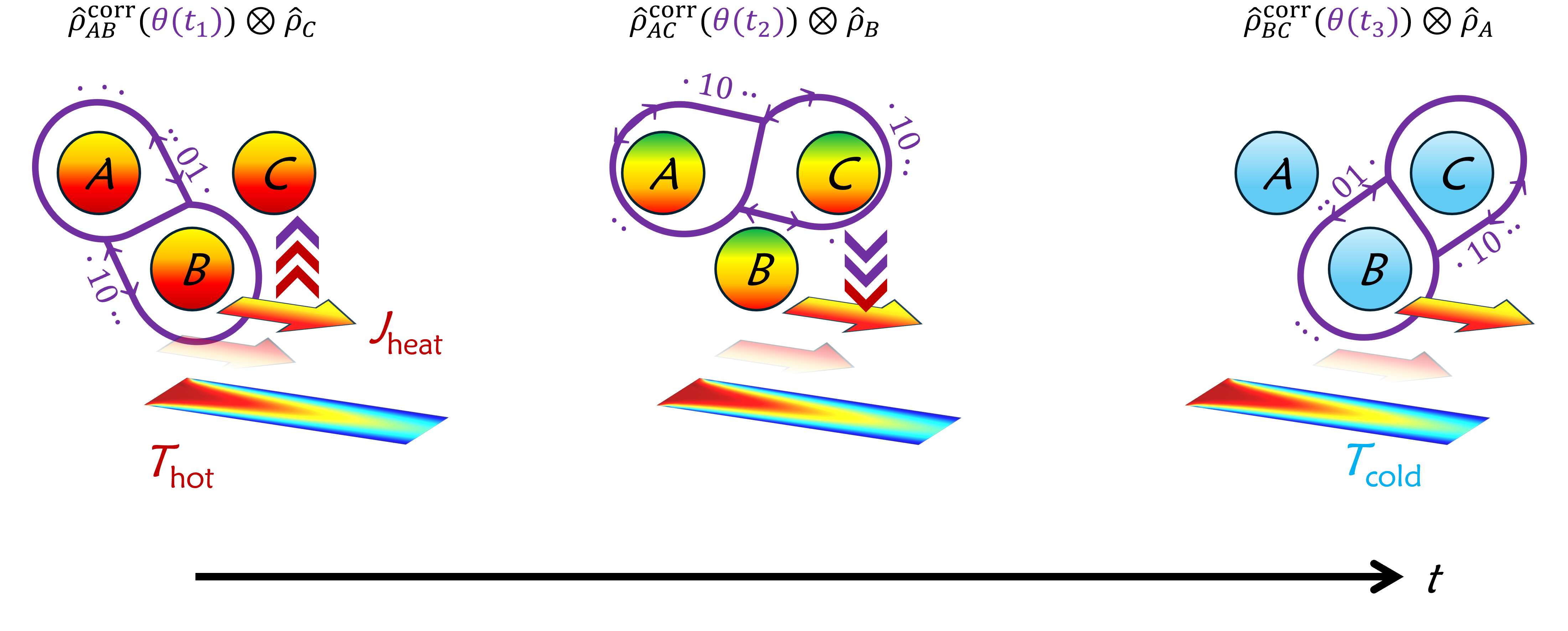
Figure 1: Carrier-based local information flow, illustrating the limitation of coarse-grained transport-based perspectives in capturing relationally distributed information support.
Instead, delocalized information flow arises when dynamical processes redistribute operationally accessible relational resources—whether classical correlations, quantum discord, or entanglement—across spatial or temporal partitions of the composite system. This is typified in settings where local marginals remain invariant while global structure (e.g., encoded in off-diagonal or block-correlated density operator sectors) modifies the system's behavior. Such resources, while hidden from effective single-time or local measurements, become physically relevant precisely when the microscopic interaction geometry and relaxation channel render them dynamically accessible.
Figure 2: Delocalized information flow, highlighting how relaxation-induced redistribution of relational support is coupled to thermal gradients and heat currents.
The formal construction is extended from single-time state descriptions to spatiotemporally ordered multi-time settings, utilizing process tensor and pseudo-density-operator frameworks to capture history-dependent relational resources relevant for non-Markovian memory, gating, and route selection in biological contexts.
Operational Mechanisms: Thermocoherent Effects and Correlation-Enabled Relaxation
The thermocoherent effect constitutes an archetype of transport-coupled delocalized information flow: a reciprocity emerges between physical energy/heat and coherence currents, where the latter is attributable to nondiagonal relational support rather than any subsystem variable. In analogy to but distinct from thermoelectric phenomena, the coherence current modulates and is modulated by the heat current via Onsager-like relations, with the coupling strictly dependent on accessible coherence sectors and their redistribution across subsystems.
The framework is further extended by analyzing correlation-enabled Mpemba-type effects: states with identical local thermodynamic descriptors (energies or temperatures) can exhibit different relaxation trajectories toward equilibrium if their relational (correlational) content differs. This leads to altered cooling and resetting hierarchies, unexplainable by local observables alone—suggesting a practical diagnostic regime for such hidden resources.
Candidate Neural Substrate Classes and Multiscale Organization
Hydrogen-Bond Networks and Proton Delocalization
Hydrogen-bond-rich environments (proteins, confined water, enzyme active sites) are identified as natural substrates for generating partially delocalized proton distributions, enabling quantum and classical correlations to develop between donor and acceptor sites. These correlations can be rendered dynamically accessible (and functionally relevant) by thermal fluctuations and geometric reconfiguration, often leveraging a quantum-to-classical transition whereby initially fragile quantum relational structure decoheres yet leaves robust classical residues that bias subsequent reactivity or binding.
Aromatic π-Networks and Microtubule Tryptophan Arrays
Aromatic protein regions, especially tryptophan-rich networks in the quasi-crystalline geometry of microtubules, are highlighted as architectures that promote coherent excitation delocalization. Within an open-system Lindblad framework, such networks demonstrably support the transient routing, buffering, and export of correlation-bearing excitation. The operational role of these architectures is contingent on network geometry, excitation preparation (superradiant vs. subradiant), local site specificity, and environmental disorder, leading to tunable regimes of internal correlation retention or rapid externalization.
Phosphate-Rich Motifs: Spin Buffering via Local Geometry
Phosphate groups and clusters (central to ATP, phospholipids, and positionally in models like the Posner molecule) instantiate geometry-dependent relational buffering. Tetrahedral or highly connected motifs enhance both the persistence of single-site quantum coherence and inter-site entanglement by reorganizing the system-bath coupling spectrum, thereby delaying coherence erasure and accessible dissipation channels.
Ion Channels: Barrier-Structured, History-Dependent Transduction
Ion channels, especially potassium-selective examples, serve as barrier-structured interfaces where local occupancy states, tunneling amplitudes, and route selection depend critically on hidden relational structure that may be distributed over ordered conduction histories rather than mere instantaneous configuration (modeled heuristically as history superposition states). This positions such interfaces as potential hotspots where multi-time quantum-to-classical relational resources are transduced into physically measurable, physiologically consequential outputs.
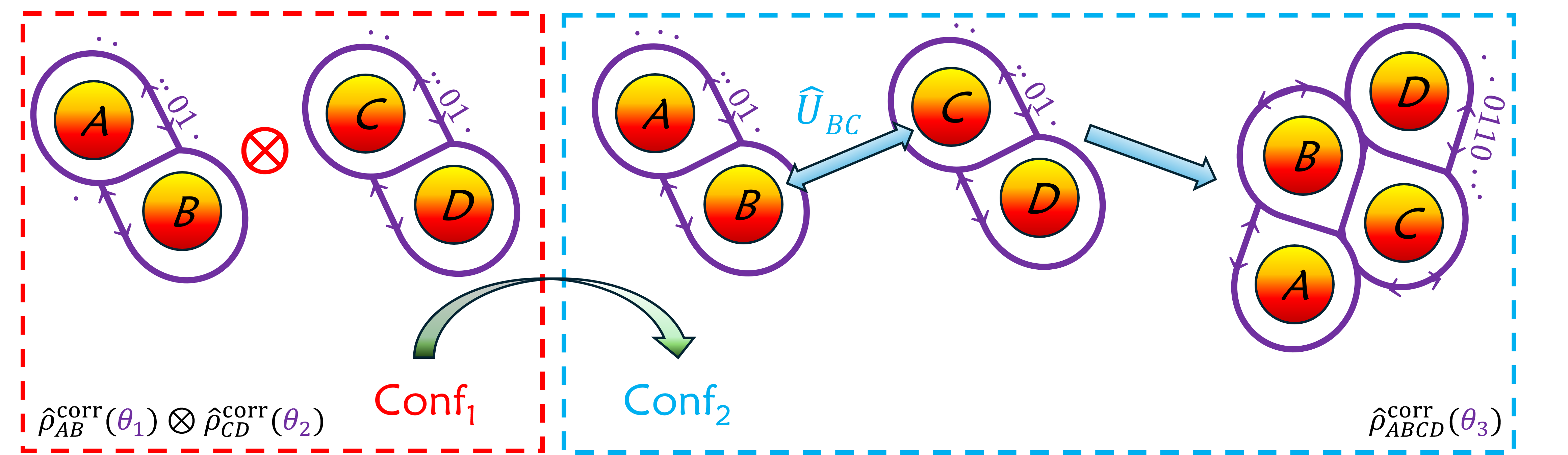
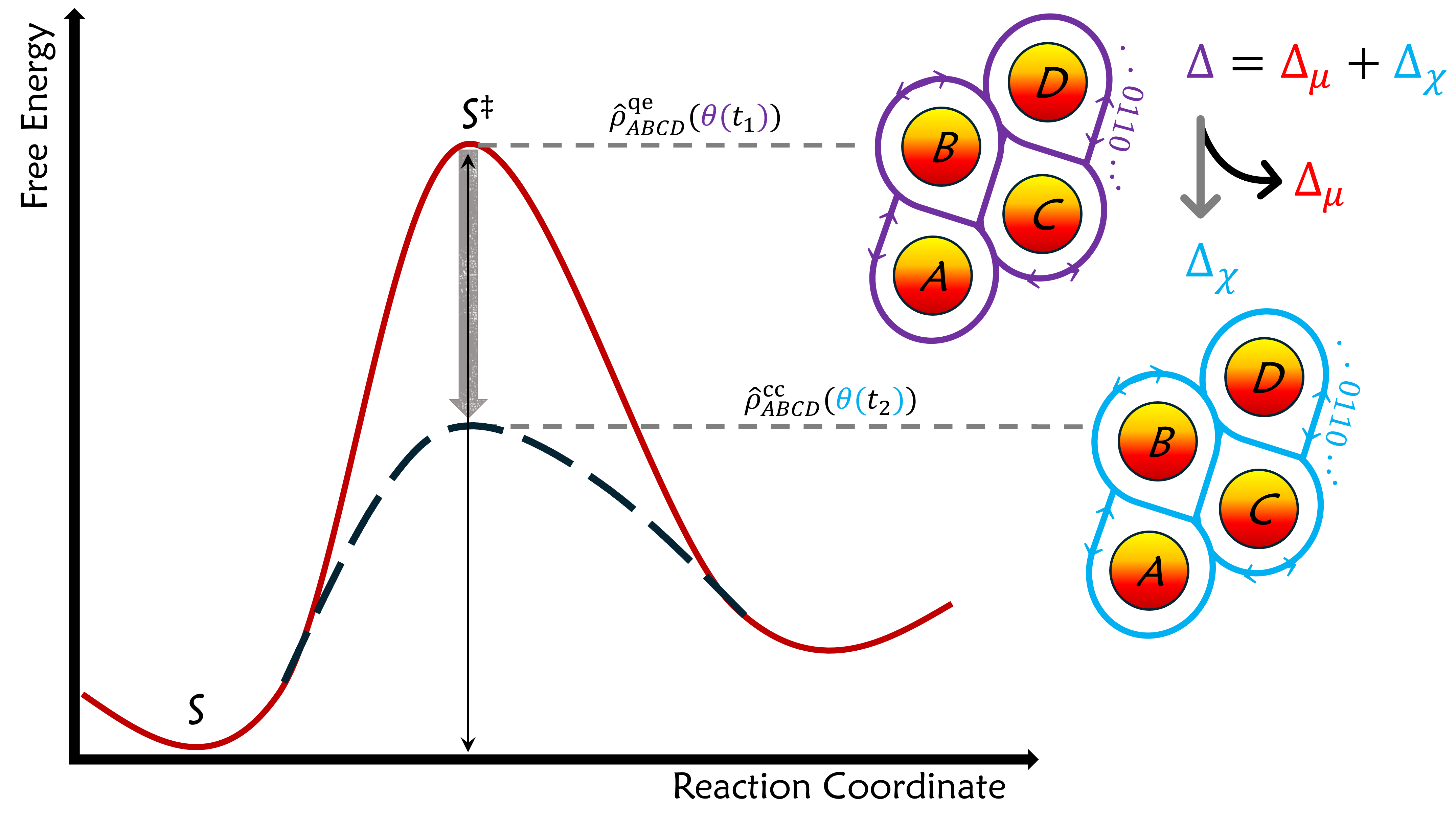
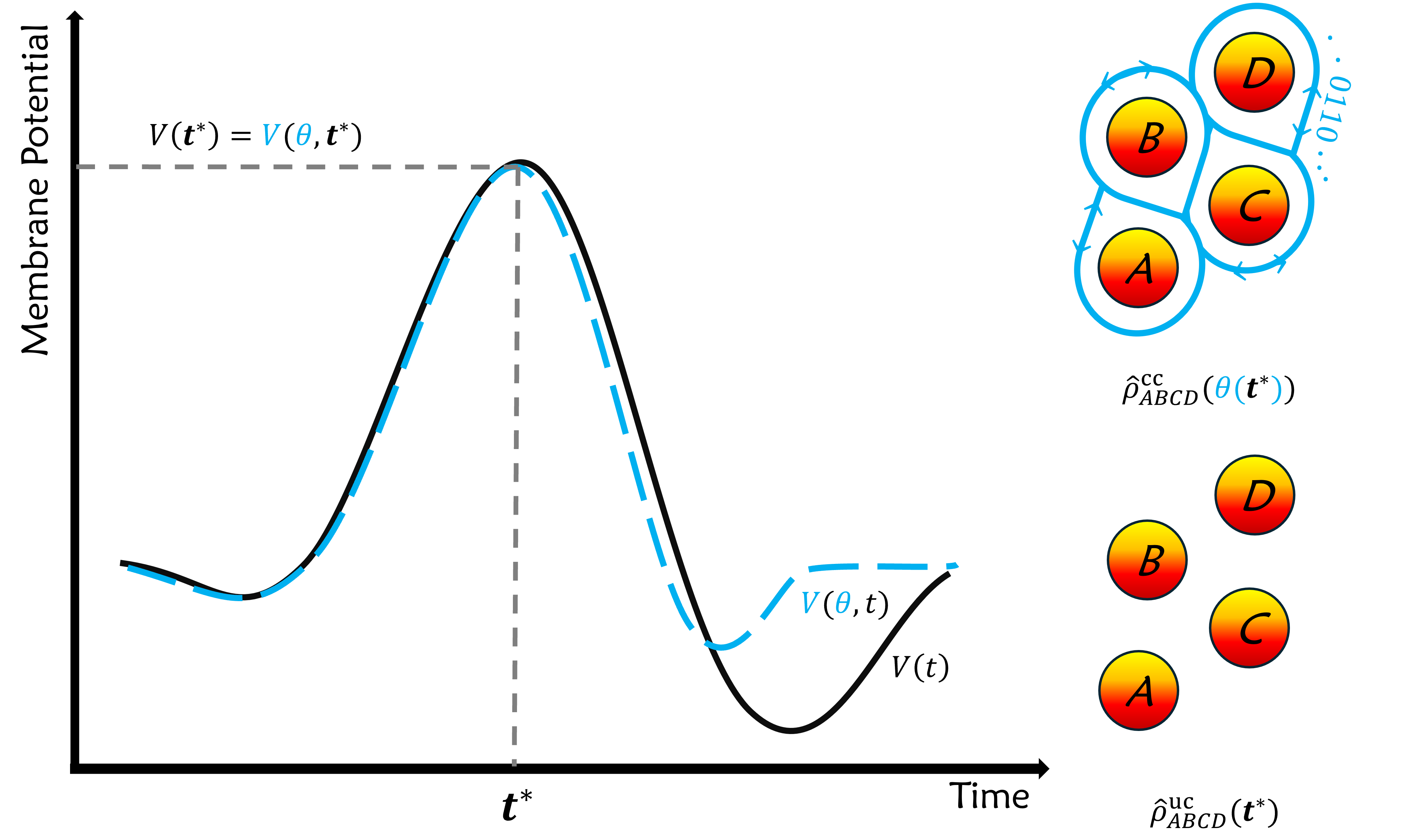
Figure 3: Schematic motif of classical reconfiguration of relational accessibility, illustrating how conformational change can enable/destroy operational access to specific relational sectors.
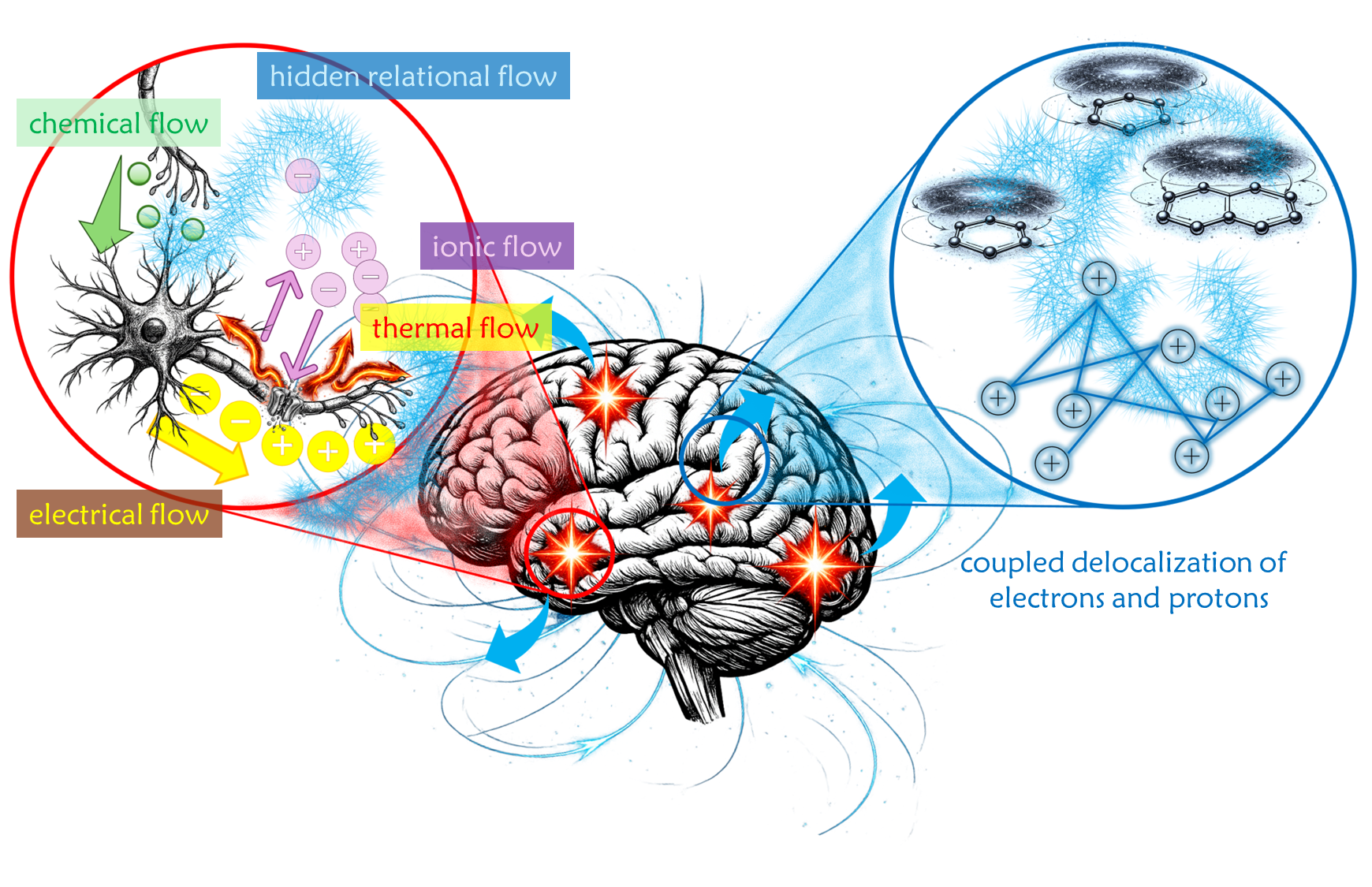
Figure 4: Neural tissue as a multiscale assembly, where electrical, chemical, ionic, and thermal processes generate, transduce, and coarse-grain hidden relational structure across substrate classes.
Implications and Experimental Projections
A central claim is that hidden relational resources—quantum and classical—provide a physically falsifiable, experimentally accessible source of deviations from local, memoryless effective models of neural dynamics, and may thus constitute a crucial substrate for understanding cognitive organization. Importantly, reproducible, structured deviations in recovery timing, metastable persistence, waiting-time statistics, and higher-order coordination—rather than directly measured fragile quantum signatures—are identified as the most plausible empirical manifestations of the proposed framework.
Robust falsifiability is emphasized: the framework can be tested by designing substrate-specific perturbation protocols (e.g., examining Mpemba-type recovery asymmetries in activation-reset cycles) or by measuring mesoscopic observables whose coarse-grained behaviors cannot be reconstructed from purely local statistical data.
Relation to Systems- and Field-Level Theories
This approach neither champions nor rejects field-centric or abstract coding-based frameworks. Rather, it recasts mesoscale electromagnetic signatures and systems-level information flow as coarse-grained emergent phenomena, shaped and constrained by deeper, transport-coupled relational organization arising from physically specified substrate classes.
Conclusion
The resource-theoretic and thermocoherent framework developed in this work presents a physically constrained, multiscale architecture for information flow in neural matter, grounded in the controlled redistribution, retention, and transduction of dynamically accessible relational structure. By bridging quantum information thermodynamics and the biophysics of neural substrates, the approach offers both a falsifiable research program and an avenue for integrating experimental anomalies into a principled theoretical narrative, without recourse to speculative or reductionist claims.
The framework emphasizes that the operational relevance of delocalized, hidden relational resources is substrate-class specific and contingent on dynamic access under nonequilibrium constraints. It encourages sharp experimental and theoretical scrutiny, with future directions focused on explicit open-system modeling, discriminating nonequilibrium observables, and systematic mapping of recovery and signaling dynamics under controlled relational state preparation. If validated, the approach could reshape not only the foundational understanding of cognitive dynamics but also the interpretation of experimental neurobiology across multiple scales.