- The paper demonstrates that quasi-1D Bose gases exhibit a long-lived microcanonical prethermal plateau before transitioning to canonical equilibrium.
- The study employs a deep learning pipeline and a modified Boltzmann equation to reconstruct phase-space distributions and quantify weak integrability breaking.
- Experimental observations show that enhanced transverse coupling accelerates energy shell contraction, linking microscopic scattering to macroscopic relaxation rates.
Exceptionally Slow Relaxation from Micro-canonical to Canonical Ensembles in Quasi-one-dimensional Quantum Gases
Introduction
The relaxation dynamics in isolated quantum many-body systems traversing from a microcanonical ensemble (characterized by sharply constrained energy) to canonical equilibrium (ensemble at thermal equilibrium with energy fluctuations) is central to nonequilibrium statistical mechanics. Theoretical constructs such as the Eigenstate Thermalization Hypothesis (ETH) delineate rapid thermalization in generic nonintegrable systems, but in nearly integrable or weakly nonintegrable systems, thermalization can be highly nontrivial or extremely slow due to the presence of an extensive number of conservation laws.
In "Exceptionally Slow Relaxation from Micro-canonical to Canonical Ensembles in Quasi-one-dimensional Quantum Gases" (2604.04062), the authors present a comprehensive experimental and theoretical investigation of quasi-1D Bose gases. These systems, close to integrable due to pronounced one-dimensionality and weak interatomic interactions, display anomalously long-lived noncanonical (microcanonical) prethermal states. The work elucidates the microscopic relaxation mechanisms, quantifies the characteristic thermalization timescales, and introduces a modified Boltzmann equation framework incorporating small stochastic violations of integrability to model the observed slow evolution toward thermal equilibrium.
Experimental Observation of Rapid Dephasing and Slow Relaxation
The system under study is a cloud of 85Rb atoms confined in a quasi-1D geometry. The experimental protocol generates a highly nonthermal state by spatially displacing the atomic cloud and monitoring the real- and phase-space dynamics during relaxation. Immediately post-quench, the atoms exhibit rapid dephasing driven by the presence of a shallow optical lattice. The initial Wigner distribution, a localized Gaussian in phase space, quickly evolves to a uniform ring-like shell corresponding to a highly nonthermal, microcanonical-like ensemble.
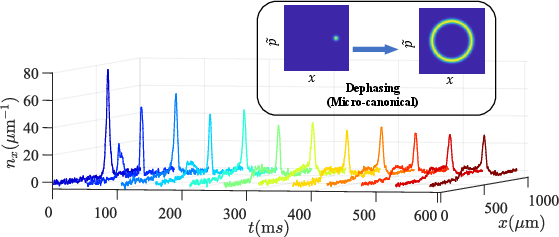
Figure 1: Time evolution of dephasing—delocalized atoms initially perform oscillations and rapidly dephase in the presence of a shallow lattice, forming a plateau density profile with a central dip. The Wigner function transitions from a Gaussian packet to an angular-uniform energy shell.
Numerical simulations confirm that purely harmonic trap anharmonicity induces dephasing on timescales two orders of magnitude slower than those observed, demonstrating that the shallow lattice and the associated band structure are essential for rapid initial microcanonicalization.
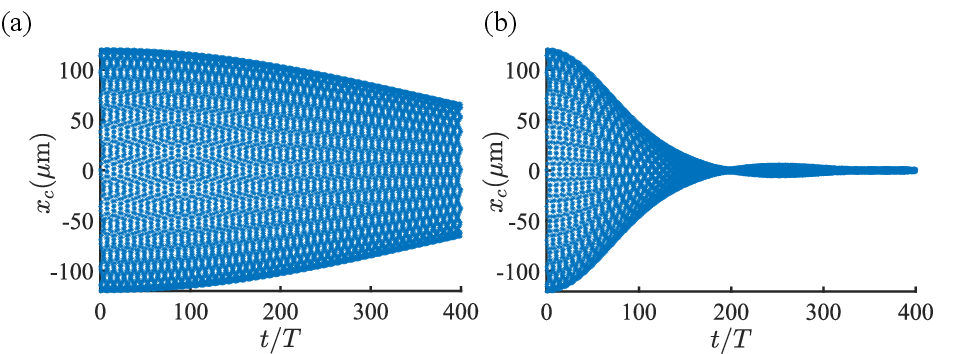
Figure 2: Time evolution of the center-of-mass: weak anharmonicity alone preserves coherence over hundreds of oscillation periods; this fails to account for observed early-time dephasing.
Subsequent dynamics are not governed by further strong ergodic mixing. Instead, the system remains trapped near the microcanonical shell for exceptionally long times, exhibiting a clear prethermal plateau. Only over timescales of several seconds does the atomic distribution approach the canonical (thermal) form, with the ring-like shell in phase space contracting and homogenizing. This two-stage relaxation—fast dephasing via lattice-induced Bloch oscillations/Landau-Zener physics and slow approach to thermal equilibrium—underscores the quasi-integrable structure of the system.
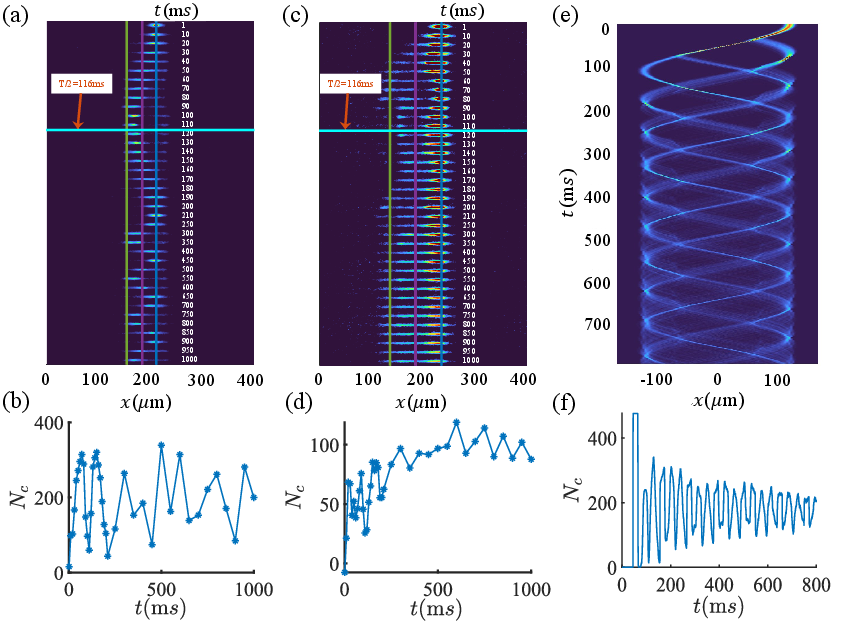
Figure 3: Evolution in the band structure: strong gradients (large displacement from trap center) drive atoms to the Brillouin-zone edge, leading to rapid dephasing; weak gradients preserve coherent harmonic motion.
Machine Learning–Assisted Reconstruction of Quantum State Distributions
Characterizing the phase-space distribution f(x,p) from experimentally measured (and noisy) atomic density profiles is a nontrivial inverse problem. The authors utilize a two-stage deep learning pipeline based on denoising autoencoders (DAEs). The architecture first reconstructs clean density profiles from noisy measurements, and then extracts the key Wigner function parameters (shell radius ρ0 and shell width σρ) describing the phase-space structure.
A large database of synthetic data is constructed by generating Wigner functions with an angular-uniform energy shell ansatz, mapping to real-space densities, and superimposing empirically characterized experimental noise. The DAE is trained using mean squared error loss to achieve accurate denoising and parameter extraction. The method robustly recovers smooth physical profiles and phase-space metrics across a range of interaction strengths and initial ensemble widths.
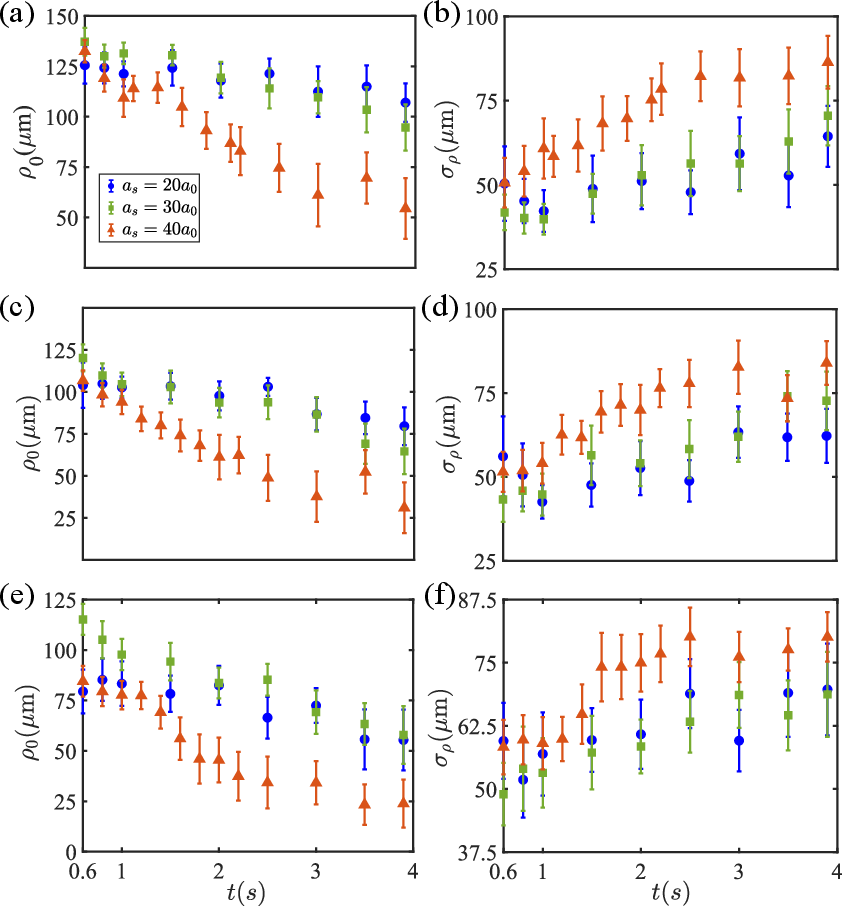
Figure 4: Time evolution of extracted Wigner parameters for varying interaction strengths and initial cloud widths: increasing interaction or width enhances the energy-shell width post-dephasing.
Microscopic Model: Modified 1D Boltzmann Dynamics with Integrability Breaking
Canonical ensemble formation requires thermalizing collisions to ergodically redistribute energy. For strictly 1D Bose gases, two-body collisions cannot enable such redistribution due to exact integrability. In the experimental quasi-1D configuration, extremely weak integrability-breaking couplings—primarily to transverse modes—permit slow stochastic violation of energy conservation in the axial direction.
To quantitatively model this, the authors construct a generalized Boltzmann equation with a collision term incorporating a stochastic axial energy mismatch ϵ, sampled from a distribution g(ϵ). The variance σ2 of g(ϵ) sets the magnitude of integrability breaking, governed microscopically by transverse excitations during two-body collisions, and is calculated via multi-channel scattering theory. The equilibrium (detailed balance) condition for Maxwell-Boltzmann statistics is satisfied for a broad class of even distributions h(ϵ) enveloped by e−βϵ/2.
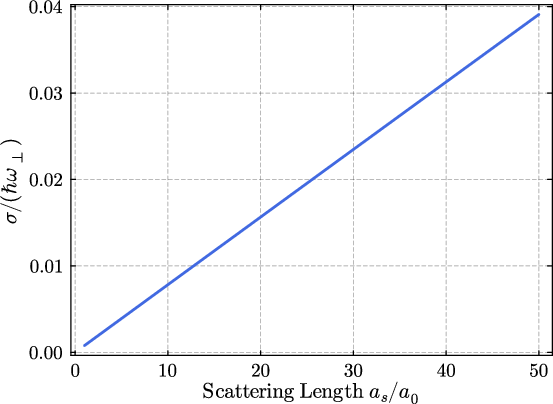
Figure 5: Numerically calculated energy uncertainty f(x,p)0 as a function of 3D scattering length, establishing the dimensionless parameter f(x,p)1 that links microscopic scattering to macroscopic relaxation dynamics.
Parameter estimates from two-body theory yield f(x,p)2 typical axial kinetic energy, fully justifying the use of the modified Boltzmann formalism in the experimental regime.
Numerical Relaxation Dynamics and Shell Contraction Analysis
The authors discretize the phase-space and solve the modified Boltzmann equation numerically using DifferentialEquations.jl. The initial state is the dephased, microcanonical-like Wigner function constructed from the experimental protocol. The time evolution of the Wigner function is tracked for varying strengths of energy uncertainty (axial energy mismatch), revealing how increasing integrability breaking (larger f(x,p)3) accelerates relaxation.
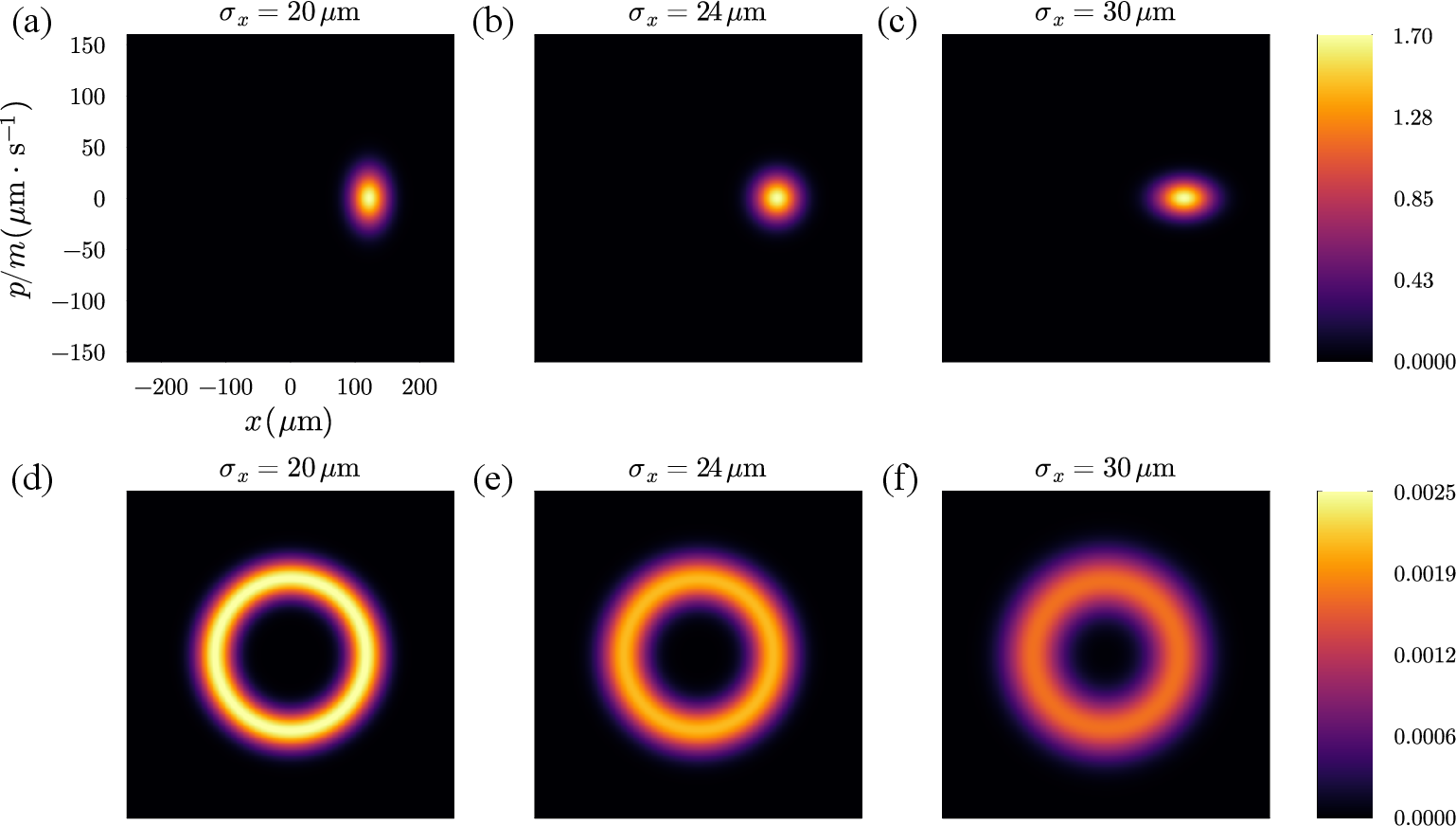
Figure 6: Comparison of pre- and post-dephasing Wigner functions for different initial state widths; dephasing drives the distribution to an angular-uniform energy shell in phase space.
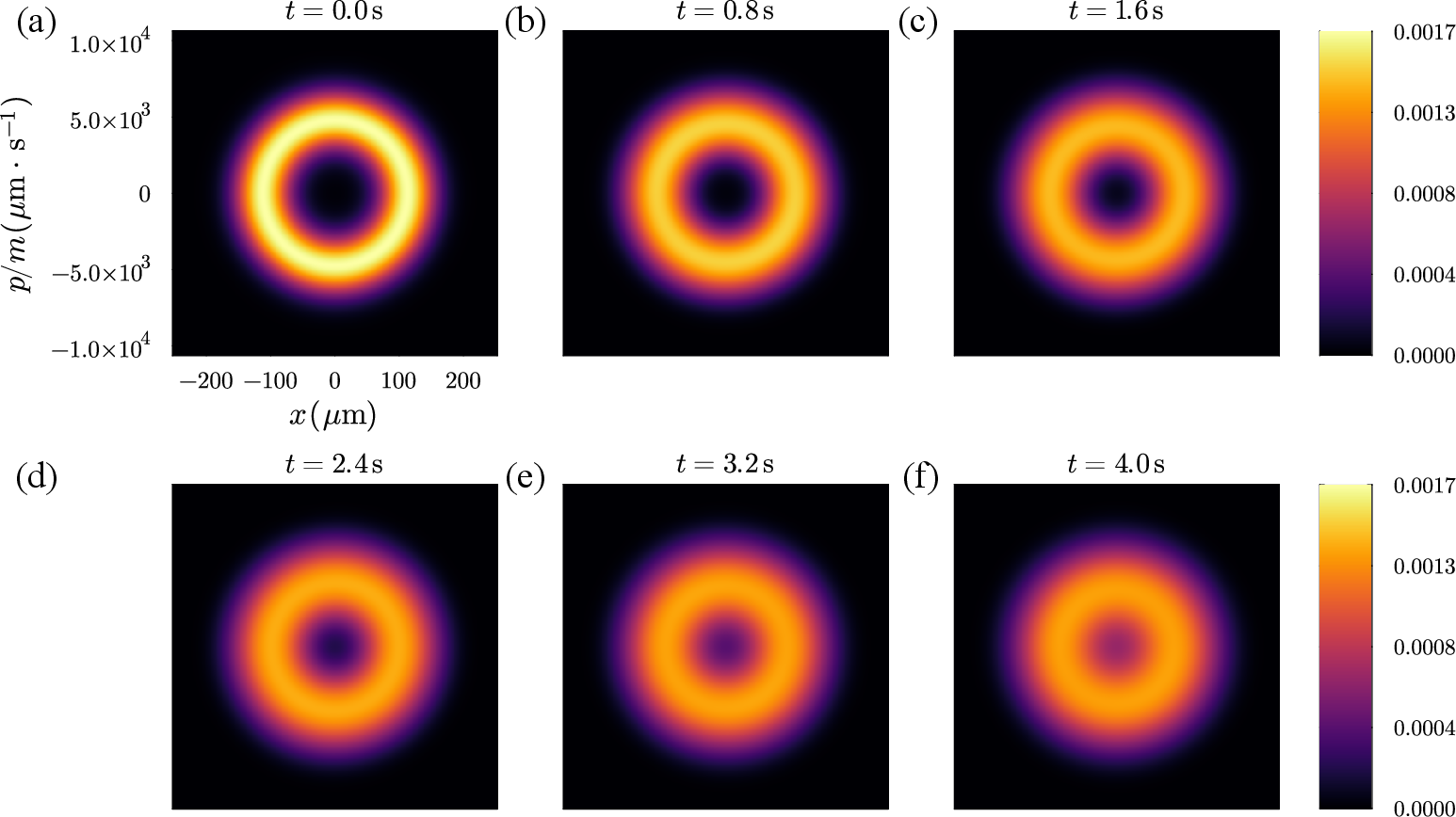
Figure 7: Phase-space evolution for weak integrability breaking (f(x,p)4): shell contracts slowly, incomplete thermalization is evident at f(x,p)5 s.
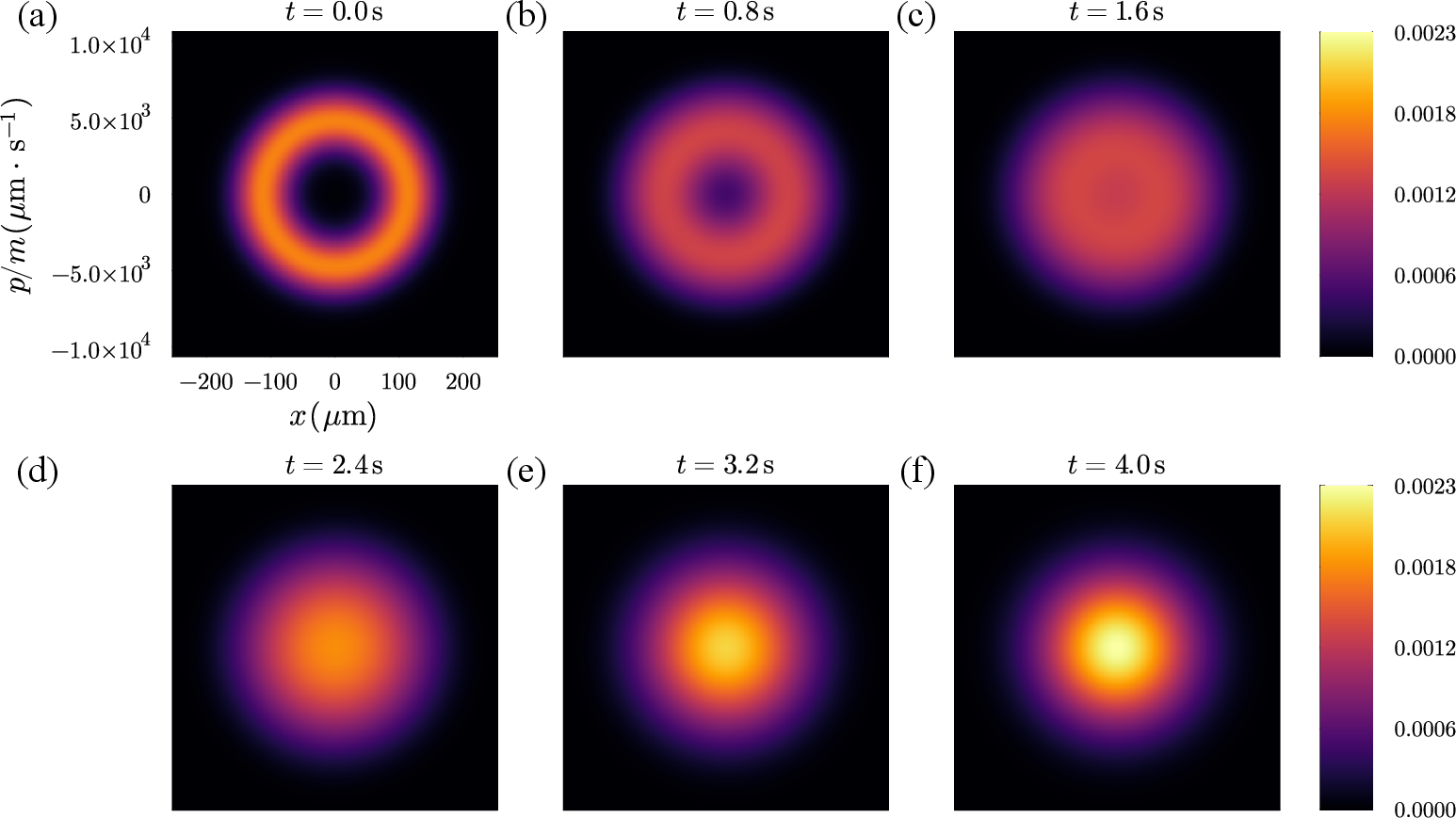
Figure 8: For larger energy uncertainty (f(x,p)6), the Wigner function approaches the thermal Maxwell-Boltzmann form on similar timescales.
Analysis of experimentally relevant observables in real space supports these trends.
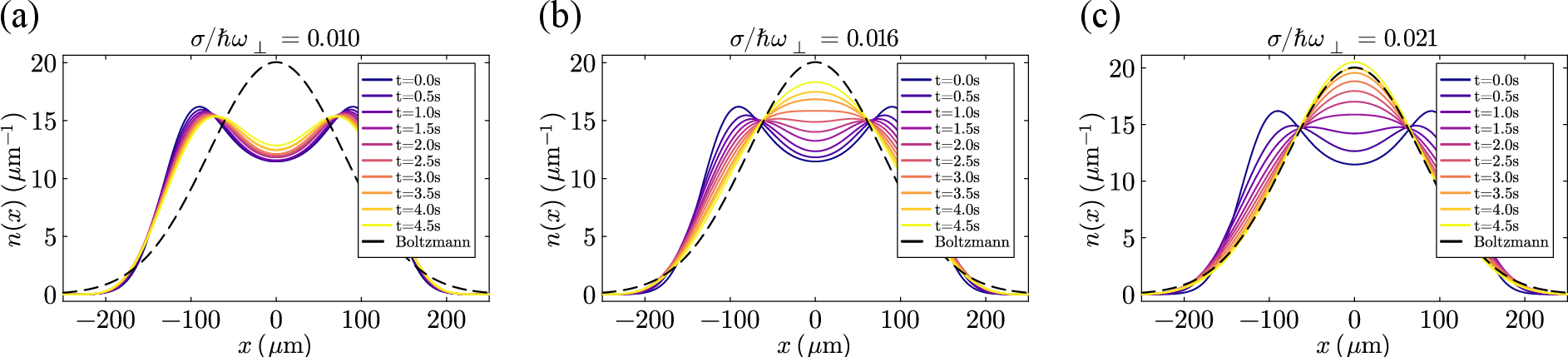
Figure 9: Real-space density evolution for increasing energy uncertainties; higher f(x,p)7 accelerates the disappearance of the shell structure and promotes canonical-like broadening.
Quantitative analysis of the contraction of the energy shell in phase space shows that the relaxation (decrease in f(x,p)8) is linear in time initially, and that the contraction rate is an increasing function of the energy uncertainty f(x,p)9.
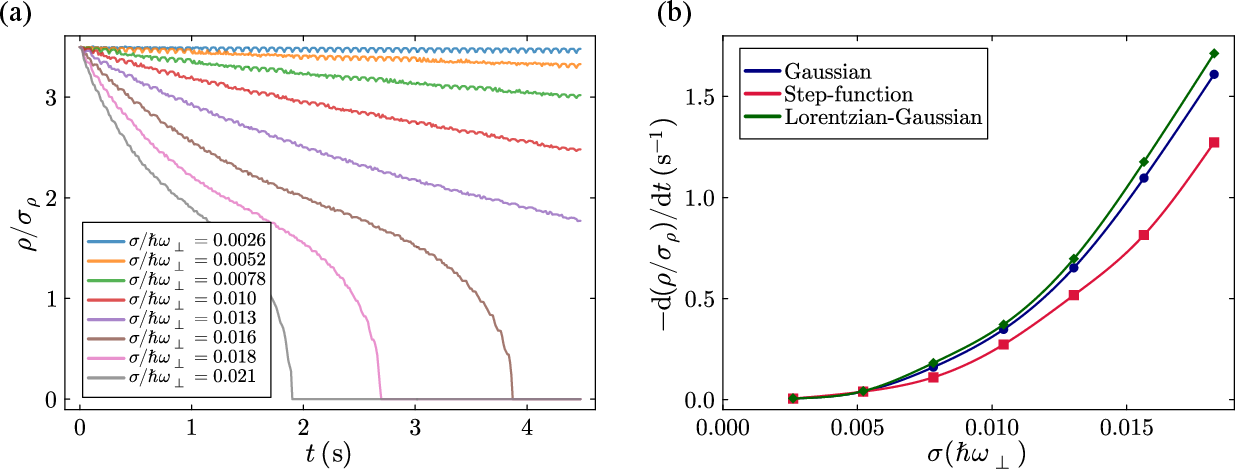
Figure 10: (a) Temporal decay of the shell radius-to-width ratio for different energy uncertainties. (b) Extracted contraction rates as a function of ρ00. The contraction rate displays nearly linear dependence on the energy uncertainty, directly mapping the microscopic integrability breaking to macroscopic relaxation speed.
Implications, Open Questions, and Outlook
The empirical observation and theoretical substantiation of a long-lived microcanonical-like prethermal plateau in weakly nonintegrable quasi-1D Bose gases demonstrates how the rate of true thermalization can be parametrically suppressed. The work provides a robust framework for connecting microscopic (two-body scattering and transverse coupling) and macroscopic (observable relaxation times) quantities, facilitating rigorous benchmarking of nonequilibrium quantum statistical mechanics in nearly integrable systems.
Experimentally, the findings may inform protocols aiming to preserve noncanonical memory in cold atom platforms, with direct implications for quantum simulation, information retention, and transport. Theoretically, the introduced stochastic Boltzmann formalism offers a tractable tool for modeling more complex systems in which integrability is weakly or controllably broken. It is anticipated that this approach will extend to other dimensional crossovers and strongly interacting regimes, and may be adapted to incorporate higher-order collision processes or explicit quantum fluctuations.
Conclusion
This work establishes that quasi-one-dimensional quantum gases can exhibit relaxation to the canonical ensemble on anomalously slow timescales, a direct manifestation of their near-integrability and minimal energy-mixing via weak transverse excitations. The integration of advanced experimental protocols, machine learning for state reconstruction, and modified kinetic theory yields a quantitative and predictive description of nonequilibrium relaxation, delineating the precise mechanisms and rates controlling the breakdown of microcanonical constraints. These results have broad relevance for controlled quantum many-body systems and the study of prethermalization, thermalization, and dimensional crossover phenomena.

