- The paper introduces a novel modeling framework that integrates Extended Timed Continuous Petri Nets with semi-supervised anomaly detection for real-time fault diagnostics in hybrid systems.
- It employs marking-dependent flow mechanisms and mode-dependent observers synthesized via LMI optimization to achieve global asymptotic stability and rapid fault recovery.
- Experimental validation on switched LTI benchmarks demonstrates superior detection sensitivity and computational efficiency compared to conventional techniques.
Extended Hybrid Timed Petri Nets with Semi-Supervised Anomaly Detection for Switched Systems: Modeling and Fault Detection
Introduction
This work presents a unified framework for fault detection in hybrid dynamical systems (HDS), integrating an advanced modeling formalism—Extended Timed Continuous Petri Nets (ETCPN)—with state-of-the-art semi-supervised anomaly detection. The proposed framework holistically addresses the intrinsic hybrid nature of modern systems exhibiting both continuous and discrete-event dynamics, such as those found in transportation, robotics, and energy networks. The integrated approach overcomes limitations in prior art: it natively encodes switching logic without reliance on external machinery and enables scalable, real-time, and interpretable fault diagnostics.
The ETCPN model synthesizes discrete Petri nets (DPN), continuous Petri nets (CPN), and timed continuous Petri nets (TCPN) into a unified framework. The primary innovation is the marking-dependent flow mechanism, where continuous transition rates are functions of discrete markings. This enables the ETCPN to encode switching behaviors intrinsically and to represent the evolution of switched linear time-invariant (LTI) subsystems under the control of discrete-event logic.
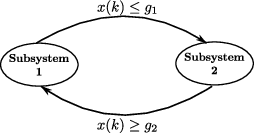
Figure 2: Subsystem switching logic in a hybrid dynamical system, with transitions between modes governed by marking-dependent switching signals and state-dependent thresholds.
ETCPNs formally couple continuous dynamics (with state updates expressed via hybrid incidence matrices) and discrete events, supporting seamless transitions and concurrency. This avoids the artificial separation and limited expressiveness of traditional Hybrid Petri Nets, where switching and system dynamics are often managed externally.
The marking vector Mq(k) decomposes into discrete MqD(k) and continuous MqC(k) components, with system evolution governed by mode-dependent incidence matrices. The model supports both upward and downward level-triggered switches via test arcs, which enforce mode enablement conditions natively in the model structure.
Hybrid Observer Synthesis and Stability
Fault detection relies on an ETCPN-based hybrid observer (ETCPN-HO) to estimate system states and detect residual behavior indicative of faults. The observer design comprises two coupled estimators:
- Discrete event observer: Estimates marking and firing sequences of the discrete net, identifying active operational modes.
- Continuous LTI observer: Implements a switched Luenberger structure; gain matrices are mode-dependent and computed via offline Linear Matrix Inequality (LMI) optimization.
Offline LMI synthesis guarantees the global asymptotic stability of the estimation error for all admissible mode transitions, a property formally proven using mode-dependent Lyapunov arguments. This ensures resilience even under complex switching and arbitrary discrete-event scenarios.
Residual-Based Semi-Supervised Fault Detection
Residuals—the discrepancies between observed and estimated behaviors—are generated for state, output, and discrete-event variables. The primary fault indicators are the state residuals:
rx(k)=x(k)−x^(k)
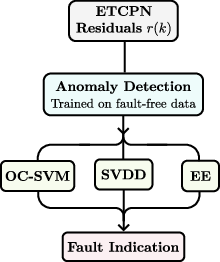
Analyzing these residuals is performed via semi-supervised anomaly detection, avoiding dependence on labeled fault data. Three methods were implemented:
This residual-centric approach enables high sensitivity to both abrupt and subtle anomalies, effectively managing class imbalance without explicit fault samples.
Experimental Validation
A comprehensive switched LTI benchmark with two operating modes was used to validate the framework. Three fault scenarios were assessed:
- Discrete-event faults: Mode-blocking glitches trapped the system; ETCPN-HO exhibited rapid convergence post-fault, outperforming Hybrid Automaton-based benchmarks.
- Continuous-domain faults: Intermittent sensor errors; the ETCPN-HO maintained robust state and mode estimation, with low-latency recovery.
- Hybrid/simultaneous faults: Concurrent continuous and discrete faults; the framework maintained stability and high-fidelity estimation.
Strong detection rates were observed for OC-SVM and SVDD across all scenarios, evidenced by recall, F1, and accuracy statistics that consistently outperformed alternative approaches. The EE method was competitive in low-noise settings but less robust during mode transitions or under non-Gaussian residuals.
Key Findings
- Faults are accurately and rapidly detected across discrete, continuous, and hybrid domains.
- OC-SVM and SVDD yield superior sensitivity and a favorable trade-off between detection rate and false alarms without requiring any labeled fault data.
- The approach is computationally lightweight online: all matrix computations are performed at runtime with LMI synthesis offline, supporting real-time deployment on embedded controllers.
Implications and Future Developments
The ETCPN-HO framework advances formal methods for observable HDS, offering an analytic toolchain with interpretable, scalable, and robust performance for multi-domain fault detection. The methodology’s strict separation of offline/online computation, transparent observer formulation, and data-efficient anomaly detection make it particularly suited for industrial and safety-critical contexts where high concurrency and limited fault history are present.
On the theoretical front, ETCPN provides a formalism with provably correct mode/state estimation and tight coupling of discrete/continuous artifacts—a notable advancement over HPNs and automata-based methods. Practically, the avoidance of fault labeling sets a new standard for low-data, interpretable digital twins and runtime monitors.
Potential future avenues include:
- Adaptive and uncertainty-aware observer synthesis, enabling threshold-free, unsupervised adaptation to evolving plant conditions.
- Explainable fault identification via XAI tools, enriching the interpretability of residual-based alarms and linking anomalous behavior to root causes.
Conclusion
This work formalizes a comprehensive, unified framework for modeling, state estimation, and fault detection in hybrid dynamical systems via ETCPN and semi-supervised anomaly detection. The presented architecture closes existing gaps in hybrid system monitoring, delivering strong empirical and theoretical results across a broad spectrum of fault scenarios. Its structure supports immediate adoption in industrial real-time applications, and future research will extend its flexibility and interpretive potential (2604.04051).