- The paper demonstrates that DPS contributions exceed SPS by an order of magnitude in J/ψ+γ production.
- It employs the Parton Reggeization Approach with NRQCD and ICEM hadronization models to predict detailed differential cross sections.
- Results offer robust guidance for multi-parton interaction studies and constraints on nonperturbative QCD dynamics at the LHC.
Associated Production of J/ψ Mesons and Photons in the Parton Reggeization Approach and DPS
Introduction
The paper "Associated production of J/ψ mesons and photons in the Parton Reggeization Approach and the double parton scattering model" (2604.04049) presents a comprehensive theoretical study of dileptonic quarkonium-plus-photon (J/ψ+γ) production in pp collisions at the LHC, focusing on large transverse momenta and contrasting single parton scattering (SPS) and double parton scattering (DPS) mechanisms. The calculations are implemented within the high-energy factorization regime using the gauge-invariant Parton Reggeization Approach (PRA). Two frameworks are used for the hadronization of the ccˉ pair: Nonrelativistic QCD (NRQCD) and the improved color evaporation model (ICEM), each fitted to LHC data for single charmonium production. The analysis aims to elucidate the relative contributions of SPS and DPS across observables and models, providing predictions relevant for future experimental searches.
Theoretical and Computational Framework
The PRA is employed for all hard-process calculations, using kT-factorization and Reggeized parton amplitudes. For the SPS component, the framework convolutes two unintegrated PDFs (uPDFs) with hard partonic cross sections computed with gauge-invariant amplitudes from Lipatov’s high-energy effective action. The uPDFs are constructed via the modified KMRW prescription, and the collinear input is from MSTW2008lo. For the DPS component, the standard "pocket formula" is used, employing the PRA-predicted SPS cross sections for single J/ψ and single photon production; an effective cross section σeff=11.0mb, fitted to various associated heavy-quarkonium production data, controls DPS normalization. Prompt photon production is included using leading-order PRA, with NLO* corrections approximated by dominant Compton-like RQ→γq scattering incorporating photon isolation.
For the hadronization of ccˉ pairs, two models are analyzed. In NRQCD, LDMEs are fitted to CMS and ATLAS data for both J/ψ0 and J/ψ1, including feeddown contributions from higher charmonia. The ICEM calculation follows the conventional procedure, integrating over J/ψ2 invariant masses up to the J/ψ3 threshold, with hadronization parameter J/ψ4 fixed from phenomenology.
LDME Extraction and Single Quarkonium Validation
Octet and singlet LDMEs are extracted from fits to differential J/ψ5 spectra of J/ψ6 and J/ψ7 from CMS and ATLAS at J/ψ8 TeV and are found to be consistent with both data sets at low J/ψ9. This underpins the reliability of both NRQCD and ICEM modeling for single-quarkonium channels in the J/ψ+γ0 GeV region, but highlights a breakdown at higher J/ψ+γ1—a limitation noted and respected in the subsequent predictions.
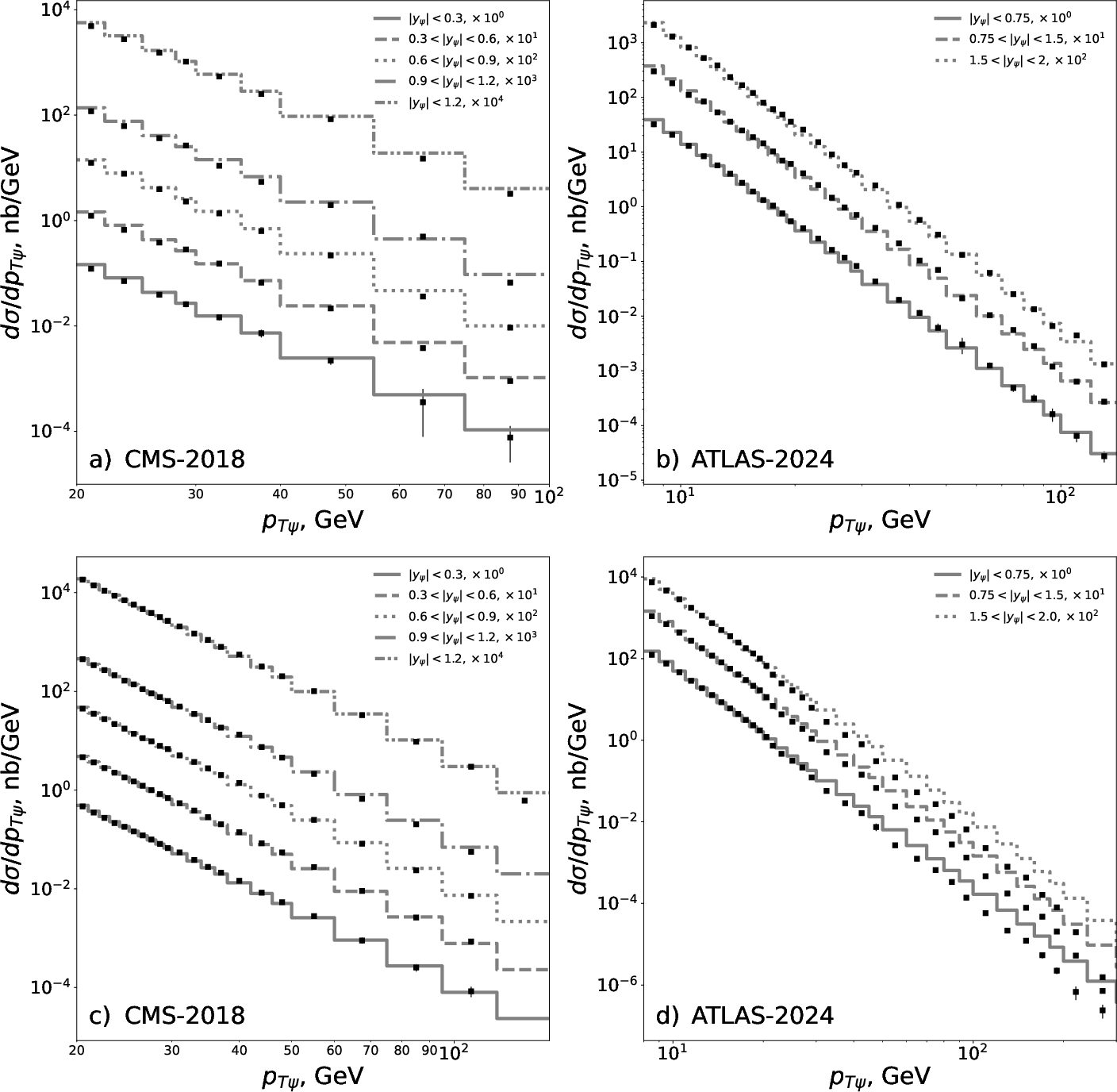
Figure 1: Differential cross sections as functions of J/ψ+γ2 for J/ψ+γ3 and J/ψ+γ4 production compared to CMS and ATLAS data. The fitted NRQCD and ICEM predictions are shown alongside experimental spectra.
Associated J/ψ+γ5 Production: Central Rapidity Region
In the central rapidity region (J/ψ+γ6), the study provides detailed predictions for J/ψ+γ7 cross section distributions as functions of J/ψ+γ8, J/ψ+γ9, pp0, pp1, pp2, and the pair invariant mass pp3. Across all observables, the DPS contribution is found to significantly exceed the SPS contribution, independently of the hadronization model. Notably, the DPS cross section predicted with NRQCD is greater than that obtained with ICEM, a pattern mirrored in the SPS sector but with an even larger suppression in ICEM.
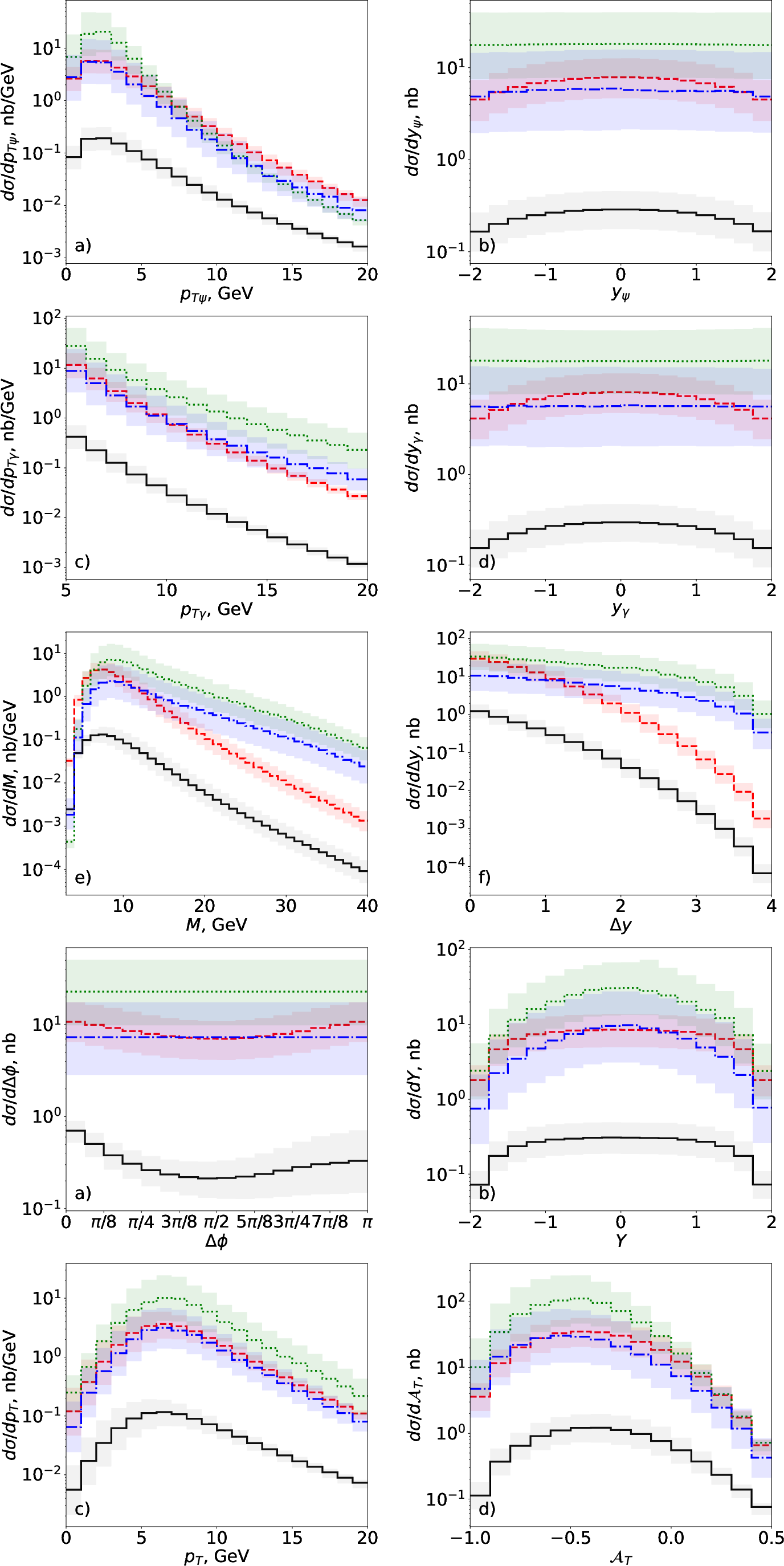
Figure 2: pp4 differential cross sections vs. pp5, rapidity, pp6, and invariant mass in the central region, comparing DPS and SPS from NRQCD and ICEM.
Correlation observables such as the azimuthal angular difference pp7, pair rapidity pp8, pair pp9, and transverse momentum asymmetry are also analyzed. DPS processes generate broader, less correlated distributions, consistent with their uncorrelated origin, while SPS contributions remain subdominant but exhibit more pronounced kinematic correlations.
Figure 3: ccˉ0 cross sections as functions of ccˉ1, pair rapidity, pair ccˉ2, and ccˉ3 asymmetry in the central region, differentiating DPS versus SPS and NRQCD versus ICEM.
Forward Rapidity Region Observables
The analysis is repeated in the forward rapidity window (ccˉ4), relevant for LHCb. Here, the dominance of DPS over SPS persists across all studied observables and models. The kinematic dependence of differential distributions matches expectations from DPS factorization: nearly flat in ccˉ5, broadened in ccˉ6, with significantly reduced sensitivity to hadronization model at the qualitative level, though the normalization difference between NRQCD and ICEM is maintained.
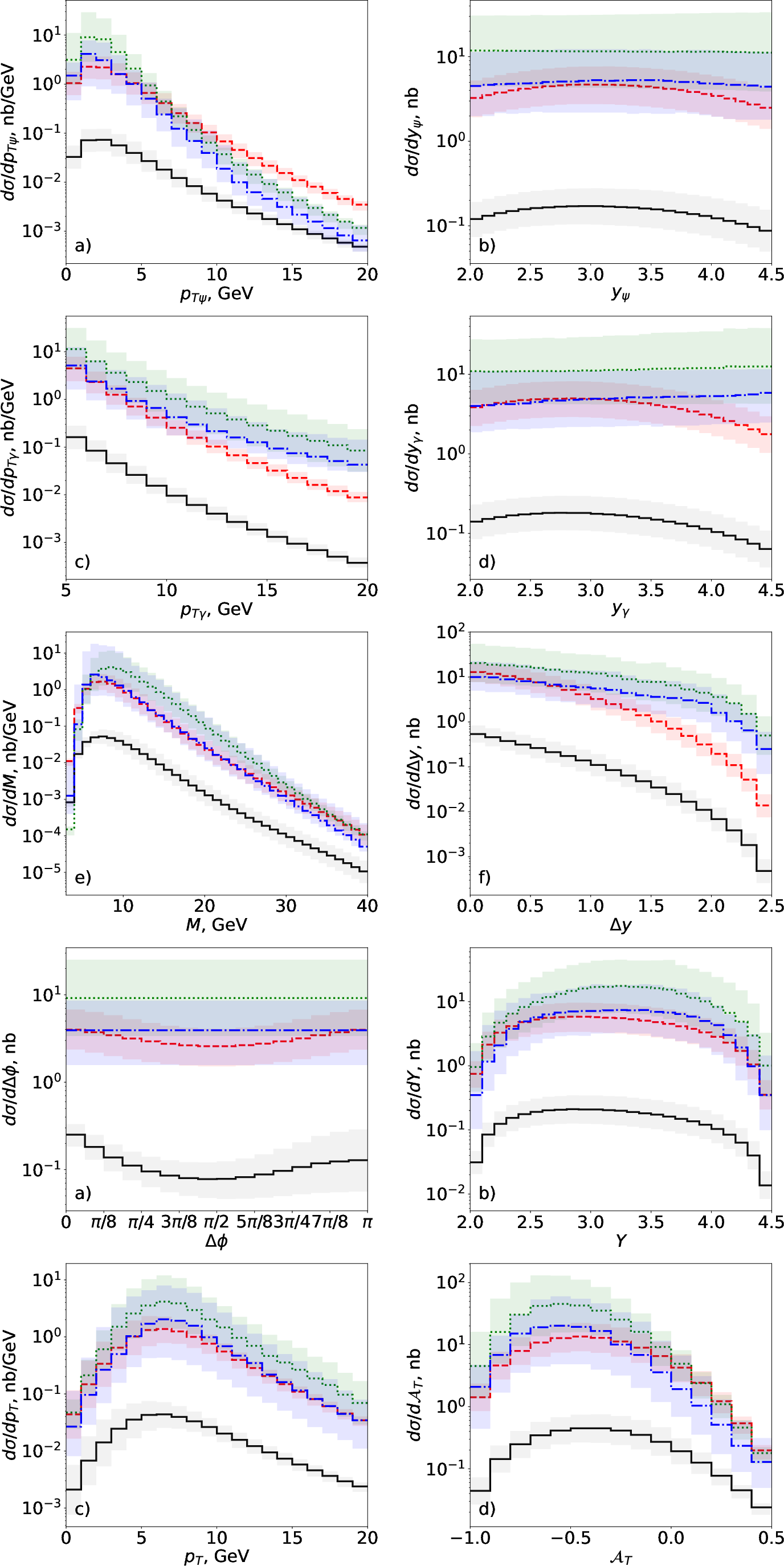
Figure 4: ccˉ7 differential cross sections in the forward rapidity region as functions of ccˉ8, rapidity, pair mass, and rapidity difference, distinguishing DPS and SPS and hadronization models.
Figure 5: ccˉ9 correlation and asymmetry distributions in the forward rapidity region, highlighting DPS dominance and hadronization model dependence.
Numerical Highlights and Model Sensitivity
Numerical predictions reveal that, in every analyzed kinematic regime, the DPS component surpasses the SPS yield by at least an order of magnitude. The NRQCD hadronization model yields substantially higher cross sections for kT0 than ICEM, reinforcing previous findings in the SPS sector. Model dependence is strongest for normalization, not qualitative shape. The uncertainty from factorization/renormalization scale variation, represented by bands in all results, is moderate but not negligible. The suppression of the ICEM prediction in SPS, previously noted in [Alimov:2024pqt], extends to DPS as well.
Implications and Prospects
The analysis delivers clear theoretical guidance for future experimental studies of kT1 at the LHC. The overwhelming dominance of DPS over SPS, regardless of hadronization modeling, establishes kT2—like double quarkonium—as a robust probe of multi-parton dynamics rather than of the short-distance hard subprocess. The pronounced sensitivity of absolute rates to hadronization model, especially between NRQCD and ICEM, persists even in DPS-dominated observables and could be leveraged, given sufficiently precise data, to further constrain nonperturbative QCD models.
Practically, because associated kT3 production couples gluon PDFs in both the soft and moderate-kT4 regions, differential measurements can yield novel constraints on TMD gluon distributions if sufficiently precise separation of DPS and SPS can be achieved. The established dominance of DPS also calls for refined modeling of proton structure, especially regarding correlations and fluctuations in parton density at small kT5.
Theoretically, extension to higher-order corrections within PRA, more sophisticated DPS models with correlated parton densities, and exploration of polarization observables are natural next steps. With the ongoing experimental push toward higher luminosities and forward rapidity acceptance, these predictions will become increasingly testable.
Conclusion
This study provides a detailed prediction for associated kT6 production at LHC energies using the PRA with both NRQCD and ICEM hadronization models. Across the entire accessible phase space, the DPS mechanism dominates over SPS by an order of magnitude or more, and the cross sections are strongly sensitive to the hadronization model, with NRQCD consistently predicting larger yields than ICEM. These results have significant implications for the experimental exploration of multi-parton interactions and for the validation of nonperturbative QCD models in charmonium-associated final states.