- The paper introduces a dual-hypergraph RAG framework that fuses structured pedagogical theory with real student mistake cases to tackle novice teachers' challenges.
- Evaluation on the MisstepMath dataset shows up to 15.3% improvement in multi-dimensional response quality, especially boosting diversity and empowerment.
- The modular, scalable design supports integration into teacher professional development and can adapt to evolving curricular and subject-specific needs.
MisEdu-RAG: A Misconception-Aware Dual-Hypergraph RAG for Novice Math Teachers
The persistent difficulties novice math teachers face in diagnosing and remediating student misconceptions present an empirical and operational challenge, especially given the resource constraints in scalable professional development (PD). Traditional LLM-based solutions exhibit inadequate pedagogical grounding and failures in evidence integration, largely due to the unstructured, flat retrieval mechanisms that do not align pedagogical concepts with situated student errors. MisEdu-RAG directly addresses this deficiency through a formalized dual-hypergraph Retrieval-Augmented Generation (RAG) framework that bridges structured pedagogical theory with concrete case-level exemplars, aiming for actionable, reliable, and context-responsive feedback generation.
MisEdu-RAG Framework and Dual-Hypergraph Construction
Central to MisEdu-RAG is a two-layer dual-hypergraph architecture. The concept hypergraph encodes pedagogical references—distilled from curriculum standards, theoretical texts, and evidence-based guidelines—via high-order and low-order hyperedges, supporting query-time extraction of relational pedagogical knowledge. In parallel, the instance hypergraph is constructed from the MisstepMath dataset, structuring authentic student mistake cases with fields such as grade, topic, challenge type, and annotated teacher responses.
The framework implements a two-stage cognitive-inspired retrieval pipeline. The first stage retrieves similar mistake instances from the instance hypergraph, supporting context grounding by analogy. The second stage supplements this with aligned pedagogical concepts, retrieved from the concept hypergraph based on extracted concepts from both the query and the instance-aligned draft response. This layered retrieval mechanism is explicitly designed to optimize not merely semantic relevance, but also the compositional and explanatory requirements of actionable misconception handling.
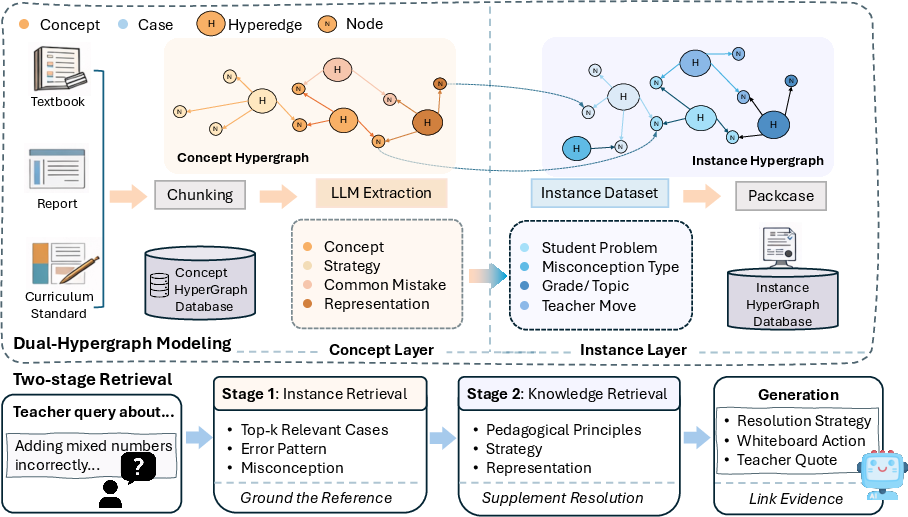
Figure 1: Schematic overview of the MisEdu-RAG dual-hypergraph architecture and two-stage retrieval pipeline.
Evaluation: Retrieval Precision and Instructional Response Generation
Experiments are conducted on the semi-synthetic MisstepMath dataset (12,000 annotated cases, K-8, multiple misconception categories), with benchmarking against LLM-only, StandardRAG, and state-of-the-art HypergraphRAG baselines. Four LLM backbones are evaluated: Qwen-Plus, GPT-4o-mini, DeepSeek-R1, and LLaMa3.3-70B.
Quantitative metrics include cosine similarity and token-level F1 for retrieval, as well as five-dimension response quality for instructional generation (Comprehensiveness, Diversity, Empowerment, Logicality, Readability). MisEdu-RAG consistently yields the highest performance across all backbones.
Notable numerical result: Compared to HypergraphRAG, MisEdu-RAG boosts token-level F1 scores by up to 10.95% (Qwen-Plus) and achieves up to 15.3% relative improvement in multi-dimensional response quality (DeepSeek-R1). The strongest gains are observed in the Diversity and Empowerment dimensions, indicating superior capacity for providing varied strategies and actionable, targeted guidance. These effects are backbone-agnostic, confirming that the dual-hypergraph design systematically improves information fusion and instructional value.
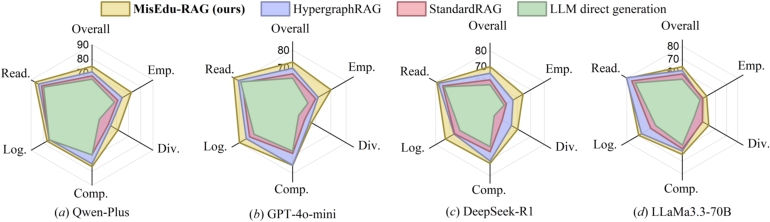
Figure 2: Radar plots comparing MisEdu-RAG and baselines on five instructional quality dimensions across four LLM backbones.
Ablation studies further reveal that removing either the concept or instance layer degrades performance (notably −6.31 overall when case evidence is omitted). This quantifies the complementarity of the two evidence sources: the concept layer primarily drives strategy diversity and empowerment, while the instance layer is critical for concrete guidance.
Alignment with Novice Teacher Needs: Qualitative Findings
A large-scale practitioner survey (N=221, 31.2% novices) and follow-up interviews (N=6) demonstrate strong user demand for fine-grained, actionable, and situation-specific instructional support. Novice teachers report high cognitive load and time constraints inhibiting diagnostic and remedial effectiveness. MisEdu-RAG's responses—validated with strong performance especially on strategic, logic, and misconception challenge types—closely match the distribution and practical requirements of real classroom demands.
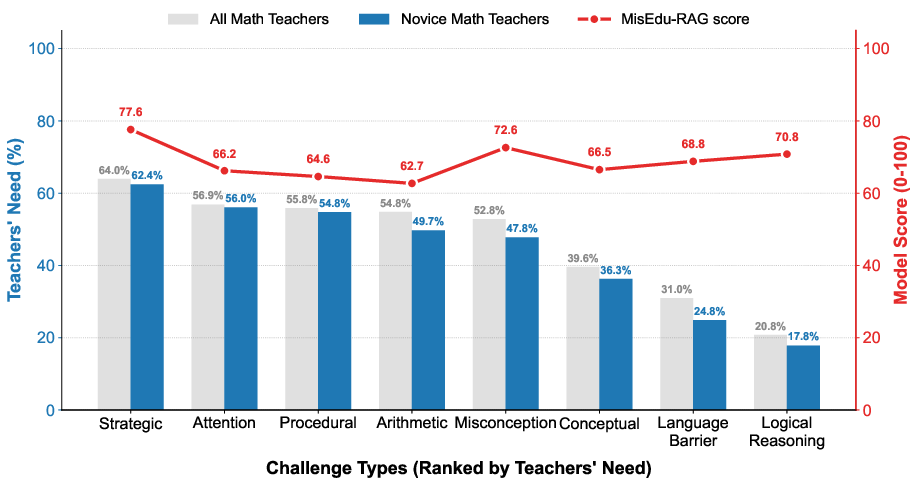
Figure 3: Prevalence of instructional challenge types reported by teachers and alignment with MisEdu-RAG's performance by challenge category.
Representative response case studies exhibit a clear contrast: LLM-only and StandardRAG produce plausible but generic or misaligned feedback, while MisEdu-RAG demonstrates consistent faithfulness to the target misconception and more granular, implementable instructional moves.
Practical and Theoretical Implications
The technical composition of MisEdu-RAG suggests several implications:
- Actionability and Scalability: By structuring evidence via dual-hypergraphs, MisEdu-RAG facilitates update and maintenance, supporting addition of new references or cases independently. This modularity is critical for keeping models aligned with curricular or pedagogical shifts and for continuous deployment in dynamic educational contexts.
- Generalizability: Although currently evaluated on K–8 U.S. mathematics, the separation of concept and case evidence, and the abstraction of retrieval over hypergraphs, permits straightforward adaptation to other subjects, languages, and teacher support tasks.
- Instructional Decision Support: The format of MisEdu-RAG's outputs (strategy, classroom action, teacher quote) supports direct integration into in-service PD, lesson planning, and reflective practice, potentially reducing expert supervision requirements.
Limitations and Future Directions
The study's primary limitations pertain to the MisstepMath data scope (limited to U.S., K–8 math), and the potential incompleteness of hypergraph construction when relations span multiple documents. Future research trajectories should address cross-chunk fusion, coverage extension to other domains, and broader teacher cohorts. Additional technical improvements may consider more sophisticated global relation extraction and dynamic evidence weighting to further enhance response fidelity.
Conclusion
MisEdu-RAG introduces a rigorous dual-hypergraph RAG framework that systematically aligns theoretical pedagogical knowledge with situated student cases. The two-stage retrieval mechanism delivers substantial gains in retrieval precision and instructional response quality—especially in actionable strategy diversity and empowerment—over previous methods. Qualitative analyses confirm high alignment with practical novice teacher needs, positioning the framework as a scalable, maintainable foundation for AI-assisted teacher PD and misconception remediation.