- The paper shows that both SHG and THG in CoSi exhibit circular dichroism of order unity, with THG-CD remaining robust under dissipation.
- It employs a four-band tight-binding model alongside Floquet-Keldysh formalism for accurate nonequilibrium electronic dynamics.
- The study highlights the critical role of phase structure in nonlinear currents, offering insights for phase-resolved chiroptical spectroscopy.
Introduction
This paper systematically investigates the emergence and robustness of circular dichroism (CD) in second-harmonic generation (SHG) and third-harmonic generation (THG) in the chiral topological semimetal CoSi. Utilizing a four-band tight-binding model parameterized by ab initio data and integrating Floquet theory with nonequilibrium Green’s function calculations, the study reveals that both SHG and THG exhibit pronounced CD with magnitude of order unity. Remarkable differences in dissipation sensitivity between SHG-CD and THG-CD are identified, traced to distinct phase structures of the underlying nonlinear currents.
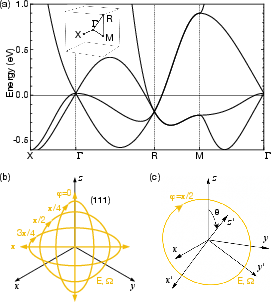
Figure 1: Panels (a)–(c) show the energy band structure, experimental geometry, and coordinate rotation for SHG and THG under polarized light in CoSi.
A four-band model on the B20-type lattice, capturing the essential topology near the Fermi level, forms the basis for the analysis. The Hamiltonian incorporates inversion- and mirror-symmetry breaking via chiral hopping terms and fully respects space group 198 symmetries, including multiple screw and threefold rotations. The model allows explicit tuning of crystal chirality via the sign of the key hopping parameter.
Floquet theory is employed for time-periodic electric fields, and the Peierls substitution maps the field into the momentum-dependent terms of the tight-binding Hamiltonian. The use of the Floquet-Keldysh formalism enables accurate computation of driven nonequilibrium electronic dynamics, accounting for both coherence and dissipation effects through a spectral broadening parameter γ.
SHG and THG Under Circularly Polarized Excitation
Numerical integration over the Brillouin zone and Floquet harmonics yields the SHG and THG intensities and their polarization dependence. Under circularly polarized light incident on the (111) surface, selection rules enforce that SHG manifests only as in-plane emission, while THG is strictly out-of-plane for pure circular polarization.
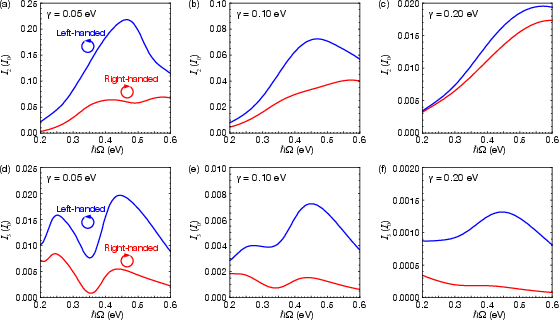
Figure 2: SHG and THG intensity as a function of driving frequency ℏΩ, for various dissipation strengths γ, under left- and right-handed circular polarization.
Strong CD is observed in both SHG and THG (Figure 2), with left- and right-handed circular polarization producing distinct intensity spectra across a broad frequency range. Notably, increasing broadening (γ) strongly attenuates SHG intensity and reduces the SHG-CD, whereas THG-CD remains robust across γ values.
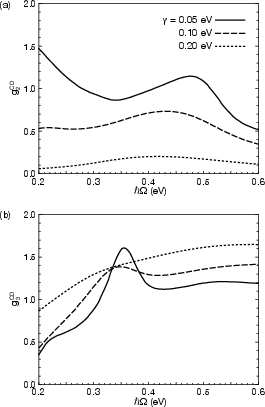
Figure 3: Frequency-dependent SHG-CD g2CD and THG-CD g3CD for multiple dissipation parameters; SHG-CD is rapidly suppressed by γ, while THG-CD remains stable.
The dichroic response, quantified by gnCD (with n=2 for SHG and ℏΩ0 for THG), decays rapidly in SHG with increasing ℏΩ1 but is essentially insensitive in THG, except near electronic structure-related spectral dips.
Microscopic Origin of the Dichroism and Robustness
The study links these qualitative differences to the phase structure in the nonlinear current spectra ℏΩ2. For SHG, dichroism emerges only at the subleading nonlinear level, requiring phase-sensitive interference between different nonlinear pathways and making it highly vulnerable to dephasing and dissipation. By contrast, in THG, leading-order nonlinear processes directly encode the chiral response, rendering THG-CD insensitive to spectral broadening and thus robust in realistic environments.
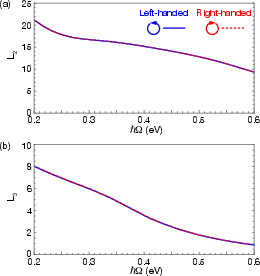
Figure 4: The frequency dependence of the magnitude of the integrated harmonic current spectrum, illustrating the negligible role of amplitude structure in generating dichroic effects.
Integrated amplitude measures reveal little polarization dichroism, confirming the centrality of phase structure—rather than magnitude—in controlling CD. This identifies phase-resolved high-harmonic spectroscopy as a unique probe for chiral quantum materials.
Field and Polarization Dependence
The dependence of SHG and THG intensities on driving field amplitude exposes additional differences. SHG intensities are well-fitted by an ℏΩ3 power law in the weak field regime, and CD effects are negligible at leading order; dichroism grows only at higher field strengths due to higher-order nonlinearities. In contrast, THG intensities scale as ℏΩ4 already in the lowest-order fit, and dichroism is present from this leading nonlinear term, further emphasizing the robustness of THG-CD to perturbations.
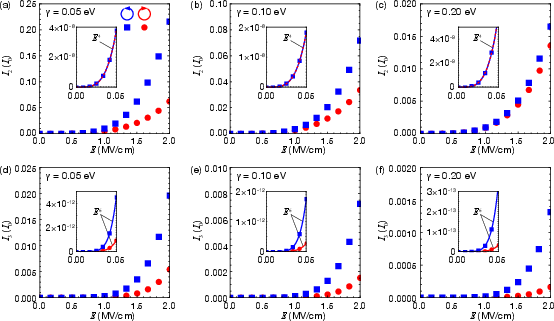
Figure 5: SHG and THG intensities versus field amplitude ℏΩ5 for different ℏΩ6. SHG-CD arises only beyond leading order, while THG-CD is immediate.
Exploring the effect of incident polarization, the emission pattern for both harmonic orders is highly sensitive to driving polarization state. For SHG, the in-plane emission predominates for all ellipticities except at strict circularity, while THG shifts from out-of-plane dominance at circularity to in-plane as ellipticity is decreased.
Crystallographic Orientation Effects
Tilting the polarization rotation plane away from (111) reveals nuanced selection rule consequences: certain orientations forbid either SHG or THG emission in-plane or out-of-plane, and the dichroic patterns vanish at high symmetry orientations consistent with crystal group theory predictions. These orientation dependencies offer routes for experimental discrimination of chiral electronic responses.
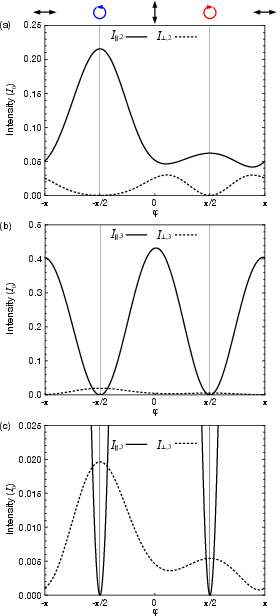
Figure 6: SHG and THG intensities as a function of polarization plane tilt angle ℏΩ7, resolved into in-plane and out-of-plane components for both circular polarizations.
Chirality and Measurement Implications
Although the calculated intensities are even under crystal chirality reversal (i.e., they do not directly reveal handedness), the time-dependent and phase-resolved current components (accessible through ultrafast or phase-sensitive probes) retain odd-under-chirality information. This suggests that full access to chiral electronic dynamics requires measurement protocols beyond simple intensity detection, underscoring the power of phase-resolved harmonics for probing symmetry-breaking phenomena.
Conclusion
This work elucidates the mechanisms governing circular dichroism in nonlinear harmonic generation in the archetypal chiral topological semimetal CoSi. Both SHG and THG display order-unity CD, but only THG-CD is robust to environmental dephasing due to its leading-order microscopic origins. The results provide general principles dictating nonlinear chiroptical response and spotlight high-harmonic generation as an incisive spectroscopic tool for probing electronic dynamics, the phase structure of nonlinear currents, and the effects of symmetry breaking in topological quantum materials.
These findings have immediate implications for ultrafast optical experiments in chiral crystals, offering guidance for the choice of probe (THG versus SHG) depending on dissipation environments and sensitivity requirements. The demonstration of phase-structure-controlled dichroism highlights the broader importance of phase-resolved detection schemes and motivates future work targeting direct measurement of chirality-odd observables, as well as exploration of additional symmetry classes and material platforms.
Reference: "Circular dichroism in second- and third-harmonic generation in chiral topological semimetal CoSi" (2604.03983).