- The paper introduces the strongly positive recurrent (SPR) condition for GPS systems, proving it implies finiteness of the BMS measure.
- It employs a Kac-like lemma and weighted Poincaré series convergence in flow spaces to establish positive recurrence and ergodicity.
- It extends classical Patterson–Sullivan theory to non-Anosov, higher-rank settings, unifying concepts from thermodynamic formalism and geometric group theory.
Finiteness of Bowen–Margulis–Sullivan Measure for Gromov–Patterson–Sullivan Systems
Introduction and Motivation
This paper introduces a generalization of the finiteness criterion for the Bowen–Margulis–Sullivan (BMS) measure in the context of Gromov–Patterson–Sullivan (GPS) systems, focusing particularly on discrete groups acting in higher rank settings beyond the well-studied relatively Anosov case. This follows the trend of extending Patterson–Sullivan theory and thermodynamic formalism—classically developed for negatively curved spaces and Anosov flows—to broad classes of convergence group actions and their associated cocycle structures.
The central innovation is the introduction and systematic study of the strongly positive recurrent (SPR) property for groups admitting a continuous GPS system (in the sense of Blayac–Canary–Zhu–Zimmer). The author establishes that SPR implies the finiteness of the associated BMS measure on certain flow spaces and develops a set of equivalent or consequential dynamical properties. This framework unifies several prior lines of research and opens the study of new non-Anosov examples.
GPS Systems, Cocycles, and Flow Spaces
The GPS system framework generalizes Patterson–Sullivan theory to cocycles and boundary pairs beyond the Gromov hyperbolic context. For a convergence group Γ acting on a compact metrizable space M, a continuous cocycle σ:Γ×M→R and the associated flow space Ω~Γ=ΛΓ(2)×R (where ΛΓ is the limit set) are constructed. These flow spaces are equipped with natural Γ-actions and a flow ψ~s along the R-coordinate.
The GPS systems (σ,σˉ,G) relate two cocycles and a "Gromov product", satisfying a specific coboundary relation, producing an intrinsic framework for constructing invariant measures and studying ergodic properties.
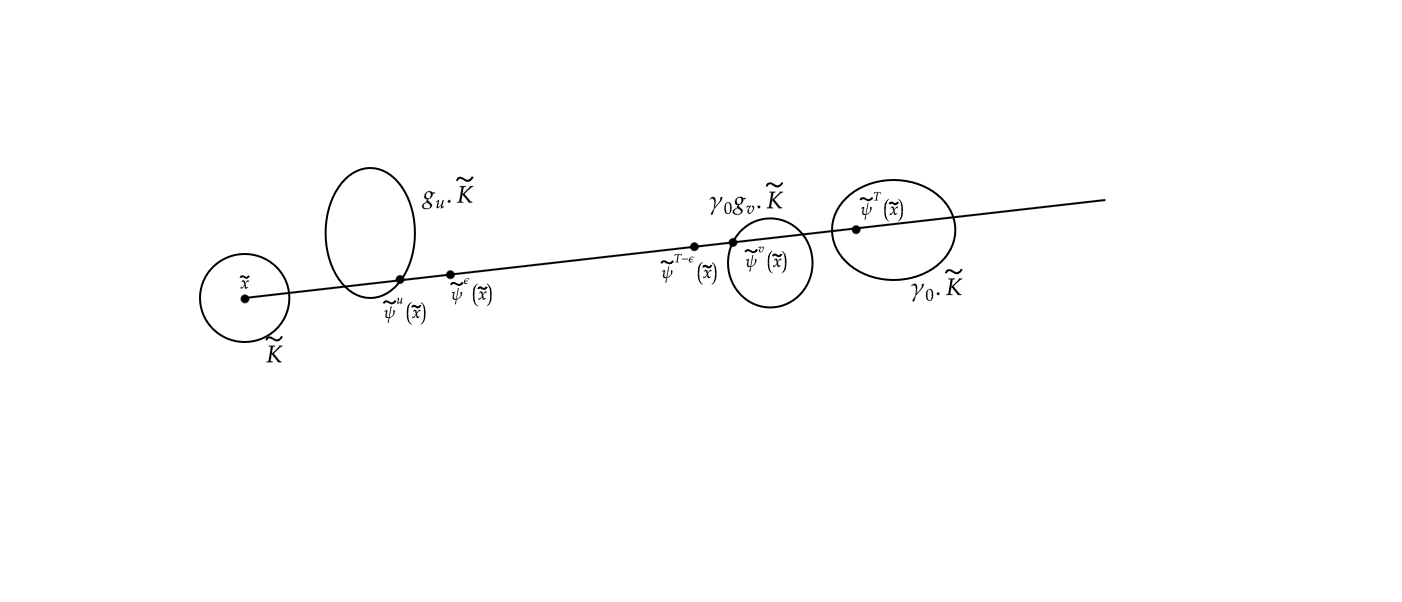
Figure 1: The flow line structure and intersection pattern of compact sets and their images under group action, illustrating the combinatorics underlying the definition of the subsets ΓK and the application of recurrence arguments in the flow space.
SPR, Positive Recurrence, and BMS Measure Finiteness
The main technical achievement is the generalization of positive recurrence—a condition originating from symbolic dynamics and adopted for hyperbolic dynamical systems by Pit–Schapira—to the setting of GPS systems. For a chosen compact set M0, the subset M1 of M2 consists of group elements whose translates of M3 are "close" in the flow, with no intermediate intersections. The group is said to be positive recurrent with respect to M4 if a weighted Poincaré series over M5 converges at the critical exponent.
The author proves that positive recurrence implies finiteness of the BMS measure on the quotient flow space via a Kac-like lemma for flows and a careful analysis of measure-theoretic recurrence. The critical step is showing that the positive recurrence (and a fortiori the SPR) condition ensures divergence of the global Poincaré series at the critical exponent, which is necessary for mixing, ergodicity, and uniqueness properties. The SPR condition strengthens positive recurrence by requiring a strict entropy gap at infinity: the "entropy at infinity" (limiting critical exponent for the escape-to-infinity part of the group) is strictly less than the global critical exponent.
Examples, New Constructions, and Schottky Products
An important consequence is that the SPR property is stable under free (Schottky) product operations, allowing the construction of new, non-relatively Anosov, non-geometrically finite, SPR subgroups whose BMS measures are finite. For instance, one can take Schottky products of two SPR (or geometrically finite/Anosov) subgroups in higher rank Lie groups situated in careful "Schottky position" in the sense of proper domain visibility conditions. A technical theorem shows that the entropy at infinity of the product equals the maximum entropy at infinity of the factors, yielding further control.
The paper generalizes and systematizes classical examples, such as Peigné's construction of geometrically infinite subgroups with finite BMS measure in higher-dimensional hyperbolic space, to the GPS/higher-rank context.
Geometric Finiteness, Relative Anosov Groups, and Generalizations
The GPS system formalism includes as particular cases discrete groups acting as relatively Anosov in higher rank Lie groups, or more generally, geometrically finite convergence groups with suitable entropy gap conditions for parabolic subgroups. Using a thick–thin decomposition, horoball analysis, and measure-theoretic techniques, the author shows geometrically finite groups are SPR if their peripheral subgroups possess lower critical exponent than the ambient group, extending finiteness results for the BMS measure to the GPS framework.
This theorem encompasses, via the SPR approach, practically all finiteness results previously obtained for relatively Anosov representations and geometrically finite groups acting on partially flag manifolds or convex projective domains.
Implications and Future Directions
The significance of these results is threefold:
- Unification: It unifies various strands—Patterson–Sullivan theory, thermodynamic formalism, BMS measure finiteness, entropy at infinity, Schottky and combination theorems—under a cocycle/flow-space-centric GPS system.
- Extension: It produces new non-Anosov, non-classical subgroups with finite invariant measure, with amenable applications in enumeration, equidistribution, and mixing theories for discrete group actions in high rank.
- Technical groundwork: The framework provides the apparatus for extending measure classification, rigidity, and entropy-regularity questions into a significantly broader context.
The theoretical implications involve possible progress toward measure rigidity phenomena, general counting results for orbits, and new mixing/uniqueness theorems for flows outside the classical Gromov hyperbolic world.
Conclusion
This work further systematizes the structure theory of invariant measures for higher-rank and non-hyperbolic group actions via GPS systems, establishing the SPR condition as the correct criterion for BMS measure finiteness. The developed techniques and constructions provide a robust foundation for future investigations into ergodic theory, dynamics, and geometric group theory in both classical and non-classical settings.