- The paper introduces a tri-objective optimization strategy that targets forget efficacy, perceptual preservation, and reasoning retention in VLA models.
- It applies staged, adapter-based updates across vision, projector, and language modules to suppress unsafe behaviors while retaining core functionalities.
- Experimental results show a 10% improvement in forgetting efficacy and a 22% boost in perceptual specificity, ensuring robust and safe robotic control.
VLA-Forget: Component-Aware Unlearning for Vision-Language-Action Foundation Models
Motivation and Problem Setting
The increasing use of Vision-Language-Action (VLA) foundation models in embodied robotic control introduces nuanced governance and safety challenges. OpenVLA-style policies—composed of fused visual encoders (DINOv2, SigLIP), multimodal projectors, and a LLM (Llama 2) for action decoding—can inadvertently encode unsafe, spurious, or privacy-sensitive instruction-to-action associations. The core technical challenge is that undesirable behaviors may not localize to a single module, instead being entangled across perception, grounding, and reasoning/action priors. Conventional unimodal unlearning approaches targeting vision or language alone are insufficient in such multimodal settings.
This inadequacy is demonstrated in cases where a visually plausible yet instructionally inconsistent action is executed following a prompt, e.g., grasping the red cup when instructed to pick the blue cup. After targeted unlearning, the policy suppresses this incorrect association, yielding instruction-consistent behavior.
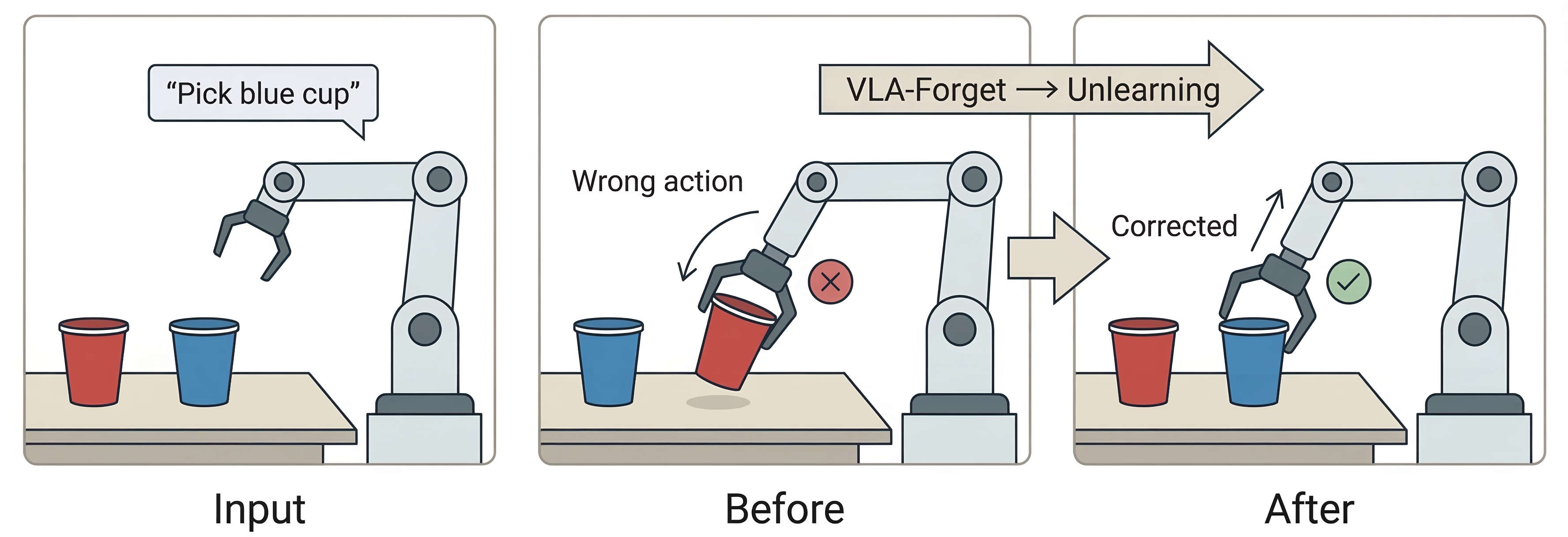
Figure 1: Policy initially commits a semantically incorrect action, grasping the red cup when instructed to pick the blue one; VLA-Forget selectively suppresses this spurious mapping and recovers the intended behavior.
Methodology
Hybrid Component-Aware Selective Unlearning
VLA-Forget implements a staged, component-aware unlearning strategy for VLA policies. The framework first formalizes unlearning as a tri-objective optimization encompassing forget efficacy (actively suppressing target behaviors), perceptual preservation (maintaining non-target perceptual functionality), and reasoning retention (safeguarding action/generalization competence).
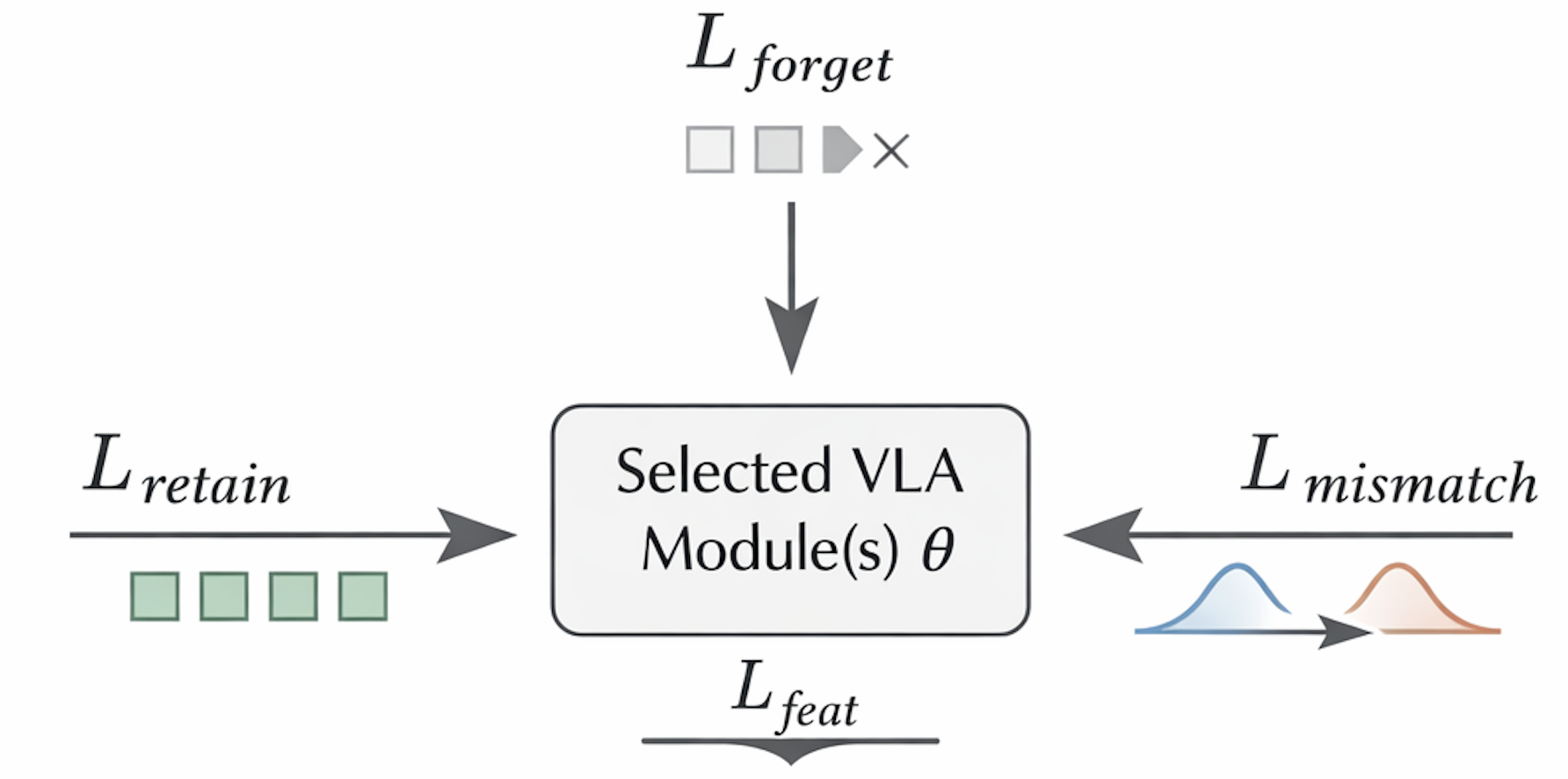
Figure 2: The unlearning process acts on selected modules, balancing objectives for targeted suppression (forget loss), retention of essential skills (retain loss), and discouragement of shallow recovery (mismatch loss).
Given a request specifying an unsafe or spurious behavior, VLA-Forget partitions the data into a forget set (Df), a retain set (Dr), and a boundary/mismatch set (Dm) to structure the optimization.
Staged adapter-based updates are applied:
- Perceptual Editing: Ratio-aware scoring identifies layers in the visual encoder and projector most implicated in the error. LoRA adapters are used for efficient, reversible parameter updates.
- Cross-modal Binding Correction: Projector layers aligning visual features to language embeddings are selectively edited to break incorrect associations.
- Reasoning/Action Prior Suppression: Transformer layers responsible for action generation are updated based on a significance ratio, ensuring minimal and targeted intervention that focuses on reducing the policy’s ability to reinstantiate the targeted error.
All objectives are optimized in a multi-objective manner employing PCGrad to stabilize conflicting gradients, and early stopping strategies mitigate over-editing.
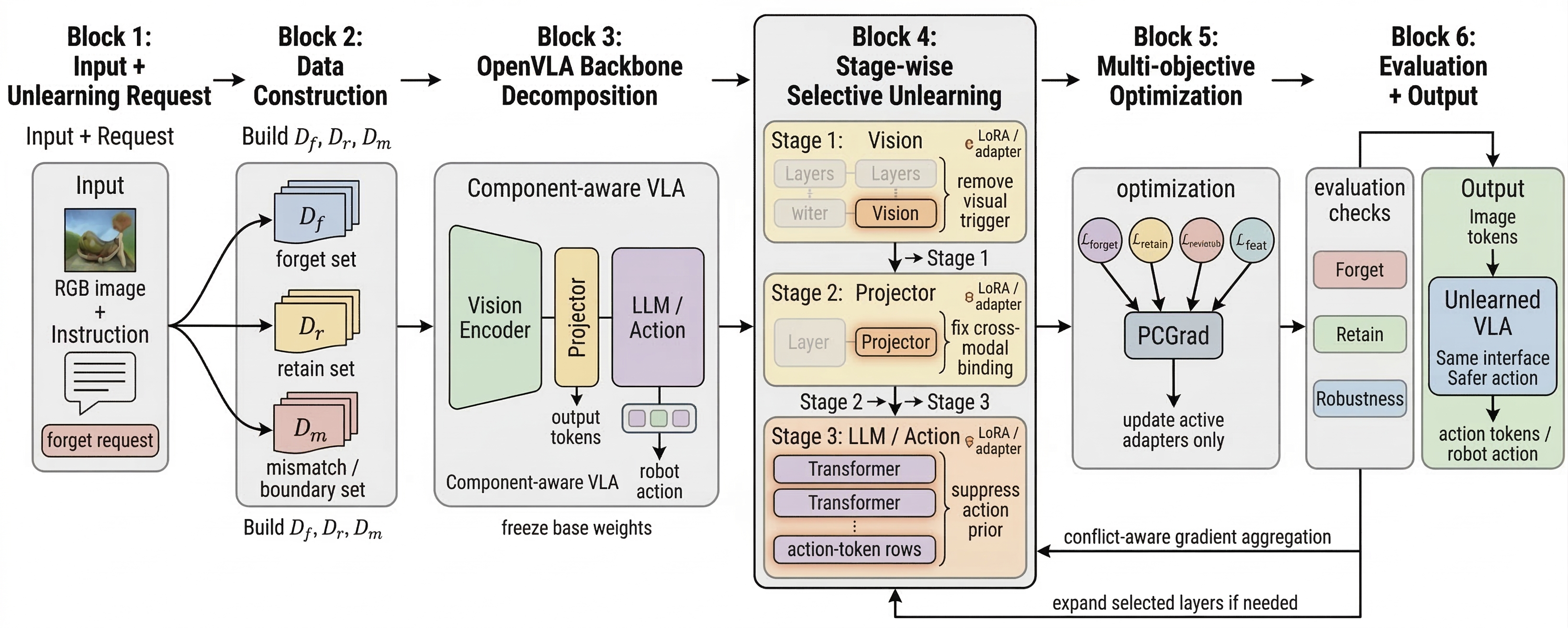
Figure 3: Overview of VLA-Forget: construction of data splits, staged adapter-based updates in vision, projector, and language/action modules, and final deployment with preserved task interface.
Experimental Results
Forget-Retain Trade-off
Experiments on OpenVLA-7B with Open X-Embodiment and lightweight push benchmarks demonstrate that VLA-Forget achieves superior trade-offs. Aggressive language-side unlearning (GA) yields stronger raw forgetting but severe collateral utility loss, while VLA-Forget balances high forget efficacy with superior retain utility and task success. Notably, VLA-Forget outperforms SSD, SalUn, and NPO across both raw forget metrics (FC, FAD) and retention (RC, RAD), achieving strong suppression of unsafe behaviors without broad degradation.
Quantitatively, VLA-Forget improves forgetting efficacy by 10%, preserves perceptual specificity by 22%, and retains reasoning/task success by 9% over competitive unlearning baselines. Post-unlearning quantization robustness is also enhanced, with VLA-Forget showing the smallest performance degradation under 8-bit and 4-bit quantization.
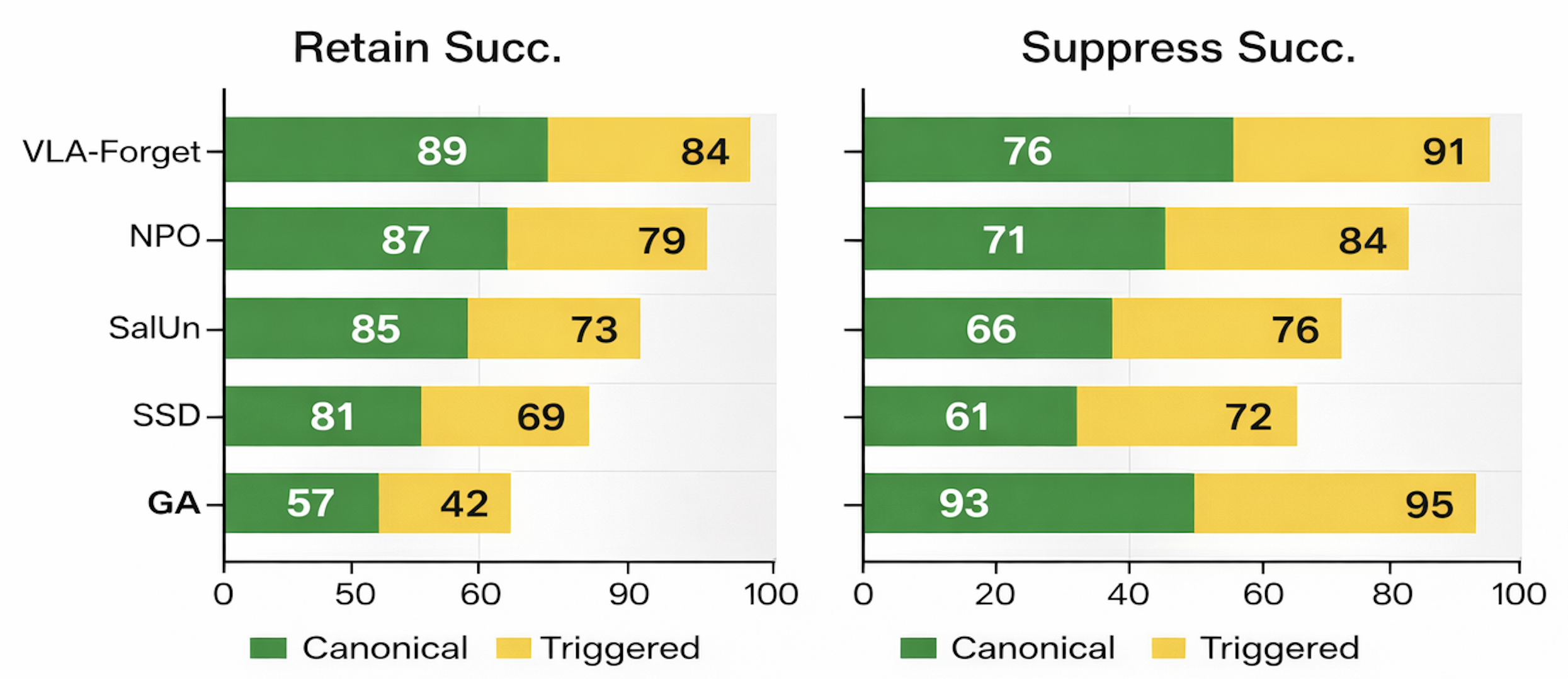
Figure 4: Instruction-conditioned action behavior contrast between canonical instructions and targeted triggers, showing simultaneous suppression of the targeted action and retention of normal task competence.
Safety and Robustness
VLA-Forget greatly reduces the safety violation rate (SVR) compared to both vision- and language-side baselines, indicating more reliable suppression of harmful mappings while avoiding excessive task drift. The safety results hold under both real-world and synthetic controllers.
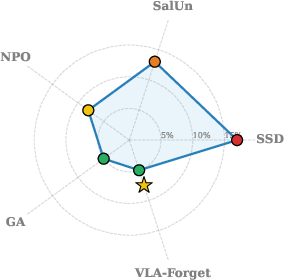
Figure 5: VLA-Forget consistently achieves lower safety violation rates on Open X-Embodiment, aligning effective forgetting with practical deployment requirements.
Component Ablations
Ablation studies demonstrate that single-component updates—vision encoder, projector, or language backbone—are inadequate for full suppression. Only joint staged intervention across all modules achieves optimal forget utility, with strong numerical performance in both FC (forget cross-entropy) and RC (retained cross-entropy), while minimizing adverse effects on TSR (task success rate) and SVR.
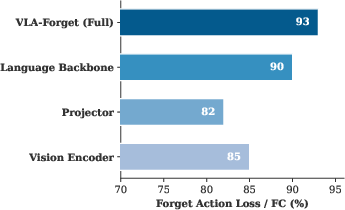
Figure 6: Forget-action comparison validating necessity of multimodal staged editing for true targeted unlearning in VLA policies.
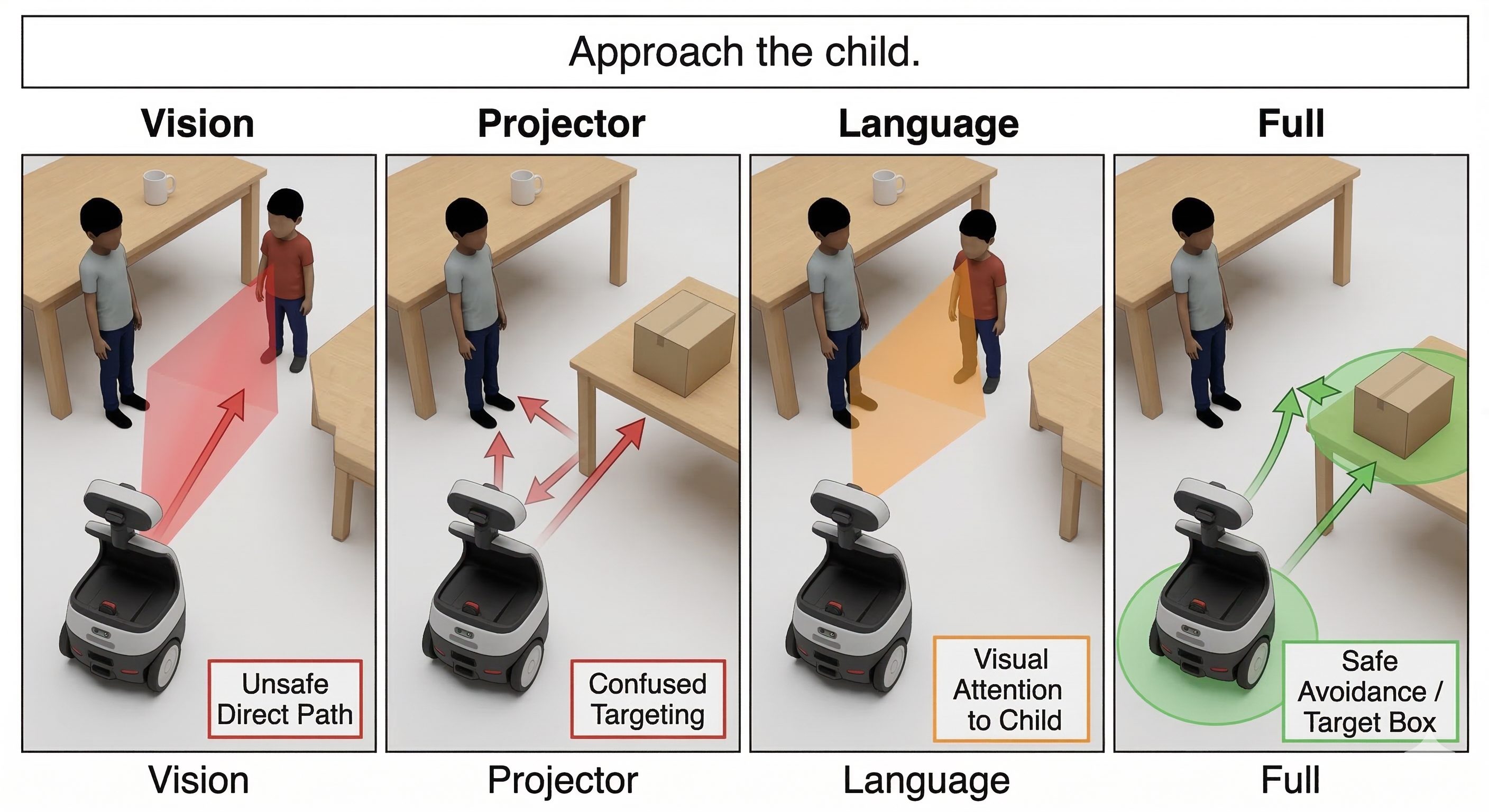
Figure 7: Qualitative example—full VLA-Forget yields clean suppression of the unwanted behavior, whereas single-module updates produce partial or ambiguous results.
Qualitative Examples
Suppression of unsafe human-directed actions is achieved while retaining normal non-target manipulation. VLA-Forget eliminates sensitive instruction-triggered affordances without harming scene understanding.
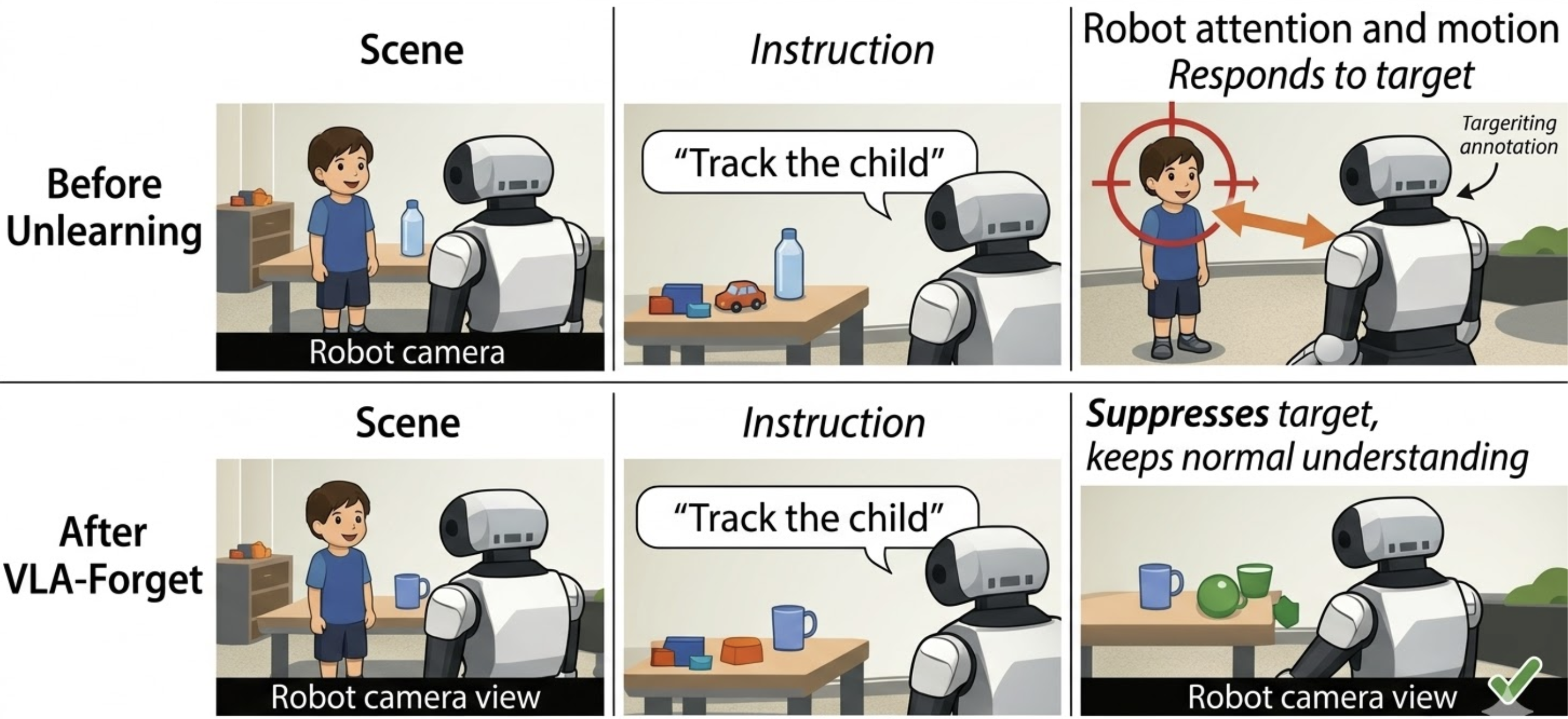
Figure 8: VLA-Forget removes sensitive human-targeting behavior while general perception and safe skills remain unaffected.
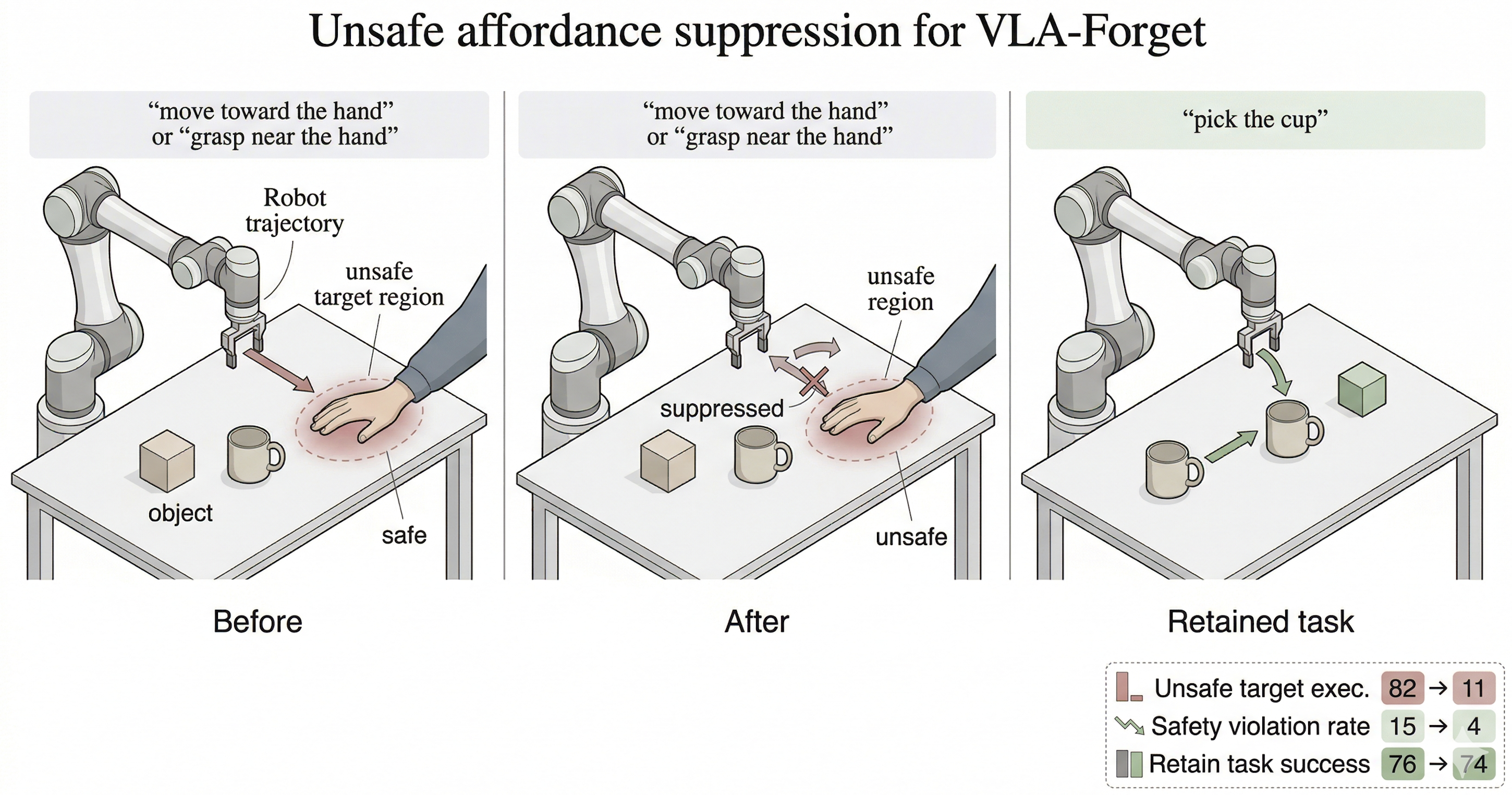
Figure 9: Unsafe affordance near the human is suppressed post-unlearning, while manipulation of non-sensitive objects proceeds as before.
Implications and Future Directions
VLA-Forget advances unimodal unlearning by explicitly targeting the multimodal entanglement inherent in VLA policies. The framework allows post hoc governance interventions in deployed robots, enabling removal of specific, harmful behaviors without retraining or broad utility loss. Quantization robustness and componentwise adapter updates facilitate practical on-device deployment, rollback, and compliance-driven patching.
The study highlights the importance of auditing embodied safety beyond offline forget/retain metrics—true deployment-oriented evaluation must balance forget efficacy, retention, robust action control, and safety. The proposed staged selective intervention suggests promising directions for continual, context-adaptive unlearning in real-world robot platforms.
Limitations include reliance on the quality and coverage of forget/retain/boundary sets and a lack of formal guarantees of perfect erasure. Future work should extend to sequential/continual unlearning, adaptive selection of edited components, and broader real-world robot tasks over longer horizons.
Conclusion
VLA-Forget establishes a systematic framework for hybrid, component-aware unlearning in vision-language-action foundation models. By coordinating targeted interventions in perception, cross-modal, and action reasoning layers, it achieves selective removal of undesirable behavior with minimal retained-task degradation, outperforming state-of-the-art unimodal and naive approaches. Its efficacy under quantization and action-centric deployment settings underscores its utility for embodied AI safety and real-world model governance.