- The paper demonstrates high-resolution, channel-resolved photoelectron spectroscopy revealing field-induced modifications in helium's 3s3p doubly excited states.
- It employs time-resolved XUV and 800 nm NIR pulses along with TDHS calculations to capture resonance shifts and sideband features.
- The study validates dynamic resonance coupling and Stark-induced Fano profile changes, advancing ultrafast quantum control of correlated electrons.
Photoelectron Spectroscopy of 3s3p Doubly Excited Helium States in Strong Near-Infrared Laser Fields
Introduction
This study presents a comprehensive time-resolved investigation of the 3s3p doubly excited states of helium under the influence of strong near-infrared (NIR) laser dressing, utilizing synchronized extreme ultraviolet free-electron laser (XUV-FEL) and 800-nm NIR pulses (2604.03943). The helium atom’s electronic structure, particularly the doubly excited states between the N=2 and N=3 He+ thresholds, provides an exceptional platform for fundamental tests of electron correlation and quantum interference dynamics, crucial for understanding photoionization and photoabsorption processes in few-body Coulomb systems.
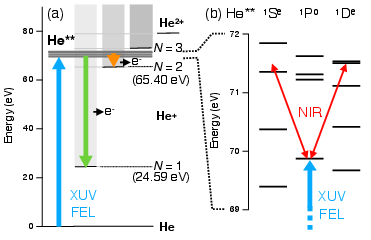
Figure 1: Energy diagram of helium electronic states, highlighting the coupling of the bright $3s3p\,^1P^o$ state to nearby dark 1De and 1Se resonances by 800-nm NIR fields.
While transient absorption and photoelectron spectroscopy have been widely used to probe doubly excited states, most prior studies focused on the 2s2p manifold. By targeting N=3 resonances, this work extends experimental control over strongly correlated two-electron dynamics and enables resolved dissection of channel-specific decay and field-induced coupling phenomena.
Experimental and Theoretical Methodology
The experiment was conducted at the SACLA XFEL facility with ∼30 fs, 70 eV XUV pulses, cross-synchronized with intense 800 nm, ∼1012 W/cm2 NIR pulses focused onto an effusive helium target. Energy- and time-resolved electron spectra were acquired via a magnetic-bottle spectrometer, with single-shot arrival time correction. Electron energy calibration and instrument response accounted for all broadening mechanisms, yielding high-resolution channel-resolved spectra for decays to distinct HeN=30 final states.
The theoretical treatment involved direct solution of the time-dependent Schrödinger equation (TDSE) using the time-dependent hyperspherical (TDHS) method, with explicit inclusion of the coupled excitation, time-dependent field interactions, and all near-threshold resonance structures up to the HeN=31 limit. Benchmarking against reference values and previous hyperspherical channel assignments validated the theoretical spectral assignments.
Field-Dressed Photoelectron Spectra: Results and Interpretation
Theoretical Channel-Resolved Spectra
The calculated spectra reveal sharp, asymmetric structures associated with the N=32 Fano resonance in the N=33 decay channel near 4.4 eV, and featureless continua in the N=34 channel, in line with established selection rules and resonance profiles.
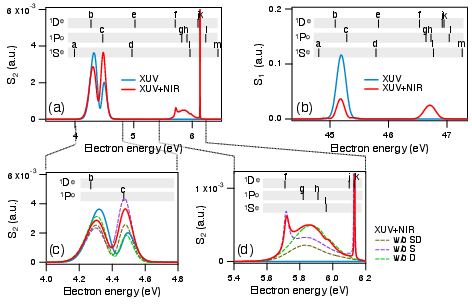
Figure 2: Theoretical photoelectron spectra of NIR-dressed helium, showing pronounced Fano structure and field-induced sidebands, with spectral changes upon removal of N=35 and N=36 resonance channels.
Application of strong NIR fields creates characteristic sidebands (N=37 energy shifts) in both channels, but induces additional sharp resonant enhancements exclusively in N=38, correlated with the coupling to neighboring dark N=39 and +0 autoionizing states lying below the +1 threshold. Channel truncation calculations systematically verify these assignments: removal of +2 channels suppresses the corresponding resonance peaks, highlighting the essential role of these field-induced couplings.
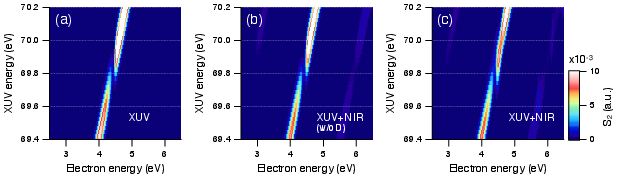
Figure 3: Theoretical +3 spectra as a function of XUV photon energy, comparing spectra with/without +4 channels under NIR dressing.
Experimental Observations
The measured +5 spectra exhibit a clear delay-dependent shift of the Fano minimum as the XUV-NIR pulse overlap increases, with a distinct resonance structure emerging in the sideband region around +6 ≈ 5.7 eV at zero delay.
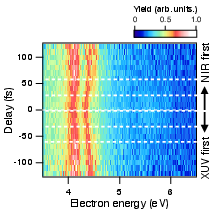
Figure 4: Experimental +7 channel photoelectron spectrogram as a function of XUV-NIR delay, exhibiting shift of resonance minima and emergence of sideband features.
High-resolution delay-resolved spectra at selected delays align with theoretical predictions, confirming the field-induced dressing and channel-resolved resonance control. The +8 spectra, by contrast, display only sideband structure with no evidence of analogous resonance features, consistent with the negligible overlap matrix elements and nonresonant continuum contributions in this channel.
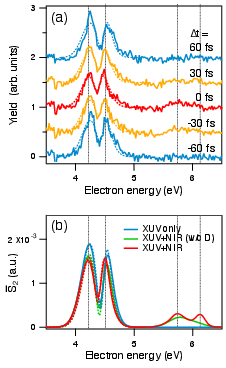
Figure 5: Experimental +9 photoelectron spectra at different pump-probe delays, showing the delay-dependent Fano feature and resonance shifts; comparison with convolution-broadened theory.
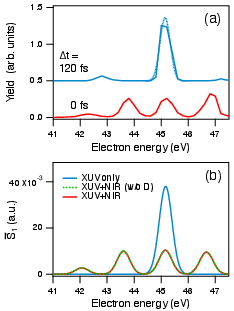
Figure 6: Experimental and theoretical $3s3p\,^1P^o$0 spectra, highlighting the presence of NIR-induced sidebands and absence of resonance structures.
Multichannel Fano Analysis and Delay-Dependent Line Shape Dynamics
To parametrize the field-induced lineshape modifications, a rigorous multichannel Fano fitting protocol was implemented, using advanced generalizations to capture the correlated decay dynamics across the $3s3p\,^1P^o$1, $3s3p\,^1P^o$2, and $3s3p\,^1P^o$3 continua. Key profile parameters ($3s3p\,^1P^o$4, $3s3p\,^1P^o$5) and the effective resonance energy $3s3p\,^1P^o$6 were extracted as a function of XUV-NIR delay.
Strong delay dependence of both $3s3p\,^1P^o$7 and $3s3p\,^1P^o$8 was observed: as the pulses overlap, Fano asymmetry and profile depth decrease, and the resonance energy $3s3p\,^1P^o$9 undergoes a significant downward shift (from 1De0 to 1De1 eV), consistent with the predicted NIR-induced AC Stark shift of the doubly excited resonance.
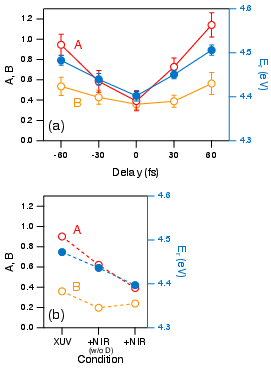
Figure 7: Delay-dependent evolution of profile parameters (1De2, 1De3) and resonance energy 1De4 for experimental and theoretical 1De5 spectra.
Quantitative agreement between theory and experiment demonstrates that both the shift and the profile modifications are direct signatures of the coherent NIR-induced coupling between the bright 1De6 and dark 1De7, 1De8 states, and cannot be explained by background or single-channel Stark shifts alone.
Interpretation in Terms of Dynamic Resonance Coupling
The extracted 1De9 shift and lineshape evolution match nonperturbative two-level dressed-state models, giving upper estimates for Stark shifts consistent with the observed modulation, as well as with independent transient absorption and attosecond photoionization results (2622.78163, Ehnes, 2019). The multichannel nature of the 1Se0-converging manifold, as opposed to the more commonly studied 1Se1 case, is crucial to the emergence of these effects.
Inclusion of continuum dressing and partial wave interference, as well as two-photon couplings to nonresonant continua, further refines the understanding of the delay-dependent Fano profiles, as corroborated by additional calculations with selective channel exclusion.
Implications, Applications, and Theoretical Extensions
This study advances the high-precision characterization of strong field-induced modifications in two-electron systems, extending the toolkit for manipulating correlated electron motion and quantum interferences at the multichannel, few-electron level. The approach enables experimental control of resonance interaction pathways—channel-selectively and with sub-femtosecond precision—providing a robust platform for quantum control protocols and for benchmarking nonperturbative atomic-structure calculations.
Practically, channel-resolved photoelectron spectroscopy under field-dressed conditions emerges as a unique probe of correlated electronic structure, suitable for:
- Time-domain imaging and manipulation of electron-electron correlation
- Dissection of quantum interference and Stark shifts in the presence of strong AC fields
- Validation and refinement of hyperspherical close-coupling and multichannel scattering models
Prospective future work should address:
- Systematic incorporation of continuum-continuum couplings and higher-order field interactions
- Quantification of phase-shifts and time-dependent resonance lifetimes
- Application of these methodologies to more complex systems, including multi-electron or molecular targets
Conclusion
This work provides an authoritative, quantitatively validated demonstration of channel-resolved, time-resolved control and measurement of Fano resonance lineshapes and energy shifts in 3s3p doubly excited helium under strong-field NIR dressing. The combined experimental–theoretical framework captures the essential physics of dynamic resonance coupling, multichannel decay, and field-induced quantum interference, defining new standards for ultrafast spectroscopy and the study of strongly correlated electron dynamics in few-body systems.
These advances define the path for extending field-dressing and control schemes beyond the helium atom, placing a quantitative foundation under future time-resolved quantum control and attosecond dynamics investigations in atomic, molecular, and condensed systems.