- The paper proposes a biconvex relaxation method that jointly optimizes bicluster assignments and feature weights, yielding finite-sample error bounds.
- It employs proximal alternating minimization and adaptive affinity learning to efficiently update centroids and weights in high-dimensional settings.
- Empirical results show robust recovery of biclusters and reliable feature selection, outperforming conventional methods in noisy environments.
Biconvex Biclustering: Theory, Algorithms, and High-dimensional Feature Selection
Introduction
The paper "Biconvex Biclustering" (2604.03936) introduces a novel framework for biclustering in high-dimensional matrices that incorporates adaptive feature selection directly into the biclustering process. Unlike traditional biclustering algorithms, which are not robust to noisy or uninformative features, this approach integrates a feature weighting mechanism within a biconvex optimization scheme. The method leverages proximal alternating minimization and adaptive affinity learning, delivering practical and theoretical advances including finite-sample guarantees under sub-Gaussian noise and strong empirical performance in both simulated and real-world genomics contexts.
The primary contribution is a biconvex relaxation of the convex biclustering objective, where feature relevance is captured by non-negative weights w learned jointly with the bicluster assignments. The objective function balances fused penalties for rows and columns with a weighted Frobenius loss, regulated by hyperparameters. Unlike typical approaches using fixed feature subsets (e.g., via PCA or ad-hoc filtering), the proposed method optimally tunes feature inclusion, mitigating the risk of discarding informative covariates.
A key theoretical advance is the establishment of finite-sample prediction error bounds for any local optimum of the objective under sub-Gaussian errors, for arbitrary affinity graphs. These bounds depend on the algebraic connectivity of the affinity (fusion) graph, explaining practical sensitivity to affinity specification. The generalization to weighted, possibly sparse, affinity graphs aligns the theoretical foundation with common practices in modern biclustering implementations.
Optimization Algorithm: PALM and Adaptive Affinity Learning
The biconvex structure admits block coordinate minimization—specifically Proximal Alternating Linearized Minimization (PALM)—which alternates between updating bicluster centroids and feature weights. Each update leverages efficient subroutines: the centroid update reduces to a convex biclustering problem with weighted inputs, and the weight update is an orthogonal projection onto the simplex, accelerated by specialized algorithms for simple constraints.
Moreover, the paper extends affinity learning to the adaptive regime by updating the row/column affinities using the current version of the fit, with k-nearest neighbor graphs formed in the reweighted representation. This substantially increases robustness, especially in high-dimensional settings where fixed affinities can yield degenerate clustering due to feature noise.
Hyperparameter Selection
A two-stage procedure, inspired by prior work in sparse biclustering, is used for hyperparameter tuning. The fusion strength γ is selected via a missing value imputation criterion (hold-out prediction error), while the sparsity/weight penalty λ is selected by an extended Bayesian Information Criterion (eBIC). The eBIC leverages the number of unique centroids as a complexity measure, providing a data-driven means to balance fit quality and model parsimony.
Empirical Results
Simulation studies explore the performance in two high-dimensional regimes: (1) adding increasing numbers of uninformative (noise) features, and (2) varying noise magnitude and data dimension. The standard evaluation employs Adjusted Rand Index (ARI) for recovery of true (row, column) biclusters and AUC for detecting informative features via the fitted weights.
Adaptive BCBC and its nearest neighbor–accelerated variant are consistently robust to large volumes of noise features, in sharp contrast to convex biclustering baselines (e.g., COBRA) and methods relying on initial feature selection. Notably, there is only minor degradation in ARI and feature AUC for BCBC methods as the number of uninformative features increases, while classical and k-means–inspired sparse biclustering methods suffer substantial drops.
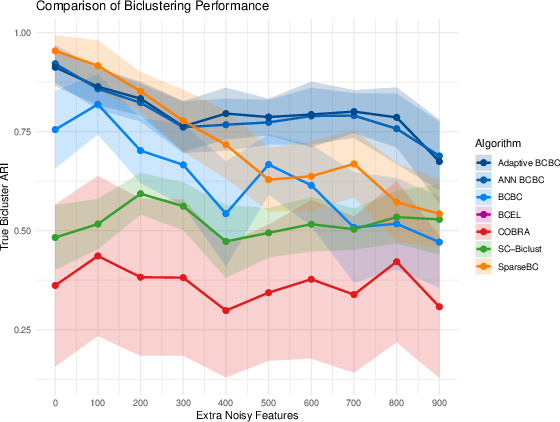
Figure 1: Mean ARI for true bicluster recovery under increasing uninformative features; adaptive BCBC methods demonstrate stability whereas traditional approaches degrade rapidly.
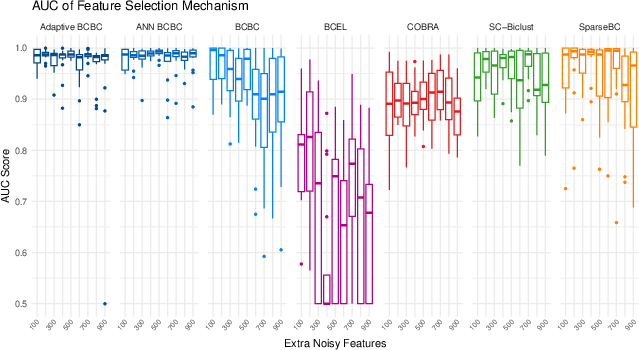
Figure 2: Distribution of feature-weight AUC scores under increasing noise columns; adaptive BCBC robustly assigns high weights to informative features.
In high-noise regimes, BCBC outperforms leading alternatives (SparseBC, SC-Biclust), especially under challenging conditions—small informative feature sets and large noise variance.
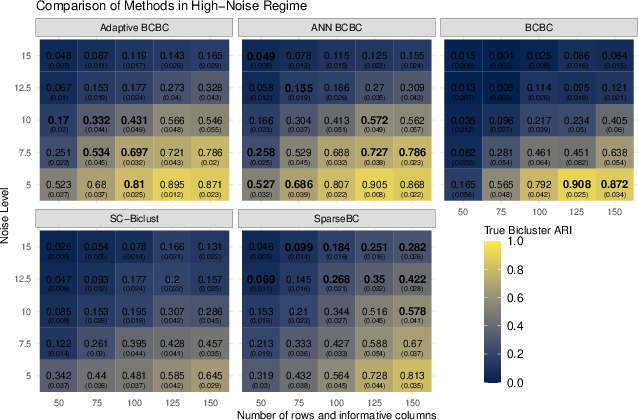
Figure 3: Performance (mean ARI) as a function of data dimension and noise; BCBC maintains higher clustering fidelity in difficult regimes.
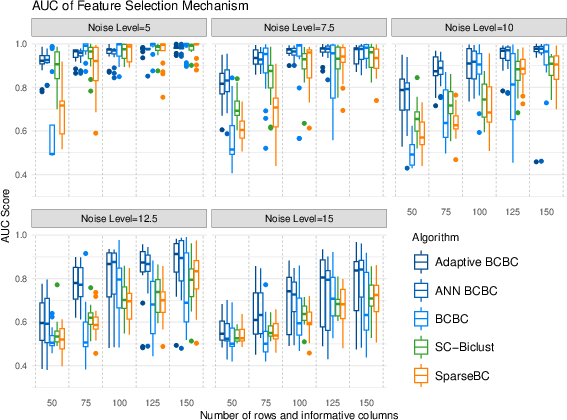
Figure 4: Feature-weight AUC scores for different noise/dimension settings; BCBC sustains strong feature selection capability where others falter.
Application to Lymphoma Microarray Data
The method is further validated on a gene expression microarray of lymphoma samples. Adaptive BCBC discovers biclusters closely aligned with known biological subtypes and attributes meaningful weights to columns (mRNA samples). The feature weights provide interpretable insight into which genes most differentiate disease subtypes, including top-weighted markers with established oncological roles (e.g., Ki-67, Cathepsin B, Beta-actin).
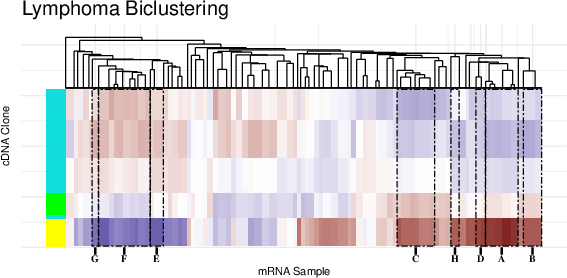
Figure 5: Biclustering results for Lymphoma data; row and column clusters correspond to disease labels and associated feature weights highlight biologically relevant genes.
Implications and Future Directions
The introduction of biconvex biclustering shows that stability and interpretability of convex biclustering can be extended to high-dimensional, noisy contexts by integrating feature selection into the core optimization. Theoretical results connect spectral properties of the affinity graph to finite-sample recovery, underscoring the importance of fusion graph design and motivating further research on adaptive affinity learning.
Practically, these advances support robust exploratory analysis in genomics, bioinformatics, and other domains with high-dimensional data matrices, where discovery of informative biclusters and relevant features is paramount. Theoretical considerations suggest that similar biconvex or nonconvex relaxations could be extended to structured data models (e.g., tensors or supervised biclustering), and inspire new work on optimization landscapes and adaptive regularization schemes in unsupervised learning.
Conclusion
The proposed biconvex biclustering framework achieves effective joint bicluster recovery and feature selection in high-dimensional data by means of a theoretically justified and computationally tractable biconvex objective. Its empirical superiority over prior art and ability to provide interpretable weighted feature groupings mark a significant advance in unsupervised learning methodology for structured high-dimensional data.