- The paper demonstrates that ICL’s spatial correlation with dark matter, quantified using the Weighted Overlap Coefficient, differentiates SIDM from CDM models.
- Using high-resolution C-EAGLE simulations, the study reveals how tracer fidelity among gas, stars, and galaxies varies between relaxed and merging clusters.
- The findings imply that a closer gas-DM correspondence in SIDM systems offers a promising diagnostic to constrain dark matter self-interaction cross-sections.
Intracluster Light as a Probe for Dark Matter: A Comparative Analysis of SIDM and CDM with C-EAGLE Simulations
Introduction
The intrinsic properties and distribution of intracluster light (ICL) in galaxy clusters offer a unique perspective on dark matter (DM) physics, particularly in distinguishing between collisionless cold dark matter (CDM) and self-interacting dark matter (SIDM) scenarios. "Intracluster Light as a Probe for Dark Matter: Exploring SIDM and CDM with C-EAGLE Sims" (2604.03907) undertakes a comparative study leveraging high-resolution re-simulations from the Cluster-EAGLE (C-EAGLE) project for both CDM and SIDM frameworks. The work robustly evaluates the morphological correspondence between dark matter and several baryonic tracers, including gas, all stars, galaxies, and the combined brightest cluster galaxy plus ICL (BCG+ICL), quantifying their spatial similarity using the Weighted Overlap Coefficient (WOC).
Simulation Methodology and Tracer Definitions
The study utilizes two C-EAGLE clusters (CE12: relaxed; CE05: unrelaxed/merging) re-simulated from identical initial conditions under both collisionless CDM and SIDM with cross-section σ/m=1 cm2/g. Structure identification employs the PGalF PSB-based finder, with halo decomposition distinguishing galactic, BCG, and ICL components. The ICL is defined as stellar particles gravitationally unbound from any galaxy but contained within the cluster’s FoF halo.
To quantify DM–baryon morphological correspondence, the Weighted Overlap Coefficient (WOC) is used. WOC is a robust contour-overlap metric normalized for map area and threshold, designed to directly compare projected surface densities of different components, minimizing projection and masking biases and insensitive to zero-point photometric offsets.
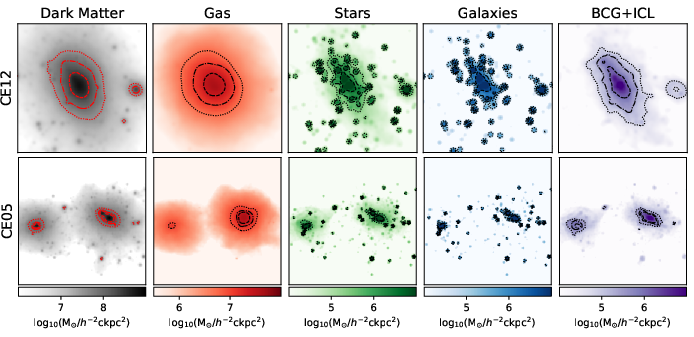
Figure 1: Multi-component spatial maps of CE12 (relaxed, upper row) and CE05 (disturbed, lower row) at z=0 in CDM; columns: dark matter, gas, all stars, galaxies, BCG+ICL.
Mass Assembly and Baryonic Fraction Evolution
The temporal evolution of mass assembly in CE12 (relaxed) and CE05 (merging) was tracked for both DM and all baryonic subcomponents (Figure 2). No significant differences in the overall DM assembly history or stellar mass growth between CDM and SIDM were observed at the halo-integrated level, consistent with prior findings indicative of the mild global influence of SIDM with σ/m=1 cm2/g.
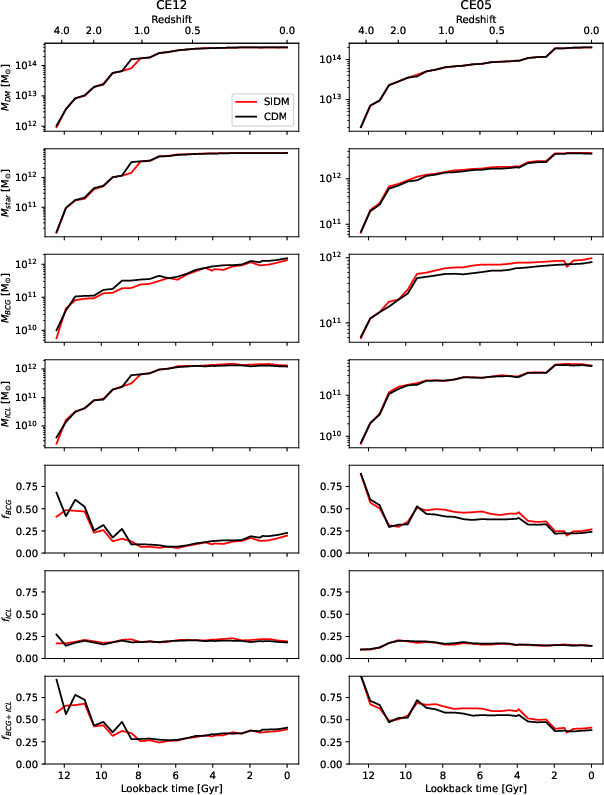
Figure 2: Evolution of dark matter, stellar, BCG, ICL, and BCG+ICL mass and mass fractions for CE12 (left) and CE05 (right); black: CDM, red: SIDM.
CE12 displays early rapid assembly followed by steady accretion, reflected in a smoothly increasing BCG+ICL fraction post-z∼1. CE05, in contrast, experiences major mergers at late times, resulting in a declining BCG+ICL fraction and other pronounced dynamical disturbances. Notably, the expected enhancement of ICL production in SIDM, due to predicted increased satellite disruption and tidal debris, is not strongly evident, with the ICL fraction plateauing around 15–20% across both models.
Weighted Overlap Coefficient Analysis: Spatial Tracing Fidelity
Spatial fidelity between baryonic components and DM is systematically evaluated via WOC at fixed fractions of the cluster virial radius, over multiple random projections. Across both clusters and DM models, BCG+ICL displays the highest and most stable WOC values (close spatial morphology to DM), followed by gas, all stars, and galaxies, though the relative ranking and time evolution show key physical differences contingent on cluster dynamical state and DM physics.
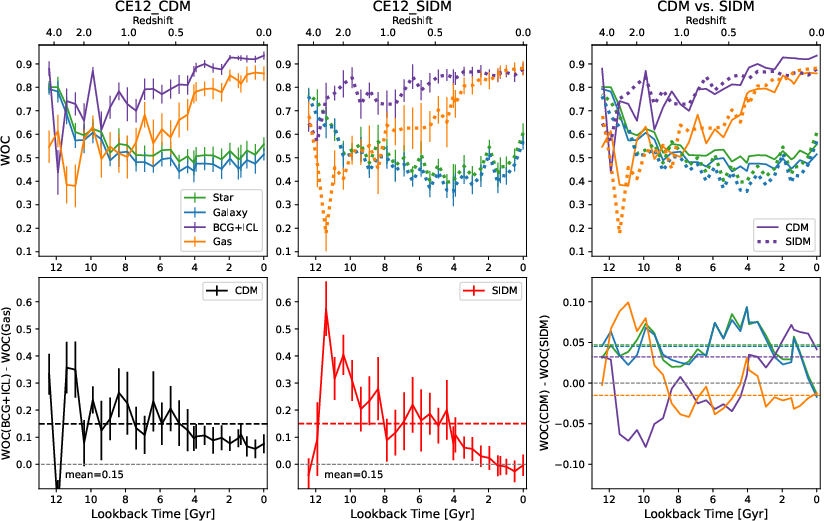
Figure 3: WOC evolution for CE12: CDM (left), SIDM (middle), and CDM–SIDM differential (right). Top: All stars (green), galaxies (blue), BCG+ICL (purple), gas (orange). Bottom: BCG+ICL vs. gas residuals (left/middle) and model differences (right).
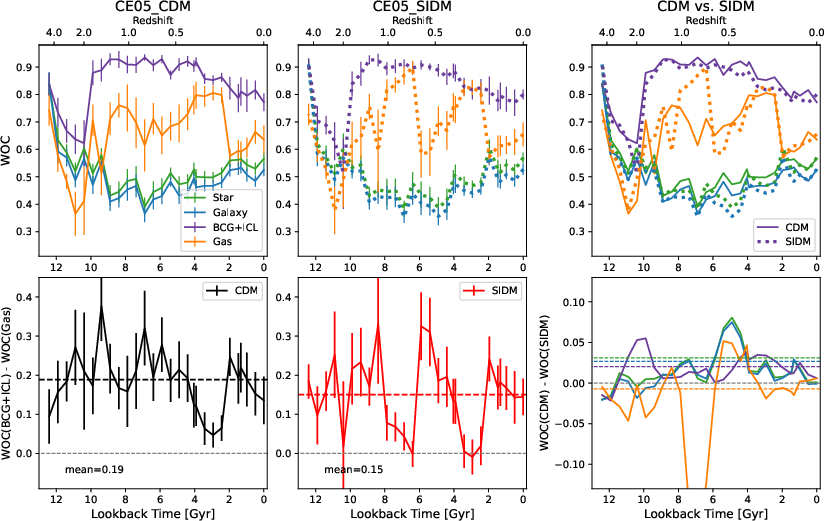
Figure 4: WOC evolution for CE05 under identical conventions as Figure 3.
For the dynamically relaxed CE12, BCG+ICL closely traces DM at all epochs, with WOC values high and stable even at high z, while gas initially correlates poorly but systematically improves to reach parity as the cluster relaxes. Interestingly, in the SIDM case, this convergence is more rapid and, at late times, gas can slightly exceed BCG+ICL in tracing performance. In CE05, the unrelaxed system, merger activity generates sharp WOC fluctuations, and BCG+ICL remains more consistent than gas, which responds with strong variability to dynamical events.
Visualization of major merger events clarifies the causal mechanisms behind these trends. During mergers, collisional gas undergoes shock heating and loses central concentration, causing a marked drop in WOC relative to collisionless BCG+ICL, which maintains a stable spatial association with the DM. This distinction is manifest in the sequential merger snapshots for CE12 and CE05:
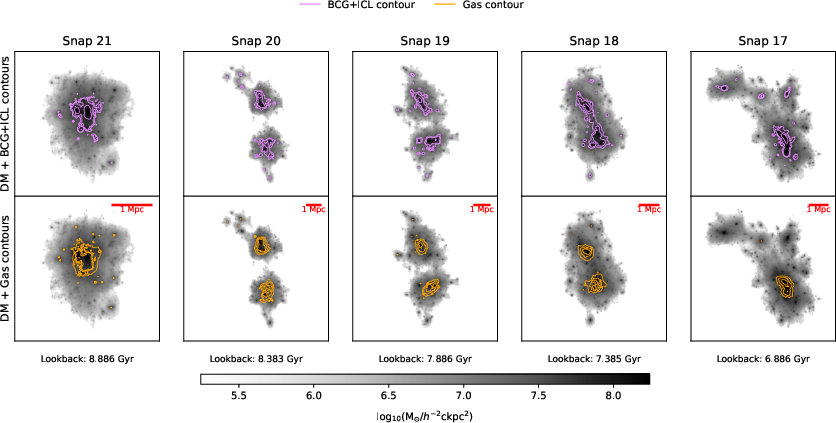
Figure 5: Sequential merger-phase snapshots for CE12, showing 2D DM density maps with BCG+ICL contours (top) and gas contours (bottom) overlaid; BCG+ICL follows DM morphological evolution more closely than gas.
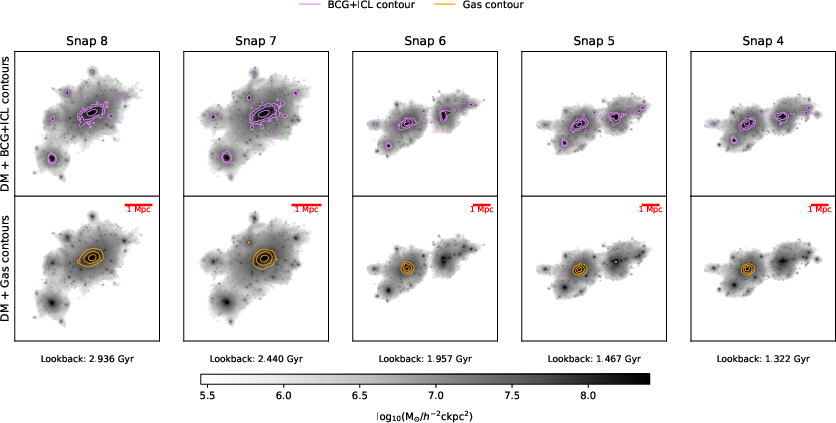
Figure 6: Merger-phase snapshots for CE05, plotting conventions as in Figure 5.
These differences underscore the differential response of collisional and collisionless baryonic components to cluster dynamical evolution and the underlying DM physics.
Sensitivity to Dark Matter Microphysics: CDM vs. SIDM
The WOC framework enables quantification of the relative similarity of baryonic components to DM under both dark matter models. In SIDM, dark matter acquires mild effective collisionality, which facilitates greater spatial coupling with the gas distribution. This is evidenced by the systematically reduced residual WOC(BCG+ICL)−WOC(gas) in SIDM versus CDM, especially in relaxed systems. For CE12, at late times the gas and DM are nearly as well-correlated as BCG+ICL and DM (mean residual ∼0.15). In CE05, the difference is more pronounced, with BCG+ICL outperforming gas more strongly in CDM.
Collisionless components (galaxies, stars, BCG+ICL) display higher WOC to DM in CDM than in SIDM, while gas is universally closer in SIDM, implying true collisionality. The differential sensitivity is most pronounced for satellite and dwarf galaxies, aligning with predictions that these populations more faithfully encode the impact of SIDM-induced tidal heating and disruption.
ICL as a Diagnostic of Dark Matter Properties
The comparative analysis yields the strong claim that the joint evolution of WOC(DM, BCG+ICL) and WOC(DM, gas) provides a new empirical diagnostic of the DM microphysical model. In particular, the rate of convergence and absolute difference between these metrics across cluster dynamical states and redshift can, in principle, be calibrated as a function of the SIDM cross-section.
Translating these simulation predictions to observational constraints requires (a) a statistical sample of clusters simulated across a grid of σ/m values, (b) high-quality maps of ICL, gas, and lensing-derived DM, and (c) robust, standardized application of WOC or similar spatial diagnostics across both simulation and observation. The expected outcome is that if gas traces DM more closely than ICL in relaxed low-z clusters observationally, this would provide evidence for substantial self-interaction (σ/m approaching z=00), whereas ICL remaining the best tracer would favor CDM or SIDM with small z=01.
Outlook for Observational Tests and Future Simulations
The imminent arrival of large-scale cluster surveys from Rubin/LSST and dedicated telescopes such as K-DRIFT, combined with optical, X-ray/SZ, and strong+weak lensing capabilities, will provide the necessary data to test these predictions. The optimal regime for distinguishing DM models will be the comparative analysis of WOC for gas and BCG+ICL in both dynamically relaxed and unrelaxed systems at z=02.
Future simulations should sample a range of cluster masses, dynamical histories, and SIDM cross-sections (including possible velocity dependence), and incorporate full radiative transfer and realistic observational effects in mock maps. Coupling the framework with high-resolution cosmological hydrodynamic suites (e.g., IllustrisTNG, Horizon-AGN) would ensure broad statistical relevance. Extended analysis of the stochasticity and systematic uncertainties in observational WOC recovery is required for robust empirical application.
Conclusion
This work substantiates ICL as a critical tool in the arsenal for probing DM microphysics, providing a robust, morphologically grounded method that complements traditional strong and weak lensing analyses. The use of the WOC as a quantitative measure of tracer–DM correspondence enables a clear, empirically testable connection between high-fidelity cosmological simulations and forthcoming multiwavelength cluster datasets. The findings collectively indicate that the spatial relationship between diffuse stellar and gaseous tracers and the underlying dark matter, and their evolution, offers direct, model-dependent signatures of collisionality in the dark sector.
Future research should prioritize expansion to larger cluster samples, a refined grid in SIDM parameter space, and observational efforts to extract robust, component-resolved maps of ICL, gas, and DM. These steps are vital for transforming the theoretical promise of ICL as a dark matter probe into a practical, discriminant constraint on the physics of the dark universe.