- The paper demonstrates that antichain-lattice PID is structurally incapable of recovering mutual information in systems with three or more sources.
- It introduces the System Information Decomposition (SID) as an alternative framework that omits singleton-free antichains to maintain consistency in three-variable scenarios.
- The study highlights practical implications for analysis in neural coding and complex systems, urging a shift to richer models beyond traditional PID.
Introduction and Motivation
Partial Information Decomposition (PID) aims to resolve the structure of multivariate mutual information into interpretable components—redundant, unique, and synergistic information—by indexing information atoms using the lattice of source antichains. This operationalizes the assignment of information content to precise source sets, foundational for understanding distributed computation and neural coding, among numerous applications. However, it has been recognized that in systems with three or more sources, no axiomatic scheme based solely on the antichain-lattice can simultaneously satisfy the commonly desired properties of a decomposition, notably the Whole Equals Sum of Parts (WESP) principle, commutativity, monotonicity, and self-redundancy.
The work "Structural Impossibility of Antichain-Lattice Partial Information Decomposition" (2604.03869) advances the field by proving that this incompatibility is structural—rooted in the antichain-lattice representation itself rather than the specifics of any redundancy function or combination of axioms. The authors establish that, for general multivariate PID, it is impossible to recover the mutual information or entropy of the system from the collection of antichain-indexed atoms. They demonstrate that none of the possible tunings or modifications of PID axioms can overcome this representational bottleneck.
The redundancy lattice is central to PID. It organizes antichains, each encoding a collective "access pattern" of sources that can supply overlapping components of target information. In the bivariate case—two sources—the lattice cleanly indexes redundant, unique, and synergistic atoms. The system’s total mutual information with a target decomposes as follows:
(I)
I(S1,S2;T)=Red(S1,S2→T)+Un(S1→T∣S2)+Un(S2→T∣S1)+Syn(S1,S2→T)
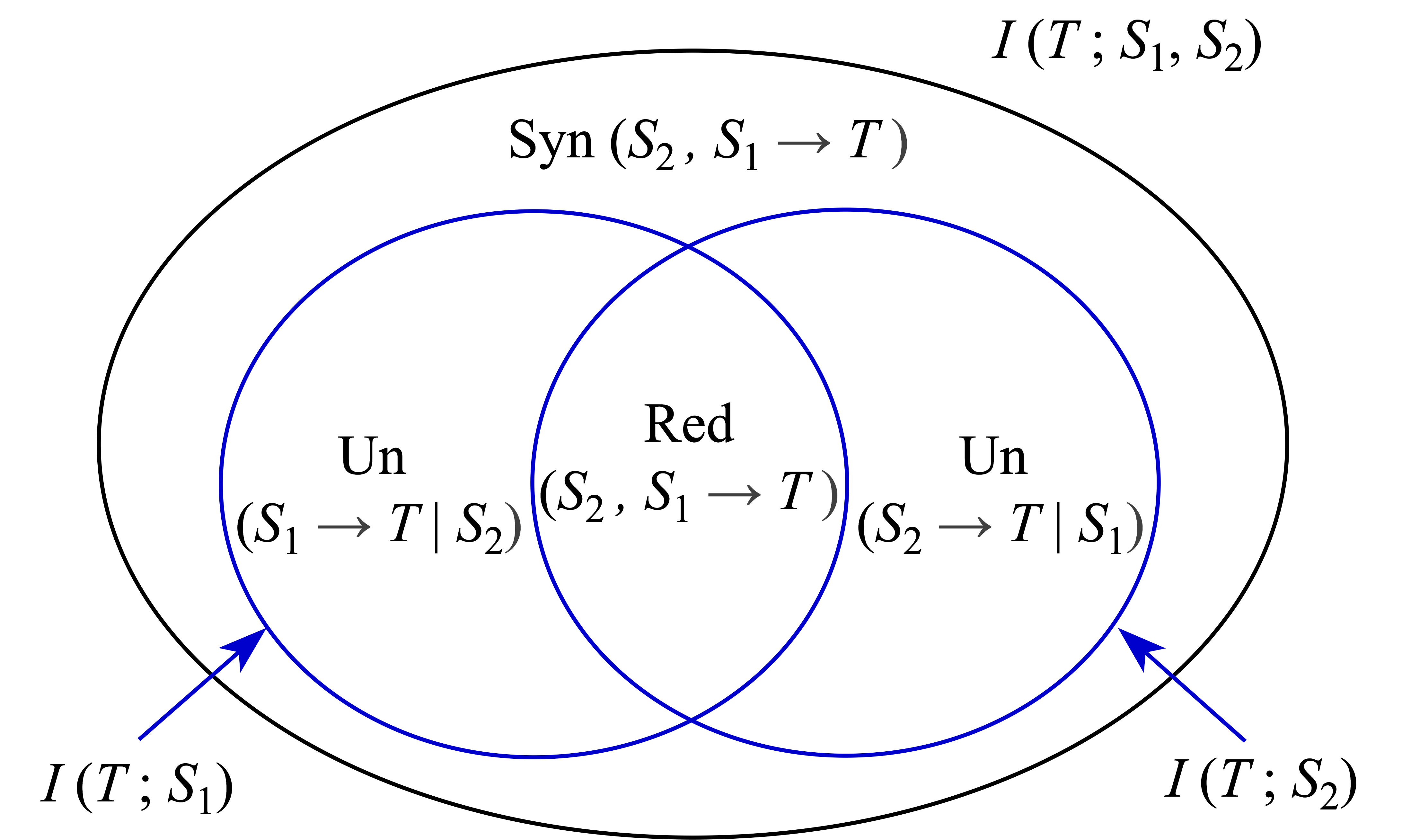
Figure 1: The structure of PID with two source variables, depicting the relationships among redundancy, uniqueness, and synergy in the bivariate decomposition.
The antichain redundancy lattice is well-defined and operational in the two-source case; the sum of all atoms recovers the mutual information (WESP), and all principal axioms are consistent.
Generalization Failure: The Three-Source Setting
In the setting of three or more sources, the lattice indexing and the associated mutual information summation become fundamentally inconsistent. For example, in the "XOR" system with three variables, explicit constructions show that the sum over all lattice-indexed atoms can exceed the joint mutual information, regardless of how redundancy is defined. This violation directly manifests as a breakdown of the WESP property and subsumes all known axiom incompatibility results into a single structural phenomenon.
In detail, the lattice fails to encode key global dependencies, especially high-order synergy. Redundancy labels alone are insufficient to specify the information allocation; some information is only recoverable by considering entire relations (e.g., perfect symmetry or XOR structure), not captured by the antichain.
To elucidate the root of the inconsistency, the authors introduce System Information Decomposition (SID) for three variables, considering the special case of decomposing joint entropy rather than mutual information against a fixed target. In SID, the antichain lattice is halved, considering only atoms indexed by antichains containing singletons, and the WESP summation is modified by an exclusion correction that explicitly encodes symmetric synergistic interactions.
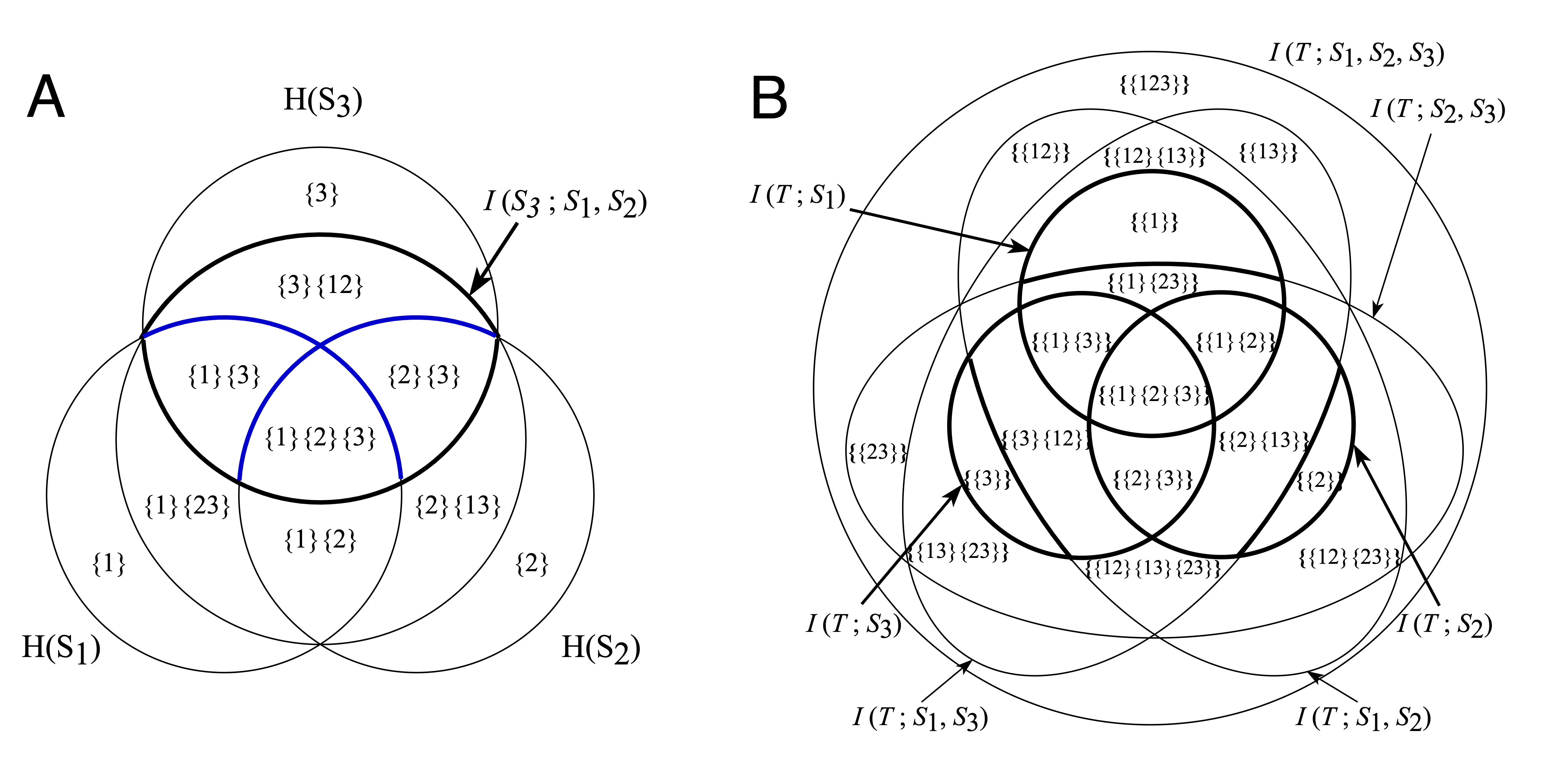
Figure 2: Comparison between the structure of three-variable SID and the full three-source PID redundancy lattice. Bold antichains reflect the SID-relevant subset, highlighting the omitted singleton-free elements responsible for overcounting.
SID is self-consistent in the three-variable boundary case, satisfying all structural axioms—commutativity, monotonicity, and self-redundancy—by design, but abandons the goal of universal additive recovery. This exposes that consistency is only achievable via explicit tracking of global symmetric relations among atoms, which the full antichain lattice omits.
The key result is a formal impossibility theorem, demonstrating that for three or more sources, it is impossible to universally recover mutual information (or system entropy) from the set of all antichain-indexed atoms. This is shown constructively: the authors build pairs of systems with non-trivial joint dependency structure that induce identical collections of atoms per the lattice indexing, yet have strictly different total mutual information. Thus, there cannot exist any reconstruction map—linear or nonlinear—from the antichain-atom vector to the decomposed quantity. This holds even under idealized "antichain-realizable" constructions, where atoms are assigned using the strict intended semantics of recoverability.
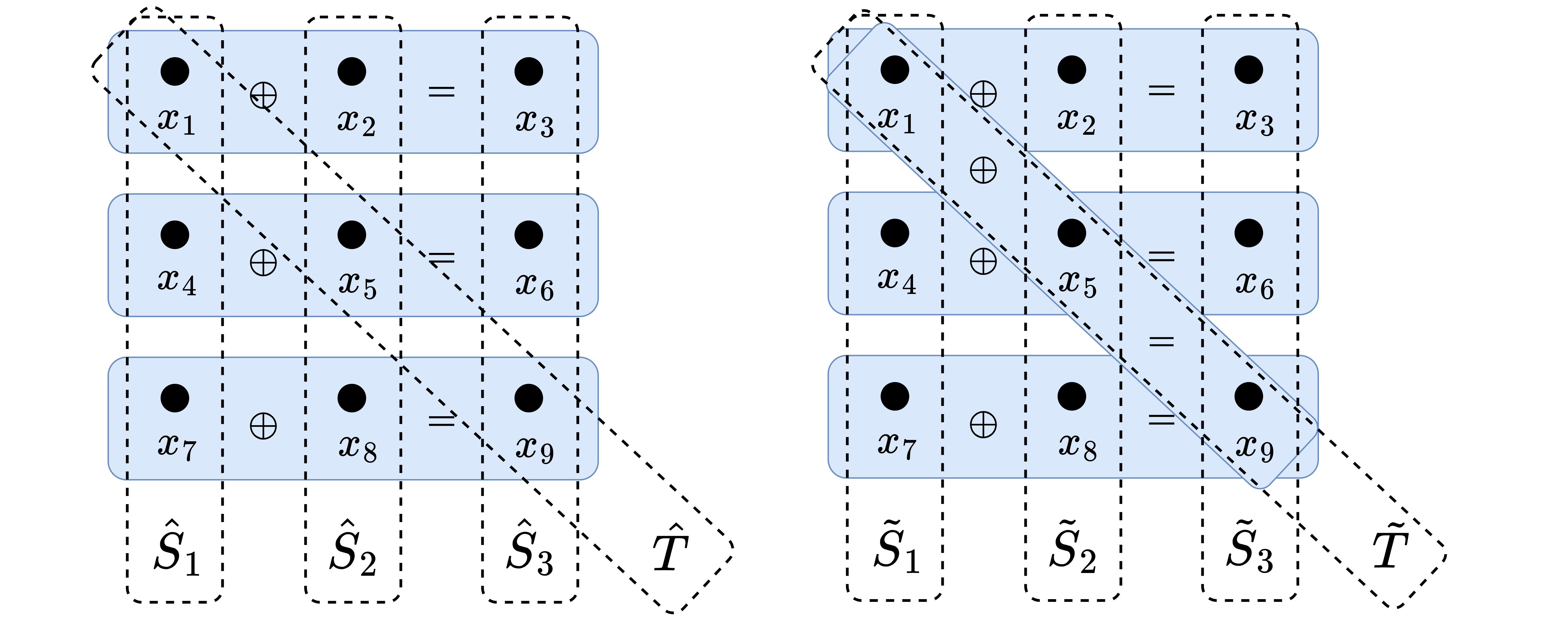
Figure 3: Three-source systems (S^1,S^2,S^3,T^) and (S~1,S~2,S~3,T~) constructed from latent bits, both yielding identical PID atoms but distinct mutual information, exemplifying the impossibility theorem.
This theorem conclusively demonstrates the structural limitation: the antichain-lattice PID is not merely incomplete or in need of better axioms—it is insufficient as a representational scaffold when higher-order information constraints exist.
Interplay Between SID and Classic PID
The relation between SID (joint entropy decomposition without external target) and classic PID (mutual information decomposition) is systematically analyzed. Notably, in the two-source case, the proposed SID coincides with standard PID up to a change in the decomposed quantity from I(S;T) to H(S), with an exact correspondence in antichain atoms. For three or more variables, SID can be viewed as a structurally consistent restriction of PID, yielding valid decompositions only by omitting the problematic singleton-free antichains and adopting non-standard summation conventions. This supports the thesis that the PID lattice only admits consistent additive decompositions in very restricted settings.
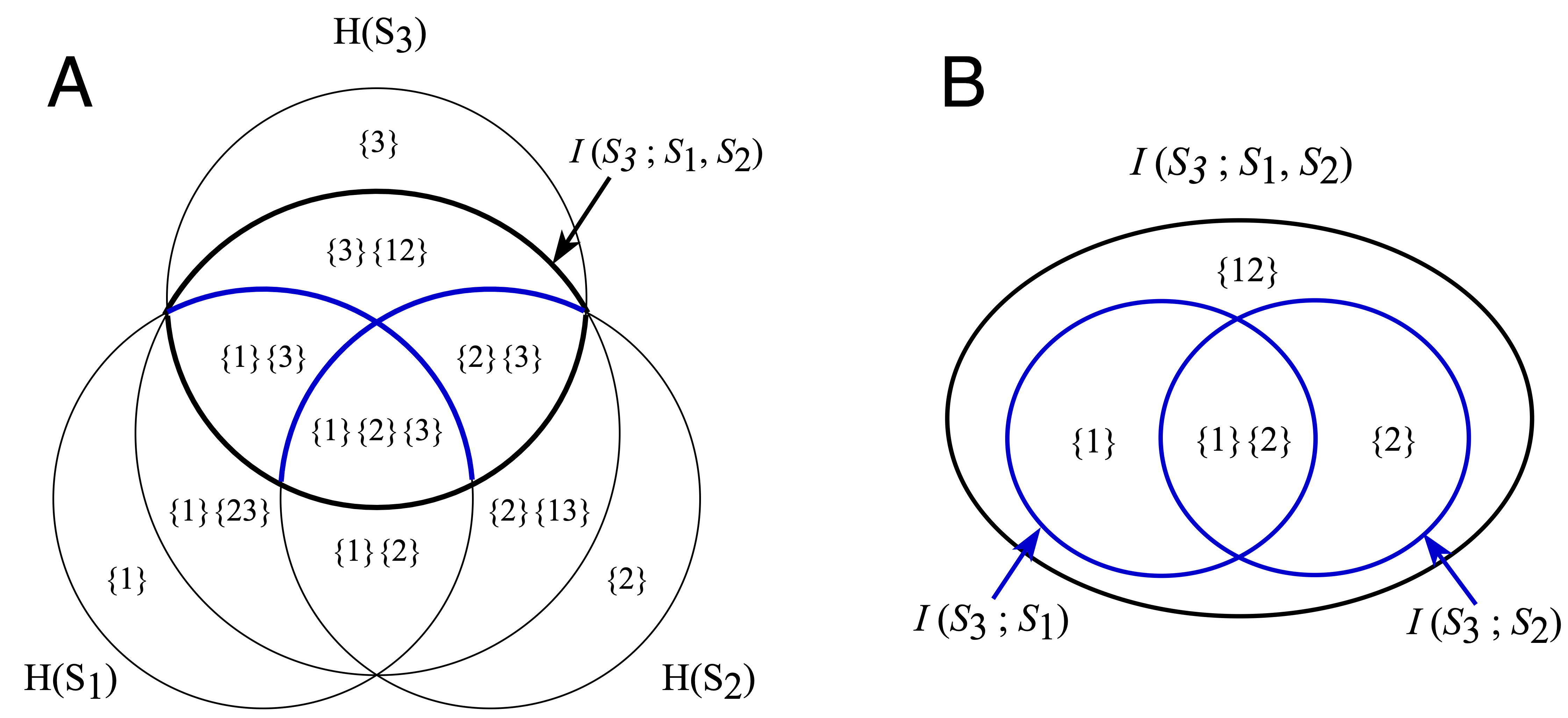
Figure 4: Diagrammatic correspondence between SID and classic two-source PID, emphasizing the isomorphism in the bivariate setting and divergence in higher dimensions.
Practical and Theoretical Implications
Practically, these results indicate that multivariate decompositions relying solely on the antichain lattice—no matter how the axioms are tuned or which redundancy functions are plugged in—necessarily conflate or misallocate higher-order dependencies. Use of existing PID frameworks for analysis of complex neural activity, multimodal fusion, or causal emergence must thus be interpreted with caution when beyond the bivariate setting. Empirical "violations" such as atom sums exceeding total information are not artifacts of statistics or estimator bias but intrinsic to the lattice-based accounting.
Theoretically, the findings motivate relation-based or hypergraph-based models of information decomposition, where the assignment of information to atoms is augmented with explicit representation of global constraints and higher-order synergistic structure. Only by extending beyond the antichain-lattice—and thus encoding inter-atom relations—can one hope to achieve universal, axiomatic, and additive decompositions in multivariate information theory.
Conclusion
This paper offers a decisive structural critique of antichain-lattice-based PID for n≥3 variables, shifting focus from axiomatic "tuning" to representational sufficiency. By proving that the lattice itself is unable to encode the global dependencies needed to reconstruct system information, the authors set forth an agenda for developing richer frameworks—beyond antichain labels—that are capable of simultaneously decomposing and reconstructing multivariate information in distributed systems.