- The paper introduces electrostatic skeletons in convex polygons, proving existence under the strict descent condition.
- It employs advanced analytic methods, using Schwarz reflection and a shrinking loop algorithm to construct the skeleton.
- Key results include explicit bounds on the structure of skeleton supports and potential extensions to broader polygon classes.
Electrostatic Skeletons and the Condition of Strict Descent
Introduction and Background
This work rigorously advances the theory of electrostatic skeletons for planar domains, focusing on convex polygons. The electrostatic skeleton is a positive measure, supported on a loop-free set (a tree), that realizes the Green's function equipotentials and reproduces the equilibrium measure's potential exterior to the domain. The central question, rooted in conjectures by Eremenko, and subsequent advances [Lundberg & Ramachandran; Eremenko et al.], is whether every convex polygon admits a unique electrostatic skeleton. Prior art proved this for triangles and regular polygons; the present work expands on both existence, algorithmic construction, and structural properties, specifically for symmetric quadrilaterals and, more generally, polygons satisfying a newly defined "strict descent" condition.
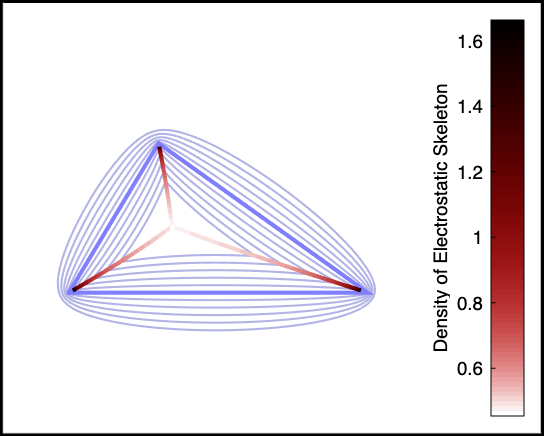
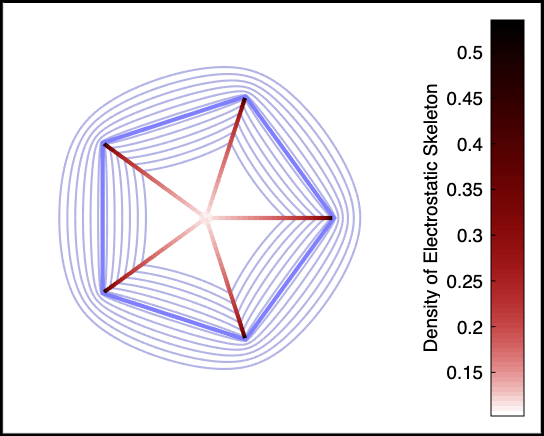
Figure 1: Electrostatic skeletons for a triangle and a regular pentagon, with level sets of the logarithmic potentials in blue.
Definitions and Analytical Framework
Let Ω⊂R2 be a precompact domain, and μ a compactly supported, positive Borel measure. The logarithmic potential Uμ(z) encodes the harmonic interaction of μ. An electrostatic skeleton is such a measure, supported on a subset S⊂Ω with no simple loops, and satisfies Uμ(z)=UμE(z) for z∈/Ω, where μE is the equilibrium measure on ∂Ω. This framework recasts the problem into potential theory, conformal mapping (specifically, the properties of the Green's function and Schwarz-Christoffel type reflections), and geometric measure theory.
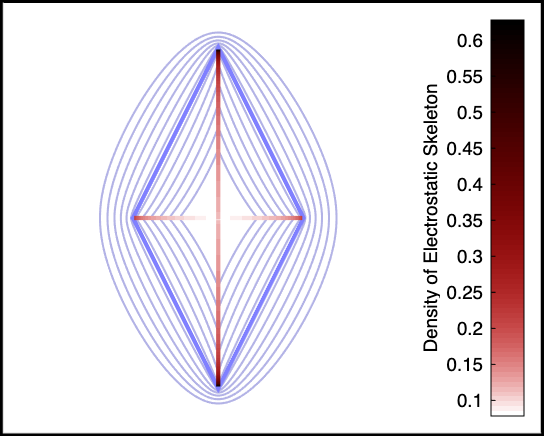
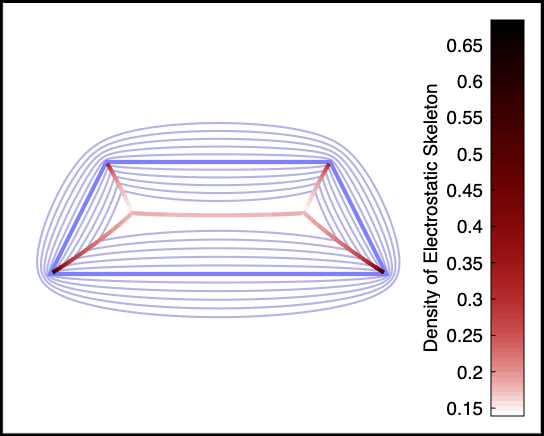
Figure 2: Electrostatic skeletons for a kite shape and an isosceles trapezoid, with level sets of the logarithmic potentials in blue.
Main Results for Symmetric Quadrilaterals
The author establishes two structural existence results:
- Kite-shaped Convex Quadrilaterals: For any convex quadrilateral symmetric about a diagonal (kite), an electrostatic skeleton exists. The proof exploits the symmetry to control the loci where reflected Green's functions coincide, resulting in a unique, tree-like support for the skeleton.
- Isosceles Trapezoids: For convex isosceles trapezoids, the skeleton can be constructed by analyzing the monotonicity and intersection properties of level sets and their symmetry across the axis.
Both arguments rely on the geometry of the Green's function and its Schwarz reflections, controlling the topology of intersection loci of equipotentials.
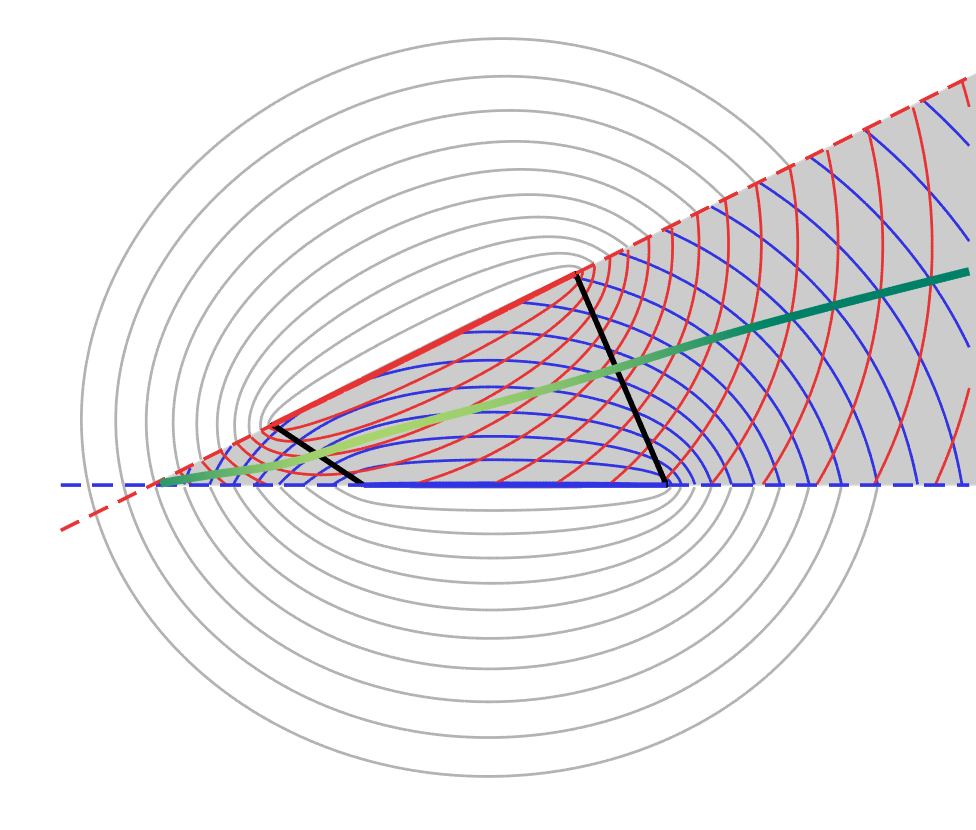
Figure 3: Level sets of g1 and μ0 are highlighted in red and blue, respectively. The wedge μ1 is the gray area between μ2 and μ3 containing the polygon.
The Condition of Strict Descent
The strict descent condition is introduced as the central analytic property under which existence of skeletons is shown for broader classes of convex polygons. Informally, for any distinct pair of reflected Green's functions μ4 and at any point μ5 where their gradients are parallel, the inner product μ6. This precludes tangential or degenerate intersections that would preclude a tree-like skeleton.
The main theorem is as follows:
- Main Theorem: Every convex polygon satisfying the strict descent condition admits an electrostatic skeleton. The support consists of at most μ7 analytic curves for an μ8-gon, and the measure is absolutely continuous with respect to μ9 on this support.
The proof evolves through a careful analysis of how the intersection sets of the different Green's function reflections—essentially, how the maximizer of the Green's function transitions, and how the skeleton can be built as equipotential level sets are shrunk. This process is analogous to a combinatorial tree-growth where at each phase, the boundary may split or contract, but never forms loops.
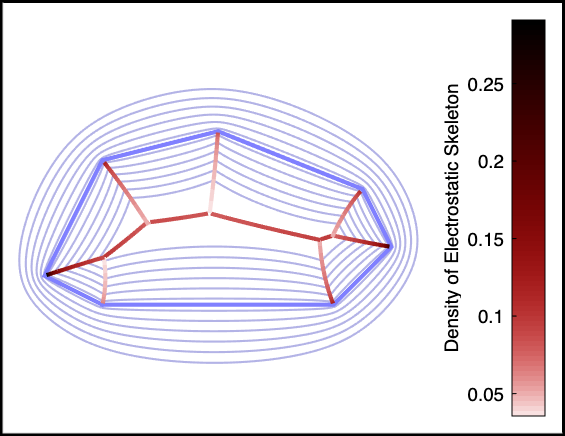
Figure 4: Electrostatic skeleton for a heptagon and its corresponding partition of (regular) heptagon.
Geometric and Algorithmic Construction
The construction is implemented via a "shrinking loop" algorithm: one considers level sets of the maximum of the reflected Green's functions, which delineate analytic polygons within the original domain. As these level sets are shrunk (i.e., the corresponding potential parameter is increased), topological "phase transitions" occur—these are critical moments when the polygon splits or contracts, encoding the combinatorial structure underlying the skeleton.
Each "regular loop"—a piecewise analytic Jordan domain formed by these level sets—either shrinks to a point (for triangles) or splits according to non-crossing matchings corresponding to partitions of the original polygon. These transitions are tracked analytically and encoded in the support of the skeleton measure.
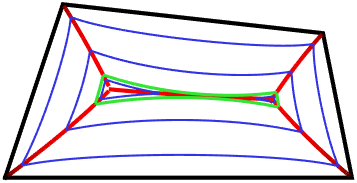
Figure 5: Shrinking level sets in a thin quadrilateral; the phase transition is highlighted in green.
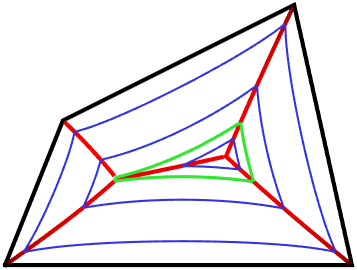
Figure 6: Shrinking level sets in a quadrilateral with a significantly shorter side, phase transition highlighted in green.
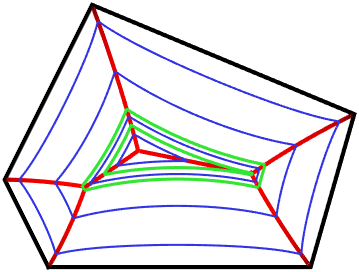
Figure 7: Multiple phase transitions occur when shrinking the level sets inside the pentagon.
Implications and Theoretical Significance
These results provide a constructive analytic and combinatorial pathway for identifying skeletons in a wide range of convex polygons, reducing a geometric-potential problem to precise analytic and measure-theoretic conditions. The strict descent condition, while still unproven for all convex polygons, is numerically and heuristically observed to be generic, suggesting that the full class of convex polygons likely admits skeletons.
The existence of analytic bounds (at most Uμ(z)0 arcs), explicit support structure, and subharmonic extension process links this measure-theoretic skeleton construction to deep themes in conformal geometry, potential theory, and combinatorics. The methods may inform further research in conformal invariants, the structure of Green's functions in planar domains, and the recovery of outer boundary data from inner "skeleton" measures.
Conclusion
The paper substantiates existence and characterizations of electrostatic skeletons for new families of convex polygons, introduces the strict descent condition as an effective analytic criterion, and develops a suite of geometric-analytic tools for constructing skeleton supports. The implications extend toward a potential full resolution of Eremenko's conjecture, subject to future confirmation that all convex polygons satisfy strict descent, and provide a clear analytical-combinatorial template for related extremal problems in two-dimensional potential theory.
Reference: "Electrostatic skeletons and condition of strict descent" (2604.03861).