- The paper presents HYMOR, an open‐source tool for comprehensive global stability, transient growth, and receptivity analysis in high‐enthalpy hypersonic flows.
- It employs finite-volume discretization with shock-fitting techniques and GPU-accelerated eigenvalue solvers to capture both modal and non-modal disturbance dynamics.
- The framework integrates advanced thermochemical models to accurately simulate real-gas effects, enabling precise transition prediction for high-speed vehicle design.
HYMOR: An Open-Source Framework for Global Stability and Receptivity Analysis in High-Enthalpy Hypersonic Flows
Introduction and Motivation
The prediction, analysis, and physical understanding of laminar-to-turbulent transition in hypersonic boundary layers are central concerns for thermal protection system and aerodynamic design at high enthalpy. Traditional stability tools built on local linear stability analysis (LST), the Parabolized Stability Equations (PSE), and their nonlinear variants inadequately capture phenomena involving spatially separated mechanisms such as mode conversion at detached bow shocks, transient non-modal growth, and global receptivity. Additionally, local solvers often lack high-fidelity thermochemical modeling needed for high-enthalpy effects and are rarely open-source or extensible for modern code workflows. “HYMOR: An open-source package for global modal, non-modal, and receptivity analysis in high-enthalpy hypersonic vehicles” (2604.03824) introduces a comprehensive, open-source suite for global linear analyses of high-enthalpy hypersonic flows, providing coupled global modal, non-modal (transient growth), and global receptivity analysis for generic 2D and axisymmetric geometries with sophisticated thermochemical modeling and shock-fitting.
Framework and Methodology
HYMOR implements a global formulation for the compressible Navier–Stokes system, discretized with second-order finite-volume methods on curvilinear structured grids, supporting curvilinear transformations for generic hypersonic geometries (e.g., blunt cones, wedges, cylinders). The code self-consistently computes nonlinear steady base flows and automatically linearizes the discrete operators to construct the system matrix L for stability and receptivity analysis.
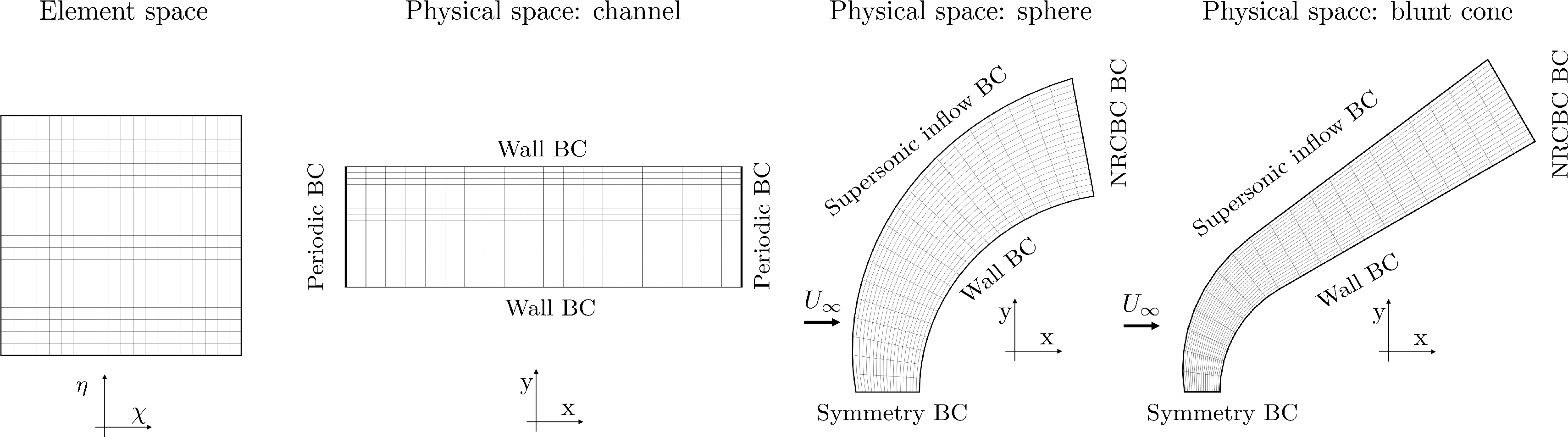
Figure 1: Illustration of possible geometries and boundary condition types accessible within HYMOR using curvilinear mesh mappings.
To correctly capture the critical physics of disturbance-shock interaction, HYMOR utilizes a bow shock shock-fitting method, representing the shock as a moving spline with exact Rankine–Hugoniot jump enforcement at subcell accuracy. This eliminates artificial shock thickness, carbuncle artifacts, and the associated corruption of receptivity, which are present in shock-capturing methods, enabling precise reproduction of linear interaction analysis (LIA) for infinitesimal disturbances.
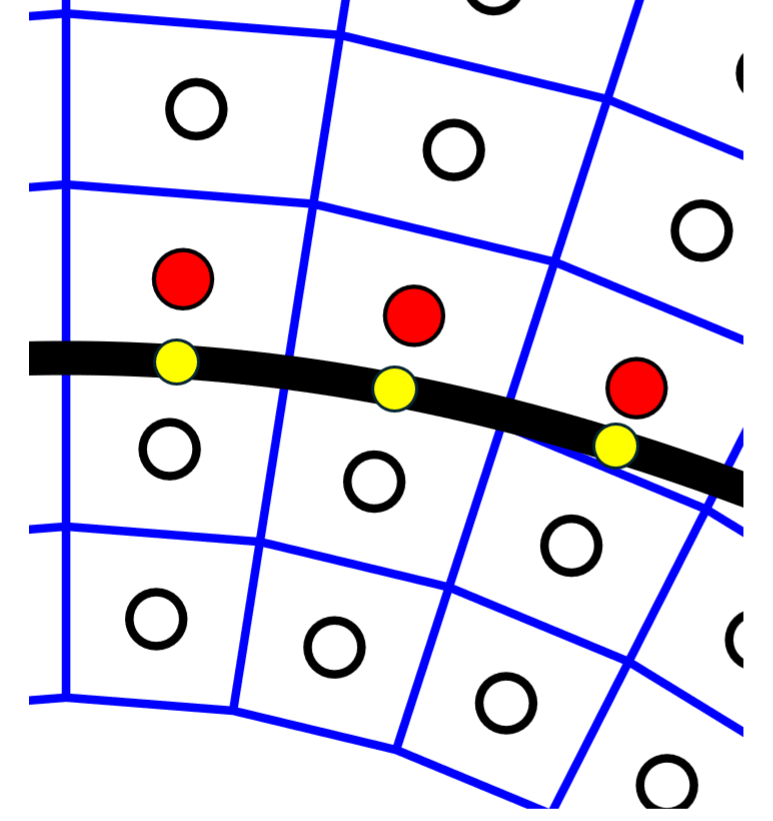
Figure 2: Notation and schematic for shock/finite-volume grid information exchange at each time step in the shock-fitting algorithm.
Thermochemical closure is handled via five interchangeable models—ranging from calorically perfect gas (CPG), through various levels of chemical/vibrational/electronic equilibrium, to a reduced-order chemical non-equilibrium scheme. Equilibrium quantities such as effective specific heats are tabulated via least-squares fits to Cantera-based reference data, yielding several orders of magnitude speedup while maintaining excellent accuracy for high-enthalpy effects. Mixture transport properties are evaluated either via Sutherland’s laws or collision-integral-based models with Cantera.
Linear Analysis Capabilities
Modal (Eigenvalue) Analysis
Global modal stability is implemented by constructing and linearizing the full spatially dependent discrete operator L about the computed steady base flow. The eigenproblem λq′=Lq′ is solved using a sparsity-preserving exponential spectral transformation to ensure rapid Arnoldi iteration convergence to the most unstable global modes, offloading matrix-vector products to GPU for acceleration. This supports practical grids far exceeding what is tractable for traditional shift-and-invert approaches.
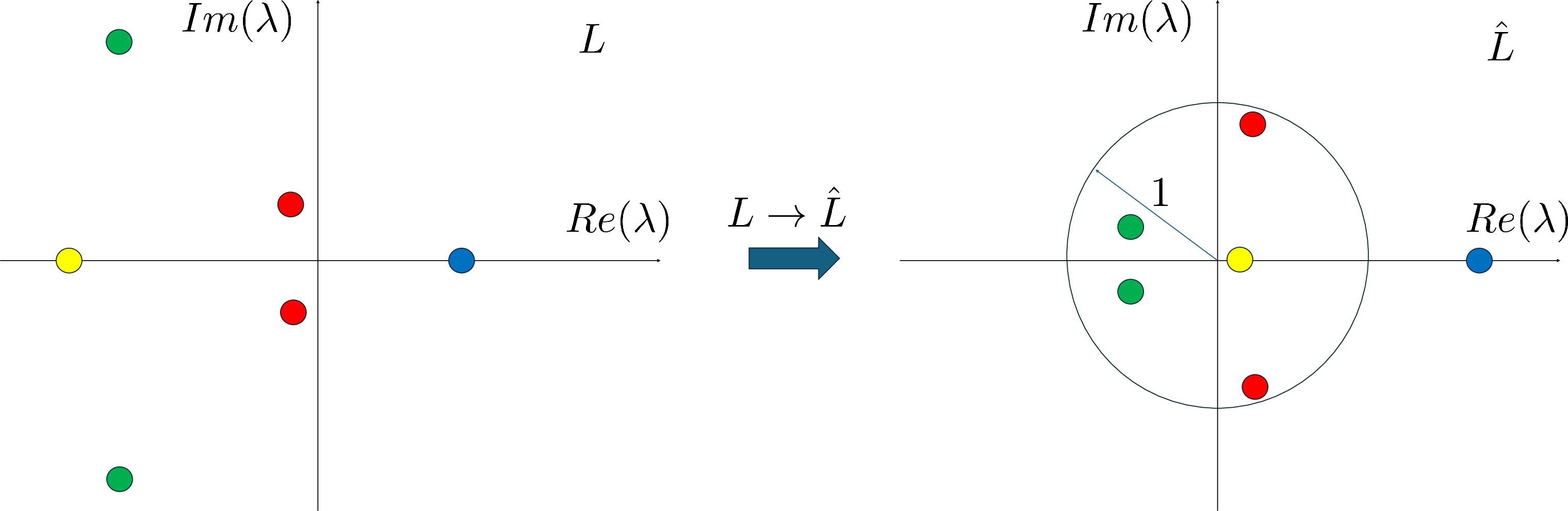
Figure 3: Spectrum transformation applied to the system matrix L accelerating identification of unstable modes via Arnoldi iteration.
Non-Modal (Transient Growth) and Freestream Receptivity
Global transient growth analysis computes the optimal initial disturbance maximizing the energy norm at a target time t, solving a generalized eigenproblem via the Chu norm, distinguishing kinetic, acoustic, and entropic contributions. The analysis leverages matrix exponential approximations and GPU-accelerated Lanczos iteration for tractability.
Global freestream receptivity is addressed by posing a time-dependent coupled downstream/upstream (freestream) system with the shock interface as a coupling boundary, rigorously projecting imposed broadband or monochromatic upstream disturbances across the shock and quantifying the maximal post-shock amplification using a generalized Rayleigh quotient. This makes explicit the separation of shock transmission and post-shock amplification.
Verification and Physical Results
Real Gas and Shock–Disturbance Physics
Extensive verification is performed for the implementation of chemical equilibrium and non-equilibrium models. The real-gas effects under Mars conditions over a wedge, representative of missions like MSL, are compared to high-fidelity Eilmer finite-rate solutions, showing that including chemical non-equilibrium yields accurate prediction of post-shock temperature and standoff distance. The reduced-order non-equilibrium model reproduces key departures from equilibrium, most notably the vibrational and chemical non-equilibrium spike immediately behind the shock.
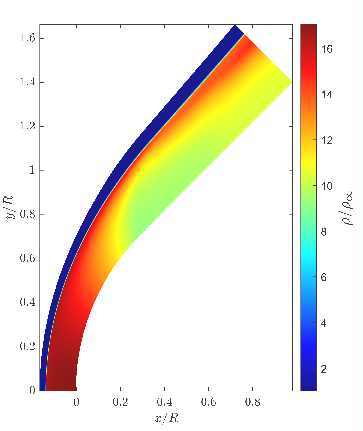
Figure 4: Verification of real-gas models on a 2D inviscid wedge flow, demonstrating the impact of vibrational/chemical modes as captured by HYMOR.
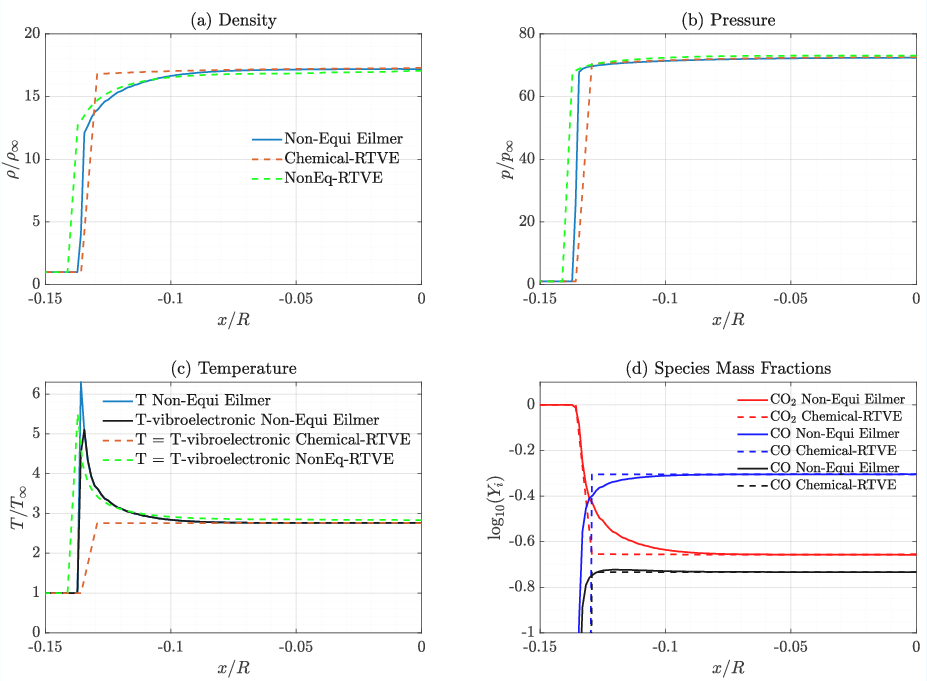
Figure 5: Equilibrium and non-equilibrium temperature and density evolution along the stagnation line—HYMOR models versus Eilmer reference.
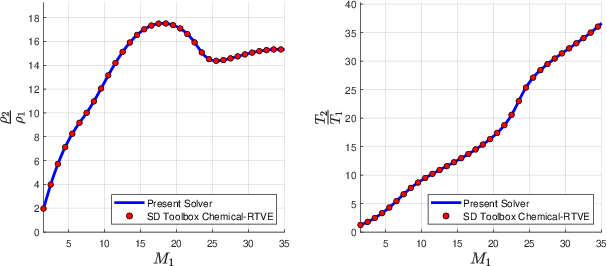
Figure 6: Rankine-Hugoniot jump verification with thermochemical effects: HYMOR and SDToolbox compared for Martian atmosphere.
Moreover, HYMOR’s shock–disturbance interface is rigorously validated by injecting entropy waves upstream of a normal shock and cross-comparing the transmitted downstream mode amplification and mode-conversion with analytic LIA solutions, capturing the physics at Mach 28 and strong real-gas effects.
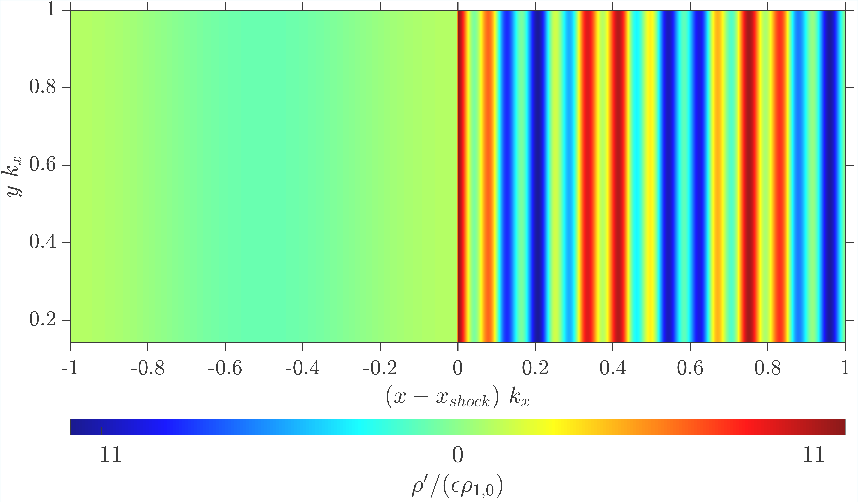
Figure 7: Mode-conversion of an upstream entropy wave into coupled acoustic and entropy modes across a normal shock at high Mach.
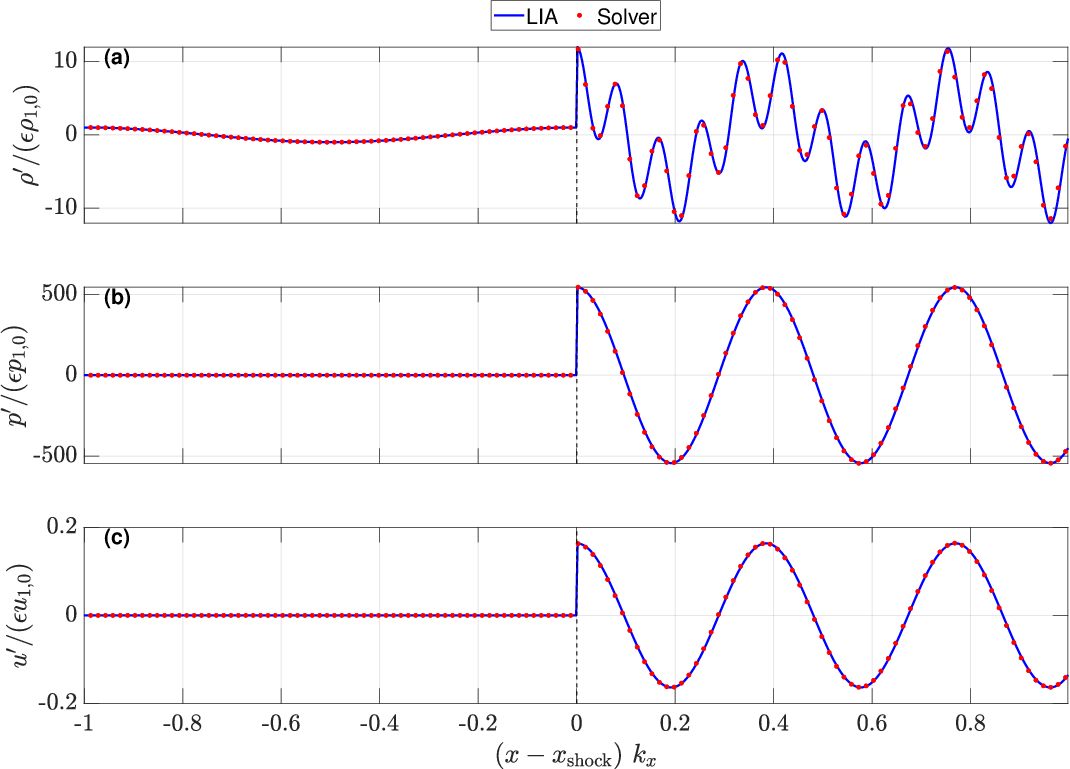
Figure 8: HYMOR versus analytic LIA for 1D shock-induced disturbance; excellent agreement in density, pressure, and velocity.
High-Enthalpy Application: Blunt-Body Transition Analysis
An application scenario models a blunt cone (e.g., Mars entry configuration) at M∞=12, Re∞=105, with full real-gas effects. HYMOR computes the steady base flow, explicit shock stand-off geometry, and boundary layers with coupled nonequilibrium chemistry.
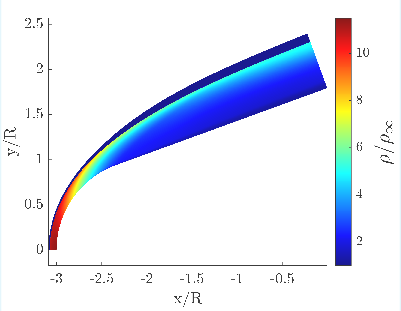
Figure 9: Steady-state density field over a high-enthalpy blunt cone, revealing detached bow shock and strong compression at the stagnation region.
Modal analysis reveals that all global modes are significantly damped (smallest Re(λ)=−0.139), implying the absence of exponentially growing disturbances and that classic modal instability lacks sufficient gain under these conditions.
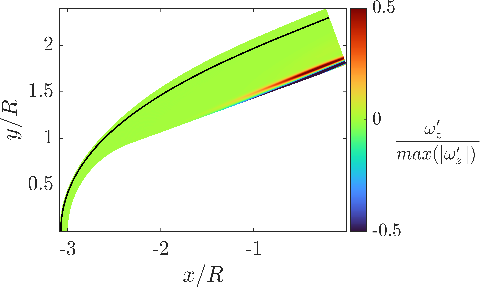
Figure 10: Least-damped global disturbance: vorticity contours are confined within the boundary layer.
Non-modal (transient growth) analysis, for a time horizon tU∞/R=3, shows optimal initial disturbances inside the lower boundary layer yield a substantial energy amplification (factor ≈ 40), with a 50:25:25 split between entropic, kinetic, and acoustic energy—consistent with non-modal streak and Orr-like mechanisms.
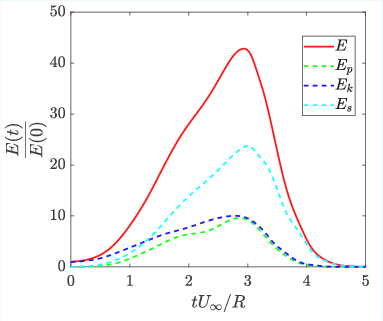
Figure 11: Temporal evolution of optimal energy amplification in the transient growth analysis for the blunt cone.
Freestream Receptivity at High Mach
Freestream receptivity analysis exposes energy amplification orders of magnitude higher than non-modal growth (optimal gain L0 at L1), with amplification scaling as L2. The spatial structure shows receptivity is maximized by disturbances targeting the stagnation region and advection into the boundary layer.
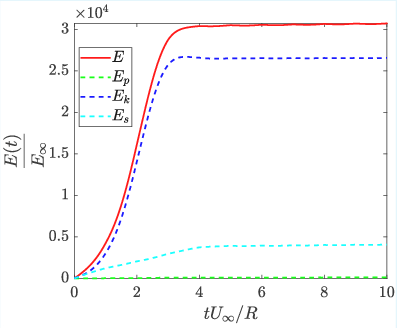
Figure 12: Energy amplification history for freestream receptivity analysis—demonstrating immense gain relative to base flow.
HYMOR is implemented in both MATLAB and Julia, with full parity and open-source distribution (MIT license). Benchmarking demonstrates competitive time-marching efficiency for non-linear base flows (L3s/DOF/RK-stage) and superior scaling for GPU-accelerated stability solvers, with wall-clock times and memory usage of the spectral exponential method significantly lower than shift-invert alternatives.
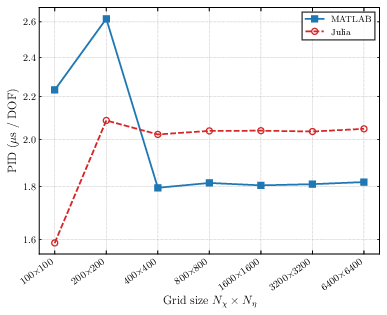
Figure 13: PID scaling for time-marching solvers in MATLAB and Julia versions of HYMOR for varying grid sizes.
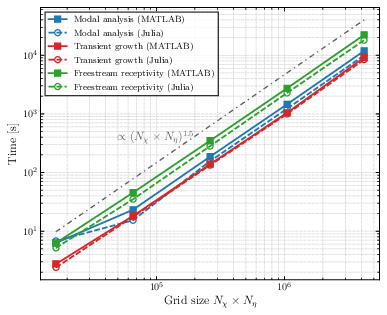
Figure 14: Wall-clock time scaling for modal/transient/receptivity analysis: GPU-accelerated implementation enables large grid computations.
Implications and Future Developments
HYMOR advances the state of high-enthalpy stability analysis with an extensible, reproducible, and efficient global analysis platform. The capability to couple real-gas effects, exact shock-fitting, and global modal and non-modal analysis enables direct quantification of non-local physics such as mode conversion, shock-induced amplification, and receptivity inaccessible to local and weakly nonparallel approaches.
Practically, this facilitates high-fidelity transition prediction for atmospheric entry and high-speed vehicle design, identifying the effective amplification mechanisms (modal, non-modal, and receptivity-driven) and directly implicating the physics controlling heat shield sizing. As experimental diagnostics in high-speed wind tunnels improve, HYMOR provides a reproducible reference for benchmarking and uncertainty quantification in transition prediction.
Theoretically, the approach invites further research coupling nonlinear non-modal growth, resolvent frameworks, input–output and control theory, and physics-informed data-driven modeling. The open-source, modular design enables integration with modern high-performance computing, ML-accelerated sorvers, and adjoint-based optimization for receptivity control.
Conclusion
HYMOR (2604.03824) fills a critical gap in hypersonic transition analysis tools, offering a global, open-source, and extensible platform validating both the underlying physics and efficient numerical implementation for high-enthalpy, high-speed flows with complex thermochemistry. Its open availability and modern codebase position it as an enabling tool for future research in hypersonic flow transition, control, and uncertainty quantification.