- The paper demonstrates that cross-spectral analysis exposes hidden dissipation where single-channel methods fail, using a rank-one hidden mode structure.
- It employs a minimal two-channel observation strategy, where the off-diagonal spectral term yields a finite detectability coefficient independent of channel dynamics.
- The findings are validated through analytical derivations and Monte Carlo simulations, linking cross-spectral detectability directly to entropy production.
Cross-Spectral Structure and the Overcoming of Single-Channel Detectability Limits
Introduction
This paper, "Cross Spectra Break the Single-Channel Impossibility" (2604.03775), addresses a central problem in nonequilibrium statistical mechanics: the detection and quantification of hidden irreversibility (i.e., dissipation) from partial observations of multivariate linear Gaussian systems. While recent results established that time-irreversibility and hidden dissipation are undetectable from a single observed scalar time series under the diagonal null hypothesis (Lucente impossibility), this work rigorously demonstrates that minimal extension to two observed channels---and, crucially, explicit cross-spectral analysis---qualitatively restores detectability even at the timescale coalescence singularity where all single-channel witnesses fail.
The key finding is a structural-geometric cancellation law: the cross-spectral block resides in a subspace orthogonal to the diagonal tangent space of the Whittle-KL divergence between candidate spectral models, yielding a detectability coefficient that is exactly independent of the observed-channel dynamics and remains strictly positive at coalescence. This property is not merely a byproduct of increased data dimensionality, but a consequence of cross-spectral geometry and the statistical structure imposed by a single hidden mode (rank-one additive model). The work provides both an analytical hierarchy of detectability and entropy production relations and corresponding finite-sample evidence, together with precise conditions under which these phenomena hold or fail.
Model Specification and Structural Setting
The base model is a discrete-time multivariate linear system with two observed channels Xt(1), Xt(2) and a shared latent driver Ft (Ornstein–Uhlenbeck type; one-way coupling). The observed spectra are constructed as the sum of autonomous innovation spectra and a rank-one additive hidden input with arbitrary coupling coefficients u1,u2. This structure generalizes to arbitrary linear filters Hi(z) in each observed channel, provided the cross-spectral block is entirely mediated by the common hidden driver. The null hypothesis is a diagonal AR(1) spectral model with channelwise parameters; absence of cross-spectral structure corresponds to the physical scenario where no common driver is present.
Analytical Decomposition: Single-Channel Impossibility and Cross-Term Resurrection
The main technical result is a spectral decomposition of the Whittle (or KL) divergence between the observed process and the diagonal null model. To leading (quartic) order in the hidden coupling strength λ, the divergence splits into the sum of channelwise auto contributions Cauto(i) and an off-diagonal cross-spectral term Ccross:
D(λ)=(Cauto(1)+Cauto(2)+Ccross)λ4+O(λ6)
For a single observed channel, the auto term vanishes quadratically as the observed and hidden timescales coalesce (ai=b). At precise coalescence, all scalar measures of irreversibility identically vanish, establishing the impossibility result of Lucente et al. Under two-channel observation, however, the cross term remains strictly positive and independent of observed-channel AR parameters:
Xt(2)0
This coefficient is a functional of only the hidden-mode spectral density and cross-channel loadings---an exact cancellation Figure 1.
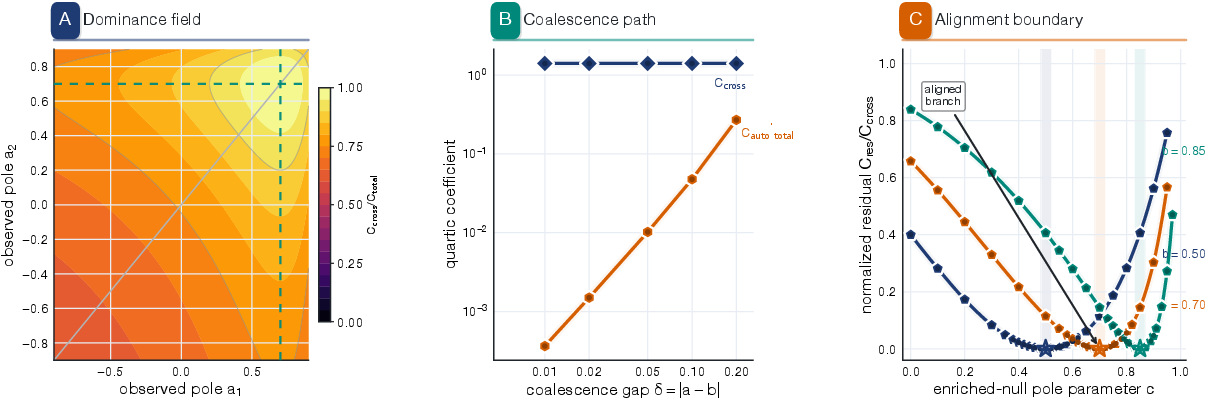
Figure 1: Panel A: Fractional cross-term dominance Xt(2)1 as a function of observed-channel poles; at Xt(2)2 (coalescence) the cross term solely determines detectability. Panel B: Cross-term persistence along the coalescence path.
Consequently, the cross-spectral block provides an irreducible witness of hidden dissipation missed by any scalar-reduction-based approach. The result exploits the explicit Hermitian geometry of the spectral matrix: the cross spectrum is orthogonal to any diagonal spectral null built from individual channel dynamics.
The Cancellation Law and Insensitivity to Observed-Channel Dynamics
A major analytical finding is the cancellation law (Lemma 1 and Theorem 2), stating:
Xt(2)3
for arbitrary stable linear filters in the observed channels. Thus, all dependence on observed-channel transfer functions is removed prior to integration over frequency. The final cross-term coefficient is dictated only by the hidden spectral density and channel loadings.
This orthogonality and cancellation are not generic for latent-variable models; they result from the additive rank-one structure (single hidden mode) and the chosen diagonal hypothesis geometry.
Entropy Production: Exact Quantitative Bridge
Moving from detectability to quantitative thermodynamic interpretation, the paper shows for the one-way coupled Ornstein–Uhlenbeck system that the full-system entropy production rate (EPR) is
Xt(2)4
with analytic form for Xt(2)5. Crucially, the cross-spectral coefficient Xt(2)6 links directly to the EPR (Corollary 1):
Xt(2)7
Thus, a strictly positive cross-spectral residual under the diagonal null witnesses full-system dissipation, even when all single-channel EPR estimators are provably zero Figure 2.
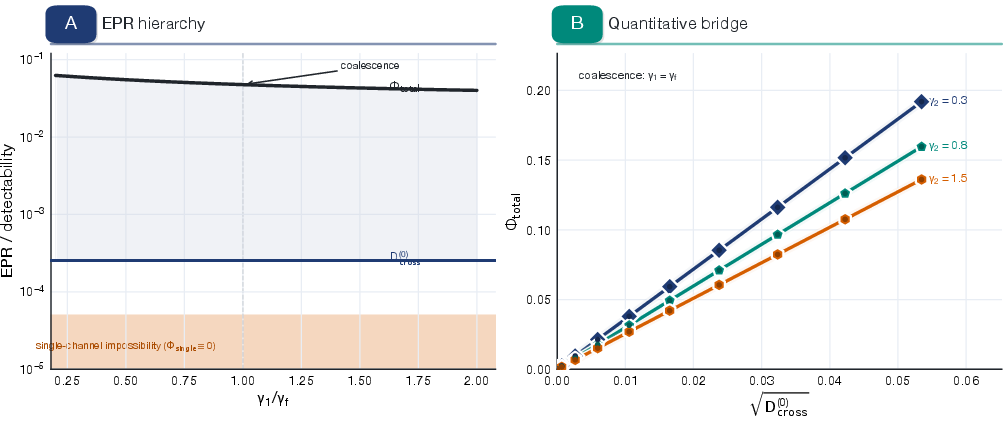
Figure 2: Panel A: The full-system EPR (black) is strictly positive across timescale ratios, while the cross-spectral witness (blue) remains finite at coalescence; all single-channel witnesses are identically zero. Panel B: At coalescence, the EPR and cross-spectral detectability align as predicted.
Finite-Sample Evidence and Robustness
Extensive Monte Carlo experiments corroborate all analytical predictions. The key diagnostic is the critical coupling Xt(2)8 for detection. For single-channel reductions, Xt(2)9 diverges as coalescence is approached; for two-channel (cross-spectral) reductions, Ft0 remains bounded and flat with respect to timescale proximity Figure 3.
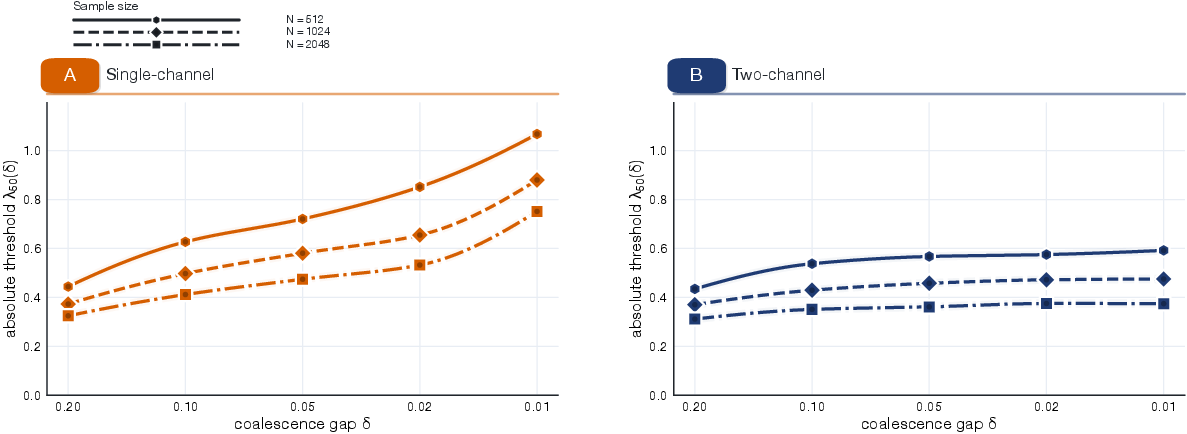
Figure 3: Detection threshold Ft1 as a function of coalescence gap Ft2 for single- and two-channel reductions across sample sizes. The single-channel threshold blows up at coalescence; the two-channel threshold is finite and robust.
Robustness evaluations demonstrate persistence of the cross-spectral witness under: (i) bidirectional coupling (with rigid Ft3 up to Ft4 times the hidden friction), (ii) higher-order AR processes in observed channels, and (iii) weak cubic nonlinearities, with only the explicit quantitative bridge to dissipation requiring one-way coupling Figure 4.
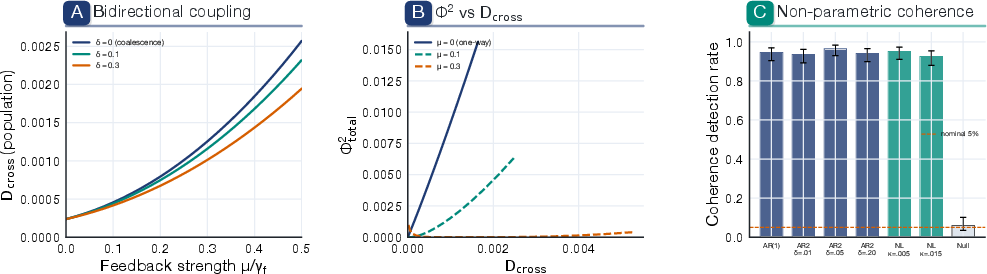
Figure 4: Panel A: Positive cross-spectral detectability across feedback strengths (bidirectional coupling). Panel B: Ft5 and cross-spectral detectability remain monotonically associated under feedback deformations.
Hypothesis-Class Semantics and Domain of Validity
The empirical preference for a cross-shape family over a diagonal null is strong in data generated from persistent hidden drivers and weak/absent in the absence of cross-channel dependence or for instantaneous coupling Figure 5.
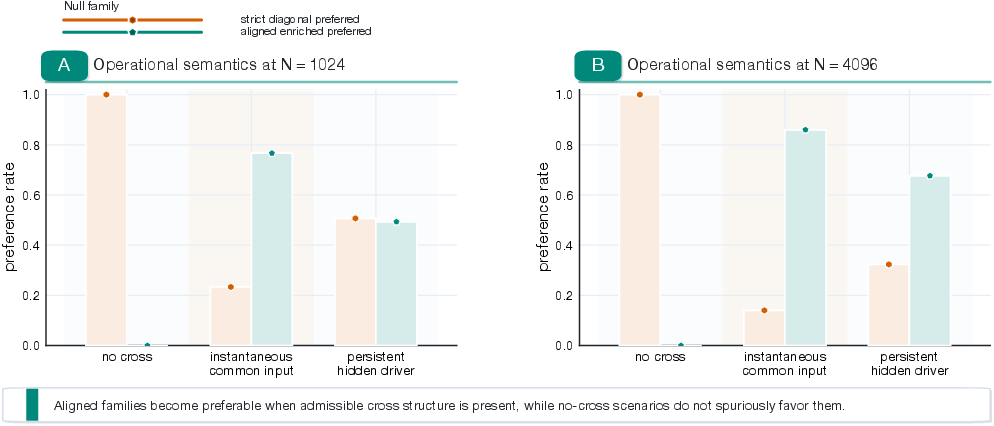
Figure 5: Preference rates for aligned cross-shape hypothesis class as a function of generating process; persistent hidden drivers yield clear preference for cross structure, absent for uncorrelated or instantaneous input.
The domain where the cross-spectral witness is both necessary and sufficient is characterized: only null hypotheses that include the exact cross-spectral structure of the hidden mode can absorb the cross-term, maintaining qualitative difference from generic cross-correlation enrichment.
Implications and Future Directions
Theoretical
The result reveals a precise hierarchy: single-channel reduction fundamentally loses all sensitivity to time-irreversibility in the hidden driver (even with auxiliary features); cross-spectral analysis recovers full structural detectability, invariant under channelwise dynamics. Thermodynamic interpretation (witnessing dissipation) is valid only under one-way coupling, making the physical specification of coupling geometry (i.e., the absence of feedback) central for task identification.
Practical
The predicted threshold split and singularity removal are directly testable in laboratory systems with coupled probes, multi-electrode arrays, or multisite climate stations where hidden modes drive cross-channel synchronization. This informs experimental design and the interpretation of irreversibility estimates from partially observed complex systems.
Extensions
Structural cancellation is valid for arbitrary stable linear observed dynamics and single hidden mode. Generalizations to multiple hidden drivers and noncanonical null hypotheses introduce new directions in which cross-spectral structure can be absorbed, requiring further geometric analysis. Extension to long-memory (Ft6) hidden modes requires alternative divergence functionals. The finite-sample efficiency cost (as revealed in simulated data) motivates development of new statistical estimators.
Conclusion
This work provides a rigorous, geometric characterization of the minimal requirements for detection of hidden dissipation and irreversibility in partially observed linear systems. By establishing the insensitivity of scalar auto-spectral measures, the structural capacity of cross-spectra, and exact analytic links to entropy production, it defines both the boundary and remedy of detectability limitations imposed by projection and coarse-graining. The explicit cancellation mechanism paves the way toward more general multivariate and nonlinear extensions and grounds the practical deployment of cross-spectral inference in physical, biological, and engineered systems.