- The paper demonstrates that the linear instability threshold is governed solely by a geometric factor, κ(M), derived from the manifold’s projection properties.
- It reveals that the Euler characteristic, χ(M), of the manifold determines the allowable nonlinear phase transitions, enforcing specific defect patterns when nonzero.
- The framework unifies the analysis of oscillator networks on various manifolds, providing predictive insights into critical behavior and defect genesis in high-dimensional systems.
Geometry- and Topology-Controlled Synchronization Phase Transition on Manifolds
Introduction
This work rigorously develops a general framework for understanding how the geometry and topology of the underlying state space govern synchronization phase transitions in high-dimensional oscillator systems. Extending the classic Kuramoto-Sakaguchi model, the authors analyze collective dynamics on compact, connected, orientable, and homogeneous Riemannian manifolds of arbitrary dimension and topology. By deriving explicit response equations for the global order parameter, the framework separates geometric and topological contributions to the onset and type of synchronization phase transitions, facilitating a unified theoretical approach that encompasses spheres, tori, homogeneous spaces, Lie groups, and beyond.
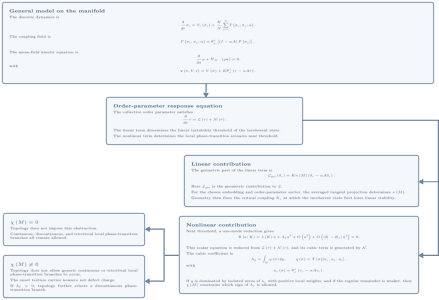
Figure 1: Schematic summary of the framework—geometry (via κ(M)) governs the linear instability threshold, while topology (via the Euler characteristic χ(M)) restricts nonlinear phase transition scenarios and defect charges in the ordered state.
Generalized Kuramoto-Sakaguchi Dynamics on Manifolds
The generic model comprises N oscillators with states σi∈M, where M is a compact, connected, orientable, and homogeneous Riemannian manifold of dimension D. The intrinsic drift field Vi lies in the tangent space TσiM, and pairwise coupling is structured by a smooth geometric embedding F:M→RDa. The coupling incorporates both symmetric and phase-frustrated (non-reciprocal) terms, the latter parameterized by an antisymmetric operator A with strength χ(M)0. Dynamics are confined to χ(M)1 by orthogonal projection χ(M)2 onto χ(M)3.
The mean-field continuum limit leads to a kinetic equation for the oscillator probability density χ(M)4, where the macroscopic order parameter is χ(M)5. The coupling term is organized as
χ(M)6
fully encoding the geometric structure of interactions and constraints.
Geometry Determines the Instability Threshold
Linearizing near the fully incoherent (uniform) state, the authors give an explicit perturbation expansion for the order parameter response. The critical coupling χ(M)7 (threshold for linear instability of incoherence) is set by a purely geometric scalar coefficient, χ(M)8, that arises from averaging the tangent projection over χ(M)9 in the embedding sector considered: N0
For instance, for the standard sphere N1, one has N2, recovering the known hyperspherical threshold as a special case. The choice of N3 and the homogeneous symmetry of N4 ensure that N5 reflects only geometric properties of the state space, regardless of detailed oscillator heterogeneity.
Topology Restricts Synchronization Phase Transition Scenarios
A central advance of this work is to separate the effect of topology, encoded by the Euler characteristic N6, on the cubic coefficient N7 of the order parameter amplitude equation. Under mild locality conditions (supported by symmetry arguments and mode reduction), the theory shows:
- If N8: The sign of N9 is fixed by topology to be negative (under generic conditions). Continuous or tricritical synchronization transitions are thus forbidden; only subcritical (discontinuous) transitions or first-order hysteretic behavior are permitted.
- If σi∈M0: There is no topological restriction; continuous, discontinuous, and tricritical transitions are all accessible, with the realized scenario determined by analytic details of the coupling.
This is traced to the structure of the induced tangent field σi∈M1 (the direction of emerging order at onset). The Poincaré-Hopf theorem fixes the net defect index of zeros of σi∈M2 to σi∈M3. Thus, for nonzero Euler characteristic, the order parameter texture at onset must include at least σi∈M4 point defects of nonzero topological charge. The sign and structure of the cubic coefficient are directly linked to the contributions around these critical zeros.
Defect Content at Synchronization Onset
When σi∈M5, the forced existence of zeros and their index sum imposes a nonzero net topological charge in the emergent synchronized pattern. This inevitable defect structure is a robust, model-independent consequence of topology, impervious to variations in drift, interaction, or local coupling details (provided the system remains in the generic class considered).
Case Studies: Spheres, Tori, Homogeneous Spaces, Lie Groups
The theory is verified across a range of representative manifolds:
- Odd-dimensional hyperspheres σi∈M6: σi∈M7, only discontinuous onset is allowed, with a minimum two defect cores appearing in the ordered state.
- Even-dimensional hyperspheres σi∈M8 and tori σi∈M9: M0, all transition types are possible, and defect-free (e.g., uniform) textures can appear.
- Complex Grassmannians M1, complex projective spaces M2: Nonzero Euler characteristic values proportional to binomial coefficients or M3, so discontinuous transitions with multiple defect cores at onset are topologically requisite.
- Homogeneous Lie groups (e.g., M4, M5, M6): M7, so topology does not constrain the type or presence of defects.
The parity law for hyperspheres is thus subsumed as a particular case of the general topological selection rule derived.
Implications and Perspectives
The framework rigorously reveals that the linear instability threshold is entirely set by geometric projection; transition type and defect structure at onset are dictated by global topology. This partitions oscillator synchronization phenomena into two universality classes: those with a strictly constrained set of possible transitions and defect content (nonzero M8), and those with flexible, analytic-structure-dependent behavior (zero M9).
Practical and theoretical consequences include:
- Defining dynamical universality classes based on geometric and topological invariants of the state space.
- Predicting and characterizing hysteresis, metastability, and critical behavior in high-dimensional and structured oscillator ensembles, applicable to physical, biological, and engineered systems modeled on nontrivial manifolds.
- Guiding the design and analysis of coupled oscillator networks and consensus protocols (e.g., for robotics or quantum synchronization) where the state space has a prescribed geometry or topological constraints.
- Bridging synchronization dynamics with algebraic and differential topology, offering concrete connections to the theory of defects, texture formation, and statistical transitions in complex media.
The analytic separation of geometric (linear) and topological (nonlinear, global) effects suggests clear future directions: finite size and fluctuation effects near topology-conditioned onset, noise-induced switching, defect kinetics and coarsening, effects of quenched disorder, impact of sparse or modular network structure, and nonequilibrium hysteresis (including in higher-order interaction systems). These are explicitly enumerated by the authors as promising statistical-physics extensions that can now be pursued with the developed framework.
Conclusion
The separation of geometry and topology in determining synchronization phase transitions on manifolds represents a substantial advance in the systematic and rigorous analysis of high-dimensional collective dynamics. The ability to predict, from first principles, the set of possible critical phenomena and defect patterns accessible to oscillator systems as a function of the underlying state space positions this framework as foundational for future research at the intersection of nonlinear dynamics, geometry, and topological analysis.
Figure 1: The interplay between geometry (setting the linear threshold via D0) and topology (restricting nonlinear scenarios and enforced defects via D1) in manifold-based synchronization phenomena.