- The paper introduces ITIScore, a novel image-to-text-to-image metric that achieves the highest correlation with human judgment for captioning.
- It presents ICBench, a large-scale benchmark with extensive human annotations assessing fluency, relevance, conciseness, and completeness for both short and long captions.
- Experimental validation demonstrates ITIScore's superior performance across diverse MLLMs and benchmarks, highlighting its potential in real-world multimodal applications.
ITIScore: An Image-to-Text-to-Image Evaluation Metric for Image Captioning by MLLMs
Introduction and Motivation
The rapid progress in Multimodal LLMs (MLLMs) has brought significant advancements in image captioning. Despite these developments, evaluating generated captions—a critical component for both model development and real-world deployment—remains challenging. Main limitations of existing benchmarking efforts include restricted caption length diversity, lack of human annotations at scale and granularity, absence of comprehensive assessment for state-of-the-art MLLMs, and potential data leakage in open datasets. The paper introduces two key contributions to address these, (i) ICBench, a large-scale, high-diversity benchmark for captioning, and (ii) ITIScore, a novel automatic metric based on image-to-text-to-image reconstruction and multimodal reasoning.
ICBench: A Comprehensive Captioning Benchmark
ICBench is constructed to enable detailed and reliable evaluation of MLLM image captioning capabilities across both short and long captions.
ICBench is comprised of 2,040 images sampled from 12 diverse categories, with each image described by both a short and a long caption generated by each of 10 advanced MLLMs (including closed-source and open models). This results in 40,800 total captions. Captions are systematically annotated by 15 professional human judges, yielding 1.8 million Mean Opinion Scores (MOS) over multiple quality dimensions: fluency, relevance, and conciseness for short captions; fluency, relevance, and completeness for long captions.

Figure 1: MOS distribution of short caption and long caption across different evaluation dimensions.
Analysis of the MOS distributions demonstrates systematic weaknesses even among advanced MLLMs, particularly in generating succinct and comprehensive captions, with divergence between short- and long-caption abilities. Variance by category and caption type is nontrivial and provides a solid empirical foundation for rigorous benchmarking.
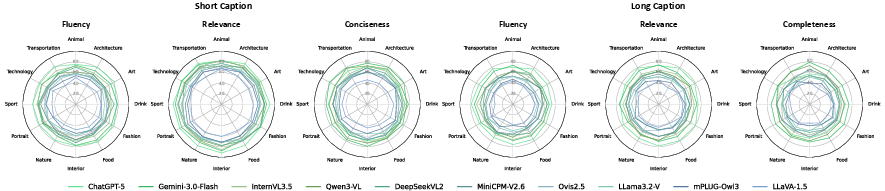
Figure 2: Performance comparison of different MLLMs on short captioning (fluency, relevance, conciseness) and on long captioning (fluency, relevance, completeness) across different image contents.
The comparative results reveal that while closed-source models (e.g., ChatGPT-5, Gemini-3.0-Flash) typically outperform open-source models across most dimensions, category-level and dimension-specific challenges remain, especially for images demanding high-level or domain-specific reasoning.
ITIScore: Image-to-Text-to-Image Quality Assessment Framework
The paper introduces ITIScore as an automatic metric for caption quality assessment, leveraging the image-to-text-to-image paradigm. Unlike conventional reference-based or reference-free textual metrics, ITIScore operationalizes caption evaluation as a reconstruction consistency problem: does the generated caption encode sufficient, correct, and visually faithful information such that a generative model can reconstruct the original image, and does a multimodal backbone extract agreement between original, reconstructed images, and text? This is further enhanced by a learned, uncertainty-aware scoring head.
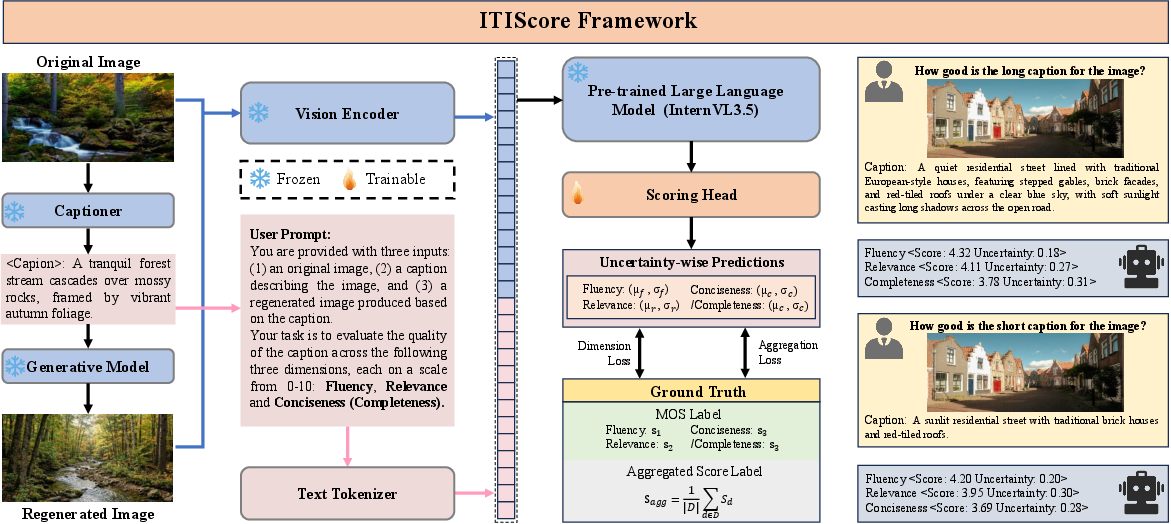
Figure 3: Overview of our ITIScore. Given an image and its caption, a pretrained generative model reconstructs an image from the caption. The original image, reconstructed image, and caption are jointly fed into a multimodal LLM to obtain a unified representation. A lightweight MLP scoring head then predicts the mean score and uncertainty for each evaluation dimension.
ITIScore System Design
- Caption-Conditional Image Reconstruction: Given an image-caption pair (I,C), a pretrained generative model G reconstructs I^=G(C).
- Multimodal Consistency Embedding: The tuple (I,I^,C) is processed by a frozen MLLM backbone, which produces a unified embedding H=fMLLM(I,I^,C).
- Dimension-Aware Scoring: A lightweight MLP scoring head predicts the mean (μ) and uncertainty (σ) for each evaluation dimension, modeled as a Gaussian. Instruction tuning enables specific dimension queries (e.g., "fluency" or "completeness").
- Uncertainty-Aware Multi-Dimensional Learning: Training objective is Gaussian negative log-likelihood, encouraging accurate mean prediction with uncertainty calibration. An auxiliary regression loss is used to stabilize mean aggregate quality predictions.
This procedure creates an automatic, reference-free metric that robustly approximates fine-grained human judgment.
Experimental Validation
The ITIScore framework is extensively benchmarked against strong reference-based (BLEU, METEOR, ROUGE, CIDEr, SPICE), reference-free (e.g., CLIP-S, PAC-S), and state-of-the-art MLLM-based metrics (e.g., FLEUR, ChatGPT-5, Gemini-3.0-Flash).
Key Results:
- ITIScore achieves the highest correlation with human judgment across all tested dimensions, for both short and long captions, and in overall aggregate rankings.
- ITIScore maintains superior zero-shot correlation performance on established external benchmarks (Composites, Flickr8k-CF, Flickr8k-Expert, MMHE, LongCap-Arena).
- Ablation studies confirm architecture choices: image reconstruction and multi-dimensional, uncertainty-aware regression substantially elevate human alignment over classical and MLLM-only approaches.
Implications and Future Directions
The ICBench resource and ITIScore metric set new standards for evaluating modern captioning models across typical and challenging settings. ITIScore’s architecture not only surpasses prior approaches in human-alignment but also enables nuanced evaluation of captioning quality along axes that matter in practical deployments, including in safety/robustness-sensitive and domain-centric applications.
The rigor of ICBench will facilitate fairer and more discerning comparison of future MLLMs, and ITIScore suggests that model-based evaluation using reconstruction and multimodal fusion is both highly effective and extensible. Further research can explore generalizing this methodology to other multimodal generation and evaluation tasks (e.g., video captioning, text-to-image synthesis) and the relationship between generative reconstruction quality and high-level semantic fidelity.
Conclusion
This work addresses persistent gaps in image captioning evaluation by delivering (i) ICBench, a large-scale fine-grained benchmark with extensive human annotation for short and long captions, and (ii) ITIScore, a robust, uncertainty-aware, image-to-text-to-image metric benchmarked to human preference. ITIScore consistently matches or exceeds human correlation metrics compared to alternative evaluation approaches, and generalizes across datasets and caption styles. This methodology and resource stand to inform the next stage of multimodal model development and evaluation.

