- The paper recalculates PEARLSDG’s distance from 30 Mpc to about 124 Mpc, reclassifying it as a group member rather than an isolated galaxy.
- The study employs non-parametric Bayesian SED fitting with multiple sampling techniques to robustly derive stellar mass, metallicity, and dust attenuation.
- Findings indicate rapid environmental quenching, supporting mechanisms like ram-pressure stripping that suppress recent star formation.
Comparative Bayesian SED Fitting and Environmental Quenching of PEARLSDG
Revision of PEARLSDG Distance and Context
The paper addresses the accurate characterization of the dwarf galaxy PEARLSDG via a revision of its distance, moving from the previously adopted Tip of the Red Giant Branch (TRGB) value of 30 Mpc to a spectroscopically determined z=0.02843±0.00012 (D≈124 Mpc). This re-calibration locates PEARLSDG within a galaxy group, rather than in isolation, fundamentally altering its inferred physical properties and the interpretation of its evolutionary history. Group association is established through spatial and velocity proximity with at least five SDSS group members spanning stellar masses 109–1010 M⊙, projected separations of 128–548 kpc, and line-of-sight velocity offsets of 68–565 km s−1.
Bayesian SED Modeling Approach
Spectroscopic data from Hectospec on the MMT, including new 2024 observations and archival spectra from 2007, provided robust constraints for spectral energy distribution (SED) modeling. The authors employed the {\sc Prospector} code to jointly fit optical spectra (∼4000–7000 \AA) and broadband photometry, fixing redshift at z=0.02843. Sky residuals and low S/N regions were masked to ensure clean data for inference.
Star formation histories (SFH) were modeled both parametrically and non-parametrically. Non-parametric SFHs, dividing stellar mass formation into discrete age bins, permit greater flexibility, avoiding biases endemic to analytic forms. Three sampling algorithms were cross-validated: dynesty (nested sampling), nautilus (dynamic nested sampling), and emcee (affine-invariant MCMC). The preferred solution was derived from the non-parametric emcee chain, which showed superior convergence and posterior fidelity across star-mass bins, metallicity, and dust attenuation.
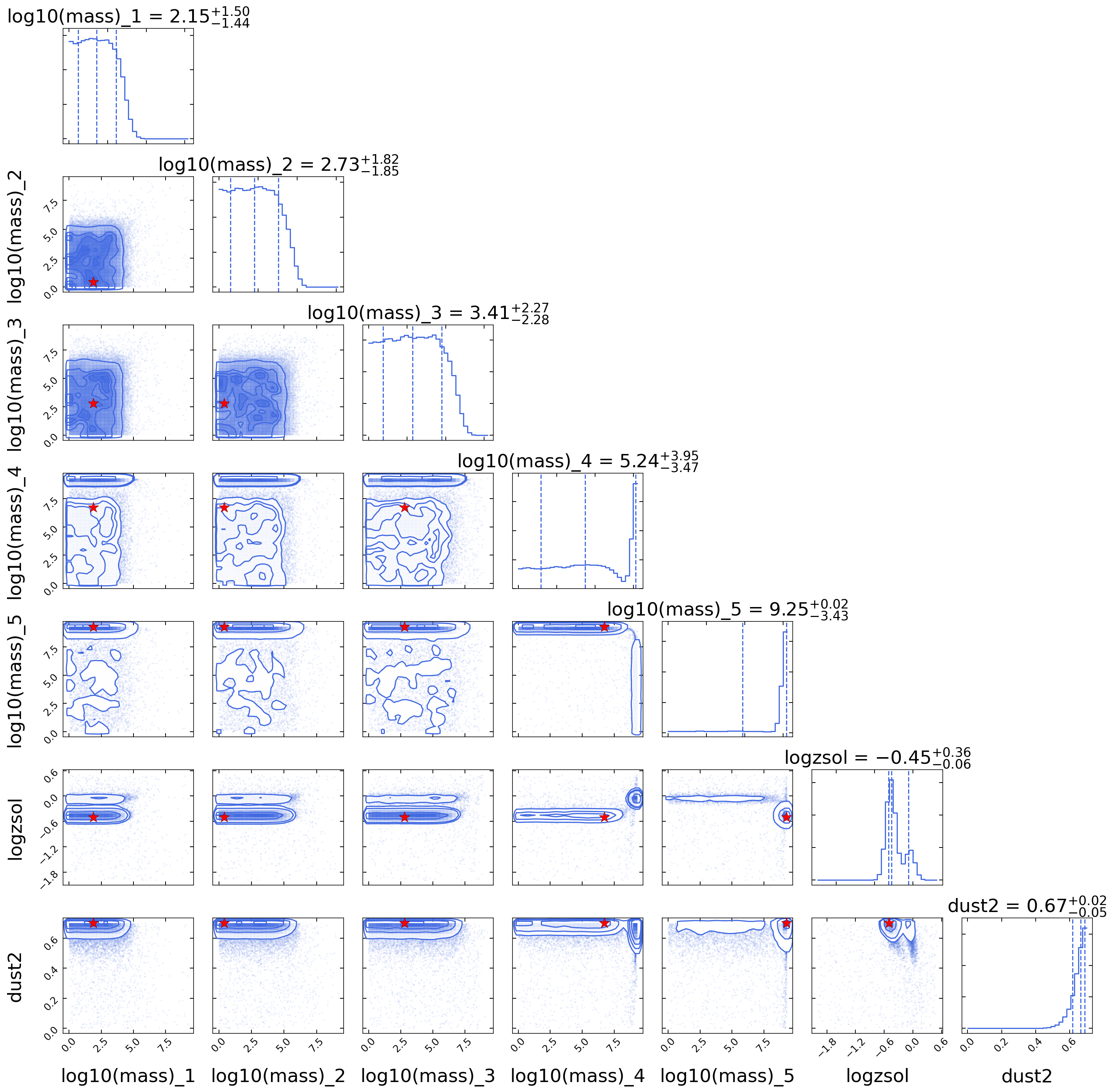
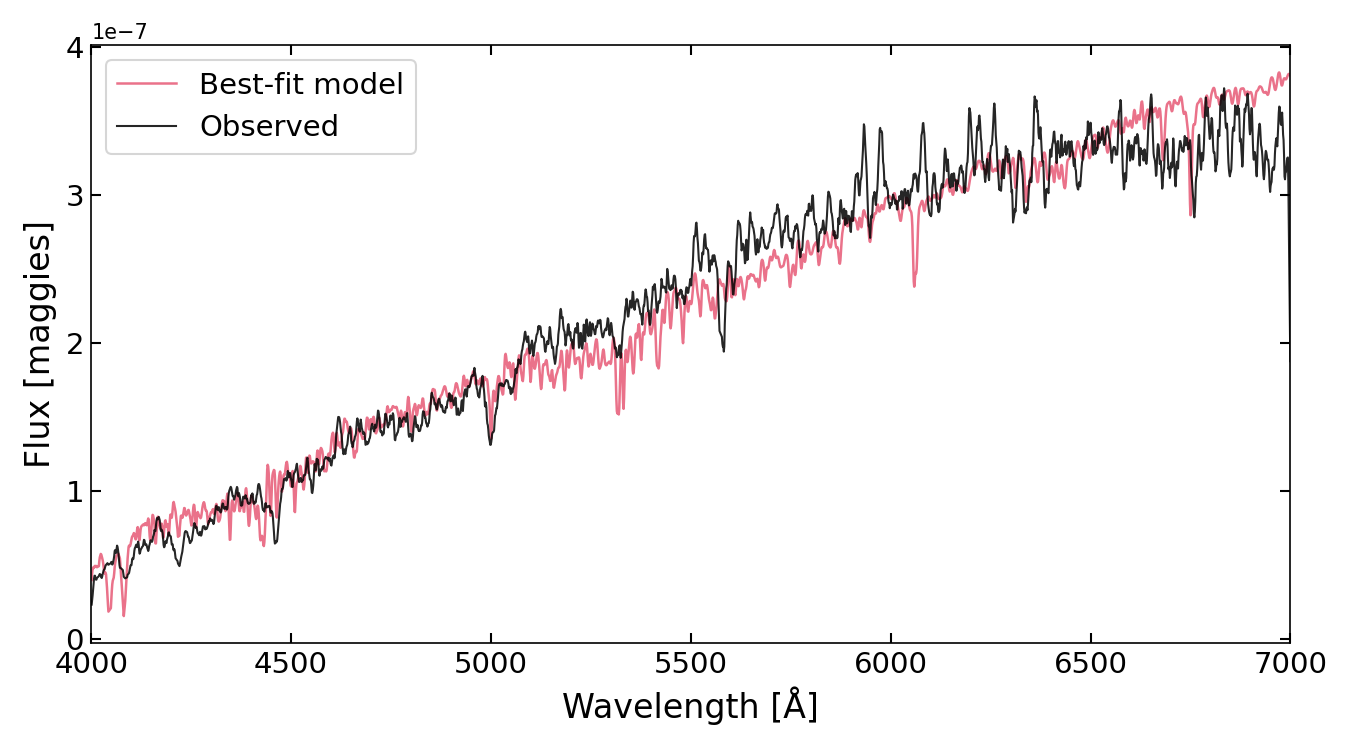
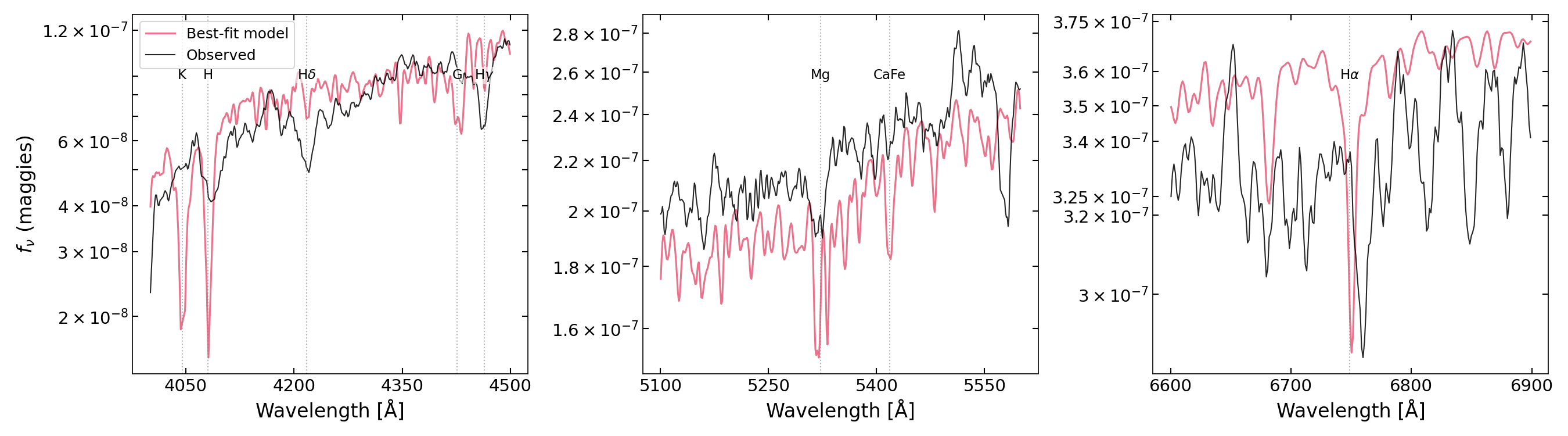
Figure 1: Posterior distributions for stellar mass bins, metallicity, and dust attenuation from non-parametric emcee SED fit; observed vs. modeled spectrum and zoomed absorption features.
Results: Stellar Population Parameters and SFH
The emcee-driven non-parametric fit recovered log10(M∗)=9.25−3.43+0.02, with virtually all stellar mass concentrated in the most recent SFH bin. Earlier bins contributed negligibly (log10(M∗)≲5), indicating a rapid, recent cessation of star formation consistent with environmental quenching. Metallicity converged to D≈1240, while dust attenuation was found to be D≈1241.
Significantly, these posteriors are robust to sampling strategy: identical parameters were recovered in nautilus runs, substantiating the reliability of the emcee solution. In contrast, the dynesty configuration systematically underestimated continuum flux beyond 5500 \AA, reflecting insufficient posterior coverage, while parametric dynesty fits yielded physically implausible metallicity and dust attenuation (e.g., D≈1242, D≈1243), impugning the restrictive analytic SFH model.
Absorption features (Ca\,ii K, H, HD≈1244) are systematically underestimated in the best-fit model over 4000–4500 \AA, possibly due to limitations in the stellar library metallicity coverage or unresolved intermediate-age populations.
Discussion: Environmental Quenching and Implications
The revised group context eliminates prior anomalies in metallicity and mass for PEARLSDG. Under the outdated 30 Mpc distance, PEARLSDG was a metal-poor outlier in the mass–metallicity relation. With the current D≈1245124 Mpc distance and emcee-derived metallicity, PEARLSDG conforms to the canonical mass–metallicity relation for local group dwarfs.
The SFH analysis validates a rapid environmental quenching scenario, aligning with mechanisms such as ram-pressure stripping or starvation in the group halo. PEARLSDG thus typifies group-driven quenching rather than requiring invocation of anomalous internal feedback physics.
From a methodological perspective, the study underscores the critical role of flexible, non-parametric SFHs and robust, multi-algorithm posterior validation for stellar population inference in low-mass systems. Combining spectroscopic and photometric data is essential to disentangle degeneracies in continuum and absorption feature fitting; model choice and sampler selection can introduce substantial biases if not properly validated. Systematic errors from SPS assumptions (IMF, binary evolution, isochrone sets) dominate at the D≈12460.1–0.2 dex level, beyond the quoted statistical uncertainties.
Theoretical and Practical Implications
This analysis reinforces the necessity of spectroscopic distance confirmation for dwarf galaxy population studies, especially where environmental context dictates star formation and chemical enrichment constraints. The convergence of non-parametric methods across samplers highlights their suitability for interpreting SFH in quenched systems with complex environmental histories.
Future directions include deeper exploration of SFH resolution, improved stellar libraries at intermediate metallicity, and integration of resolved kinematics or HI mapping to substantiate environmental interaction scenarios. Application of multi-sampler, non-parametric SED fitting has broader relevance for the study of environmental effects in galaxy evolution, particularly in the regime of low-mass satellites and quenched field objects.
Conclusion
Comparative Bayesian SED fitting of PEARLSDG establishes its group membership, typical metallicity, and suppressed recent star formation, revealing environmental mechanisms as the dominant quenching driver. Parametric SFH models and unvalidated samplers can introduce substantial error, emphasizing the necessity of non-parametric inference and cross-sampler verification. These findings support the broader adoption of flexible Bayesian SED fitting as critical for accurate dwarfs’ stellar population diagnostics in group environments (2604.03761).