- The paper introduces SA-DSVN, a dual-stream network that fuses scattering kinematics and shower multiplicity for precise voxel-level defect segmentation.
- It employs a novel cross-attention fusion mechanism and ablation studies reveal that shower features significantly boost structural defect discrimination.
- Robust data augmentation and modular design ensure high detection accuracy and efficient deployment in simulated cosmic-ray muon tomography environments.
Shower-Aware Dual-Stream Voxel Networks for Structural Defect Detection in Muon Tomography
Introduction
This work addresses the challenge of non-invasive, high-resolution structural health monitoring of reinforced concrete using cosmic-ray muon tomography, with a focus on separating defect signatures from those of intrinsic steel reinforcement. The proposed methodology leverages a novel Shower-Aware Dual-Stream Voxel Network (SA-DSVN) that independently learns from both primary scattering kinematics and secondary electromagnetic shower multiplicities to perform multi-class segmentation of material types and defects within volumetric grids. The data pipeline is based on comprehensive Geant4 simulations via the Vega framework, comprising millions of events with embedded structural defects.
The underlying hypothesis is that secondary shower multiplicity, which is closely correlated with atomic number, provides orthogonal information to scattering angle for disambiguating rebar and defects, especially when spatial overlap exists. This assertion is validated numerically, with extensive ablation and generalisation studies quantifying contributions of each modality and the necessity of data augmentation for robust model transfer.
The reconstruction task is defined as a six-class voxel-level volumetric segmentation on 203 grids, targeting discrimination of concrete, various defect morphologies (honeycombing, shear fracture, corrosion voids, delamination), and embedded rebar. The simulation environment consists of a 1m3 concrete block with a rigid 7×7 steel cage; four types of defects are synthetically embedded following physically realistic geometric patterns.
The Geant4-based Vega simulation framework emits 4GeV muons perpendicularly through the target, capturing both kinematics and secondary shower data at six detector planes. The feature extraction pipeline generates two high-dimensional input tensors per voxel: (1) scattering angle and physical interaction metrics, and (2) shower multiplicity statistics (electrons, gammas, positrons, and derived features). Large-scale AWS Batch-based orchestration enables simulation of 4.5 million events across 900 labelled volumes for training, validation, and testing. An independently seeded validation campaign ensures out-of-distribution assessment.
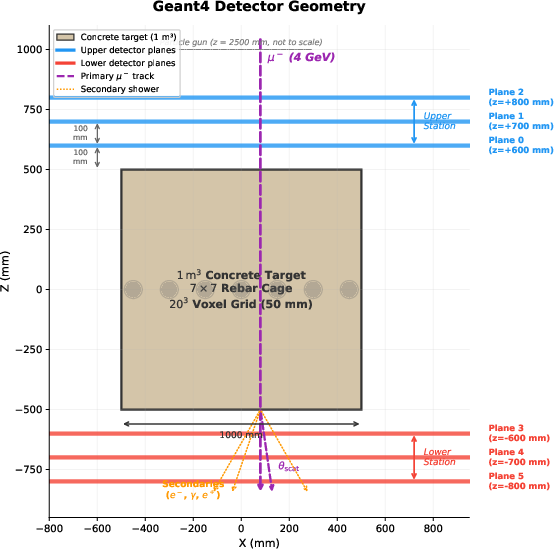
Figure 1: Side-view schematic of the Geant4 detector geometry showing target, detectors, and muon trajectories.
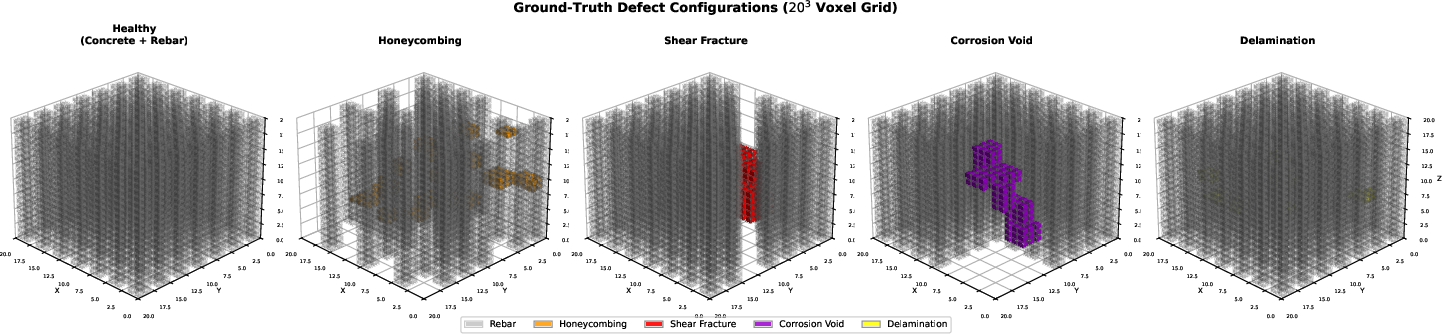
Figure 2: Ground-truth voxel label maps depicting various defect types and their configurations within the concrete-rebar system.
Architectural Design of SA-DSVN
The SA-DSVN employs an encoder–decoder topology with three distinguishing features: strictly separated scattering and shower input streams, multi-head cross-attention fusion at a 53 spatial bottleneck, and attention-gated skip connections in the decoding path. Stream 1 (scattering, 9 channels) and Stream 2 (shower, 40 channels) pass through independent three-stage encoders; this modality isolation is motivated by distinct physical processes underlying the observables. At bottleneck depth, scattering features serve as attention queries against the shower keys/values, with residual connections followed by concatenation promoting modality complementarity.
The decoder is symmetric and gated, suppressing skip activations in fully resolved regions. Deep supervision at early stages (weighted auxiliary Dice/focal losses at coarse scales) enhances gradient flow.
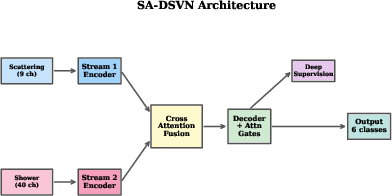
Figure 3: SA-DSVN architecture, detailing dual-stream encoding, cross-attention fusion, and attention-gated decoding.
Training Strategy and Augmentation Protocol
Training is conducted with a hybrid focal–Dice loss, with marked upweighting of rare-class (defective) voxels in the focal term. Data augmentation is central: random flips along each spatial axis (×8 effective data expansion), Gaussian channel noise, and per-channel scaling are applied at train time. Ablation experiments demonstrate that without augmentation, models catastrophically fail to generalise to new simulation seeds, despite strong in-distribution metrics.
Ablation Analysis
Extensive ablation reveals that the shower multiplicity stream is the dominant contributor to segmentation performance. The model trained on scattering features alone achieves a defect-mean Dice of 0.535, while shower-only models reach 0.685; the full dual-stream model marginally improves boundary-localised classes (notably distributed honeycombing defects) to 0.683–0.81 depending on class. Attention gates and deep supervision provide minor but consistent gains (<0.2% overall Dice).
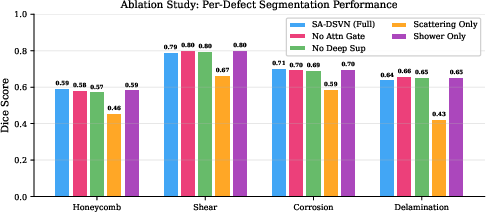
Figure 4: Per-defect Dice scores for all five ablation variants, illustrating the superior performance enabled by shower stream features.
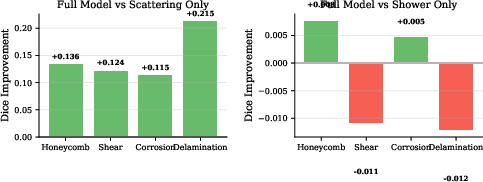
Figure 5: Per-defect Dice improvement attributed to stream addition; shower features account for the bulk of performance.
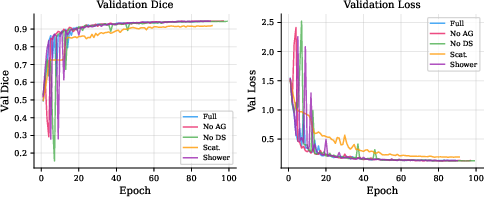
Figure 6: Validation Dice and training loss curves for all ablation variants, demonstrating higher convergence ceilings for dual-stream networks.
On a strictly held-out set of 60 independently simulated validation volumes, the best model achieves 96.3% overall voxel-level accuracy and per-defect Dice of 0.59–0.81, with volume-level defect detection sensitivity at 100% (AUC = 1.0 for all classes). Confusion is concentrated along class boundaries, reflecting the coarse (50 mm) voxel resolution; no systematic failure occurs in bulk classification.
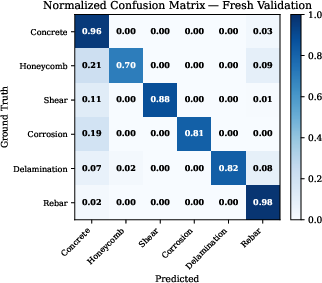
Figure 7: Normalised confusion matrix, with dominant off-diagonal error attributed to boundary mislocalisation.
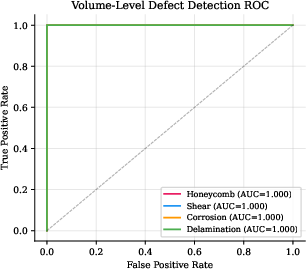
Figure 8: Volume-level ROC curves for all defect classes, each achieving AUC =1.000.
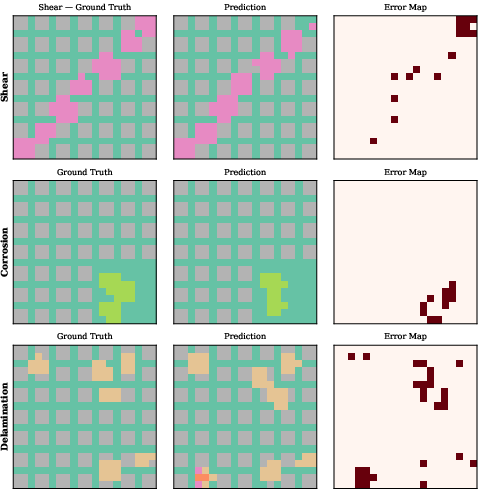
Figure 9: 2D slice visualisations showing ground truth, model prediction, and error maps; errors are localised primarily at interfaces.
Augmentation and Domain Randomisation Effects
Ablation on data augmentation strategy confirms its necessity: without spatial and intensity augmentation, unseen-data Dice collapses to zero for critical defect classes, establishing that naive training on simulated data without domain randomisation leads to severe overfitting and poor transferability.
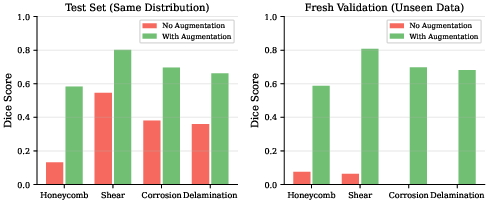
Figure 10: Impact of augmentation on generalisation—a complete collapse of performance for fresh data in its absence.
Computational Considerations and Limitations
SA-DSVN inference is highly efficient, requiring 10±3 ms per 203 volume. End-to-end simulation, training, and evaluation are tractable on commodity cloud instances, with reproducibility enabled by open-sourced Vega and model weights. Key limitations stem from the coarse (50 mm) grid, which limits the resolution for micro-defect and thin delamination feature detection. All evaluation is currently restricted to synthetic, mono-energetic, and normal-incidence data; real-world deployment will require adaptation to terrestrial cosmic-ray spectra and eventual validation using data from physical detectors.
Theoretical and Practical Implications
The results establish that secondary electromagnetic shower multiplicity is an indispensable feature for defect discrimination in reinforced-concrete muon tomography, fundamentally shifting the paradigm away from scattering-only models. In practical terms, the low-compute, high-accuracy pipeline opens the path for field-deployable, automated structural health monitoring without reliance on artificial sources or high-throughput hardware. Theoretically, the dual-stream cross-attention architecture showcases a modular design paradigm for combining orthogonal physics-driven features in volumetric segmentation tasks.
Future advances will likely require: (1) higher-resolution voxel grids with more memory-efficient 3D architectures, (2) domain adaptation or self-supervised pretraining for real muon flux and noise distributions, and (3) demonstration of end-to-end transfer from simulation to hardware in operational infrastructure environments.
Conclusion
SA-DSVN, leveraging dual-stream physics-aware features and attention-based fusion, achieves robust defect segmentation and detection in heavily reinforced concrete via simulated cosmic-ray muon tomography. Secondary shower multiplicity features fundamentally advance discrimination of defects in the presence of dense steel. Proper augmentation is essential for generalisation, underscoring the importance of simulation domain diversity. Future work should pursue deployment on empirical detector data and scaling to finer resolution. The methodological principles outlined here are broadly applicable to other tomographic modalities where multiple physically motivated observables are recorded.
(2604.03741)