- The paper introduces a framework that operationalizes runtime ethical enforcement using SLEEC rule formalization and ASM-based modeling.
- It leverages the MAPE-K control loop to monitor ethical state transitions and trigger corrective actions with minimal performance overhead.
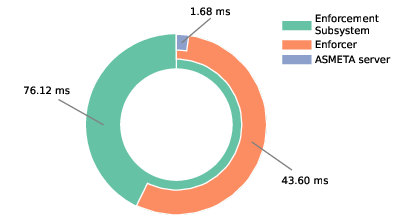
- Empirical evaluations in assistive-care scenarios validate the method's robustness and efficiency, achieving sub-100ms enforcement delays.
Operationalizing Runtime Ethics in Autonomous Systems via SLEEC Rule Enforcement
Introduction and Motivation
Adoption of autonomous systems in socially sensitive contexts raises critical concerns regarding behavioral transparency, norm compliance, and ethical guarantees. The growing prevalence of SLEEC (social, legal, ethical, empathetic, and cultural) normative frameworks has facilitated the formalization and elicitation of such requirements, yet their actual enforcement and operationalization at runtime remain under-addressed. The paper "Runtime Enforcement for Operationalizing Ethics in Autonomous Systems" (2604.03714) provides an authoritative framework for rendering SLEEC principles actionable at runtime, leveraging a dedicated enforcement subsystem and formal modeling via Abstract State Machines (ASMs). The authors ground their approach in the MAPE-K (Monitor-Analyze-Plan-Execute over Knowledge) autonomic control loop, coupling ethical rule specification and dynamic system adaptation.
A central concept introduced is the system’s ethics state space, partitioned into ethics-disregarding, ethics-critical, and ethics-respectful subregions. The enforcer module is tasked with continuous monitoring of the system’s state, classifying its configuration within this ethical state topology, and ensuring (by corrective action) that the system remains or is returned to the ethics-respectful region upon deviation.
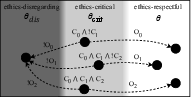
Figure 1: Visualization of the system’s ethics state space showing the enforcement step, exemplified with a SLEEC rule triggering specific transitions from critical to respectful regions.
The enforcement process is instantiated through SLEEC rules formalized in ASM, which facilitate expressive, compositional specifications over complex contexts, including support for defeasible reasoning (via hedge clauses) and temporal constraints on obligations. By mapping probe events from environmental and human interactions to this ethical state space, the system can reason over compliance with contextualized norms and initiate obligations accordingly.
\app Ethics Assurance Lifecycle
The paper presents a structured ethics assurance process covering SLEEC rule elicitation, formalization, validation, enforcement subsystem development, and runtime operation.
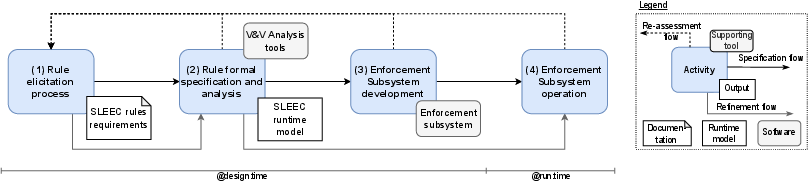
Figure 3: Stages of the \app ethics assurance process, from SLEEC rule elicitation to runtime subsystem operation.
Elicitation follows iterative refinement with domain experts and stakeholders, ensuring rules are value-aligned, contextually grounded, and free of internal conflict. Rules are then specified in a lightweight SLEEC DSL extended with explicit scopes and temporal constraints, translated to ASM-based runtime models, and validated with the ASMETA toolset (supporting animation, validation, and review for functional correctness and minimality). The enforcement subsystem (detailed below) operationalizes these validated rules in the target system.
Enforcement Subsystem Architecture
The enforcement subsystem realizes the MAPE-K loop, encompassing monitoring, ethical context evaluation, corrective (obligation) planning, and execution delegation. Rather than hijacking primary adaptation logic, the enforcer operates as an external gatekeeper, triggering actions only when SLEEC violations are detected.
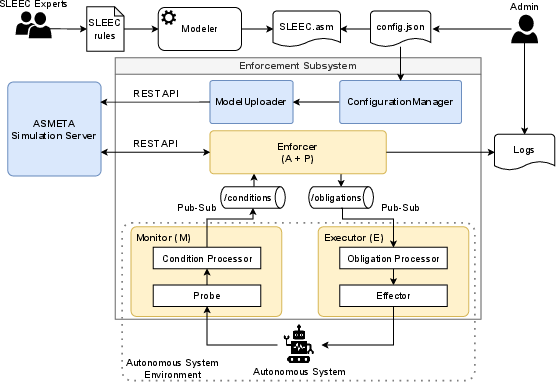
Figure 5: High-level architecture of the \app enforcement subsystem integrating with the autonomous system and the ASMETA-based ruleset.
The Monitor component synthesizes environmental and internal state signals into SLEEC rule predicates; the Enforcer evaluates rule activation and computes corrective obligations; the Executor translates these into executable tasks and invokes them through the system’s behavior manager to ensure compliance. This decoupling supports both modular evolution and transparent update of the ethical knowledge base.
The AutSys-Enf interaction protocol is succinctly encapsulated below.
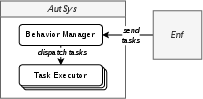
Figure 2: Communication and task execution interplay between the autonomous system and the Enforcer subsystem.
Scenario Instantiation and SLEEC Rules
The framework is validated in a complex assistive-care scenario, where an autonomous humanoid robot manages exercise, dietary compliance, and safety for diabetic patients in a rehabilitation context. The SLEEC rules instantiated capture context-sensitive behaviors, user autonomy, privacy, safety, and engagement, articulated via default and hedge clauses, temporal conditions, and explicit scopes.
SLEEC rules are automatically compiled to ASM guarded update rules. The use of invariants ensures property preservation (e.g., mutual exclusion of contradictory obligations), while simulation enables coverage-driven validation across contextual states. The enforcement protocol computes for each state transition the minimal obligation set required for restoration of ethical compliance.
Empirical Evaluation: Effectiveness and Overhead
The approach is subject to rigorous qualitative and quantitative evaluation.
Scalability analysis with synthetically enlarged SLEEC rule sets shows that computational costs for ASMETA model evaluation scale quadratically with the total number of SLEEC clauses. However, SLEEC rule sizes found in practical domains (e.g., automotive, assistive care) result in sub-20ms per enforcement step.
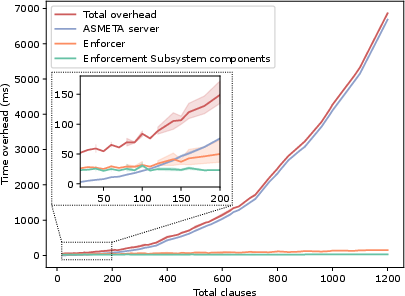
Figure 4: Component-level overhead as a function of SLEEC rule set size and clause complexity.
Comparative analysis with state-of-the-art SLEEC rulesets confirms that all reported overheads are orders of magnitude below robot control cycles, indicating practical feasibility.
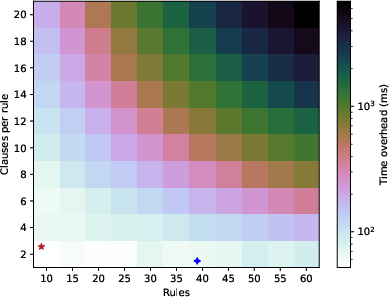
Figure 10: ASMETA server enforcement overheads compared to the rule/clause sizes of multiple practical SLEEC deployments.
Robotic Proof of Concept
A full proof-of-concept was deployed on a commercial humanoid robot (ARI), with rules from the scenario operationalized. The robot dynamically adapts to context to uphold SLEEC-encoded ethics, executing context-sensitive guidance and user interaction for exercise compliance.


Figure 6: Execution of a SLEEC obligation—robot displays exercise instructions to the user in response to contextual triggers.
Implications, Limitations, and Future Work
The work demonstrates that runtime operationalization of ethics is tractable, scalable, and minimally intrusive to autonomous system operation for practical SLEEC ruleset sizes. Importantly, the architecture is domain-agnostic and decouples ethical assurance from core adaptation logic, enabling independent evolution of both. Abstract State Machines offer sufficient expressiveness to model rich ethical constraints, including scopes, priorities, and temporal obligations.
The separation between adaptation and ethical enforcement allows for modular integration with planning and learning subsystems, and the approach can be leveraged for user-centered customization and negotiation of ethical guidelines. While the current prototype does not fully address distributed enforcement or advanced temporal workflows, these are clear avenues for extension. Exploring interplay with learning-based planning and embedding enforcement into systems with dynamic ability ontologies are immediate next steps.
Conclusion
The framework advanced in this paper (2604.03714) systematizes the operationalization of SLEEC normative frameworks in autonomous systems through runtime enforcement. Leveraging ASM-based formal modeling and the MAPE-K autonomic paradigm, the approach achieves robust, auditable, and dynamic ethical assurance with empirically validated negligible performance degradation. This closes a key operational gap in translating elicited ethical principles into actionable, enforceable runtime guarantees for real-world autonomous systems.